

| DATOS TÉCNICOS | TECHNICAL DATA |
| TIPO:Entrenador y avión de salvamento marítimo. | TYPE:Trainer and sea rescue aircraft. |
| TRIPULANTES:3 | CREW:3 |
| ENVERGADURA:12,7 m. | SPAN:41.8 ft. |
| LONGITUD:10,57 m. | LENGTH:34.8 ft. |
| ALTURA:4,36 m. | HEIGHT:14.4 ft. |
| SUPERFICIE ALAR:30,4 m². | WING AREA:327 ft². |
| PESO EN VACÍO:1.675 kg. | EMPTY WEIGHT:3,693 lb. |
| MOTOR:Un motor V-12 invertido Argus As 410C de 449,9 CV (335,5 kW) con hñelice bipala de paso variable. | ENGINE:One Argus As 410C inverted V-12 air-cooled piston engine providing 449.9 hp. (335.5 kW) driving a 2-bladed variable-pitch propeller. |
| VELOCIDAD MÁX.:260 km/h. a 3.000 m. | MAX. SPEED:160 mph. at 9,843 ft. |
| TECHO:6.500 m. | CEILING:21,300 ft. |
| ALCANCE:740 km. (400 mil. náut.). | RANGE:460 ml. (400 nm). |
| PRIMER VUELO:9 de marzo de 1939. | FIRST FLIGHT:9 March 1939. |
| VERSIONES:2 | VERSIONS:2 |
| CONSTRUIDOS:31 | BUILT:31 |
La Luftwaffe solicitó en 1938 un entrenador naval moderno. La respuesta fue el Arado Ar 199, un diseño adecuado para el entrenamiento de tripulaciones completas de hidroaviones. En la cabina del piloto había dos asientos uno al lado del otro para el entrenamiento de pilotos, detrás de ellos podía sentarse un segundo estudiante con todo el equipo de radio.
El hidroavión tenía una configuración de ala baja similar al Ar 196, pero fue desarrollado sobre la base del Arado Ar 79 y Ar 96. Sin embargo, era un diseño totalmente metálico con una estructura básica en el fuselaje delantero a base de tubos soldados. Las alas tenían un solo larguero principal, mientras que las superficies de control móviles estaban cubiertas de tela. También se instaló equipo adicional para el entrenamiento con catapulta.
El Ar 199 tenía dos flotadores totalmente metálicos con una proa de quilla fuerte que terminaba en un escalón plano. Los flotadores estaban equipados con timones para mejorar la maniobrabilidad en el agua. Estaba propulsado por un motor de pistón V-12 invertida Argus As 410C refrigerado por aire que proporcionaba 450 CV. con hélice de dos palas de paso variable.
El plan de entrega original, fechado en enero de 1939, preveía la producción de 65 máquinas, incluidos los prototipos. Se fabricaron cinco aviones de preserie (V1 a V5) antes de un primer lote de producción de 26 máquinas (WNr. 001–026), 20 de las cuales fueron construidas por SIPA (Société Industrielle Pour l’Aéronautique) cerca de París después la caída de Francia en 1940. La serie pronto se suspendió porque la necesidad de aviones de combate era más urgente.
Algunos Ar 199 fueron utilizados por el 10./Seenotstaffel (Escuadrón de Rescate Marítimo) en Tromsø/Kirkenes (Noruega) y otros operaron sobre el Mar Báltico cerca de la costa de Finlandia.
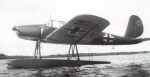
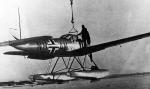
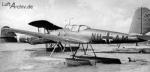


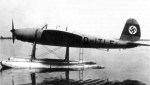


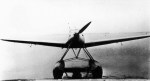

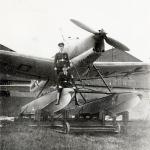


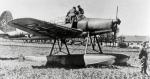

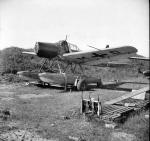


The Luftwaffe demanded a modern naval school aircraft in 1938. The answer was the Arado Ar 199, a design suitable for the training of entire seaplane crews. The cockpit was provided with two seats next to each other for pilot training, while a second student with all the radio equipment could sit behind them.
The seaplane had a low wing configuration similar to the Ar 196, but was developed on the basis of the Arado Ar 79 and Ar 96. However it was an all-metal design with the basic structure of the front fuselage consisting of a welded tubing. The wings had only one main spar, while the movable control surfaces were given a fabric covering. Additional equipment for catapult training was also fitted.
The Ar 199 had two all-metall floats with a strongly keeled bow which ran into a flat step. The floats were equipped with rudders to improve manoeuvrability on water. It was powered by an Argus As 410C inverted V-12 air-cooled piston engine providing 450 hp. with a 2-bladed variable-pitch propeller.
The original delivery plan, dated in January 1939, assumed the production of 65 machines including prototypes. Five pre-series aircraft (V1 to V5) were manufactured before a first production batch of 26 machines (WNr. 001–026), 20 of which were built by SIPA (Société Industrielle Pour l’Aéronautique) near Paris after the fall of France in 1940. The series was soon discontinued because the need for fighter aircraft was more paramount.
Some Ar 199s were used by 10./Seenotstaffel (Sea Rescue Squadron) in Tromsø/Kirkenes (Norway) and others operated over the Baltic Sea near the coast of Finland.
FUENTES Y REFERENCIA – SOURCES & REFERENCE
luftarchiv.de
Ugolok Neba
Wikipedia
flakeeins.blogspot.com
©jmodels.net
 jmodels.net
Debe estar conectado para enviar un comentario.