
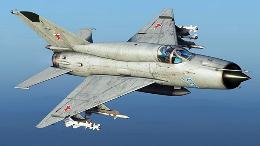
| DATOS TÉCNICOS (MiG-21bis) |
TECHNICAL DATA (MiG-21bis) |
| TIPO: Caza e interceptor. | TYPE: Fighter and interceptor aircraft. |
| TRIPULANTES: 1 | CREW: 1 |
| ENVERGADURA: 7,15 m. | SPAN: 23.6 ft. |
| LONGITUD: 14,7 m. | LENGTH: 48.3 ft. |
| ALTURA: 4,1 m. | HEIGHT: 13.5 ft. |
| SUPERFICIE ALAR: 23 m². | WING AREA: 250 ft². |
| PESO EN VACÍO: 5.339 kg. | EMPTY WEIGHT: 11,770 lb. |
| MOTOR: Un turborreactor Tumansky R-25-300 de 40.18 kN de empuje en seco y 69.58 kN con posquemador. | ENGINE: One Tumansky R-25-300 afterburning turbojet providing 40.18 kN (9,030 lbf) thrust dry, 69.58 kN (15,640 lbf) with afterburner. |
ARMAMENTO:
|
ARMAMENT:
|
| VELOCIDAD MÁX.: 2.175 km/h a 13.000 m. | MAX. SPEED: 1,351 mph at 43,000 ft. |
| TECHO: 17.500 m. | CEILING: 57,400 ft. |
| ALCANCE: 660 km a 11.000 m. | RANGE: 410 mi at 36,000 ft. |
| PRIMER VUELO: 16 de junio de 1955 (Ye-4). | FIRST FLIGHT: 16 June 1955 (Ye-4). |
| VERSIONES: 96 | VERSIONS: 96 |
| CONSTRUIDOS: Más de 13.000 (Todos los modelos). | BUILT: More than 13,000 (All variants). |
En el período posterior a la Segunda Guerra Mundial, el diseño de aviones de combate soviéticos había estado dominado por la OKB (oficina de diseño experimental) dirigida por Artyom Ivanovich Mikoyan. El Mikoyan MiG-15 había sido igualado con el F-86 Sabre norteamericano de EE. UU. sobre Corea, y había dado lugar al derivado mejorado MiG-17. A mediados de la década de 1950, los mismos conceptos de diseño condujeron al MiG-19 bimotor, el primer caza a reacción soviético supersónico que entró en servicio.
Aunque el MiG-19 comenzaba su servicio activo, la OKB de Mikoyan estaba trabajando en un sucesor que incorporase las lecciones aprendidas en Corea. En el otoño de 1953 se había aprobado un requisito estatal para un caza ligero y rápido. El requisito era de naturaleza general y proporcionaba especificaciones amplias en forma de un avión con una velocidad máxima de Mach 2, armado con un cañón y equipado con un mira de radar, con la capacidad de transportar misiles aire-aire guiados (AAM) más adelante.
Aunque otras OKB trabajaron con el mismo requisito, algunas de ella estaban demasiado comprometidas con otros proyectos como para asumir seriamente otro diseño, y otras no pudieron proporcionar diseños aceptables. Esto dejó al OKB Mikoyan como único diseñador y el visto bueno para el desarrollo fue concedido por las autoridades en enero de 1954.
Al principio, el diseño de Mikoyan recibió el código OKB de Ye-1, donde «Ye» significaba «Yedinitsa«, que significa «unidad única» y se traduce como «prototipo especial único». El Ye-1 iba a ser propulsado por un único turborreactor de flujo axial Arkady Mikulin AM-5A. Sin embargo, inmediatamente se hicieron cambios en el diseño. Tras el análisis, el AM-5A resultó inadecuado, por lo que se tomó la decisión de equipar el avión con el motor Mikulin AM-9B, que llevaba el caza MiG-19. Esta elección pasaría rápidamente al motor Mikulin AM-11 mejorado, entonces en desarrollo y optimizado para cazas ligeros y veloces. El código OKB de la aeronave se actualizó a Ye-2.
El motor AM-11 no estaría disponible de inmediato, por lo que el desarrollo tuvo que comenzar con el motor AM-9B existente. Se construyeron seis prototipos: un Ye-2, un Ye-2A, dos Ye-4 y dos Ye-5. El prototipo Ye-2 se presentó a principios de 1955 y realizó su primer vuelo el 14 de febrero de 1955, con Georgiy K. Mosolov a los mandos. El vuelo transcurrió bastante bien, aunque Mosolov notó que no tenía suficiente potencia. El primer prototipo de ala delta Ye-4 realizó su vuelo inicial el 16 de junio de 1955, con Grigory A. Sedov a los mandos, pero la máquina sólo era capaz de alcanzar una velocidad máxima de Mach 1,2. El resto de los prototipos volaron por primera vez antes de finales de 1956.
Las pruebas del Ye-2A y Ye-5 fueron tan prometedoras que a principios de 1956 la expectativa clara era que uno de ellos se pusiera en producción, con la designación de servicio de MiG-23 reservada para el Ye-2A y la de MiG-21. para el Ye-5. Se encargaron lotes de preproducción del Ye-2A y Ye-5, y cada lote constaba de cinco aviones. Las pruebas demostraron que, si bien el Ye-2A era una buena opción, a pesar de los primeros problemas de desarrollo, el Ye-5 resultó ser mejor, más maniobrable, más ligero y algo más rápido. Aparentemente debido a su mal comienzo, hubo cierta sorpresa cuando se seleccionó el Ye-5 para un mayor desarrollo, que se esperaba que condujera a la producción. El MiG-21 era el futuro; la designación MiG-23 se dejó de lado para ser «reciclada» en un caza posterior.
Occidente ya había recibido sugerencias sobre los nuevos tipos de aviones: el 24 de junio de 1956, prototipos de ala en flecha y de ala delta realizaron un sobrevuelo durante el espectáculo aéreo del Día de la Aviación en el aeropuerto de Tushino en Moscú. El avión de ala en flecha recibió el nombre clave de «Faceplate» y el de ala delta el de «Fishbed«. Occidente tardaría algunos años más en descubrir cuál de ellos se había puesto realmente en producción.
El desarrollo inicial del prototipo no estaba del todo terminado, ya que la oficina de diseño de motores (ahora bajo Sergei K. Tumanskiy porque Mikulin había sido despedido en 1955) había controlado la mayoría de los problemas del AM-11 y, de hecho, estaba ofreciendo una versión mejorada. El AM-11 se había convertido en el R-11 con la salida de Mikulin, donde la «R» significaba «Reaktivniy«, o más o menos «motor a reacción», y la nueva variante de motor era el R- 11F-300, con un salto considerable en la potencia del postquemador.
Se ordenaron tres prototipos más de ala delta, denominados Ye-6, para evaluar el motor R-11F-300. El vuelo inicial del primer Ye-6 tuvo lugar el 20 de mayo de 1958, con Vladimir Nefyedov a los mandos. Rápidamente demostró ser impresionante, rompiendo cómodamente Mach 2 en vuelo nivelado, pero desafortunadamente el avión se perdió el 28 de mayo y Nefyedov murió en el accidente.
La muerte de Nefyedov conmocionó al personal de la OKB. El fallo de sus sistemas de vuelo se debió a que el Ye-6 inicial sólo tenía un único sistema hidráulico. El segundo Ye-6 fue rápidamente desmontado y reconstruido y, con un esfuerzo considerable, provisto con sistemas hidráulicos duales. Realizó su primer vuelo el 15 de septiembre de 1958.
El tercer Ye-6 realizó su vuelo inicial en diciembre de 1958. Se completaron las pruebas y se dio luz verde a la producción. Las entregas iniciales de la producción Ye-6T o MiG-21F a la VVS (Voyenno Vozdushniye Sily / Fueza Aérea Roja) se realizaron en el otoño de 1959. También se conocía por el código de fábrica de Izdeliye (Tipo) 72 o I-72. La OTAN se referiría a esta variante como Fishbed-B, y los prototipos se denominarían Fishbed-A posteriormente.
La producción para la VVS se asignó a la fábrica estatal número 21 en Gorkiy. Más tarde, la fábrica MMZ Znamya Truda (Bandera del Trabajo), anteriormente fábrica estatal número 30, fue asignada para desarrollar la producción de exportación.
Los dos prototipos supervivientes del Ye-6 continuaron en pruebas, y en un ejercicio particularmente interesante y significativo, el segundo prototipo se utilizó para las pruebas en 1960 del nuevo misil K-13 con búsqueda de calor, una copia del Sidewinder estadounidense, que recibió el nombre clave de la OTAN de AA-2 Atoll.
El MiG-21F estaba fabricado principalmente de aleación de aluminio, con algunas piezas de acero, magnesio y fibra de vidrio. Presentaba un fuselaje delgado con una entrada circular en el morro, interrumpida por un cono móvil ajustable automáticamente, alas delta triangulares montadas en el medio con puntas recortadas y un plano de cola en flecha de disposición convencional y totalmente móvil, más una aleta ventral fija debajo de la cola. llevaba un carenado para el paracaídas de freno detrás de la aleta ventral y un freno de aire accionado hidráulicamente debajo del fuselaje por delante de la aleta. También había un par de frenos de aire activados hidráulicamente en el vientre, debajo de la parte delantera de las raíces de las alas.
El piloto se sentaba bajo una cubierta de una sola pieza con bisagras en la parte delantera, terminando en un carenado con un panel transparente y luego en una columna dorsal que volvía a la cola. El tren de aterrizaje tenía una configuración de triciclo, todos los conjuntos llevaban ruedas simples, el tren de morro se retraía hacia adelante y el tren principal se retraía girando hacia adelante en ángulo hacia el fuselaje. La rueda del morro giraba libremente y el avión se dirigía en tierra utilizando el frenado de la rueda principal. Todas las ruedas tenían frenos de disco accionados neumáticamente. Había un tubo pitot debajo del morro con bisagras para plegarlo hacia arriba.
El ala tenía un barrido en el borde de ataque de 57 grados y una caída anédrica de 2 grados. Presentaba flaps accionados hidráulicamente y alerones hidráulicos, además de alambrado cerca de la punta del ala para evitar la pérdida de flujo de aire sobre ella. La aleta de cola tenía un barrido en el borde de ataque de 60 grados y el timón se accionaba hidráulicamente. Los estabilizadores de cola de una sola pieza tenían un ángulo de ataque de 55 grados, no eran anédricos y se accionaban hidráulicamente. Las puntas del plano de cola estaban cargadas con masas en forma de huso para reducir la vibración o el aleteo.
El motor era un turborreactor Tumanskiy R-11-300F con 38,1 kN (3.880 kgp) de empuje en seco y 56,3 kN (5.740 kgp) de empuje con postcombustión. Utilizaba un sistema de arranque eléctrico integral y presentaba un sistema automático de extinción de incendios. Junto con la entrada del morro con su cono había tomas de entrada auxiliares a lo largo del morro de accionamiento hidráulico y automático para proporcionar un mejor flujo de aire en ángulos de ataque altos, y una toma auxiliar con resorte a cada lado del fuselaje justo delante y debajo del ala para proporcionar un flujo de aire adicional. Poseía seis depósitos de combustible flexibles en el fuselaje y dos tanques de combustible integrales en cada ala con un total de diez depósitos, lo que proporcionaba una capacidad interna utilizable de combustible de 2.280 litros.
El MiG-21F presentaba un armamento de dos cañones automáticos Nudelmann-Richter NR-30 de 30 mm, en la zona ventral debajo de la cabina. La instalación del cañón estaba escalonada, con el arma derecha delante a la izquierda, presumiblemente para acomodar municiones. Cada cañón estaba alimentado por una cinta de 30 balas. Los cañones eran apuntados con una mira ASP-5ND, que incluía un indicador de alcance impulsado por un simple radar SRD-5 en el cono de entrada. También había una cámara en el soporte superior del cono de entrada.
Había un pilón central para llevar un depósito con una capacidad de 490 litros, y cada ala podía equiparse con un único pilón de almacenamiento para una bomba o un cohete no guiado. Dado que el MiG-21F no tenía equipo para apuntar bombas, pocas imágenes de este modelo lo muestran con bombas, siendo los cohetes no guiados el armamento predeterminado de ataque a tierra, ya que podían apuntarse con la mira.
El piloto estaba sentado en una cabina presurizada y con aire acondicionado sobre un asiento eyectable SK, que se activaba bajando una persiana y utilizaba un cartucho explosivo. La cubierta con bisagras hacia adelante se desprendía con el asiento eyectable, el principio era que proporcionaría una protección contra el viento para el piloto, pero resultó que era mejor sobre el papel de lo que funcionó en la práctica. Había paneles blindados en el respaldo del asiento, en el reposacabezas y en el lateral de la cabina. Había un sistema de oxígeno de emergencia en caso de que fallara la presurización. Junto con el radar de alcance, la aviónica incluía una radio VHF, una radiobrújula automática, un receptor de baliza marcadora, un radioaltímetro de baja altitud, un transpondedor de control de tráfico aéreo (ATC), un transpondedor de identificación amigo o enemigo (IFF) SRO-2 Khrom y un receptor de alerta de radar (RWR) Sirena-D, con una antena en la parte posterior de la aleta trasera.
El avión presentaba sistemas hidráulicos dobles, así como un sistema neumático dual para manejar los frenos de las ruedas, el accionamiento de la cubierta, el traje de piloto, el control del armamento y el despliegue del paracaídas de freno. El hecho de que tanto el sistema hidráulico como el neumático fueran duales no implicaba que cada sistema tuviera dos mitades idénticas, sino que había un patrón complicado de operación principal y de soporte entre los sistemas hidráulico y neumático.
A los pilotos les gustó mucho el MiG-21F porque era bonito, rápido, ágil y se manejaba bien. Del MiG-21F se decía que era el más divertido de volar de toda la familia, ya que las versiones posteriores eran progresivamente más pesadas. Por otra parte, también era el menos efectivo en combate, ya que estaba limitado en armamento, aviónica, carga útil y alcance en comparación con sus sucesores. La autonomía era de aproximadamente 90 minutos con un depósito externo. Era estrictamente un interceptor de defensa de punto, ya que no podía permanecer en el aire el tiempo suficiente para realizar patrullas aéreas o misiones ofensivas.
La experiencia demostró que el MiG-21F tenía una peculiaridad de manejo desagradable: si el avión se desviaba de su línea de vuelo real, el flujo de aire hacia la entrada se interrumpiría, lo que podía causar paradas del motor que podrían causar daños al mismo. Las alas pequeñas también permitieron despegues largos y aterrizajes en caliente, con el paracaídas de freno agregado para reducir el recorrido de aterrizaje; mientras que el escape del motor tendía a sobrecalentarse, provocando incendios. Otra dificultad fue que la cabina era pequeña y el piloto tenía un campo de visión deficiente, ninguno hacia atrás; pero en su madurez, el MiG-21 resultó robusto, confiable y fácil de mantener.
A partir de la segunda mitad de 1960, la producción pasó a una variante ligeramente mejorada denominada MiG-21F-13, que tenía el código de fábrica I-74. La principal mejora fueron los misiles aire-aire (MAA en adelante) AA-2 Atoll, uno en un soporte debajo de cada ala, eliminándose el cañón izquierdo. El radar SRD-5 se actualizó a la variante SRD-5M Kvant (Quantum), con un rendimiento mejorado.
El número de depósitos de combustible en cada ala también se incrementó de dos a cuatro, dando un total de 14, y la capacidad de combustible de las alas aumentó en la producción posterior para proporcionar una capacidad interna total de combustible de 2.470 litros, pero en la práctica se limitó a 2.340 litros. Se agregó la capacidad para llevar un depósito externo más grande en la línea central con una capacidad de 800 litros, así como para una cámara que podía instalarse detrás del compartimiento de la rueda delantera para proporcionar una capacidad de reconocimiento limitada. La OTAN asignó al MiG-21F-13 el nombre de informe de Fishbed-C.
Aunque los soviéticos a veces se mostraban reacios a exportar sus armas más modernas, no dudaron en exportar el MiG-21. Las primeras máquinas de exportación salieron de la fábrica de Znamya Truda en el verano de 1960. La fábrica Aero Vodochody en Praga obtuvo una licencia para construir el MiG-21, y la copia checa se denominó S-106. Era efectivamente un MiG-21F-13, excepto que se eliminó el panel transparente en el carenado trasero de la cabina, ya que no había demostrado ser útil en la práctica. También se eliminaría en la producción soviética posterior. Los checos construyeron 194 S-106. No llegaron a fabricar ninguna otra variante del MiG-21.
El MiG-21F era un caza diurno, sin capacidad real para operaciones nocturnas o con mal tiempo, por lo que era inútil para la organización PVO (Protivo-Vozdusdushnoi Oborony), un servicio armado distinto dedicado a la defensa aérea de la URSS utilizando misiles tierra-aire (SAM) e interceptores. Debido a la enorme extensión de la frontera soviética, el PVO tendía a adquirir interceptores pesados de largo alcance, como el Yak-25 y su derivado Yak-28P Firebar, pero esos aviones eran caros. Un aparato más ligero, más barato y menos capaz permitiría al PVO desplegar más aviones, asignando los aviones más económicos a la defensa de las fronteras occidentales de la Unión Soviética, donde los centros de población estaban más concentrados y donde tener aviones con un gran radio de acción no era tan importante.
A finales de 1957, la OKB MiG comenzó a trabajar en el Ye-7, esencialmente un MiG-21F con un radar Sapfir (Zafiro) en un cono de entrada más grande. Se construyeron tres prototipos, y el primero realizó su vuelo inicial el 10 de agosto de 1958. Al menos cinco aviones de evaluación Ye-7 siguieron a los tres prototipos.
Las pruebas fueron bien, y el modelo entró en producción en Gorkiy en junio de 1960, con la designación de MiG-21P, donde «P» significaba «Perekvatchik (Interceptor) y el código de fábrica I-75. Sin embargo, estas primeras máquinas no se consideraron realmente satisfactorias y sólo se construyeron unos pocos MiG-21P, empleándose la mayoría o todos como aviones de desarrollo. La producción del interceptor MiG-21PF o I-76, mucho más satisfactorio, comenzó a principios de 1962.
El MiG-21P inicial contaba con el radar de producción RP-21 Sapfir (Spin Scan-A para la OTAN), un armamento de dos MAA AA-2 Atoll (sin cañón), frenos de aire delanteros más grandes y reformados, un piloto automático simple, provisión para el ajuste de dos propulsores de despegue asistido por cohetes (RATO) a lo largo del fuselaje trasero y neumáticos más grandes. Los neumáticos más gruesos conllevaron carenados de engranajes más prominentes en la parte superior del ala y en las tapas. Las mejoras de la aviónica consistieron en un receptor de navegación de baliza tipo TACAN conocido como KSI y un enlace Lazur (Azur) a la red terrestre de defensa aérea Vozdukh-1 (Aire-1).
Aunque el MiG-21P carecía de cañón, tenía una mira óptica simple para usarla con cohetes no guiados situados debajo de las alas. El tubo Pitot se movió desde debajo del morro hasta la parte superior del mismo y se eliminó la bisagra. La producción posterior incluyó una aleta trasera más ancha para garantizar que el avión volara en línea recta y no sufriera caladas del motor, y el conducto de freno se movió desde debajo del escape a un carenado de punta cónica debajo de la aleta trasera. Con el tiempo, se introduciría un paracaídas cruciforme más eficaz para aprovechar la posición más alta, reemplazando el paracaídas circular original. Al MiG-21P se le asignó el nombre clave de la OTAN de Fishbed-D.
El MiG-21PF mejoró el MiG-21P agregando dos depósitos de combustible al fuselaje detrás de la cabina, lo que dio como resultado un carenado trasero distintivo y grueso y una capacidad de combustible de 2.750 litros. El MiG-21PF también agregó el motor R-11F2-300, que proporcionaba 38,7 kN (3950 kgp) de empuje en seco y 60,0 kN (6120 kgp) de empuje con postcombustión. A esta variante se le asignó el nombre clave de la OTAN de Fishbed-E.
El empuje adicional proporcionado por el motor R-11F2-300 parecía adecuado para soportar una característica conocida como «soplado de flaps», en la que el aire purgado del motor se dirigía sobre los flaps para permitir velocidades más bajas de despegue y aterrizaje. Era efectivo pero requería mucha potencia del motor, ya que el soplado le robaba empuje al motor en el despegue, justo cuando más se necesitaba el empuje. El esquema entró en producción en 1964 con la nueva variante denominada MiG-21PFS, conocida en la fábrica como I-94. El MiG-21PFS en realidad presentaba un motor R-11F2S-300, que se diferenciaba de su predecesor por incorporar un postquemador de dos etapas.
Sólo se construyeron un puñado de MiG-21PFS, y la producción fluyó a su vez en el MiG-21PFM a finales de 1964, conservando el código de fábrica I-94. Presentaba una aleta trasera aún más amplia y un nuevo radar RP-21M (Spin Scan-B para la OTAN), que admitía el transporte de MAA guiados por radar. Inicialmente, el MAA estándar guiado por radar era el K-5/R-2, conocido por la OTAN como AA-1 Alkali, pero fue reemplazado por el mucho mejor K-13R/R-3R, denominado AA-2-2 Advanced Atoll por la OTAN.
Además, en ese momento la decisión de eliminar el armamento de cañones había sido reconsiderada y juzgada demasiado apresurada, por lo que el MiG-21PFM podía equiparse con un paquete de cañones Gryasev-Shipanov GSh-23 de 23 mm opcional montado en la línea central con 200 cartuchos de munición. Tenía una velocidad de 3.600 disparos por minuto. Se agregó una mira PKI mejorada como apoyo a los cañones. Otras mejoras incluyeron un nuevo sistema IFF Khrom-Nikel SRO-2M y un radar Sirena-3M.
Posteriormente, la producción del MiG-21PFM incluyó un nuevo asiento eyectable, el KM-1. No se trataba de un moderno asiento eyectable «cero-cero», capaz de funcionar con seguridad si el avión simplemente estaba parado en la pista, pero podía utilizarse a altitud cero si el avión se movía a una velocidad mínima de 130 km/h. y suponía una gran mejora con respecto al asiento SK. Se introdujo una nueva cubierta de la carlinga de dos piezas que se abría hacia la derecha en lugar de hacia adelante. La nueva disposición de la cubierta redujo ligeramente la capacidad de combustible del fuselaje. La OTAN asignó al MiG-21PFS y al MiG-21PFM el nombre Fishbed-F.
En servicio, los nuevos interceptores MiG-21 fueron bien recibidos, proporcionando un sistema de armas más sofisticado con mayor alcance y, con el movimiento de flaps, mejores características de despegue. El radar Sapfir sólo tenía un alcance de unos 10 km, lo que significa que el avión dependía casi por completo de la red de control terrestre, pero se consideraba perfectamente aceptable y, de hecho, era parte de la doctrina de defensa aérea del PVO.
Los interceptores de la serie MiG-21P se construyeron en la fábrica de Znamya Truda para su exportación. Vietnam del Norte obtuvo una variante tropicalizada única, el MiG-21PF-V, con sistemas acondicionados para altas temperaturas y humedad. Las máquinas de exportación generalmente tenían sistemas de un estándar ligeramente inferior, ya que los soviéticos preferían no utilizar los sistemas más recientes para no verse comprometidos.
Hindustan Aircraft LTD (HAL) de la India construyó bajo licencia una versión degradada del MiG-21PFM denominada MiG-21FL. Si bien los MiG-21 indios llevaban MAA de diseño soviético, también estaban calificados para llevar el MAA francés Matra Magic con búsqueda de calor. No llevaban el Magic con regularidad, pero la Fuerza Aérea de la India quería asegurarse de que pudiera usarse en caso de necesidad si las existencias de otros MAA eran bajas.
Mientras el OKB de Mikoyan trabajaba en las variantes de interceptor, también trabajaba en una variante de reconocimiento táctico para el servicio de Aviación de Primera Línea de la Fuerza Aérea Roja. El punto de partida fue el conjunto de conceptos probados en el Ye-7 que se estaban desarrollando para los interceptores. La idea era instalar una cápsula de reconocimiento en la línea central, con diferentes cápsulas desarrolladas para respaldar una variedad de misiones. Eso significaba que el depósito externo de la línea central tendría que desaparecer. Para garantizar que el avión obtuviera la cantidad justa de combustible, se tuvieron que añadir dos nuevos soportes debajo de las alas, hasta un total de cuatro.
Uno de los aviones de desarrollo del interceptor Ye-7 fue modificado como prototipo de reconocimiento inicial, siendo el cambio principal el ala de cuatro soportes. El modelo entró en producción en 1964 en Gorkiy como MiG-21R, donde «R» significaba «Razvedchik (Reconocimiento)». Los aviones de exportación de denominaron MiG-21RF. La OKB lo llamó I-94R. Los aviones de serie se entregaron entre 1965 y 1971. La OTAN le asignó el nombre Fishbed-H.
En su configuración de producción el MiG-21R incorporó suficientes cambios como para ser considerado un MiG-21 de segunda generación. La diferencia más notable fue una nueva columna gruesa que recorría el fuselaje desde la carlinga hasta la aleta trasera, permitiendo alojamiento de aviónica y combustible adicional, con un almacenamiento interno de combustible que aumentaba a 2.800 litros. El MiG-21R presentaba la aleta trasera ancha definitiva, introducida en el MiG-21PFM, con el conducto de freno en la base de la aleta trasera. Estaba equipado con el motor R-11F2S-300. Conservó la cubierta de dos piezas, el asiento eyectable KM-1 y los neumáticos gruesos introducidos en el desarrollo del interceptor MiG-21.
Podía llevar una amplia gama de contenedores de reconocimiento tanto diurnos, que normalmente llevaban siete cámaras de película, una mirando hacia delante en un ángulo oblicuo y las otras seis montadas en tres compartimentos como nocturnos, que eran similares a los diurnos pero usaban película infrarroja y cápsulas de Radio (R), o en otras palabras, cápsulas ELINT (Inteligencia Electrónica). La cámara oblicua proporcionaba imágenes para hacer referencias cruzadas de los datos ELINT.
Todos los contenedores podrían equiparse con dispensadores de bengalas y, al parecer, otros sistemas de contramedidas. Una configuración operativa típica era un depósito en cada soporte exterior y un MAA en cada soporte interior, y hasta cinco depósitos en misiones de transporte, aunque se trataba de una configuración inusual en el mejor de los casos. También se podía transportar el cañón GSh-23 desarrollado para el MiG-21PFM, pero rara vez se le instalaba.
En la fábrica de Znamya Truda se construyó una versión especializada del MiG-21RF para los egipcios. Esta subvariante presentaba un paquete de reconocimiento instalado en el vientre debajo de la cabina, que llevaba tres cámaras dispuestas para brindar imágenes panorámicas. Un MiG-21R estándar podía convertirse fácilmente a esta configuración.
Dado que el MiG-21R conservaba una capacidad de combate completa incluso si no se usaba en la práctica, era obvio que el siguiente paso era producir una nueva variante basada en su estructura actualizada. Después de la evaluación con prototipos designados Ye-7S, el caza actualizado se puso en producción en Gorkiy en 1965 como MiG-21S, o I-95 como lo llamó el OKB de Mikoyan. Permaneció en producción hasta 1968.
Aparte del nuevo fuselaje, el MiG-21S presentaba algunos equipos nuevos, incluido un radar RP-22 Sapfir (Jay Bird para la OTAN) con un alcance al menos duplicado, una mira ASP-PF para el cañón central GSh-23 opcional y un enlace para el sistema de control terrestre Lazur-M. Podría transportar una variedad de MAA guiados por radar o buscadores de calor, así como cohetes o bombas. Desde el principio, el MiG-21S estaba calificado para transportar un arma nuclear táctica en el soporte central. El sensor de ángulo de ataque, el tubo Pitot desplazado y el periscopio se agregaron en la producción posterior.
Aunque el MiG-21R y el MiG-21S incorporaron muchas mejoras, el aumento de peso significó que el techo y la velocidad de ascenso sufrieran. Peor aún, el esperado aumento de alcance proporcionado por una mayor capacidad de combustible no se materializó, principalmente debido a problemas de ajuste de combustible que hicieron que la capacidad ampliada de combustible fuera una ficción. Obviamente era necesario repensar más el diseño, pero eso requeriría tiempo y esfuerzo.
Una versión de exportación del MiG-21S, el MiG-21M o I-96, se construyó en la fábrica de Znamya Truda entre 1968 y 1971. Conservó el radar RP-21M más antiguo, pero presentaba un cañón de dos tubos GSh-23L en una instalación enrasada ventral, que reemplazó al montaje del cañón GSh-23 introducido en el MiG-21PFM. La plataforma del cañón empotrada llevaba una munición de 200 cartuchos y podía sacarse del fuselaje con un cabrestante para realizarle mantenimiento. El nuevo cañón no sólo redujo la resistencia, sino que también permitió el transporte de un depósito de combustible u otro material de almacenamiento en el soporte central. Se instaló un panel antiexplosión de acero en la panza del avión, delante de las bocas de los cañones. HAL de India construyó bajo licencia el MiG-21M, y la producción inicial se entregó en 1973.
Un avance más significativo fue el desarrollo de un mejor motor, el Tumanskiy R-13-300, un derivado sustancialmente mejorado de la serie R-11, con 39,9 kN (4.070 kgp) de empuje en seco y 63,7 kN (6.490 kgp) de empuje con postcombustión. El R-13-300 era generalmente compatible mecánicamente con la serie R-11, por lo que se adaptaba fácilmente al MiG-21S, dando como resultado el MiG-21SM o I-15. Excepto por el motor más potente, así como por el ajuste del cañón GSh-23L, el MiG-21SM se parecía mucho a un MiG-21S de última producción.
El MiG-21SM se produjo en gran medida en Gorkiy desde 1968 hasta 1974. Una versión de exportación, el MiG-21MF o I-96F, esta vez conservando el radar de largo alcance RP-22, se puso en fabricación en Znamya Truda en 1970. HAL de India construyó una variante similar con el motor R-13-300, pero conservó la designación MiG-21M.
Los ingenieros de Mikoyan OKB continuaron ajustando la columna ampliada introducida en el MiG-21R, creando una configuración abultada que elevó la capacidad total de combustible a 2.950 litros. La columna era tan grande que le daba al avión una apariencia jorobada y, a diferencia de las variantes anteriores del MiG-21, se fusionaba con el carenado del conducto de freno en la base de la cola.
El resultado fue el MiG-21SMT o I-50, que entró en producción en Gorkiy en 1971. Excepto por el lomo abultado, se parecía mucho a un MiG-21SM de última producción, con lo último en aviónica y el motor R-13-300. El ajuste del motor aún no proporcionaba suficiente empuje para seguir el ritmo del aumento de peso del MiG-21SMT y, de hecho, el modelo fue una especie de decepción, ya que se fabricó en cantidades limitadas. La experiencia operativa sugirió que la columna hinchada era otro ejercicio inútil porque los problemas de ajuste una vez más significaban que no se podía utilizar toda la capacidad de combustible. La planta de Znamya Truda construyó 15 ejemplares de una versión de exportación del MiG-21SMT denominada MiG-21MT o I-96T en 1971, pero nunca abandonaron el país.
En ese momento, el OKB había introducido el motor Tumanskiy R-25-300, que proporcionaba 40,2 kN (4100 kgp) de empuje en seco y tenía un postquemador de dos etapas, con 69,6 kN (7100 kgp) en condiciones normales y 95 kN (9.690 kgp) con posquemador en un modo de postcombustión de combate especial que podría activarse durante hasta tres minutos. El R-25-300 estaba más optimizado para operaciones a baja cota que sus predecesores y era menos susceptible a pérdidas y fallos de funcionamiento.
La idea original era rediseñar los MiG-21 de los últimos modelos con el R-25-300, pero los ingenieros de Mikoyan decidieron usarlo en una nueva variante, el MiG-21bis o I-75. El resultado no fue sólo un viejo MiG-21 equipado con el nuevo motor, sino un verdadero MiG-21 de tercera generación, ya que los ingenieros aprovecharon la oportunidad para realizar una reforma en profundidad de todo el avión. Externamente, el MiG-21bis se parecía al MiG-21SMT, pero dado que la gruesa columna vertebral del MiG-21SMT terminó proporcionando más espacio del que podía usarse, la columna del MiG-21bis era más similar a la de los predecesores del MiG-21SMT. La capacidad interna de combustible era de 2.880 litros y toda ella era realmente utilizable.
La estructura del avión se reformó en gran medida utilizando nuevas aleaciones, lo que dio como resultado un avión más resistente pero más ligero. Se instalaron los últimos sistemas de aviónica, incluido un radar RP-22 mejorado que brindaba capacidad para detectar objetivos que volaban cerca del suelo; un sistema de navegación de corto alcance RSBN-6S y un sistema de aterrizaje por instrumentos acoplado que permitía operaciones en condiciones de muy mala visibilidad; y un sistema de prueba incorporado para simplificar el mantenimiento. El armamento incluía el cañón GSh-23L enrasado, MAA y aire-tierra no guiados.
Los MAA típicos incluían el AA-2-2 Advanced Atoll, pero en la era del MiG-21bis el AA-2 Atoll había sido reemplazado por un MAA con búsqueda de calor de corto alcance muy mejorado, el K-60 / R-60, conocido a la OTAN como AA-8 Aphid. El misil era muy ágil, letal y liviano. Se podían transportar dos en un solo soporte usando un adaptador doble, lo que le daba al MiG-21bis gran capacidad de ataque.
Algunos aviones MiG-21bis fueron equipados para transportar un arma nuclear táctica en el soporte central y fueron designados MiG-21bisN. La producción inicial del MiG-21bis recibió el nombre de la OTAN Fishbed-L. La producción posterior presentaba una aviónica más completa, con nuevas antenas, por lo que la OTAN asignó a los aviones posteriores el nombre de Fishbed-N.
Los 2.030 ejemplares del MiG-21bis se construyeron en Gorkiy entre 1972 y 1984. Las máquinas soviéticas fueron designadas I-75P, mientras que las exportaciones al Pacto de Varsovia fueron designadas I-75A y las exportaciones a otros lugares I-75B. Los finlandeses obtuvieron algunos cazas MiG-21bis y quedaron muy impresionados con el modelo. India adquirió 75 aparatos de la URSS, y HAL produjo 220 entre 1979 y 1987.
El MiG-21bis fue considerado un avión excelente, que recuperó parte del terreno perdido en capacidad de vuelo, aunque era mucho más capaz. Sin embargo, aunque se pensó en mejorarlo aún más, a principios de la década de 1970 el diseño claramente estaba perdiendo fuerza. El OKB Mikoyan estaba pasando a un nuevo diseño, que surgiría como el MiG-29.
Los resultados de las pruebas con una variante de entrenamiento resultaron satisfactorios, y el modelo entró en producción como MiG-21U, donde «U» significaba «Uchyebniy (Entrenador)», con el código de fábrica I-66. Los aviones para la URSS se construyeron en la fábrica estatal número 31 en Tbilisi, la capital de Georgia. La producción de exportación se construyó en la fábrica de Znamya Truda, cerca de Moscú. La mayoría o todos los usuarios extranjeros que adquirieron cazas o interceptores MiG-21 también compraron algunos MiG-21U para entrenamiento. Los pilotos soviéticos lo llamaron Sparka (gemelo), un término general para un entrenador de dos asientos, mientras que la OTAN le asignó el nombre de Mongol.
La producción inicial del MiG-21U era parecida, con cambios mínimos, a la del MiG-21F-13. El MiG-21U tenía exactamente la misma longitud que este, y la inclusión de la cabina con asientos en tándem se consiguió ajustando la disposición de los tanques de combustible internos. Aunque se eliminó el único cañón NR-30, la capacidad máxima real de combustible práctica seguía siendo de 2.350 litros.
La cabina presentaba cubiertas gemelas que se abrían hacia la derecha, con un cortavientos transparente entre las posiciones delantera y trasera. La posición del instructor en la parte trasera no estaba elevada, lo que le daba una mala visión hacia adelante. La aviónica era muy parecida a la del MiG-21F-13, incluida una mira ASP-5ND y un radar de alcance SRD-5. El MiG-21U podría llevar un AA-2 Atoll u otro misil debajo de cada ala, y podría equiparse con una cápsula central que llevaba una ametralladora de 12,7 mm para entrenamiento.
El MiG-21U se desvió del patrón MiG-21F-13 moviendo el tubo pitot a la parte superior del morro y convirtiéndolo en una instalación fija, y también incorporó los neumáticos gruesos y los bultos de las tapas del interceptor MiG-21P. También reemplazó los frenos de aire delanteros dobles del MiG-21F-13 con un único freno de aire grande. Los MiG-21U de producción posterior presentaban la aleta trasera de tamaño completo, con el contenedor del conducto de freno en la base.
La introducción del sistema de flaps soplados en los cazas e interceptores MiG-21 sugirió que podría ser una buena idea producir un entrenador con este sistema, por lo que el MiG-21US o el I-68 reemplazaron al MiG-21U en la línea de producción de Tbilisi en 1966. Era difícil diferenciarlo de un MiG-21U de producción tardía, ya que los cambios fueron en gran medida internos, siendo el más significativo la instalación del motor R-11F2S-300 mejorado para soportar el sistema de flaps. Otros cambios incluyeron un aumento en la capacidad máxima de combustible a 2.450 litros; la opción de instalar cuatro soportes en lugar de dos; y la sustitución de los asientos eyectables SK originales por los asientos KM-1 más modernos.
Al MiG-21US se le asignó el nombre clave de la OTAN de Mongol-B, mientras que el MiG-21U se convirtió retroactivamente en Mongol-A. Toda la producción, tanto nacional como extranjera, procedía de Tbilisi. La producción posterior incluyó un interesante sistema de periscopio para el instructor en el asiento trasero.
En 1971, el MiG-21US fue reemplazado en la línea de producción por el MiG-21UM o I-69, que nuevamente se construyó únicamente en Tbilisi y cuyo último ejemplar se entregó en 1975. Era casi idéntico en apariencia al MiG-21US, la única diferencia externa real era el ajuste del sensor de ángulo de ataque y el tubo pitot desplazado que lo acompaña, pero la cabina y la aviónica se actualizaron en general, con un piloto automático de tres ejes, además de sistemas de aviónica en módulos extraíbles para simplificar el mantenimiento. El MiG-21UM conservó el nombre de Mongol-B en la OTAN.
La China Roja también produjo el MiG-21. De hecho, a principios de 1961 se firmó un acuerdo de licencia con la fábrica estatal de Shenyang para realizar la producción, pero las relaciones chino-soviéticas se estaban rompiendo en ese momento y las entregas de especificaciones y materiales de fabricación se interrumpieron antes de que Shenyang hubiera recibido todo lo necesario para construir el avión.
Los chinos terminaron, con cierta dificultad, construyendo el avión de todos modos sin ayuda soviética, designándolo J-7, donde la «J» significaba «jianjiji / jian (caza). El diseño y la producción de aviones es una tarea complicada y la China comunista efectivamente tuvo que desarrollar toda una industria desde cero, con la dificultad agravada por la falta general de infraestructura industrial y por las ocasionales iniciativas sociales lunáticas de Mao Zedong.
El MiG-21 era una máquina bastante sofisticada para que la abordaran los chinos. No fue hasta el 17 de enero de 1966 cuando finalmente volaron un prototipo del J-7, con el piloto de pruebas Ye Wenrong a los mandos. El modelo fue entregado para la producción en serie a la fábrica estatal de Chengdu. Se construyeron alrededor de una docena de J-7 para su desarrollo, y la versión de producción inicial, el J-7I, realizó su primer vuelo en junio de 1976.
El J-7I de CAC (Chengdu Aircraft Company) era muy parecido a un MiG-21F-13, con un motor WP-7, una versión ligeramente modificada del turborreactor R-11F-300 y un único cañón Tipo 30-1 de 30 mm, copia del NR-30 soviético. Su MAA principal era el PL-2, también copia del AA-2 Atoll soviético. El J-7I no resultó muy satisfactorio y no se construyó en grandes cantidades, aunque algunos se exportaron a Albania y Tanzania con la designación de F-7A.
Por el momento, la Fuerza Aérea del Ejército Popular de Liberación de China confió en el J-6, una copia del MiG-19 y un desafío no tan grande, mientras que el trabajo avanzaba a un ritmo lento hacia un J-7 más satisfactorio. El primer J-7II o J-7B realizó su vuelo inicial el 30 de diciembre de 1978, con Yu Mingwen a los mandos. Conservó las líneas del MiG-21F-13 pero presentaba un asiento eyectable Tipo II, una copia del asiento eyectable SK soviético, y estaba equipado con una cubierta de dos piezas; un motor WP-7B más confiable, con un tiempo entre revisiones duplicado a 200 horas; y el distintivo carenado del conducto de freno en la base de la aleta trasera instalado en variantes soviéticas posteriores del MiG-21.
El J-7II se exportó como F-7B y fue comprado por Egipto, Irak y Sri Lanka. Los F-7B iraquíes fueron calificados con el MAA francés Matra Magic con búsqueda de calor, que también fue sometido a ingeniería inversa y construido en China como el PL-7 para ventas de exportación. Los aparatos de Sri Lanka cumplían con el estándar F-7BS, con cuatro soportes debajo de las alas en lugar de los dos tradicionales, y el soporte exterior de cada ala conectado a un tanque externo de 720 litros.
Los retrasos en el J-7II llevaron a estudiar diseños para modernizarlo. Una línea de trabajo se centró en una variante de exportación denominada J-7IIA o F-7M, que presentaba mejoras con pocos cambios en el diseño básico. El J-7IIA se anunció en 1984. Se parecía mucho al J-7II, pero se modernizó considerablemente, con cuatro pilones debajo de las alas, un asiento eyectable CAC cero-cero, parabrisas y tren de aterrizaje más resistentes y un motor WP-7B(BM), con el mismo empuje, pero más ligero, más fiable. El J-7IIA estaba equipado con dos cañones Tipo 30-1 de 30 mm con 60 balas cada uno, y podía transportar los MAA chinos PL-2 o Matra Magic.
El modelo resultaba atractivo para fuerzas aéreas con presupuesto limitado y el F-7M se vendió a Bangladesh, Egipto, Irán, Myanmar y Zimbabwe. La Fuerza Aérea de Pakistán (FAP) obtuvo una variante del F-7M denominada F-7P. Las primeras entregas comenzaron en 1988. El F-7P era esencialmente un F-7M con varios ajustes según la especificación de la FAP, incluido un asiento eyectable cero-cero Martin-Baker Mark 10L británico y la capacidad de transportar cuatro MAA Sidewinder fabricados en Estados Unidos. La FAP obtuvo un F-7PM mejorado que era externamente similar pero contaba con aviónica Rockwell-Collins suministrada por Estados Unidos y un radar italiano FIAR Grifo.
A principios de la década de 1980, la fábrica de Guizhou desarrolló un entrenador con asiento tándem, el JJ-7, donde «JJ» significaba «jianjiji–jiaolianji (entrenador de combate)». Fue designado FT-7 en el mercado de exportación. El JJ-7 era básicamente un clon del MiG-21US, con periscopio y dos pilones en las alas. Se diferenciaba visiblemente de los Mongol soviéticos por estar equipado con dos aletas ventrales inclinadas, en lugar de una única aleta ventral. El vuelo inicial del primer prototipo tuvo lugar el 5 de julio de 1985, con Yan Xiufu a los mandos. La FAP obtuvo su propia variante de entrenador, el FT-7P, sin periscopio pero con cuatro pilones debajo de las alas y aviónica mejorada, incluido el GEC Marconi HUD/WAC.
Paralelamente, la industria china trabajó en un diseño más agresivo, esencialmente tratando de construir un equivalente al MiG-21SM/MiG-21MF soviético. El primer prototipo J-7III o J-7C realizó su vuelo inicial el 26 de abril de 1984. Presentaba una configuración muy parecida a la del MiG-21SM, con el gran cono de entrada para el radar de intercepción aérea; una espina dorsal gruesa; un motor WP-13 equivalente pero aparentemente no idéntico al R-13-300 soviético; un asiento eyectable CAC cero-cero; y un periscopio retrovisor. Desafortunadamente, el J-7III tuvo los mismos problemas con el aumento de peso que afectaron al desarrollo del MiG-21 soviético y, en general, no cumplió con las especificaciones de la fuerza aérea. Sólo se construyeron unas pocas docenas.
El trabajo en otro J-7 actualizado comenzó en 1987 en la fábrica de Chengdu, y el prototipo realizó su primer vuelo en 1990. En 1992, Chengdu anunció el J-7E, y en 1996 presentó una variante de exportación del F-7MG. El 7E presentaba aviónica moderna, en su mayoría diseñada en China o construida con licencia, un motor WP-13F con 44,1 kN (4500 kgp) de empuje seco y 63,8 kN (6500 kgp) de empuje de postcombustión, y un ala reformada, con un barrido de 42 grados. La nueva ala proporcionaba un manejo a baja velocidad mucho mejor y también llevaba flaps en los bordes de ataque, lo que le dio al J-7E una agilidad excepcional.
La FAP estaba muy interesada en el F-7MG. En 2001, encargó 60 aviones modificados según sus especificaciones como F-7PG, con radar italiano FIAR Grifo y asientos eyectables Martin-Baker. Desde entonces, el J-7E ha sido mejorado al estándar J-7G, introducido en 2002, con lo último en aviónica, incluido un radar multimodo avanzado que se sospecha es una variante construida bajo licencia del Elbit EL/M2001 israelí, además de un moderno sistema de contramedidas electrónicas y un receptor de navegación por satélite con sistema de posicionamiento global (GPS), un parabrisas de una sola pieza y solo un cañón.
A principios de la década de 1960, el MiG-21 era ampliamente usado en la Unión Soviética y en los estados clientes soviéticos. Por supuesto, la URSS fue el mayor usuario, con un total de más de 6.000 aparatos operando en la VVS y el PVO. Las variantes en servicio soviético incluyeron el MiG-21F/F-13, el MiG-21P/PF/PFS/PFM, el MiG-21R/S/SM/SMT, el MiG-21bis/bisN y el MiG-21U/US /UM.
En el momento del colapso de la Unión Soviética a principios de la década de 1990, el MiG-21 estaba en declive como avión operativo en su país de origen, habiendo sido suplantado por los superiores MiG-29 y Su-27. Algunos aparentemente permanecieron en uso como entrenadores de combate y en funciones de reconocimiento táctico, pero muchos MiG-21 se convirtieron en drones objetivo M-21.
El MiG-21/F-7 fue adquirido por decenas de estados. Todos los estados del Bloque del Este recibieron el MiG-21, y Bulgaria, Checoslovaquia (donde también se construyeron con licencia), Alemania del Este, Hungría, Polonia, Rumania y Yugoslavia obtuvieron grandes cantidades. Albania adquirió un lote de F-7 chinos. Los alemanes abandonaron su fuerza de MiG-21 después de la reunificación, mientras que Hungría la reemplazó con el SAAB Gripen y Polonia la sustituyó con el Lockheed-Martin F-16. Sin embargo, Aerostar de Rumania realizó una importante mejora en la flota rumana para mantenerla en servicio; Los búlgaros equiparon sus máquinas con modestas mejoras para prolongar su vida útil, pero finalmente retiraron la última de ellas en 2015.
Finlandia fue la única nación de Europa occidental en tener el MiG-21, obteniendo 61 aparatos, incluidos el MiG-21F-13, el MiG-21bis y el MiG-21U/UM. Los finlandeses eliminaron gradualmente su flota de MiG-21 en favor del McDonnell-Douglas F/A-18 Hornet estadounidense.
Entre los usuarios del norte de África y Oriente Medio se encontraban Argelia, Egipto, Irak, Libia, Siria, Siria y Yemen. Egipto e Irak obtuvieron una serie de F-7 chinos junto con los MiG-21 construidos por los soviéticos, mientras que Irán también obtuvo un lote de F-7. La flota iraquí fue aniquilada durante la Guerra del Golfo. Entre los usuarios de África Oriental y África Subsahariana se encontraban Etiopía, Mozambique, Nigeria, Sudán, Tanzania, Zambia y Zimbabwe. Entre los usuarios menores de la región se encontraban Burkino Faso (anteriormente Alto Volta), el Congo, la República de Guinea, Guinea-Bissau, los malgaches, Malí, Somalia y Uganda.
En el sur de Asia, India fue un usuario particularmente entusiasta del MiG-21, y lo fabricó con licencia en gran cantidad. Operó más de 650, incluidos el MiG-21F-13, el MiG-21FL, el MiG-21PFM, el MiG-21M, el MiG-21bis y el MiG-21U/UM. Muchos MiG-21bis indios recibieron una importante actualización para mantenerlos en servicio. Otros operadores en la región fueron Afganistán, Bangladesh y Sri Lanka. Pakistán también empleó el F-7, obteniendo las últimas variantes.
En el este de Asia, por supuesto, China es un importante usuario del F-7, habiendo adquirido alrededor de mil aparatos en diferentes variantes. Otros operadores en la región fueron Camboya, Indonesia, Laos, Mongolia, Corea del Norte y Vietnam. Myanmar (Birmania) obtuvo varios F-7 de China, mientras que el único usuario real de MiG-21 en el Nuevo Mundo fue Cuba, que obtuvo una flota de varios centenares.
El primer combate real del MiG-21 tuvo lugar en la Guerra de Medio Oriente de junio de 1967, pero desafortunadamente su principal servicio en el conflicto fue como blanco. Los estados árabes estaban mal preparados a pesar de su retórica agresiva, y un ataque preventivo israelí cuidadosamente planificado destruyó la mayor parte del poder aéreo árabe en tierra. Las máquinas que sobrevivieron sólo pudieron oponer una resistencia dispersa y, en general, fueron barridas del cielo inmediatamente por los cazas israelíes. Un MiG-21 iraquí logró alcanzar a un Dassault Mirage III israelí con un AA-2 Atoll, pero no logró derribar el avión.
En ese momento, los MiG-21 norvietnamitas estaban en pleno combate en el sudeste asiático compitiendo contra aviones estadounidenses que intentaban, con poco éxito, someter a Hanoi. La verdad real de la guerra aérea sobre Vietnam es difícil de determinar, ya que las fuentes estadounidenses generalmente especifican una proporción de derribos de 3 a 1 sobre aviones norvietnamitas, mientras que las fuentes norvietnamitas especifican todo lo contrario. Los estadounidenses admitieron pérdidas sustanciales, pero creían que los misiles tierra-aire (SAM) y la artillería antiaérea (AAA) se llevaron la mayor parte de los derribos.
A pesar de los desacuerdos, parece claro que los norvietnamitas consideraban su fuerza interceptora como un componente de una red de defensa aérea muy bien desarrollada y organizada, basada sobre todo en los SAM y la AAA. Los MiG eran operados, siguiendo el procedimiento de defensa aérea soviética, bajo estricto control terrestre y mantenidos en sus propias zonas de defensa aérea; si cruzaban a una zona defendida con los SAM o la AAA, los derribaban sin más. El acuerdo asignó implícitamente a los MiG un estatus subordinado y ciertamente negó a los pilotos norvietnamitas la libertad de movimiento para emprender acciones agresivas.
En diciembre de 1971, India y Pakistán volvieron a entrar en guerra en un breve conflicto que vio el surgimiento de la nueva nación de Bangladesh a partir de Pakistán Oriental. La Fuerza Aerea India (FAI) y la FAP se emplearon a fondo y los MiG-21 de la FAI demostraron ser más que rivales para los Lockheed F-104 Starfighters de la FAP, generalmente considerados como la contraparte más cercana del MiG-21 entre los cazas estadounidenses. No sorprende que las fuentes indias y paquistaníes difieran mucho sobre los detalles de la guerra aérea.
En octubre de 1973, los árabes e Israel tuvieron su propia revancha, y esta vez los árabes demostraron ser adversarios mucho más duros. El presidente egipcio Anwar Sadat había hecho hincapié en un entrenamiento intenso y había construido, con la ayuda de la URSS, una impresionante red de defensa aérea basada en los últimos misiles SAM y armamento AAA soviéticos. La fuerza aérea israelí sufrió mucho en el conflicto, aunque fuentes israelíes afirman que la mayoría de las pérdidas derribos fueron causadas por los SAM y la AAA. Fuentes árabes no están de acuerdo, afirmando que los MiG-21 fueron capaces de defenderse mejor que los Mirage y Phantom israelíes en la guerra aérea. Sin embargo, al final de la década, los israelíes, tras evaluar sus claros fracasos en la Guerra de Octubre, se enfrentaron al poder aéreo sirio y les infligieron una derrota claramente desigual, destruyendo más de cien cazas sirios con pérdidas mínimas para ellos mismos. Los israelíes también desarrollaron tácticas para contrarrestar y destruir los SAM y la AAA sirios.
El MiG-21 también apareció en conflictos más pequeños a finales de la década de 1970, incluido un choque fronterizo entre Libia y Egipto en el verano de 1977, y una guerra entre Somalia y Etiopía durante la misma época. El conflicto entre Somalia y Etiopía incluyó combates entre MiG-21 de ambos lados. Los MiG-21 angoleños de las décadas de 1970 y 1980 tuvieron enfrentamientos ocasionales con los Mirage sudafricanos, reclamando estos algunos derribos.
La Unión Soviética desplegó sus MiG-21 en Afganistán en 1979, siendo esta la única vez que los MiG-21 de la VVS entraron en combate. La lucha con los insurgentes muyahidines afganos, que se prolongó durante la década de 1980, no implicó combate aéreo, excepto enfrentamientos fronterizos aéreos ocasionales con cazas de la FAP. El conflicto demostró que el MiG-21 no podía igualar a otros modelos especializados en el apoyo al suelo como el Sukhoi Su-25.
Los MiG-21 y J-7 iraquíes participaron en muchos combates aéreos durante la guerra entre Irán e Irak en la década de 1980, luchando contra los Phantom y los Northrop F-5E Tiger II iraníes. El F-5E se comparaba particularmente bien con los MiG-21 de modelos posteriores, y los pilotos iraquíes tendían a encontrar en el Tiger II un oponente fuerte. Los MiG-21 iraquíes también operaron en la Guerra del Golfo de 1991, pero una vez más como blancos. La gestion iraquí de su fuerza aérea en la guerra fue increíblemente tímido, y las fuerzas de la Coalición bombardearon metódicamente a la fuerza aérea iraquí hasta eliminarla. En una acción que nadie puede entender incluso hoy, los supervivientes huyeron a Irán, el viejo enemigo de Irak, para ser internados. Desde entonces, sin embargo, la carrera de combate del MiG-21 se fue desvaneciendo y ya no es un modelo efectivo en el combate aéreo actualmente.
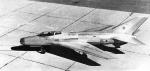


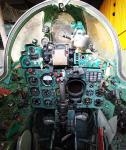









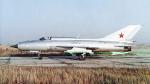
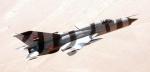


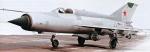
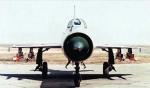
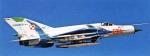
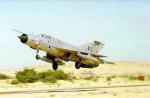
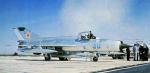


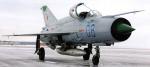


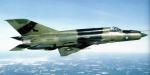


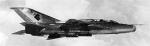


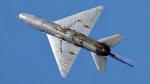
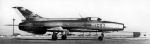




In the period after World War II, Soviet jet fighter design had been dominated by the OKB (experimental design bureau) led by Artyom Ivanovich Mikoyan. The Mikoyan MiG-15 had been evenly matched with the US North American F-86 Sabre over Korea, and had led to the improved MiG-17 derivative. In the mid-1950s, much the same design concepts led to the twin-engine MiG-19, the first supersonic Soviet jet fighter to go into widespread service.
Even as the MiG-19 was going into operation, the Mikoyan OKB was working on a successor that embodied the lessons learned in Korea. A state requirement for a fast, light fighter had been passed down in the fall of 1953. The requirement was general in nature, providing broad specifications in the form of an aircraft with a top speed of Mach 2, armed with cannon and fitted with a radar gunsight, with the capability to carry guided air-to-air missiles (AAMs) later.
Although other OKBs worked on the same requirement, some of them were too committed on other projects to seriously take on another design effort, and others were unable to provide designs that the authorities found acceptable. That left the Mikoyan OKB as the only designer, with a go-ahead for aircraft development granted by the authorities in January 1954.
At the outset the Mikoyan design was given the OKB code of Ye-1, where «Ye» stood for «Yedinitsa«, meaning «single unit» and translating as «one-off special prototype». The Ye-1 was to be powered by a single Arkady Mikulin AM-5A axial-flow turbojet. However, changes were made immediately in the design. On analysis the AM-5A proved inadequate, and so the decision was made to fit the aircraft with the improved Mikulin AM-9B derivative engine, which powered the twin-engine MiG-19 fighter; this selection would quickly move on to the further improved Mikulin AM-11 engine, then in development and optimized for the fast light fighter requirement. The OKB code for the aircraft was updated to Ye-2.
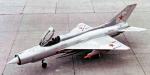
The AM-11 engine wasn’t going to be available right away, so development would have to start using the existing AM-9B engine. Six prototypes were built: one Ye-2, one Ye-2A, two Ye-4 and two Ye-5. The Ye-2 prototype was rolled out in early 1955 and performed its first flight on 14 February 1955, with Georgiy K. Mosolov at the controls. The flight went well enough, though Mosolov noted that it was underpowered. The first Ye-4 delta-wing prototype performed its initial flight on 16 June 1955, with Grigory A. Sedov at the controls, but the machine was only capable of a maximum speed of Mach 1.2. The rest of the prototypes first flew before the end of 1956.
Trials of the Ye-2A and Ye-5 were so promising that by early 1956 the clear expectation was that one of them would be put into production, with the service designation of MiG-23 being reserved for the Ye-2A and MiG-21 for the Ye-5. Pre-production batches of the Ye-2A and Ye-5 were ordered, with each batch consisting of five machines. Intensive trials showed that while the Ye-2A was a good machine, in spite of the early developmental problems the Ye-5 turned out to be better, being more maneuverable, lighter, and slightly faster. Apparently due to its bad start, there was a certain amount of surprise when the Ye-5 was selected for further development, expected to lead to production. The MiG-21 was the future; the MiG-23 designation was set aside to be «recycled» in a later Mikoyan OKB fighter.
The West had already received hints about the new types of aircraft, with swept-wing and delta-wing prototypes performing a flyby in the course of the Aviation Day air show at Tushino Airport in Moscow on 24 June 1956. The NATO assigned the swept-wing machine the reporting name of «Faceplate» and the delta-wing machine the name «Fishbed«. It would take a few more years for the West to figure out which one was actually put into production.
Initial prototype development was not quite finished, since the engine design bureau — now under Sergei K. Tumanskiy, Mikulin having been given the boot in 1955 — had got most of the problems with the AM-11 under control and was in fact offering an improved version. The AM-11 had become the R-11 with the departure of Mikulin, with the «R» standing for «Reaktivniy«, or loosely «reaction (device) / jet engine» in English, and the new engine variant was the R-11F-300, with a considerable jump in afterburner power.
Three more delta-wing prototypes, designated Ye-6, were ordered to evaluate the R-11F-300 engine. Initial flight of the first Ye-6 was on 20 May 1958, with Vladimir Nefyedov at the controls. It quickly proved impressive, handily breaking through Mach 2 in level flight, but unfortunately the aircraft was lost on 28 May and Nefyedov died in the accident.
Nefyedov’s death was a shock to the OKB staff. The failure of his flight systems was due to the fact that the initial Ye-6 only had a single hydraulic system. The second Ye-6 was promptly torn down and rebuilt, through considerable effort, with dual hydraulic systems. It performed its first flight on 15 September 1958.
The third Ye-6 performed its initial flight in December 1958. Trials were completed, and the go-ahead was given for full production. Initial deliveries of the production Ye-6T or MiG-21F to the VVS (Voyenno Vozdushniye Sily / Red Air Force) were in the fall of 1959. It was also known by the factory code of Izdeliye (Type) 72 or I-72; NATO would refer to this variant as the Fishbed-B, the prototypes being referred to as Fishbed-A retroactively.
Production for the VVS was assigned to State Factory Number 21 in Gorkiy. Later on, the MMZ Znamya Truda (Banner of Labor) factory, once State Factory Number 30, was assigned to build export production.
The two surviving Ye-6 prototypes continued in trials, and in a particularly interesting and significant exercise, the second prototype was used for trials in 1960 of the new K-13 heat-seeking AAM, a copy of the US Sidewinder, which was given the NATO reporting name of AA-2 Atoll.
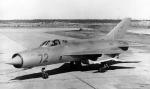
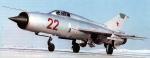
The MiG-21F was made mostly of aluminum alloy, with some steel, magnesium, and glass fiber parts. It featured a slender area-ruled fuselage with a circular intake in the nose, interrupted by an automatically-adjusted moveable intake cone, mid-mounted triangular delta wings with cropped tips and a swept tailplane of conventional arrangement, with an all-moving tailplane, and a fixed ventral fin under the tail. There was a brake parachute fairing behind the ventral fin and a hydraulically-actuated airbrake under the fuselage forward of the fin. There was also a pair of hydraulically-activated airbrakes on the belly below the front of the wingroots.
The pilot sat under a one-piece clamshell canopy that hinged on front, with the cockpit terminating in a fairing with a transparent panel and then in a dorsal spine that went back to the tail. The landing gear was of tricycle configuration, all gear assemblies featuring single wheels, the nose gear retracting forward, and the main gear retracting by pivoting forward at an angle towards the fuselage. The nosewheel freely castored, with the aircraft steered on the ground using mainwheel braking. All wheels had pneumatically-operated disk brakes. There was a pitot tube under the nose; it could be hinged upward.
The wing had a leading-edge sweep of 57 degrees and an anhedral droop of 2 degrees. It featured hydraulically actuated flaps and hydraulically boosted tabless ailerons, plus a wing fence near the tip to prevent loss of airflow over the wingtip. The tailfin had a leading-edge sweep of 60 degrees and the rudder was hydraulically actuated. The one-piece tailplanes had a leading-edge sweep of 55 degrees, no anhedral, and were hydraulically actuated. The tailplane tips were weighted with spindle-shaped masses to reduce vibration or flutter.
The engine was a Tumanskiy R-11-300F turbojet with 38.1 kN (3,880 kgp / 8,555 lbf) dry thrust and 56.3 kN (5,740 kgp / 12,655 lbf) afterburning thrust. It used an integral electrical starter system and featured an automatic fire-extinguisher system. Along with the nose intake with its automatically moving cone, there was a set of auxiliary input doors alongside the nose that were automatically hydraulically actuated to provide better airflow at high angles of attack, and a spring-loaded auxiliary input door on each side of the fuselage just forward and below the wing to provide additional airflow. There were six flexible fuel tanks in the fuselage and two integral fuel tanks in each wing for a total of ten tanks, providing a usable internal fuel capacity of 2,280 liters (602 US gallons).
The MiG-21F featured built-in armament of twin Nudelmann-Richter NR-30 30-mm automatic cannon, with the cannon firing out from the belly under the cockpit. The cannon installation was staggered, with the right weapon forward of the left, presumably to accommodate ammunition. Each cannon was fed by a 30-round belt. The guns were aimed with an ASP-5ND gunsight, which included a range indicator driven by a simple SRD-5 ranging radar in the inlet cone. There was also a gun camera in the top support brace for the inlet cone.
There was a centerline pylon for a spindle-configuration supersonic drop tank with a capacity of 490 liters (129 US gallons), and each wing could be fitted with a single stores pylon for a bomb or unguided rocket pod. Since the MiG-21F had no kit for bomb aiming, few pictures of the type show bombs being carried, with unguided rockets being the default ground-attack store since they could be aimed with the gunsight.
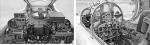
The pilot sat in an air-conditioned, pressurized cockpit on an SK ejection seat, which was actuated by pulling down a face blind and used an explosive cartridge. The forward-hinging canopy came off with the ejection seat, the principle being that it would provide a windbreak for the pilot, but as it turned out, the concept sounded better on paper than it worked in practice. There were armor panels on the back of the seat and the headrest, and armor panels on the side of the cockpit. There was a backup oxygen system in case pressurization failed. Along with the ranging radar, avionics included a VHF radio; an automatic radio compass; a marker beacon receiver; a low-altitude radio altimeter; an air traffic control (ATC) transponder; an SRO-2 Khrom identification friend or foe (IFF) transponder; and a Sirena-D radar warning receiver (RWR), with an antenna on the back of the tailfin.
The aircraft featured dual hydraulic systems, as well as a dual pneumatic system to handle wheel brakes, canopy actuation, pilot gee suit, gun cocking, and brake parachute deployment. The fact that both the hydraulic and pneumatic systems were dual did not imply that each system had two identical halves: there was actually a complicated pattern of main and backup operation between the hydraulic and pneumatic systems.
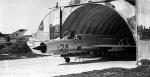
Pilots really liked the MiG-21F, since it was pretty, fast, agile, and handled well. The MiG-21F was light on its feet; of all the family was said to be the most fun to fly, since later versions tended to become heavier. Of course, on the other side of the same coin it was also the least combat-effective, being limited in armament, avionics, payload, and range compared to its successors, endurance was about 90 minutes with an external tank. It was strictly a point-defense interceptor, since it couldn’t stay in the air long enough to perform air patrols or offensive missions.
Experience showed that the MiG-21F did have one unpleasant handling quirk: if the aircraft deviated from its actual line of flight, airflow into the intake would be disrupted, resulting in engine stalls that could cause engine damage. The small wings also made for long take-off runs and hot landings, with the brake chute added to reduce landing roll; while the engine exhaust tended to overheat, leading to fires. Another difficulty was that the cockpit was cramped, and the pilot had a poor field of view, none to the rear; but as another big plus, in maturity, the MiG-21 was sturdy, reliable, and easy to maintain.
Beginning in the second half of 1960, production moved on to a slightly enhanced variant designated the MiG-21F-13, with the factory code of I-74. The main improvement was carriage of the AA-2 Atoll AAM, one on a pylon under each wing, with the left cannon deleted. The SRD-5 radar was updated to the SRD-5M Kvant (Quantum) variant, with improved performance.
The number of fuel tanks in each wing was also increased from two to four, giving a total of 14 fuel tanks, with the wing fuel tank capacity increased in later production to provide a total internal fuel capacity of 2,470 liters (652 US gallons), but in practice was limited to 2,340 liters (617 US gallons). Provision was added for an enlarged centerline external fuel tank with a capacity of 800 liters (211 US gallons), as well as for camera that could be fitted aft of the nosewheel bay to provide a limited reconnaissance capability. NATO assigned the MiG-21F-13 the reporting name of Fishbed-C.
Although the Soviets were sometimes reluctant to export their latest weapons, they had little hesitation about handing out the MiG-21. The first export machines were rolled out from the Znamya Truda factory in the summer of 1960. The Czech Aero Vodochody factory in Prague obtained a license to build the MiG-21, with Czech production designated S-106. It was effectively a MiG-21F-13, except that the transparent panel on the rear cockpit fairing was deleted, since it hadn’t proven useful in practice. It would be deleted in later Soviet production as well. The Czechs built 194 S-106s; they would not build any other MiG-21 variants.
The MiG-21F was a day fighter, with no real capability for night or foul-weather operations, and so it was useless for the PVO (Protivo-Vozdusdushnoi Oborony / Homeland Anti-Aircraft Defense) organization, a distinct armed service dedicated to the air defense of the USSR using surface-to-air missiles (SAMs) and interceptors. Due to the sheer extent of the Soviet frontier, the PVO tended to acquire heavy long-range interceptors, like the Yak-25 Flashlight and its much improved derivative, the Yak-28P Firebar, but such machines were expensive. A lighter, cheaper, less capable machine would allow the PVO to field more aircraft, assigning the cheaper machines to the defense of the western borders of the Soviet Union, where the population centers were more concentrated and long range not so important.
In late 1957, the MiG OKB began work on the Ye-7, essentially a MiG-21F with a Sapfir (Sapphire) radar in a larger inlet cone. Three prototypes were built, with the first performing its initial flight on 10 August 1958. At least five Ye-7 evaluation machines followed the three prototypes.
Trials went well, with the type going into production at Gorkiy in June 1960, with the service designation of MiG-21P, where «P» stood for «Perekvatchik (Interceptor)», and factory code of I-75. However, these early machines were not regarded as really satisfactory and only a few MiG-21Ps were built, with most or all being used as development aircraft. Production of the much more satisfactory MiG-21PF or I-76 interceptor began in early 1962.
The initial MiG-21P had featured the production RP-21 Sapfir (NATO Spin Scan-A) radar, armament of two AA-2 Atoll AAMs (no cannon), bigger and redesigned forward airbrakes, a simple autopilot, provision for fit of twin rocket-assisted take-off (RATO) boosters along the rear fuselage, and larger tires. The fat tires meant more prominent gear fairings in the top of the wing and in the gear doors. Avionics improvements consisted of a TACAN-type beacon navigation receiver known as KSI, and a Lazur (Azure) link to the Vozdukh-1 (Air-1) air defense ground network.
Although the MiG-21P lacked cannon, it did have a simple optical sight for use with underwing unguided rocket pods. The pitot tube was moved from under the nose to the top of the nose, and the pivot was eliminated. Later production featured a broader tailfin to make sure the aircraft flew straight so it and didn’t suffer from engine stalls and the brake chute moved from under the exhaust to a conical-tipped fairing under the tailfin. Eventually, a more effective cruciform parachute would be introduced to take advantage of the higher position, replacing the original circular parachute. The MiG-21P was assigned the NATO reporting name of Fishbed-D.
The MiG-21PF improved on the MiG-21P by adding two fuselage fuel tanks behind the cockpit resulting in a distinctive fat rear cockpit fairing, and a fuel capacity of 2,750 liters (726 US gallons). The MiG-21PF also added the uprated R-11F2-300 engine, which provided 38.7 kN (3,950 kgp / 8,710 lbf) dry thrust and 60.0 kN (6,120 kgp / 13,490 lbf) afterburning thrust. The variant was assigned the NATO reporting name of Fishbed-E.
The additional thrust provided by the R-11F2-300 engine seemed adequate to support a feature known as «flap blowing», in which engine bleed air was directed over the flaps to permit lower take-off and landing speeds. It was effective but required plenty of engine power, since flap blowing robbed the engine of thrust at take-off, when the thrust was needed the most. The scheme was flowed into production in 1964, with the new variant designated the MiG-21PFS, the «S» standing for «slovo pogranichnovo sloya (SPS)», which just meant «blown flaps»; the factory code was I-94. The MiG-21PFS actually featured an R-11F2S-300 engine, which differed from its predecessor by incorporating a two-stage afterburner.
Only a handful of MiG-21PFS machines were built, with production flowing in turn to the further improved MiG-21PFM by the end of 1964, retaining the I-94 factory code. It featured an even broader tailfin and a new RP-21M radar (NATO Spin Scan-B), which supported carriage of radar-guided AAMs. Initially, the standard radar-guided AAM was the K-5 / R-2 AAM, known to NATO as the AA-1 Alkali, but this was replaced by the much better K-13R / R-3R AAM, known to NATO as the AA-2-2 Advanced Atoll.
In addition, by that time the decision to delete the cannon armament had been reconsidered and judged too hasty, and so the MiG-21PFM could be fitted with an optional belly Gryasev-Shipanov GSh-23 23-mm cannon pack mounted on the centerline hardpoint, with 200 rounds of ammunition carried in the pack. It could support a rate of fire of 3,600 rounds per minute. An improved PKI gunsight was added to support the cannon pack. Other improvements included a new Khrom-Nikel SRO-2M IFF and Sirena-3M RWR.
Later MiG-21PFM production featured a new ejection seat, the KM-1. It wasn’t a modern «zero-zero» ejection seat, capable of working safely if the aircraft was just sitting on the runway, but it could be used at zero altitude if the aircraft was moving at a minimum speed of 130 km/h (80 mph) and was a big improvement over the SK seat. A new two-piece canopy scheme was introduced along with the KM-1, with the canopy hinging open to the right instead of hinging forward. The new canopy arrangement cut into the fuselage fuel capacity slightly. NATO assigned the MiG-21PFS and MiG-21PFM the reporting name of Fishbed-F.
In service, the new MiG-21 interceptors were well-received, providing a more sophisticated weapons system with greater range and, with flap blowing, better take-off characteristics. The Sapfir radar only had a range of about 10 km (6 mi), meaning that the aircraft was almost completely dependent on the ground-control network, but that was regarded as perfectly acceptable, indeed part of PVO air-defense doctrine.
MiG-21P-series interceptors were built at the Znamya Truda factory for export. North Vietnam obtained a unique tropicalized variant, the MiG-21PF-V, with systems conditioned for high temperature and humidity. Export machines generally had systems to a slightly lower standard, the Soviets preferring not to spread around the latest systems since they might be compromised.
Hindustan Aircraft LTD (HAL) India license-built a downgraded version of the MiG-21PFM as the MiG-21FL. While Indian MiG-21s carried Soviet-designed AAMs, they were also qualified to carry the French Matra Magic heat-seeking AAM. They did not carry the Magic on any regular basis, but the Indian Air Force wanted to make sure that it could be used in a pinch if stocks of other AAMs were low.
While the Mikoyan OKB worked on the interceptor variants, the OKB also worked on a tactical reconnaissance variant for the Red Air Force’s Frontal Aviation (FA) component. The starting point was the kit of Ye-7 concepts being developed for the interceptors. The idea was to fit a centerline reconnaissance pod, with different pods developed to support a range of missions. That meant the centerline external tank would have to go. In order to make sure that the aircraft got its fair share of fuel, two new underwing pylons were to be added, for a total of four.
One of the Ye-7 interceptor development aircraft was modified as the initial reconnaissance prototype, the main change being the four-pylon wing. The type went into production in 1964 at Gorkiy as the MiG-21R, where «R» stood for «Razvedchik (Reconnaissance)», with export machines designated MiG-21RF. The OKB referred to it as the I-94R. Series aircraft were delivered from 1965 into 1971. NATO assigned it the reporting name of Fishbed-H.
In its production configuration, the MiG-21R incorporated enough changes to be thought of as a second generation MiG-21. The most noticeable difference was a new fat spine that ran all the way back from the cockpit to the tailfin, allowing accommodation of avionics and additional fuel, with internal fuel storage increasing to 2,800 liters (739 US gallons). The MiG-21R featured the definitive broad tailfin introduced on the MiG-21PFM, with the brake chute at the base of the tailfin. It was fitted with the R-11F2S-300 engine and had the blown flaps scheme; it retained the two-piece canopy, KM-1 ejection seat, and fat tires introduced in MiG-21 interceptor development.
A wide range of reconnaissance packs could be carried, such as Day (D) packs, which typically carried seven film cameras, one staring forward at an oblique angle, the other six fitted in three bays, Night (N) packs, which appear to have been similar to the D packs but used infrared film and Radio (R) pods, or in other words ELINT (Electronic Intelligence) pods. They carried a single forward-looking oblique film camera to provide imagery for cross-referencing ELINT data.
All the packs could be fitted with chaff-flare dispensers and, it seems, other countermeasures systems. A typical operational configuration was a tank on each outer pylon and an AAM on each inner pylon, and up to five tanks carried on ferry missions, though this was an unusual configuration at best. The GSh-23 cannon pod developed for the MiG-21PFM could also be carried, but that was rarely if ever done.
A specialized version of the MiG-21RF was built at the Znamya Truda factory for the Egyptians. This subvariant featured a fuselage reconnaissance pack, installed in the belly under the cockpit, carrying three film cameras arranged to give panoramic imagery. A standard MiG-21R could be easily converted to this configuration.
Since the MiG-21R retained complete combat capability even if it wasn’t actually used in practice, it was an obvious next step to produce a new fighter variant based on its updated airframe. After evaluation with prototypes designated Ye-7S, the updated fighter was put into production at Gorkiy in 1965 as the MiG-21S, or I-95 as the Mikoyan OKB referred to it. It remained in production until 1968.
Aside from the new airframe, the MiG-21S featured some new kit, including a more powerful RP-22 Sapfir (NATO Jay Bird) radar with range at least doubled; an ASP-PF gunsight for the optional GSh-23 centerline cannon pod; and a link for the Lazur-M ground-control system. It could carry a range of heat-seeking or radar-guided AAMs, as well as rockets or bombs. Early on, the MiG-21S was qualified for carriage of a tactical nuclear weapon on the centerline pylon. The angle of attack sensor, the offset pitot tube, and the periscope were added in later production.
Although the MiG-21R and MiG-21S incorporated many improvements, the weight increase meant that ceiling and climb rate suffered. Worse, the hoped-for range increase to be provided by increased fuel capacity didn’t materialize, mostly due to fuel trim problems that made the expanded fuel capacity something of a fiction. Obviously the design needed further rethinking, but that was going to take time and effort.
In the meantime, incremental improvements would have to do. An export version of the MiG-21S, the MiG-21M or I-96, was built at the Znamya Truda factory from 1968 into 1971. It retained the older RP-21M radar, but featured a GSh-23L twin-barreled cannon in a flush belly installation, replacing the centerline GSh-23 cannon pod introduced on the MiG-21PFM. The flush cannon pallet carried a store of 200 rounds of ammunition and could be neatly winched out of the fuselage for servicing. The new cannon scheme not only reduced drag, but permitted carriage of a fuel tank or other store on the centerline pylon. A steel blast panel was installed on the belly of the aircraft forward of the cannon muzzles. HAL of India license-built the MiG-21M, with initial production delivered in 1973.
A more significant advance was development of a better engine, the Tumanskiy R-13-300, a substantially improved derivative of the R-11 series, with 39.9 kN (4,070 kgp / 8,973 lbf) dry thrust and 63.7 kN (6,490 kgp / 14,310 lbf) afterburning thrust. The R-13-300 was generally mechanically compatible with the R-11 series and so it was a straightforward fit to the MiG-21S, the result being the MiG-21SM or I-15. Except for the more powerful engine, as well as fit of the flush GSh-23L cannon, the MiG-21SM was much like a late-production MiG-21S.
The MiG-21SM was heavily produced at Gorkiy from 1968 into 1974. An export version, the MiG-21MF or I-96F, this time retaining the long-range RP-22 radar, was put into production at Znamya Truda in 1970. HAL of India built a similar variant with the R-13-300 engine, but retained the MiG-21M designation.
Mikoyan OKB engineers kept on tweaking the enlarged spine introduced on the MiG-21R, coming up with a bulged configuration that raised total fuel capacity to 2,950 liters (778 US gallons). The spine was so big that it gave the aircraft a humpbacked appearance and, unlike earlier MiG-21 variants, merged back into the brake chute fairing at the base of the tail.
The result was the MiG-21SMT or I-50, which went into production at Gorkiy in 1971. Except for the bulged spine, it was much like a late-production MiG-21SM, with the latest in avionics and the R-13-300 engine. The engine fit still didn’t provide enough thrust to keep up with the MiG-21SMT’s weight growth, and in fact the MiG-21SMT was something of a disappointment, being built in limited numbers. Operational experience suggested that the swollen spine was another exercise in futility because trim problems once again meant all the fuel capacity couldn’t be used. The Znamya Truda plant built 15 examples of an export version of the MiG-21SMT designated the MiG-21MT or I-96T in 1971, but they never left the country.
By that time, the Tumanskiy engine OKB had introduced the R-25-300, which provided 40.2 kN (4,100 kgp / 9,040 lbf) dry thrust and had a two-stage afterburner, with 69.6 kN (7,100 kgp / 15,650 lbf) in normal afterburning and 95 kN (9,690 kgp / 21,355 lbf) in a special combat afterburning mode that could be engaged for up to three minutes. The R-25-300 was more optimized for low-level operation than its predecessors and less susceptible to stalls and flame-outs.
The original idea was to re-engine existing late-model MiG-21s with the R-25-300, but Mikoyan OKB engineers decided to use it on a new variant, the MiG-21bis or I-75. The result was not just an old MiG-21 fitted with the new engine, but a true third-generation MiG-21, since the OKB engineers used the opportunity to perform an extensive redesign on the whole machine, and this time they wanted to get it right. Externally, the MiG-21bis resembled the MiG-21SMT, but since the MiG-21SMT’s fat spine had ended up providing more space than could be used, the spine on the MiG-21bis was more similar to that on the MiG-21SMT’s predecessors. The internal fuel capacity was 2,880 liters (760 US gallons) and all of it was actually usable.
The airframe was largely redesigned using new alloys, resulting in a stronger but lighter aircraft. The latest avionics were fitted, including an improved RP-22 radar that provided capability to spot targets flying near the ground; an RSBN-6S short-range navigation system and coupled instrument landing system that permitted operations in very poor visibility conditions; and a built-in test system to simplify maintenance. Weapons loads included the flush-mounted GSh-23L cannon, AAMs, and unguided air-to-ground stores, usually unguided rocket pods.
Typical AAM stores included the AA-2-2 Advanced Atoll, but by the era of the MiG-21bis the AA-2 Atoll had been replaced by a much improved short-range heatseeking AAM, the K-60 / R-60, known to NATO as the AA-8 Aphid. The Aphid was very agile, lethal, and lightweight; two could be carried on a single pylon using a dual-stores adapter, giving the MiG-21bis a very nasty bite indeed.
Some MiG-21bis aircraft were fitted for carriage of a tactical nuclear weapon on the centerline pylon and designated MiG-21bisN. Early MiG-21bis production was given the NATO reporting name of Fishbed-L; later production featured a more complete avionics spec, with new antennas, and so NATO assigned the later machines the reporting name of Fishbed-N.
All 2,030 examples of the MiG-21bis were built at Gorkiy from 1972 into 1984. Soviet machines were designated I-75P, while exports to the Warsaw Pact were designated I-75A and exports elsewhere were designated I-75B. The Finns obtained some MiG-21bis fighters, and were very impressed with the type. India obtained 75 machines from the USSR, with HAL producing 220 from 1979 into 1987.
The MiG-21bis was regarded as an excellent aircraft, regaining some of the ground lost in flyability, while being far more capable. However, although there was some thought to further enhancement, by the early 1970s the design was clearly running out of steam; the Mikoyan OKB was moving on to a new design, which would emerge as the MiG-29.
The results of trials with a trainer vaiant proved satisfactory, with the type entering production as the MiG-21U, where «U» stood for «Uchyebniy (Trainer)», with the factory code of I-66. Machines for Soviet use were built at State Factory Number 31 in Tbilisi, the capital of Georgia; export production was built at the Znamya Truda factory near Moscow. Most or all foreign users who obtained MiG-21 fighters or interceptors also obtained some MiG-21Us for conversion training. Soviet pilots called it the Sparka (Twin), a general term for a two-seat trainer, while NATO assigned it the reporting name of Mongol.
Initial MiG-21U production amounted to a minimum-change derivative of the MiG-21F-13. The MiG-21U was exactly the same length as the MiG-21F-13, the tandem-seat cockpit being crammed in by adjusting the arrangement of internal fuel tanks. Since the single NR-30 cannon was deleted, the actual maximum practical fuel capacity was still 2,350 liters (620 US gallons).
The cockpit featured twin canopies that hinged open to the right, with a transparent windbreak between the front and rear positions. The instructor’s position in the rear was not raised, giving him a poor forward view. Avionics were much the same as for the MiG-21F-13, including an ASP-5ND gunsight and SRD-5 ranging radar. The MiG-21U could carry an AA-2 Atoll AAM or other store under each wing, and could be fitted with a centerline pod carrying a 12.7-mm machine gun for gunnery training.
The MiG-21U deviated from the MiG-21F-13 pattern by moving the pitot tube to the top of the nose and making it a fixed installation, and it also incorporated the fat tires and wing / gear door bulges of the MiG-21P interceptor. It also replaced the double forward airbrakes of the MiG-21F-13 with a single large airbrake. Later production MiG-21Us featured the full-sized tailfin, with the brake chute container at the base.
The introduction of the blown-flaps system on MiG-21 fighters and interceptors suggested that it might be a good idea to produce a trainer with the blown-flaps system, and so the MiG-21US or I-68 replaced the MiG-21U on the Tbilisi production line in 1966. It was hard to tell from a late-production MiG-21U, the changes being largely internal, the most significant being fit of the uprated R-11F2S-300 engine to support the flap-blowing system. Other changes included an increase in maximum fuel capacity to 2,450 liters (646 US gallons); the option of fitting four stores pylons instead of two; and replacement of the original SK ejection seats with the better KM-1 seats.
The MiG-21US was assigned the NATO reporting name of Mongol-B, the MiG-21U retroactively becoming the Mongol-A. All production, both domestic and foreign, was from Tbilisi. Later production featured an interesting periscope system for the instructor in the back seat.
In 1971, the MiG-21US was replaced on the production line by the MiG-21UM or I-69, which again was built solely at Tbilisi, with the last rolled out in 1975. It was almost identical in appearance to the MiG-21US, the only real external difference being the fit of the angle of attack sensor and the accompanying offset pitot tube, but the cockpit and avionics were generally updated, with a three-axis autopilot, plus avionics systems on pull-out rack modules to simplify maintenance. The MiG-21UM retained the NATO reporting name of Mongol-B.
Red China also produced the MiG-21. A license agreement was indeed signed in early 1961, with the state factory at Shenyang to perform production, but Sino-Soviet relations were breaking down at the time, and deliveries of manufacturing specs and materials were broken off before Shenyang had received everything needed to build the aircraft.
The Chinese ended up, with some difficulty, building the machine anyway without Soviet assistance, designating it the J-7, where the «J» stood for «jianjiji / jian (fighter)». Aircraft design and production is an elaborate task and Communist China effectively had to develop an entire industry from square one, with the difficulty compounded by China’s general lack of industrial infrastructure, and by Mao Zedong’s occasional lunatic social initiatives.
The MiG-21 was a fairly sophisticated machine for the Chinese to tackle; it wasn’t until 17 January 1966 that they finally flew a prototype of the J-7, with test pilot Ge Wenrong at the controls. The type was passed off for series production to the Chengdu state factory. About a dozen J-7s were built for development, with the initial production version, the J-7I, performing its first flight in June 1976.
The CAC (Chengdu Aircraft Company) J-7I was very close to a MiG-21F-13, with a WP-7 engine, a slightly modified version of the R-11F-300 turbojet, and a single Type 30-1 30 mm cannon, a copy of the Soviet NR-30. Its primary AAM was the PL-2, a copy of the AA-2 Atoll. The J-7I was not very satisfactory and wasn’t built in large numbers, though some were exported to Albania and Tanzania under the designation of F-7A.
For the time being, the Chinese People’s Liberation Army Air Force (PLAAF) relied on the J-6, a MiG-19 copy and not as big a challenge, while work went on at a slow rate towards a more satisfactory J-7. The first J-7II or J-7B performed its initial flight on 30 December 1978, with Yu Mingwen at the controls. It retained the lines of the MiG-21F-13 but featured a Type II ejection seat, a copy of the Soviet SK ejection seat, and was fitted with a two-piece canopy; a more reliable WP-7B engine, with time between overhauls doubled to 200 hours; and the distinctive brake chute fairing at the base of the tailfin fitted to later Soviet MiG-21 variants.
The J-7II was exported as the F-7B, and was obtained by Egypt, Iraq, and Sri Lanka. Iraqi F-7Bs were qualified with the French Matra Magic heatseeking AAM, which was also reverse-engineered and built in China as the PL-7 for export sales. Sri Lankan machines were to F-7BS standard, with four underwing pylons instead of the traditional two, the outer pylon on each wing being plumbed for a 720-liter (190 US gallon) external tank.
Even the more satisfactory J-7II was lagging the times, and so an effort was made to bring the type up to date. One line of work focused on the an export variant designated the J-7IIA or the export F-7M, which featured improvements with few changes to the basic machine. The J-7IIA was announced in 1984. It looked much like the J-7II but was considerably modernized, with four underwing pylons, a CAC zero-zero ejection seat, stronger windscreen and landing gear, a WP-7B(BM) engine, with the same thrust, but lighter, more reliable, and a few others. The J-7IIA was fitted with twin Type 30-1 30-mm cannon with 60 rounds each, and could carry the Chinese PL-2 or the Matra Magic AAMs.
The type was attractive to air forces on a budget and the F-7M was sold to Bangladesh, Egypt, Iran, Myanmar, and Zimbabwe. The Pakistani Air Force (PAF) obtained a variant of the F-7M designated the F-7P. Early deliveries began in 1988. The F-7P was essentially an F-7M with various tweaks as per PAF specification, including a British Martin-Baker Mark 10L zero-zero ejection seat and the ability to carry four US-built Sidewinder AAMs. The PAF went on to obtain an enhanced F-7PM that was externally similar but featured US-supplied Rockwell-Collins avionics and Italian FIAR Grifo radar.
In the early 1980s, the Guizhou factory developed a tandem-seat trainer, the JJ-7, where «JJ» stood for «jianjiji-jiaolianji (fighter trainer)». It was designated the FT-7 on the export market. The JJ-7 was basically a clone of the MiG-21US, with the periscope and two wing pylons. It differed visibly from Soviet Mongols by being fitted with twin canted ventral fins, instead of a single ventral fin. Initial flight of the first prototype was on 5 July 1985, with Yan Xiufu at the controls. The PAF obtained their own unique trainer variant, the FT-7P, without the periscope but four underwing pylons and improved avionics, including the GEC Marconi HUD/WAC.
In parallel, Chinese industry worked on a more aggressive redesign, essentially trying to build an equivalent to the Soviet MiG-21SM / MiG-21MF. The first J-7III or J-7C prototype performed its initial flight on 26 April 1984. It featured a configuration much like that of the MiG-21SM, with the big intake cone for air intercept radar; a fat dorsal spine; flap blowing; a WP-13 engine equivalent but apparently not identical to the Soviet R-13-300; a CAC zero-zero ejection seat; and a rear-view periscope. Unfortunately, the J-7III ran into the same problems with weight increase that plagued later Soviet MiG-21 development, and in general did not meet PLAAF spec. Only a few dozen were built.
Work on another updated J-7 began in 1987 at the Chengdu factory, with a prototype performing its first flight in 1990. In 1992, the Chengdu organization announced the J-7E, unveiling an F-7MG export variant in 1996. The J-7E featured modern avionics, mostly Chinese designed or license-built, a WP-13F engine with 44.1 kN (4,500 kgp / 9,920 lbf) dry thrust and 63.8 kN (6,500 kgp / 14,300 lbf) afterburning thrust, a redesigned wing, with outer wing panels featuring sweep cut back to 42 degrees. The new wing provided much improved low-speed handling and also included leading-edge drooping maneuvering flaps, giving the J-7E outstanding agility.
The PAF was very interested in the F-7MG; in 2001, the service ordered 60 machines modified to their specifications as the F-7PG, with Italian FIAR Grifo radar and Martin-Baker ejection seats. The J-7E itself has since been improved to the J-7G standard, introduced in 2002, with the latest avionics, including an advanced multimode radar suspected to be a license-built variant of the Israeli Elbit EL/M2001, plus a modern ECM suite and a Global Positioning System (GPS) satellite navigation receiver; a single-piece windscreen; and only one cannon.
By the early 1960s, the MiG-21 was in widespread use in the Soviet Union and in Soviet client states. Of course, the USSR was the biggest user, with more than 6,000 machines serving with the VVS and PVO in all. Variants in Soviet service included the MiG-21F/F-13, the MiG-21P/PF/PFS/PFM, the MiG-21R/S/SM/SMT, the MiG-21bis/bisN, and the MiG-21U/US/UM.
By the time of the collapse of the Soviet Union in the early 1990s, the MiG-21 was in decline as an operational aircraft in its homeland, having been supplanted by the superior MiG-29 and Su-27. Some apparently lingered in use as fighter trainers and in the tactical reconnaissance role, but many MiG-21s were converted to M-21 target drones.
The MiG-21 / F-7 was obtained by dozens of states. All the Eastern Bloc states received the MiG-21, with large numbers obtained by Bulgaria, Czechoslovakia (where they were also built under license), East Germany, Hungary, Poland, Romania, and Yugoslavia. Albania obtained a batch of Chinese F-7s. The Germans gave up their MiG-21 force after reunification, while Hungary replaced it with the SAAB Gripen, and Poland replaced it with the Lockheed-Martin F-16. However, Aerostar of Romania performed a major upgrade on the Romanian fleet to keep it in service; the Bulgarians fitted their machines with modest upgrades to extend their service lives, but finally retired the last of them in 2015.
Finland was the only Western European nation to obtain the MiG-21, obtaining 61 machines, including the MiG-21F-13, the MiG-21bis, and the MiG-21U/UM. The Finns phased out their MiG-21 fleet in favor of the US McDonnell-Douglas F/A-18 Hornet.
Users in North Africa and the Middle East included Algeria, Egypt, Iraq, Libya, Syria, Syria, and Yemen. Egypt and Iraq obtained a number of Chinese F-7 machines along with Soviet-built MiG-21s, while Iran has obtained a set of F-7s as well. The Iraqi fleet was wiped out during the Gulf War. Users in East Africa and Sub-saharan Africa included Ethiopia, Mozambique, Nigeria, Sudan, Tanzania, Zambia, and Zimbabwe. Minor users in the region included Burkino Faso (previously Upper Volta), the Congo, Guinea Republic, Guinea-Bissau, Malgasy, Mali, Somalia, and Uganda.
In South Asia, India was a particularly enthusiastic MiG-21 user, as mentioned license building the type in quantity. Over 650 were obtained, including the MiG-21F-13, the MiG-21FL, the MiG-21PFM, the MiG-21M, the MiG-21bis, and the MiG-21U/UM. Many Indian MiG-21bis machines were given an extensive upgrade to keep them in service. Other operators in the region included Afghanistan, Bangladesh, and Sri Lanka. Pakistan has become an enthusiastic user of the F-7, obtaining the latest variants.
In East Asia, of course China is a major F-7 user, having obtained about a thousand machines in different variants. Other operators in the region included Cambodia, Indonesia, Laos, Mongolia, North Korea, and Vietnam. Myanmar (Burma) obtained a number of F-7 machines from China, while the only real user of MiG-21s in the New World was Cuba, which obtained a fleet of hundreds.
The MiG-21’s first real combat was in the June 1967 Mideast War, but unfortunately its major service in the conflict was as a target. The Arab states were poorly prepared despite their aggressive rhetoric, and a neatly-planned Israeli pre-emptive strike destroyed most Arab air power on the ground. Such machines as survived could only put up scattershot resistance and were generally swept out of the sky immediately by Israeli fighters. An Iraqi MiG-21 did score a hit on an Israeli Dassault Mirage III with a AA-2 Atoll AAM, but failed to knock the aircraft down.
By that time, MiG-21s were seeing plenty of combat over Southeast Asia, with North Vietnamese MiGs contesting fleets of American strike aircraft attempting, with little success, to pound Hanoi into submission. The actual truth of the air combat war over Vietnam is hard to determine, since American sources generally specify a 3:1 kill ratio over North Vietnamese aircraft, while North Vietnamese sources specify just the opposite. The Americans did admit to substantial losses, but believed that surface-to-air missiles (SAMs) and anti-aircraft artillery (AAA) claimed the lion’s share of kills.
Despite the disagreements, it does seem clear that the North Vietnamese regarded their interceptor force as a component of a very well-developed and organized air defense network, weighted towards SAMs and AAA. MiGs were operated, following Soviet air-defense procedure, under strict ground control and kept to their own air-defense zones; if they crossed into a SAM or AAA zone, they would be fired upon, no questions asked. The arrangement implicitly assigned the MiGs a subordinate status, and certainly denied North Vietnamese pilots the freedom of movement to take aggressive action.
In December 1971, India and Pakistan went to war again in a brief conflict that saw the emergence of the new nation of Bangladesh from East Pakistan. The IAF and PAF engaged each other energetically, with IAF MiG-21s proving more than a match for PAF Lockheed F-104 Starfighters, generally regarded as the MiG-21’s closest counterpart among US fighters. Not surprisingly, Indian and Pakistani sources differ very greatly on the details of the air war.
In October 1973, the Arabs and Israel had their own rematch, with the Arabs proving much tougher adversaries this time around. Egyptian President Anwar Sadat had emphasized intense training and built up, with assistance from the USSR, an impressive air-defense network based on the latest Soviet SAMs and AAA weaponry. The Israeli air force suffered badly in the conflict, though Israeli sources claim most of the kills were inflicted by SAMs and AAA. Arab sources do not agree, claiming that MiG-21s were able to hold their own or better against Israeli Mirages and Phantoms in the air war. However, at the end of the decade the Israelis, having assessed their clear failures in the October War, took on Syrian air power and inflicted a clearly lopsided defeat on them, destroying over a hundred Syrian fighters at minimal losses to themselves. The Israelis also developed tactics to counter and destroy Syrian SAMs and AAA.
The MiG-21 featured in smaller conflicts later in the 1970s, including a border clash between Libya and Egypt in the summer of 1977, and a war between Somalia and Ethiopia during the same season. The conflict between Somalia and Ethiopia featured fights between MiG-21s from both sides. MiG-21s also flew with the Angolan government in the 1970s and 1980s, occasionally having it out with South African Mirages, with the South Africans claiming a few kills.
The Soviet Union deployed MiG-21s to Afghanistan in 1979, this being the only time VVS MiG-21s saw combat. The fight with Afghan mujahedin insurgents, which dragged through the 1980s, didn’t involve air combat, except for occasional aerial border clashes with PAF fighters; while the MiG-21 couldn’t match dedicated close-support types like the Sukhoi Su-25.
Iraqi MiG-21s and J-7s did see plenty of air combat during the Iran-Iraq War in the 1980s, fighting against Iranian Phantoms and Northrop F-5E Tiger IIs. The F-5E was particularly well-matched against later-model MiG-21s, and Iraqi pilots tended to find the Tiger II a sharp opponent. Iraqi MiG-21s also operated in the 1991 Gulf War, but once again in the role of targets. The Iraqi use of air power in the war was unbelievably timid, and Coalition forces methodically bombed the Iraqi air force out of existence. In an action that nobody can figure out even today, the survivors fled to Iran, Iraq’s long-standing enemy, to be interned. Since that time, however, the MiG-21’s combat career went on the fade, and it is no longer a real factor in air combat.
FUENTES Y REFERENCIA – SOURCES & REFERENCE
airvectors.net
Ugolok Neba
aviadejavu.ru
©jmodels.net
 jmodels.net
Debe estar conectado para enviar un comentario.