
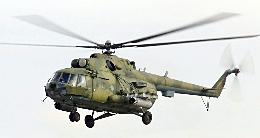
| DATOS TÉCNICOS (Mi-8MT) |
TECHNICAL DATA (Mi-8MT) |
| TIPO:Helicóptero de transporte. | TYPE:Transport helicopter. |
| TRIPULANTES:3 | CREW:3 |
| ALTURA:5,5 m. | HEIGHT:18.1 ft. |
| SUPERFICIE ROTOR PPAL.:356 m². | MAIN ROTOR AREA:3,830 ft². |
| PESO EN VACÍO:7.100 kg. | EMPTY WEIGHT:15,653 lb. |
| MOTOR:Dos motores turboeje Klimov TV3-117MT de 1.950 hp. (1.454 kW) cada uno. | ENGINE:Two Klimov TV3-117MT turboshaft engines providing 1,950 hp. (1,454 kW) each. |
ARMAMENTO:
|
ARMAMENT:
|
| VELOCIDAD MÁX.:250 km/h. | MAX. SPEED:160 mph. |
| TECHO:5.000 m. | CEILING:16,000 ft. |
| ALCANCE:495 km. (267 mil. náut.) | RANGE:308 ml. (267 nm.) |
| PRIMER VUELO:7 de julio de 1961. | FIRST FLIGHT:7 July 1961. |
| VERSIONES:43 | VERSIONS:43 |
| CONSTRUIDOS:Más de 17.000 (Todos los modelos). | BUILT:Over 17,000 (All variants). |
La oficina de diseño experimental (OKB) de Mikhail Lyeontivich Mil fue responsable de varios de los primeros helicópteros soviéticos, incluido el Mi-1 Hare de pistón y el Mi-4 Hound más grande, lo que llevó al Mi-6 Hook de carga pesada propulsado por turboeje. En 1957, la Mil OKB comenzó a considerar un sucesor del Mi-4 de elevación media, propulsado por motores de doble turboeje. En ese momento, por varias razones, había un sesgo en contra del desarrollo de nuevos tipos de aviones, por lo que la nueva máquina se vendió como una actualización del Mi-4.
En febrero de 1958, el Consejo de Ministros soviético aprobó cautelosamente el plan. Los ministros autorizaron el desarrollo de un helicóptero de carga media, con la designación OKB de V-8, la «V» significaba vertolyot (helicóptero), para ser propulsado por un solo motor turboeje Ivchenko Al-24V, de 1.420 kW (1.900 shp.). El Al-24V era una versión de turboeje reducida del turbohélice Al-24 de 1.790 kW (2.400 shp.) entonces en desarrollo para el avión de transporte bimotor Antonov An-24.
Los ingenieros de Mil OKB no estaban nada contentos con el requisito de usar un solo motor, ya que comprometía la seguridad, y tampoco les gustaba el excesivo consumo del Al-24V. Mikhail Mil presionó a las autoridades para que aprobaran el desarrollo paralelo de una versión bimotor, señalando que la máquina se usaría como transporte VIP y que no sería prudente comprometer la seguridad de los líderes soviéticos. La apelación al interés propio resultó exitosa; después de que se inspeccionaron los diseños preliminares y una maqueta a gran escala, se aprobó el V-8A bimotor en mayo de 1960. Sin embargo, no había un motor de turboeje apropiado para impulsar al V-8A y los motores mas parecidos requerirían una nueva caja de cambios principal para engranar su potencia de salida, pero la Isotov OKB diseñó un nuevo turboeje, el TV2, con una potencia nominal de 930 kW (1250 shp.) y también una caja de cambios.
El monomotor V-8 fue el primero en volar, realizando su vuelo inicial el 24 de junio de 1961, con el piloto de pruebas Boris V. Zemskov. Esta máquina tenía el sistema de rotor y otros elementos tomados directamente del Mi-4. Estaba configurado como un transporte de pasajeros, con 18 asientos y ventanas rectangulares, y también tenía carenas en las ruedas principales, que no se incorporarían en las máquinas de producción.
El V-8 se mostró al mundo el 9 de julio de 1961 en la exhibición aérea del aeropuerto Tushino de Moscú, y la OTAN asignó al tipo el nombre de Hip, para convertirse en Hip-A después de que aparecieran otras versiones. Cuando el V-8 apareció, había ya escaso interés en su producción, y simplemente se usó como plataforma de prueba y en 1963 fue desechado. Se construyeron otros dos prototipos V-8, pero nunca volaron y se utilizaron como fuselajes de prueba en tierra.
El vuelo completo inicial del primer prototipo del bimotor V-8A fue el 17 de septiembre de 1961, con el piloto de pruebas V.N. Loshkin a los mandos. Era muy similar al V-8 excepto por los turboejes gemelos TV2. Se le equipó gradualmente con nuevos componentes, en particular un rotor de cinco palas aprovechado del rotor de cuatro palas del Mi-4, acercando la máquina a las especificaciones de producción. Cuando la OTAN reconoció el V-8A, se le asignó el nombre de Hip-B. Este prototipo sirvió fielmente como plataforma de desarrollo hasta que se estrelló en enero de 1966, matando a los tres tripulantes a bordo.
Se construyeron dos prototipos de vuelo de la serie V-8A iniciales más, incluido el prototipo de transporte de asalto militar V-8AT y el transporte VIP V-8AP. El V-8AT realizó su vuelo inicial en el verano de 1963. Aunque tenía configuración militar, conservaba las ventanas rectangulares de la configuración civil. Se modificó temporalmente en 1964 a una configuración de transporte VIP como demostrador del V-8AP, que realizó su vuelo inicial en la primavera de 1964.
Las pruebas fueron muy bien, y los prototipos V-8A demostraron que tenían el doble de capacidad de elevación y un 50 % más de velocidad que el Mi-4, y que eran mucho más económicos de operar. Se ordenó la producción de la versión militar como Mi-8T en el otoño de 1964, con la versión de helicóptero autorizada como Mi-8P en la primavera de 1965. A ambos se les asignó el nombre clave de la OTAN Hip-C. Inicialmente, la producción se asignó a la Fábrica Estatal 387 en Kazán. Esta fábrica ya estaba construyendo el Mi-4 y los primeros Mi-8 comenzaron a salir de la línea de producción a fines de 1965. En 1970, ante la gran demanda del Mi-8, la Fábrica Estatal 99 en Ulan-Ude en Siberia también comenzaría la fabricación del modelo.
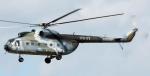
El Hip era, de hecho, una máquina excepcional, un ejemplo de la ingeniería soviética en su máxima expresión: robusta, fiable, fácil de mantener y operar, capaz y relativamente económica. Sería uno de los helicópteros más importantes jamás construidos.
El Mi-8T estaba fabricado principalmente con aluminio de avión, con un fuselaje similar a un autobús bajo un motor compuesto de turboejes gemelos Isotov TV2-117A con brazo de cola. Cada motor proporcionaba 1.120 kW (1.500 shp.) como máximo, pero el sistema de rotor no podía tolerar la potencia total de ambos motores, por lo que había un sistema limitador para restringir la potencia de salida del motor. Sin embargo, si un motor fallaba, el otro podía funcionar a plena potencia nominal. Las entradas del motor presentaban un sistema de descongelación que utilizaba aire caliente de purga del motor.
La producción posterior mejoró los motores TV2-117F con 1268 kW (1700 shp.) cada uno, para ser seguidos a su vez por los motores TV2-117AG con las mismas prestaciones pero menor costo y mayor confiabilidad, en parte gracias a los sellos de grafito.
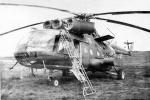
Las puertas de servicio del motor tenían bisagras hacia abajo y eran lo suficientemente resistentes como para usarse como plataformas de trabajo cuando estaban abiertas, una característica común en los helicópteros Mil. Había una escotilla de acceso en el techo de la bodega de carga para permitir que el personal de servicio subiera a la parte superior del helicóptero.
El sistema del rotor principal tenía cinco palas, mientras que el rotor de cola tenía tres e iba montado a la derecha. Todas las palas del rotor eran de metal y disponían de un sistema de deshielo electrotérmico. Se instaló un plano de cola delante del rotor de cola, y la mayoría (aunque no toda) la producción de Mi-8T tenía un carenado cuadrado debajo del brazo de cola con un sensor de velocidad Doppler. El brazo de cola se podía desmontar con relativa facilidad para su transporte o almacenamiento.
Se instaló un tren de aterrizaje triciclo, con el tren delantero giratorio de dos ruedas y el tren principal de una rueda, montado sobre trípodes amortiguadores. La dirección durante el rodaje se hacía mediante frenado diferencial. Las carenas de la rueda principal instaladas en los prototipos se eliminaron en las máquinas de producción. El almacenamiento de combustible estaba en depósitos de combustible externos, uno a cada lado del fuselaje por delante del tren de aterrizaje principal. Inicialmente, la capacidad de combustible era de 745 litros en un tanque en el lado izquierdo y 680 litros en el derecho, pero la producción tardía llevaba depósitos de 1.140 litros y 1030 litros respectivamente. El tanque externo del lado derecho tenía un carenado extendido en la parte delantera para acomodar un calentador de cabina. También había un depósito de reserva de 445 litros montado detrás de la caja de cambios principal, y se podían instalar temporalmente en la cabina depósitos gemelos con una capacidad de 915 litros.
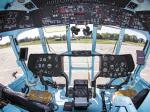
El piloto y el copiloto se sentaban uno al lado del otro, con un asiento plegable para el ingeniero de vuelo detrás de ellos. La cabina estaba separada de la bodega de carga por un mamparo con una puerta. Los tres paneles principales del parabrisas estaban hechos de vidrio, los otros eran de plexiglás y se descongelaban eléctricamente. Los paneles del piloto y el copiloto también tenían un limpiaparabrisas. Las ventanas laterales (deslizantes) de la cabina se abultaron para brindar a la tripulación una mejor vista hacia atrás y hacia abajo.
Había una puerta de entrada corrediza con escalones plegables detrás de la cabina a la izquierda, con capacidad para montar un montacargas de rescate sobre la puerta. La configuración estándar incluía 24 asientos junto a las paredes del compartimiento de carga para el transporte de tropas, aunque se podía cambiar a una configuración de evacuación médica con 12 camillas y un asiento reclinable para un asistente médico. Había ojos de buey circulares a lo largo de cada lado del fuselaje que podían inclinarse hacia adentro y hacia arriba para bloquearse en posición abierta, lo que permitía a las tropas disparar sus armas desde afustes instalados en los marcos de las ventanillas.
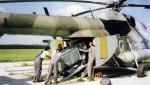
Se instalaron puertas abombadas en la parte trasera para la carga de mercancías, con una escotilla de escape en una puerta. Se colocaron rampas gemelas de enganche para permitir la entrada de vehículos. Se instaló una rampa integral en el desarrollo del prototipo, pero no siempre resultaba un beneficio: al cargar desde la parte trasera de un camión, era más fácil deshacerse de las rampas y simplemente retroceder el camión hasta la parte trasera del helicóptero.
La bodega de carga tenía una longitud de 5,34 m., un ancho de 2,3 m., y una altura de 1,82 m. Había amarres de carga en el piso y un cabrestante eléctrico en el techo con una capacidad de carga de 200 kg. La capacidad máxima de carga interna era de 4.000 kg. y podían transportarse vehículos livianos, piezas de artillería y similares. Se podrían instalar depósitos gemelos en la bodega. Debajo del helicóptero había un sistema de eslingas externas con una capacidad de 3.000 kg. para cargas voluminosas.
El Mi-8T fue diseñado desde el principio para transportar armamento, aunque estuvo disponible como tal hasta 1968. Podía equiparse con el sistema estabilizador de armas del Mi-4AV, con soportes de almacenamiento gemelos en cada estabilizador. Por lo general, llevaba un total de cuatro de lanzadores con 16 cohetes sin guía de 57 mm. apuntados por una mira instalada en la cabina. También podía llevar bombas de hasta 500 kg., aunque no parece haber sido habitual. La ventana inferior de la cabina delantera podría reemplazarse por un panel con un soporte giratorio para una ametralladora Kalashnikov PKT de 7,62 mm. La versión armada finalmente se denominó Mi-8TV, la «V» significaba voruzhonniy (armado), pero no era diferente de ningún otro Mi-8T, excepto por las armas. Cualquier Mi-8T podía equiparse fácilmente con la misma configuración de armamento. La OTAN continuó denominándolo Hip-C.
En 1974, la planta de Kazán decidió mejorar el Mi-8TV. El Mi-8TV-2, en su designación informal, seguía siendo un Mi-8TV. Presentaba un nuevo sistema de armamento con tres soportes en cada estabilizador capaces de transportar cargas más pesadas, generalmente cohetes de 57 mm. También se podían montar un total de cuatro cohetes anticarro 9M17P Falanga-P (AT-2 Swatter-C para la OTAN) en la parte superior de los estabilizadores, con enlace de radio para controlar los misiles y mira giroestabilizada para el copiloto.
Se mantuvo la ametralladora del morro. Los depósitos de combustible se llenaron con espuma de poliuretano para mejorar la capacidad de supervivencia en combate. Se construyó un Mi-8TVK similar para la exportación, que solo difería en la sustitución de los cuatro Falanga-P por seis misiles anticarro guiados por cable 9M914M Malyutka (AT-3 Sagger en clave OTAN). La OTAN le dio al Mi-8TV el nombre clave de Hip-E, y al modelo de exportación Hip-F. Parece que la práctica soviética era usarlos generalmente como cañoneras especiales, ya que cuando tenían una carga completa de municiones no podían transportar mucho más. Las variantes militares de producción tardía a veces se equiparon con lanzadores de bengalas, junto con una baliza de contramedidas infrarrojas (IRCM) en la parte posterior del rotor para proporcionar defensa contra misiles guiados por calor.
El Mil-8T se utilizó como base para variantes de mando en el campo de batalla, comenzando con el Mi-8VKP (o Mi-8VZPU). Todos fueron modificaciones de Mi-8T estándar. Presentaban una antena de comunicaciones de comando y control, más significativamente antenas gemelas en el extremo del fuselaje, así como equipos rectangulares instalados en los soportes externos. Recibió el nombre clave de la OTAN de Hip-D.
El Mi-8IV (o Mi-9) era un puesto de mando aerotransportado táctico especialmente diseñado, que utilizaba un fuselaje con ventanas de ojo de buey como el Mi-8T con la misma compuerta trasera del Mi-8P. No tenía los equipos externos, pero sus antenas bajo el fuselaje eran significativamente largas. Entró en producción a fines de la década de 1970 y recibió el nombre de informe de la OTAN de Hip-G.
También se fabricaron varios modelos de contramedidas electrónicas (ECM). Uno de los primeros fue el Mi-8MV, que llevaba el sistema ECM Smalt’a-V para bloquear los radares de defensa aérea en el campo de batalla. Fue una modificación relativamente discreta del Mi-8T. Se le dio el nombre NATO de Hip-J. Los Mi-8MV a menudo se actualizaban con equipos ECM mejorados con antenas ligeramente diferentes.
El Mi-8PP se desarrolló más o menos en paralelo. También fue diseñado para bloquear los radares de defensa aérea, pero también tenía función de inteligencia de señales (SIGINT). Presentaba un sistema ECM Pole (Campo) y tenía una apariencia mucho más desordenada que el Mi-8MV, con seis antenas en forma de X en dos filas. Dado que el equipo ECM generaba mucho calor, tenía seis intercambiadores de calor en carenados en fila debajo del fuselaje. El Mi-8PP recibió el clave en la OTAN de Hip-K.
Una versión mejorada, el Mi-8PPA, presentaba el equipo ECM Akatsiya (Acacia). Se parecía casi exactamente al Mi-8PP y la OTAN también se refirió a él como Hip-K.
Había una gama muy amplia de subvariantes militares del Mi-8 que solo se fabricaron en pequeñas cantidades. El Mi-8MB era un helicóptero de evacuación médica (medevac). Fue introducido a mediados de la década de 1970. El Mi-8R (o Mi-8GR) era una variante de reconocimiento, con grandes ventanas de observación traseras. Había otra variante de reconocimiento, el Mi-8TG (o Mi-8TARK) con un equipo diferente, apto para la detección de artillería.
Algunos Mi-8T se utilizaron en misiones de búsqueda y rescate (SAR) después de haber sido equipados con un montacargas. Estas máquinas generalmente se designaban como las versiones civiles de transporte. El Mi-8TL era un aparato apagafuegos cuyo equipo principal era un sistema de carga de agua con eslinga. Aparentemente, el Mi-8TL fue muy empleado.
También se construyeron helicópteros civiles especializados. La variante civil Mi-8P era muy similar a la militar, con el mismo rendimiento y límites de carga. La principal característica distintiva eran las ventanas rectangulares en lugar de los ojos de buey. También había salidas de emergencia a cada lado del fuselaje en la posición de la ventana más retrasada. Se mantuvieron las puertas de abombadas, aunque eran más pequeñas, con una puerta de pasajeros en ellas. El número normal de asientos era de 28, aunque también se adoptaron diseños de 26, 24 y 20 asientos. Los asientos se podían retirar para permitir el transporte de carga y también se podían transportar cargas en eslinga incluso con asientos.
El Mi-8P fue la base para las variantes de transporte VIP Mi-8PS y Mi-8S. La versión militar Mi-8T también se usó como aparato civil, aunque en muchos casos los aparatos de Aeroflot, la aerolínea estatal, tuvieron uso militar y no eran tan diferentes. de los militares. Todos tenían ventanas redondas.
La planta de Kazán construyó en total alrededor de 4.500 Hip de primera generación, con alrededor de 1.700 exportados, además de los alrededor de 3.700 construidos en la planta de Ulan-Ude Siberian, todos para el mercado soviético. Esa cantidad por sí sola convierte al Hip en un helicóptero exitoso, pero en realidad solo estaba comenzando su desarrollo.
Desde mediados de la década de 1960 se trabajó en una versión ampliada y mejorada del Mi-8, a la que se le asignó la designación provisional de Mi-8M. El proyecto se atascó y se canceló a principios de la década de 1970, pero sirvió como base para el Mi-8MT, el punto de partida de una serie Mi-8 de segunda generación menos ambiciosa, aquí denominada informalmente Mi-8 Serie II para distinguirlo de las máquinas Mi-8 Serie I de primera generación, aunque estas designaciones nunca se usaron.
La principal mejora en la Serie II fue la instalación de turboejes TV3-117MT más potentes desarrollados para el Mi-14 Haze de 1.420 kW (1.900 shp.) cada uno, junto con un sistema de transmisión del rotor mejorado para operar a mayor potencia. El rotor de cola se cambió del lado derecho del brazo de cola al izquierdo, lo que mejoró su eficacia. Se agregó una unidad de potencia auxiliar (APU) Ivchenko Al-9V, que se colocó en la parte trasera del carenado del motor e hizo que el carenado fuera notablemente más grande en la parte trasera, con un escape para la APU en el lado izquierdo. Se agregó una salida de emergencia en una ventana de la cabina en el lado derecho del fuselaje. Aunque el Mi-8-II se parecía mucho al Hip de primera generación, hubo muchos cambios de producción para reducir el peso y mejorar la durabilidad.
Al igual que con el Mi-8T original, el Mi-8MT podría equiparse con armamento. Originalmente, el armamento era el mismo que con el Mi-8TV, que consistía en una ametralladora PKT de 7,62 mm. en el morro y estabilizadores para el transporte de lanzacohetes y misiles guiados anticarro. Este modelo no tuvo una designación distinta.
Dado que la producción de los Mi-8 Serie I estaba bien establecida, hubo cierta resistencia en la burocracia para asumir la carga de cambiar la producción a una versión sustancialmente actualizada. Sin embargo, el rendimiento de la Serie I en condiciones calurosas y altas (clima cálido, gran altitud) era escaso y hubo mucha presión para fabricar una segunda generación del helicóptero.
El Mi-8MT entró en producción en la planta de Kazán en 1977. La nueva variante se exhibió en el Salón Aeronáutico de París en 1981, y la OTAN le asignó el nombre Hip-H. Las variantes de exportación recibieron la designación general de Mi-17. Los modelos Mi-8 Serie I permanecieron en producción en paralelo durante un tiempo, en parte porque la producción de motores TV3-117MT era limitada, en parte porque no era posible reemplazar todas las subvariantes especializadas de Mi-8-I en las líneas de fabricación de inmediato. Los Hip de la Serie I dejaron de fabricarse en 1986.
La experiencia en combate durante la guerra de Afganistán en la década de 1980 demostró que quedaba mucho por hacer para mejorar la capacidad de supervivencia del Hip. Dado que las condiciones de calor y altura eran normales en el país, las máquinas de la Serie I eran claramente inadecuadas, pero las máquinas de la Serie II también dejaban mucho que desear. Las mejoras necesarias se incorporaron a la producción. La escotilla en las puertas de carga se amplió para permitir el manejo de una ametralladora o para escapar en caso de emergencia. El polvo era una dificultad para los motores, por lo que se desarrollaron filtros en forma de tapas hemisféricas montadas sobre las entradas del motor.
La experiencia de combate sugirió que se necesitaba mejor armamento. Se instalaron dos o cuatro ametralladoras PKT, complementando la del morro, y algunos aparatos se equiparon con una ametralladora NSV-12,7 Utyos de 12,7 mm. (calibre 0,50) o 30 mm. También llevaban un lanzagranadas automático Plamya (Llama) en un soporte flexible en la puerta lateral y la escotilla trasera. Las lanzacohetes sin guía en los estabilizadores eran un armamento común, aunque los cohetes de 57 mm. fueron menos empleados que los de 80 mm. en lanzadores de 20 proyectiles. Las sistemas de armas también fueron muy usados, particularmente el sistema UPK-23-250 compuesto por dos cañones GSh-23L de 23 mm. y 250 proyectiles.
Aquel conflicto también demostró la necesidad de contramedidas contra los misiles antiaéreos portátiles que buscan calor como el Stinger estadounidense. Se instalaron filtros de escape para enmascarar el flujo de escape caliente con aire frío en máquinas construidas a partir de 1984. Los lanzadores de bengalas se colocaron inicialmente en la parte inferior del brazo de cola, para luego montarse en el fuselaje, y se montó un sistema de contramedidas infrarrojas (IRCM) detrás del mástil del rotor. Se agregó blindaje interno en la cabina y los asientos, junto con paneles que se podían adosar en la parte externa del morro. El blindaje aumentó el peso en 180 kg.
También se fabricó una amplia gama de subvariantes de la serie Mi-8-II. El Mi-19 fue una continuación del modelo de mando Mi-9, y también se construyó una gran cantidad de variantes ECM en pequeñas cantidades.
Se vendió para exportación una versión de pasajeros del Mi-8TV denominada M-17P. Estaba configurada como un Mi-8P pero tenía ventanas circulares. También hubo una serie de conversiones VIP. Otras subvariantes incluyeron modelos de evacuación médica y ambulancia, siendo la más destacada el Mi-8MTB, que llevaba blindaje y equipo quirúrgico. Se utilizó durante el conflicto en Afganistán. El Mi-8MTL, un apagafuegos similar al Mi-8TL que tuvo amplio uso.
A finales de la década de 1980, la serie Mi-8-II se equipó con turboejes TV3-117VM mejorados, tenían la misma potencia nominal que los anteriores TV3-117MT pero, en parte gracias a un sistema de control de motor electrohidráulico, podían mantener la potencia mucho mejor en condiciones calientes y altas. El desarrollo fue impulsado por la experiencia en Afganistán.
El modelo de referencia de la esta nueva serie fue el Mi-8MTV, «V» de vysotniy (gran altitud). Se vendió para exportación como Mi-17V. Otros modificaciones de serie fueron el blindaje adicional, depósitos rellenos de espuma para reducir el riesgo de explosión, modificación de algunos componentes y diseño para mejorar la capacidad de supervivencia, lanzadores de señuelos y bengalas modificados, y un afuste trasero con una ametralladora PKT. Hubo tres variaciones principales de producción. El Mi-8MTV-1 / Mi-17-1V, era una variante civil, carecía de blindaje y otros equipos de combate. El Mi-8MTV-2 / Mi-17-2V era una variante de transporte /o artillada, con equipo de combate completo y un radar de Kontur en el morro. Poseía mejor aviónica y un aumento de la capacidad de carga externa de 5 toneladas. Además podía llevar hasta 30 pasajeros. Junto con las armas de morro y cola, llevaba afustes para ocho ametralladoras ligeras. en las puertas y ventanas laterales. Finalmente, el Mi-8MTV-3 / Mi-17V-3 fue una ligera mejora del Mi-8. Eliminó el arma del morro y redujo los soportes externos de seis a cuatro, pero permitía llevar una mayor variedad de armamento.
Después del hundimiento de la Unión Soviética, las plantas de Kazán y Ulan-Ude continuaron construyendo y desarrollando la serie Mi-8, pero lo hicieron de manera más o menos independiente, convirtiéndose en competidores. La planta de Kazán se convirtió en la compañía Kazan Helicopters, mientras que Ulan-Ude se convirtió simplemente en la Ulan-Ude Aviation Plant (UUAP). Tanto Kazan como UUAP son ahora parte del grupo Russian Helicopters, y la compañía Kamov ha sido incluida en buena medida. Si bien los pedidos nacionales fueron lentos, todavía había un interés considerable en el mercado de exportación.
Kazan Helicopters desarrolló una serie de tercera generación para presentar el Mi-8MTV-5 en 1996. UUAP pasó a su propia tercera generación, comenzando con el Mi-8AMT. Las nuevas máquinas Mi-8-3G, por denominarlas de forma general, ofrecían una variedad de características. Las versiones utilitarias de Mi-8-3G podrían configurarse para el transporte de personal o de carga, incluidas las cargas con eslingas; otras configuraciones admitían funciones de evacuación médica, búsqueda y rescate y extinción de incendios. Los accesorios incluían depósitos de combustible adicionales, cortacables, un reflector, un cabrestante de rescate, etc. Las versiones de combate, a veces denominadas Sh, se ofrecían con blindaje, contramedidas defensivas, armas en las puertas y armamento ofensivo en soportes. El armamento ofensivo podría incluir armas y lanzacohetes sin guía apuntados por una mira en la cabina, o armas anticarro.
Kazan dio a sus máquinas de exportación la designación Mi-17, mientras que Ulan-Ude designó sus máquinas de exportación Mi-171. Las variantes actuales promovidas por Russian Helicopters incluyen el Mi-8MTV-5 / Mi-17V-5, una variante de transporte con motores TV-117VM y rampa de carga trasera, y el Mi-171A-2, también una variante similar con motores VK-2500 y palas de rotor compuestas.
En 2003 realizó su primer vuelo un Mi-38 modificado con dos turboejes Pratt & Whitney Canada (PWC) PW127TS. Las dificultades por problemas en el motor suspendieron el programa durante varios años, pero un segundo prototipo voló en 2010 y un tercero en 2013, obteniendo la certificación rusa a fines de 2015. Los aparatos de serie utilizan turboejes TVA-3000 de fabricación rusa de 1.840 kW. (2.465 hp.) cada uno.
El Mi-38 es externamente similar a otras variantes Mi-8/17 de último modelo con una rampa de carga trasera. Presenta muchos elementos compuestos en su fuselaje, así como un rotor de seis palas y una cabina acristalada. Una variante militar del Mi-38T, con características como aviónica militar, un sistema de combustible resistente a explosiones y depósitos de combustible auxiliares voló por primera vez en 2018. El Mi-38 se ha entregado en pequeñas cantidades hasta la fecha.
Se han construido más de 17.000 helicópteros de la serie Mi-8, lo que lo convierte en uno de los helicópteros más importantes jamás construidos, y las ventas siguen siendo sólidas. Dada la robustez del modelo, también existe un considerable comercio de aparatos usados. El hecho de que los Hip puramente civiles sean muy asequibles permite que se vendan a países con embargos internacionales de armas. No es sorprendente que, a veces, los modelos civiles se equipen rápidamente con un equipo de combate después de la entrega.
Actualmente se ofrecen actualizaciones a países usuarios de modelos anteriores del Mi-8. Kazan Helicopters desarrolló una actualización de combate nocturno para el Mi-MT, con una cabina compatible con gafas de visión nocturna (NVG), una torreta de visión nocturna y aviónica mejorada. Esa actualización en particular se desarrolló en respuesta a un requisito militar ruso. Las máquinas actualizadas fueron designadas Mi-8MTKO o Mi-17N para exportación, y entraron en combate en Chechenia.
Ucrania, en conflicto con Rusia, implementó su propio programa de actualización para los Mi-8/17 de segunda generación a través de la empresa Motor Sich, lo que dio lugar al modelo Mi-8MSB-V, con un fuselaje reforzado, motores TV3-117VM, aviónica actualizada y compatibilidad con armas de fabricación ucraniana. Gran parte de la flota de Ucrania se ha actualizado.
Las empresas aeroespaciales extranjeras, como Israel Aircraft Industries (IAI), SAGEM de Francia y BAE Systems del Reino Unido, han ofrecido de manera similar actualizaciones de Mi-8, aunque es difícil ver si hubo interesados, ya que Russian Helicopters desalienta las mejoras por parte de las empresas extranjeras.






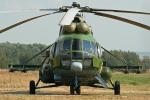



The experimental design bureau (OKB) under Mikhail Lyeontivich Mil was responsible for several early Soviet helicopters, including the piston-powered Mi-1 Hare and larger Mi-4 Hound, leading to the turboshaft-powered heavy-lift Mi-6 Hook. In 1957, the Mil OKB began to consider a successor to the medium-lift Mi-4, powered by twin turboshaft engines. At the time, there was for various reasons a bias against the development of new aircraft types, and so the new machine was sold as an upgrade of the Mi-4.
In February 1958, the Soviet Council of Ministers guardedly approved the plan. The ministers authorized development of a medium-lift helicopter, with the OKB designation of V-8, where «V» stood for vertolyot (helicopter), to be powered by a single Ivchenko Al-24V turboshaft engine, providing 1,420 kW (1,900 shp.). The Al-24V was a derated turboshaft version of the 1,790 kW (2,400 shp.) Al-24 turboprop then in development for the Antonov An-24 twin-engine transport aircraft.
Mil OKB engineers were not at all happy with the requirement to use a single engine since it compromised safety, and also did not like the fact that the Al-24V was a fuel hog. Mikhail Mil lobbied the authorities to approve parallel development of a twin-engine version, pointing out that the machine would be used as a VIP transport, and that it would be unwise to compromise the safety of Soviet leadership. The appeal to self-interest proved successful; after preliminary designs and a full-scale mockup were inspected, approval for the twin-engine V-8A was given in May 1960. There were the problems that no appropriate turboshaft engine actually existed to power the V-8A and that twin engines would require a new main gearbox to mesh their output power, but the Isotov engine OKB came on board to design a new turboshaft, the TV2, with a power rating of 930 kW (1,250 shp.), and also to implement the two-into-one gearbox.
The single-engine V-8 was the first to fly, performing its initial flight on 24 June 1961, with test pilot Boris V. Zemskov. This machine had the rotor system and other elements taken direct from the Mi-4. It was configured as a passenger liner, with 18 seats and rectangular windows, and also had mainwheel spats, which would not be featured in production machines.
The V-8 was displayed to the world on 9 July 1961 at the Moscow Tushino Airport airshow, with NATO assigning the type the reporting name Hip, to become Hip-A after other versions appeared. By the time the V-8 took to the air, whatever interest there had been in putting it into production had generally faded out, and it was simply used as a test rig, finally being grounded in 1963, to be later scrapped. Two other V-8 prototypes were built but they never flew, being used as ground-test airframes.
Initial full flight of the first prototype of the twin-engine V-8A was on 17 September 1961, with test pilot V.N. Loshkin at the controls. As it initially flew, it was very similar to the V-8 except for twin TV2 turboshafts. It was gradually fitted with new kit as it became available, particularly a five-bladed rotor leveraged from the Mi-4 four-bladed rotor, bringing the machine closer to production spec. When NATO became aware of the V-8A, it was assigned the reporting name Hip-B. This prototype served faithfully as a development platform until it crashed in January 1966, killing all three crew on board.
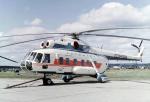
Two more initial V-8A series flight prototypes were built, including the V-8AT military assault transport prototype, and the V-8AP VIP transport. The V-8AT performed its initial flight in the summer of 1963; although it had a military configuration, it retained rectangular windows of the heli-liner configuration. It was temporarily modified the next spring, 1964, to a VIP transport configuration to act as a demonstrator for the V-8AP, which performed its own initial flight in the spring of 1964. It was later modified to a heli-liner configuration.
The trials went very well, with the V-8A prototypes demonstrating that they had twice the lift capability and 50% more speed than the Mi-4, and were much more economical to operate. The military version was ordered into production as the Mi-8T in the fall of 1964, with the heli-liner version authorized as the Mi-8P in the spring of 1965. Both were assigned the NATO reporting name of Hip-C. Initially, production was assigned to State Factory 387 in Kazan. Factory 387 was already building the Mi-4 and the first Mi-8s began rolling off the production line in late 1965. In 1970, with demand for the Mi-8 running high, State Factory 99 at Ulan-Ude in Siberia also would begin production of the type.
The Hip was in fact an outstanding machine, an example of Soviet engineering at its best: sturdy, reliable, easy to maintain and operate, capable, and relatively inexpensive. It would prove to be one of the most significant helicopters ever built.
The Mi-8T was built mostly of aircraft aluminum, with a bus-like body slung under an engine assembly consisting of twin Isotov TV2-117A turboshafts, trailed by a tail boom. Each engine provided 1,120 kW (1,500 shp.) max, but the rotor system couldn’t tolerate the full power of both engines, and so there was a limiter system to restrict engine output power; however, if one engine went down, the other could then operate at full rated power. The engine inlets featured a de-icing system using hot engine bleed air.
Later production had uprated TV2-117F engines with 1,268 kW (1,700 shp.) each, to be followed in turn by TV2-117AG engines with the same ratings but lower cost and greater reliability, partly thanks to graphite seals.
The engine service doors hinged down and were sturdy enough to be used as work platforms when open, a common gimmick among Mil helicopters. There was an access hatch in the roof of the cargo bay to allow service personnel to climb on top of the helicopter.
The main rotor system had five blades, while the tail rotor had three, with the tail rotor mounted to the right. All the rotor blades were made of metal and featured an electrothermal de-icing system. A tailplane was fitted forward of the tail rotor, and most (though not all) Mi-8T production had a boxy fairing underneath the tailboom for a Doppler speed sensor. The tailboom could be detached with relative ease for transport or storage.
Tricycle landing gear was fitted, with the castoring nose gear featuring two wheels and each main gear assembly featuring one wheel; the main gear was mounted on shock-absorbing tripod frames. Steering while taxiing was by differential braking. The mainwheel spats fitted to prototypes were deleted in production machines. Fuel storage was in external fuel tanks, one on each side of the fuselage forward of the main landing gear; initially, fuel capacity was 745 liters (196 US gallons) for the left-side tank and 680 liters (179 US gallons) for the right-side tank, but late production featured enlarged tanks with 1,140 liters (301 US gallons) and 1,030 liters (272 US gallons) respectively. The right-side external tank had an extended fairing on its nose to accommodate a cabin heater. There was also a reserve tank with a capacity of 445 liters (117 US gallons) mounted behind the main gearbox, and twin ferry tanks with a capacity of 915 liters (241 US gallons) could be temporarily fitted in the cabin.
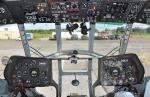
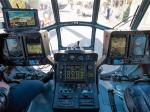
The pilot and copilot sat side-by-side in the nose, with a jump seat for a flight engineer behind them; the cockpit was separated from the cargo bay by a bulkhead with a door. The three main windshield panels were made of glass, the others were Perspex, and were electrically de-iced, with the pilot’s and copilot’s panels also featuring a windshield wiper. The (sliding) cockpit side windows were bulged to give the aircrew a better view back and down.
There was a sliding entry door with fold-down steps behind the cockpit on the left, with provision for mounting a rescue hoist above the door. The standard configuration included 24 seats alongside the cargo bay walls for troop transport, though this configuration could be changed to a medevac configuration with 12 stretchers and one tilt-down seat for a medical attendant. There were circular portholes along each side of the fuselage that could be tilted in and up to be locked in open position, allowing troops to fire their weapons from mounts fitted to the porthole frames.
Clamshell doors were fitted at the rear for freight loading, with an escape hatch in one door. Twin hook-on ramps were carried to allow vehicles to drive in; an integral ramp had been featured in prototype development, but the integral ramp wasn’t always a benefit: when loading from the back of a truck, it was easier to get rid of the ramps and just back the truck up to the rear of the helicopter.
The cargo bay had a length of 5.34 m. (17.6 ft.), a width of 2.3 m. (7.6 ft.), and a height of 1.82 m. (6 ft.). There were cargo tie-downs on the floor and an electric hoist system in the ceiling with load capacity of 200 kg. (440 lb.). Maximum internal cargo capacity was 4,000 kg. (8,800 lb.), with loads including light vehicles, artillery pieces, and the like. Twin ferry tanks could be installed in the cargo bay. There was an external sling system underneath the helicopter with a capacity of 3,000 kg. (6,600 lb.) for carrying loads too bulky to fit in the cargo bay.
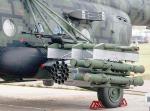
The Mi-8T was designed from the outset to carry armament, though the machine wasn’t actually available in armed form until 1968. It could be fitted with the weapons outrigger system from the Mi-4AV, with twin stores racks on each outrigger, typically carrying a total of four 16-round 57mm. unguided rocket pods, targeted by a sight fitted in the cockpit. Bombs of up to 500 kg. (1,100 lb.) each could also be carried, though bombs seem to have been an unusual store. The lower forward cockpit window could be replaced with a panel featuring a swivel mount for a 7.62mm. Kalashnikov PKT machine gun. The armed version was eventually referred to as the Mi-8TV, where the «V» stood for voruzhonniy (armed), but it wasn’t at all different from any other Mi-8T except for the weapons kit, and any Mi-8T could be easily equipped with the same armament configuration. NATO still gave it the Hip-C reporting name.
In 1974, the Kazan plant decided to up-arm the Mi-8TV. The Mi-8TV-2, an informal designation, the improved machine was still an Mi-8TV, featured a new armament system with three stores racks on each outrigger, capable of carrying heavier loads, generally a 32-round 57mm. rocket pod, providing a total of six pods and 192 rockets. A total of four 9M17P Falanga-P (NATO AT-2 Swatter-C) anti-tank rockets could be mounted on top of the outriggers as well, with the helicopter fitted with a radio link to control the missiles and the copilot directing them with a gyrostabilized sight.
The nose-mounted machine gun was retained. The fuel tanks were filled with polyurethane foam to improve combat survivability. A similar Mi-8TVK was built for export, differing only in replacing the four Falanga-Ps with six wire-guided 9M914M Malyutka (NATO AT-3 Sagger) antitank missiles. NATO gave the up-armed Mi-8TV the reporting name Hip-E, with the export model being labeled the Hip-F. It appears that Soviet practice was to use them generally as dedicated gunships, since when they had a full load of munitions they couldn’t carry much else. Late-production military Hip variants were sometimes fitted with chaff-flare dispensers, along with an infrared countermeasures (IRCM) beacon on the back behind the rotor system, to provide defense against heat-seeking missiles.
The Mil-8T was used as the basis for a set of tactical airborne command posts for battlefield operations, beginning with the Mi-8VKP (or Mi-8VZPU). All were refits of stock Mi-8Ts. They featured a nonstandard antenna fit to support command and control communications, most significantly twin outward-canted towel rack antennas above the end of the fuselage, as well as rectangular equipment boxes permanently fitted to the external stores outriggers. It received the NATO reporting name of Hip-D.
The Mi-8IV (or Mi-9) was a purpose-built tactical airborne command post, using an airframe that had porthole windows like the Mi-8T but the clamshell door arrangement of the Mi-8P heli-liners. It didn’t have the external equipment boxes, but it did have a nonstandard antenna arrangement, most significantly long strake antennas under the fuselage. It went into production in the late 1970s, and received the NATO reporting name of Hip-G.
There was also a series of electronic countermeasures (ECM) Hips, intended for the battlefield jamming mission. One of the first was the Mi-8MV, which carried the Smalt’a-V ECM system to jam battlefield air-defense radars. It was a relatively discreet modification of the Mi-8T. It was given the NATO reporting name of Hip-J. Mi-8MVs were often upgraded in service with improved ECM packages, to sport a slightly altered set of antennas.
The Mi-8PP was developed more or less in parallel. It also was designed to jam air-defense radars, but it had a signals intelligence (SIGINT) function as well. It featured a Pole (Field) ECM system and was much more cluttered in appearance than the Mi-8MV, with each side of the machine featuring a box on the middle fuselage and a rectangular array of six X-shaped antennas in a two-rows-of-three arrangement on the rear fuselage. Since the ECM gear generated a lot of heat, there were six heat exchangers in fairings in a row underneath the fuselage. The Mi-8PP was given the NATO reporting name of Hip-K.
An improved version, the Mi-8PPA, featured the improved Akatsiya (Acacia) ECM suite. It looked almost exactly like the Mi-8PP and was also referred to as the Hip-K by NATO.
There was a very wide range of military Mi-8 subvariants that were only made in small numbers. The Mi-8MB was a medical evacuation (medevac) helicopter, with some specialized kit for handling survivors of a nuclear attack. It was introduced in the mid-1970s. The Mi-8R (or Mi-8GR) was a battlefield reconnaissance variant, with large rear observation windows. There was another battlefield reconnaissance variant, the Mi-8TG (or Mi-8TARK) with a different equipment fit for artillery spotting.
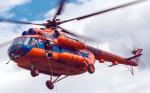
Some Mi-8Ts were used for the search and rescue (SAR) mission after being fitted with a heavy-duty door hoist. These machines were usually designated as the civil-type executive transport heli-liner versions of the Hip. The Mi-8TL was a fire-fighter, its primary kit being a sling-load bucket that it could fill with water from a lake and then dump on a fire. Apparently the Mi-8TL saw fairly extensive use.
As mentioned specific civil heli-liners and the like were built as well. The Mi-8P passenger helicopter variant was very similar to the military variant, with the same performance and load limits. The major distinguishing characteristic was rectangular windows instead of portholes; there were also emergency exits on each side of the fuselage at the rearmost window position. Clamshell doors were retained, though they were smaller, and there was a passenger door nested into them. Standard seating was 28 seats, though 26-, 24-, and 20-seat layouts were eventually adopted as well. The seats could be yanked to permit cargo carriage, and of course sling loads could be carried even if the seats were retained.
The Mi-8P was the basis for the Mi-8PS and Mi-8S VIP transport variants. The Mi-8T military version of the Hip was also used in the civil utility role, though this is doubly confusing because in many cases flying machines assigned to Aeroflot, the state airline, were actually used by the military, and were not all that different from military-spec machines. They all had round windows.
The Kazan plant built about 4,500 first-generation Hips in all, with about 1,700 exported, along with about 3,700 built at Ulan-Ude Siberian plant, all for Soviet use. That quantity alone would make the Hip significant, but the machine was really only beginning its design life.
From the mid-1960s there was work on an enlarged and improved version of the Mi-8, which was assigned the provisional designation of Mi-8M. The project bogged down and was canceled in the early 1970s, but it served as the basis for the Mi-8MT, the starting point of a less ambitious second-generation Mi-8 series, here informally referred to as Mi-8 Series II as compared to first generation Mi-8 Series I machines, though these designations were never actually used in service.
The major improvement in the Series II was the fit of more powerful TV3-117MT turboshafts developed for the heavier Mi-14 Haze and with 1,420 kW (1,900 shp.) each, along with an uprated rotor transmission system to handle the greater power. The tail rotor was switched from the right side of the tailboom to the left, which improved its effectiveness. An Ivchenko Al-9V auxiliary power unit (APU) was added, being placed at the rear of the engine fairing and making the fairing noticeably larger in the rear, with an exhaust for the APU on the left side. An emergency exit was added in a cabin window on the right side of the fuselage. Although the Mi-8-II otherwise looked much like the first generation Hip, there were many production changes to reduce weight and improve durability.
As with the original Mi-8T, the Mi-8MT could be equipped with armament. Originally the armament was the same as with the Mi-8TV, consisting of a 7.62mm. PKT machine gun in the nose and outriggers for carriage of rocket pods and anti-tank guided missiles. There was no distinct designation for an armed Mi-8MT.
Since production of Mi-8 Series I machines was well-established, there was some resistance in the bureaucracy to take on the burden of shifting production to a substantially updated version. However, the performance of the Series I under hot and high (hot weather, high ground altitude) conditions was marginal, and there was considerable pressure to move to the more powerful second generation.
The Mi-8MT went into production at the Kazan plant in 1977. The new variant was displayed at the Paris air show in 1981, with NATO assigning it the reporting name Hip-H. Export variants were given the general designation of Mi-17. Mi-8 Series I models remained in production in parallel for a time, partly because production of TV3-117MT engines was limited, partly because it wasn’t possible to replace all the specialized Mi-8-I subvariants on the manufacturing lines right away. Series I Hips were finally out of production by 1986.
Combat experience during the Soviet war in Afghanistan through the 1980s demonstrated that much needed to be done to improve the Hip’s survivability. Given that hot & high conditions were normal in the country the Series I machines were clearly inadequate, but the Series II machines also left something to be desired. Necessary improvements were rolled into production. The hatch in the clamshell cargo doors was enlarged to permit better handling of a machine gun, or for escape in an emergency. The dust tended to be hard on engines, so intake filters were developed, in the form of hemispherical caps mounted over the engine intakes.
Combat experience suggested that better armament was required. Two or four PKT machine guns, complementing the nose gun, were fitted and some Hips were fitted with a 12.7mm. (0.50-caliber) NSV-12.7 Utyos (Cliff) machine gun or 30mm. Plamya (Flame) automatic grenade launcher on a flexible mount in the side door and rear hatch. Unguided rocket pods were a common outrigger store, though the 57mm. rocket was less popular than the more potent 80mm. rocket, carried in 20-round pods. Gun pods were popular as well, particularly the UPK-23-250 with a two-barreled GSh-23L 23mm. cannon and 250 rounds of ammunition.
Experience in Afghanistan also demonstrated the need for countermeasures against heat-seeking man-portable anti-aircraft missiles like the US Stinger. Exhaust filters to mask the hot exhaust flow with cool air were fitted to machines built from 1984. Chaff-flare dispensers were initially scabbed onto the bottom of the tailboom, to be later mounted on the fuselage, and an infrared countermeasures (IRCM) was mounted behind the rotor mast. Internal cockpit and seat armor were added, along with armor panels were provided that could be scabbed on to the nose externally, with the total armor load amounting to 180 kg. (400 lb.).
There was, of course, a wide range of subvariants of the Mi-8-II series. The Mi-19 was a follow-on to the Mi-9 aerial battlefield command post, and a great number of ECM variants were also built in small numbers.
A passenger version of the Mi-8TV was sold for export as the M-17P. It was configured much like an Mi-8P but had circular windows. There were a number of VIP conversions as well. Other subvariants included a number of medevac and flying ambulance variants, the most prominent being the Mi-8MTB, Which featured armor and a surgical station. It saw use during the conflict in Afghanistan. The Mi-8MTL, a fire-bomber, was similar to the Mi-8TL, which was put into relatively widespread service.
In the later 1980s, the Mi-8-II series was fitted with improved TV3-117VM turboshafts, they had the same power rating as earlier TV3-117MT but, partly thanks to an electro-hydraulic engine control system, could maintain power much better under hot & high conditions. Development had been driven by experience in Afghanistan.
The baseline model of the revised Hip series was the Mi-8MTV, where «V» stood for vysotniy (high altitude); it was sold for export as the Mi-17V. Other fits to the variant were continuation of and improvement on fixes gradually added in response to combat in Afghanistan, produced as standard: additional armor, foam-filled fuel tanks to reduce explosion hazard, modification of some components and layout to improve survivability, more chaff-flare dispensers, exhausts modified to permit fit of exhaust filters, and the rear mount for a PKT machine gun. There were three main production variations. The Mi-8MTV-1 / Mi-17-1V, was a civil variant, lacking armor and other combat kit. The Mi-8MTV-2 / Mi-17-2V was a transport / gunship variant, with full combat kit and the Kontur nose radar. It had improved avionics and, given the increase in power, external sling load of 5 tonnes (11,000 lb.), passenger load increased from 24 to 30. Along with the nose and tail guns, there were mounts for up to eight light machine guns in the side doors and windows. Finally, the Mi-8MTV-3 / Mi-17V-3 was a slight upgrade of the Mi-8. It eliminated the nose gun and reduced the stores pylons from six to four, but it permitted a greater variety of external stores.
After the collapse of the Soviet Union, the Kazan and Ulan-Ude plants continued to build and develop the Mi-8 series, but they did it more or less independently, becoming competitors. The Kazan plant became the Kazan Helicopters company, while Ulan-Ude became very simply the Ulan-Ude Aviation Plant (UUAP). Both Kazan and UUAP are now part of the Russian Helicopters group, the Kamov organization having been thrown in for good measure. While domestic orders were slow, there was still considerable interest from the export market.
Kazan Helicopters developed a third generation series to introduce the Mi-8MTV-5 in 1996. UUAP went on to their own third generation, starting with the Mi-8AMT. The new Mi-8-3G machines, to make up a useful general designation, offered a variety of features. Utility versions of Mi-8-3G could be configured for personnel or cargo transport, including sling loads; other configurations supported medevac, search & rescue, and fire-fighting roles. Accessories included additional fuel tanks, cable cutters, a searchlight, a rescue winch, and so on. Combat versions, sometimes designated Sh, could have armor, defensive countermeasures, door guns, and offensive armament on pylons. Offensive armament could include gun and unguided rocket pods, aimed by a cockpit gunsight; or anti-armor weapons.
Kazan gave its export machines the Mi-17 designation, while Ulan-Ude designated its export machines Mi-171. Current variants promoted by Russian Helicopters include the Mi-8MTV-5 / Mi-17V-5, an utility variant with TV-117VM engines, and rear loading ramp, and the Mi-171A-2, also an utility variant with VK-2500 engines and composite rotor blades.
A redesigned Mi-38 has been introduced. A prototype with twin Pratt & Whitney Canada (PWC) PW127TS turboshafts was flown in 2003; difficulties over engine issues put the program on hold for several years, but a second prototype flew in 2010, and a third in 2013, with Russian certification following at the end of 2015. Production machines use Russian-built TVA-3000 turboshafts with 1,840 kW (2,465 hp.) each.
The Mi-38 was externally generally similar to other late-model Mi-8/17 variants, with a rear loading ramp. It featured extensive composite elements in its airframe, as well as a six-blade rotor and a glass cockpit. A military Mi-38T variant, with features such as military avionics, an explosion-resistant fuel system, and auxiliary fuel tanks, first flew in 2018. The Mi-38 has been delivered in small numbers to date.
Over 17,000 Mi-8 series helicopters have been built, making it one of the most important helicopters ever built, and sales are still going strong. Given the type’s sturdiness, there is also a considerable trade in used machines. The fact that purely civil Hips are available allows them to be sold over the table to countries under international arms embargoes. Not surprisingly, sometimes the civil machines are promptly fitted with combat kit after delivery.
Upgrades are on offer to countries that are users of older Mi-8s. Kazan Helicopters developed a night combat upgrade for the Mi-MT, with a night vision goggle (NVG) compatible cockpit, a night vision turret, and improved avionics. That particular update was developed in response to a Russian military requirement; updated machines were designated Mi-8MTKO or Mi-17N for export, and saw combat in Chechnya during the conflicts of the Soviet Succession.
Ukraine, at odds with Russia, implemented its own upgrade program for second-generation Mi-8/17 machines through the Motor Sich company, resulting in the Mi-8MSB-V, with a zero-lifed and reinforced airframe, TV3-117VM engines, updated avionics, and compatibility with Ukrainian-made weapons. Many of Ukraine’s fleet have been updated.
Foreign aerospace firms, such as Israel Aircraft Industries (IAI), SAGEM of France, and BAE Systems of the UK, have similarly offered Mi-8 upgrades, though it is difficult to see if there have were any takers, Russian Helicopters having done all they could to discourage upgrades by foreign firms.
FUENTES Y REFERENCIA – SOURCES & REFERENCE
airvectors.net
Ugolok Neba
©jmodels.net
 jmodels.net
Debe estar conectado para enviar un comentario.