
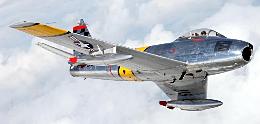
| DATOS TÉCNICOS (F-86F-40-NA) |
TECHNICAL DATA (F-86F-40-NA) |
| TIPO:Avión de caza. | TYPE:Fighter aircraft. |
| TRIPULANTES:1 | CREW:1 |
| ENVERGADURA:11,91 m. | SPAN:39.1 ft. |
| LONGITUD:11,30 m. | LENGTH:37.1 ft. |
| ALTURA:4,29 m. | HEIGHT:14.1 ft. |
| SUPERFICIE ALAR:28,12 m². | WING AREA:313.4 ft². |
| PESO EN VACÍO:5.046 kg. | EMPTY WEIGHT:11,125 lb. |
| MOTOR:Un turborreactor General Electric J47-GE-27 de 2.681 kgf. (26,3 kN) de empuje. | ENGINE:One General Electric J47-GE-27 turbojet engine, 5,910 lbf (26.3 kN) thrust. |
ARMAMENTO:
|
ARMAMENT:
|
| VELOCIDAD MÁX.:1.106 km/h. a nivel del mar. | MAX. SPEED:687 mph. at sea level. |
| TECHO:15.100 m. | CEILING:49,600 ft. |
| ALCANCE:2.454 km. | RANGE:1,525 ml. |
| PRIMER VUELO:1 de octubre de 1947. | FIRST FLIGHT:1 October 1947. |
| VERSIONES:34 | VERSIONS:34 |
| CONSTRUIDOS:9.860 | BUILT:9,860 |
En los últimos años de la Segunda Guerra Mundial, la propulsión a chorro era claramente el camino del futuro para los aviones de combate de alta velocidad. North American Aircraft (NAA) había logrado un gran éxito con su P-51 Mustang, uno de los mejores aviones de combate con motor de pistón de la guerra, y quería asumir el desafío de la propulsión a chorro. A fines de 1944, NAA comenzó un estudio de diseño con la designación RD 1265 para crear el primer avión de combate de la compañía, proponiendo el avión a la Marina de los EE.UU. El 1 de enero de 1945, la empresa recibió un contrato de la Armada de 100 cazas, a los que se les dio la designación de empresa Modelo NA-134 y la designación de la Armada FJ-1.
Mientras el Modelo NA-134 tomaba forma en 1945, North American investigaba simultáneamente un derivado más grande, el Modelo NA-140, para las Fuerzas Aéreas del Ejército de EE.UU. (USAAF, que se separaría del Ejército para convertirse en la USAF independiente en septiembre de 1947). Esto resultó en la adjudicación de un contrato en mayo de 1945 de tres prototipos con la designación de XP-86. Los requisitos de la USAAF eran exigentes, estipulando un alcance medio y una velocidad máxima de 965 km/h. El nuevo caza debía tener varias características avanzadas, como una cabina presurizada, controles reforzados hidráulicamente y una mira de radar para las seis ametralladoras Browning de 12,7 mm.
El diseño original del NA-140/XP-86 se parecía mucho al NA-134/XFJ-1. Tenía alas rectas, el mismo motor J35 y el mismo armamento de seis ametralladoras Browning. La principal diferencia era un fuselaje más largo y delgado, logrado mediante la eliminación de la estructura y el equipo necesarios para el funcionamiento en la cubierta de un portaaviones.
El diseño se representó en una maqueta parcial de madera a gran escala, mostrada en la planta de NAA Inglewood, California, el 20 de junio de 1945. No fue más allá, ya que en ese momento los ingenieros norteamericanos sabían que no había forma de que pudieran cumplir los requisitos de la USAAF. El ala recta no podía alcanzar la velocidad necesaria con los motores disponibles en ese momento.
Después del final de la guerra, el ingeniero de aviación George Schairer de Boeing Company fue a Alemania para examinar la investigación aeronáutica alemana. Lo acompañaron el conocido Theodore Von Karman de la California of Technology, y Robert Jones del Comité Asesor Nacional de Aeronáutica de EE.UU. (NACA, la principal organización precursora de la moderna Administración Nacional de Aeronáutica y del Espacio de EE.UU. / NASA). Schairer estaba extremadamente entusiasmado con los datos que encontró en el diseño de ala en flecha, y no solo propuso que Boeing los usara en su nuevo bombardero de largo alcance XB-47, sino que la información se proporcionara a otras empresas de aviación estadounidenses.
Larry Green de NAA estudió los materiales y llegó a la conclusión de que un ala en flecha era la respuesta para mejorar el rendimiento del XP-86; determinó que un listón unido al borde de ataque del ala y extendido automáticamente a bajas velocidades resolvería el problema de estabilidad a baja velocidad. Green y otros ingenieros de NAA convencieron al presidente de NAA, «Dutch» Kindelberger, de que el ala en flecha era el camino a seguir, y el 18 de agosto de 1945, Kindelberger aprobó más estudios sobre el concepto. En unas pocas semanas, los ingenieros de NAA estaban realizando pruebas en el túnel de viento en un modelo a escala 1/23 de un XP-86 con alas barridas a 35 grados. Los resultados fueron extremadamente prometedores. Después de más pruebas, la USAAF aprobó el desarrollo del XP-86 de ala en flecha el 1 de noviembre de 1945.
A medida que avanzaba el trabajo, se hicieron más cambios en el diseño. El ala se alargó y la cola, que originalmente debía permanecer recta, también se barrió hacia atrás 35 grados. Se instalaron tres frenos de velocidad operados hidráulicamente en la parte trasera del fuselaje, en sustitución de los alambrados montados en las alas. El fuselaje se partió justo detrás del ala, lo que permitió separar la aeronave para dar acceso al motor J35.
La relación del XP-86 con el FJ-1 Fury aún era evidente. El nuevo avión tenía una entrada de aire en el morro, con tres ametralladoras de 12,7 mm. a cada lado, una cubierta de burbuja de plexiglás alta que se deslizaba hacia atrás para abrirse. La USAAF estaba tan entusiasmada cuando vio el diseño que el 20 de diciembre de 1946 solicitó 33 P-86A de serie, aunque el prototipo no se había completado.
El primer prototipo XP-86 se terminó el 8 de agosto de 1947 y realizó su vuelo inicial el 1 de octubre de 1947. Estaba propulsado por un motor J35-C-3 construido por Chevrolet de 16,7 kN (1700 kgp. / 3750 lbf.) de empuje. El motor sólo era provisional, ya que los aviones de serie llevarían el GE TG-190 / J47 más potente, un derivado mejorado del J35.
El XP-86 se diferenciaba de la mayoría de los otros aviones en su tren de aterrizaje triciclo donde el tren delantero giraba hacia adelante, en lugar de hacia atrás. Esto se debía a un conflicto mecánico con el conducto de entrada. La rueda de morro no se plegaba como de costumbre porque el sistema hidráulico no era lo suficientemente fuerte para empujar la pata hacia adelante frente a la resistencia del aire. La hidráulica se reforzó rápidamente. Las siguientes pruebas transcurrieron sin problemas. La tasa de ascenso no fue satisfactoria, pero el equipo de diseño creía que el motor J47 más potente destinado a aviones de producción resolvería ese problema. Incluso con el motor J35, la velocidad del avión era impresionante, aproximadamente 150 km/h. más veloz que cualquier otro caza operativo de la USAF.
El piloto de pruebas Welch voló el primer prototipo a través de la barrera del sonido en una inmersión poco profunda el 19 de octubre de 1947, lo que lo convirtió en el primer avión no experimental en superar Mach 1. De hecho, aunque Chuck Yeager había cruzado con el X-1 la barrera del sonido el 14 de octubre de 1947, es muy posible que Welch superase Mach 1 antes que Yeager. Los instrumentos de vuelo del XP-86 no fueron capaces de determinar si la aeronave se movía más rápido de Mach 1, por lo que la velocidad supersónica tuvo que ser confirmada mediante mediciones en tierra.
La USAF se mantuvo muy interesada en el XP-86. El 16 de octubre de 1947, además de los 33 P-86A que ya estaban pedidos, ordenó 190 P-86 con tren de aterrizaje reforzado para operaciones en campo difíciles, que se designarían como P-86B. Sin embargo, el desarrollo de nuevos neumáticos de alta presión y las mejoras en el diseño del P-86A dieron como resultado un tren de aterrizaje que era perfectamente capaz de cumplir estos requisitos. El 17 de diciembre de 1947, se cambió el pedido para especificar 188 P-86A y dos ejemplares de una variante de penetración profunda drásticamente modificada, el P-86C. En realidad, nunca se construiría ninguna variante B.
La Fuerza Aérea comenzó sus propias pruebas de vuelo del XP-86 a principios de diciembre de 1947. Quedó completamente impresionada y comprobó que el avión era sustancialmente más rápido que el Republic F-84 Thunderjet de ala recta, que también estaba propulsado por el motor J35.
El segundo y tercer prototipo se entregaron para pruebas de vuelo a principios de 1948. El tercer prototipo difería del primero en muchos aspectos y estaba más cerca de las especificaciones de producción. Una de las mayores diferencias era que el prototipo número 3 estaba completamente armado, equipado con seis ametralladoras como se especificaba en el pedido original. Cada arma tenía una velocidad de 1.100 disparos por minuto con 267 proyectiles por arma.
Se instaló aviónica de serie, incluido un sistema de identificación amigo o enemigo (IFF), un sistema de brújula de radio y una mira de cálculo giroscópica Sperry Mark 18 con rango manual. Otra gran diferencia era que mientras que el prototipo número 1 tenía tres frenos de aire, uno a cada lado del fuselaje trasero y uno en la parte inferior, con bisagras en la parte trasera, el prototipo número 3 tenía dos frenos de aire, uno a cada lado del rediseñado fuselaje trasero con bisagras en la parte delantera.
El primer P-86A voló el 20 de mayo de 1948. Estaba propulsado por un motor General Electric J47-GE-1 con 21,6 kN (2200 kgp. / 4850 lbf.) de empuje. La USAF hizo un pedido de un tercer lote de 333 P-86A a finales de mes, lo que elevó el pedido total a 554. En junio de 1948, la USAF redefinió su sistema de designación de aeronaves, cambiando el prefijo «P» de «persecución». a «F» de «caza». El P-86A se convirtió en el F-86A.
Con el motor más potente, la velocidad máxima y el techo del nuevo caza aumentaron significativamente y la velocidad de ascenso casi se duplicó. El F-86A estaba equipado con un asiento de eyección T-4E-1, desechándode la cubierta manualmente antes de la eyección, además de una carga de autodestrucción para evitar que la aeronave cayera en manos enemigas.
También tenía un pilón de almacenamiento debajo de cada ala que podía llevar cada uno un tanque desechable de 782 litros o bien 450 kg. de bombas. La capacidad interna de combustible era de 1.650 litros. Se podrían instalar cuatro lanzacohetes debajo de cada ala con cuatro cohetes de 12,7 cm. de alta velocidad (HVAR) con un total de 16 cohetes. Desafortunadamente, sin los tanques desechables el radio de acción se redujo de unos 530 km. a 80 km. En efecto, el único armamento del F-86A eran sus ametralladoras, por lo que, en un principio, no era muy útil para el apoyo cercano.
El primer lote de producción de 33 aviones fue designado F-86A-1. El segundo lote de producción de 188 fue designado F-86A-5 y presentaba una serie de mejoras. Mientras que el F-86A-1 tenía un parabrisas delantero redondeado, el F-86A-5 tenía un parabrisas de vidrio blindado delantero plano, y la cubierta se desechaba con cargas pirotécnicas. Se introdujo un esquema mejorado de slats en los bordes de ataque y poseía una serie de cambios internos menores.
El tercer lote de 333 aviones también fue designado F-86A-5, pero presentaba mejoras adicionales. La más significativa era la sustitución de la mira giroscópica por la mira radar A-1B y su radar de alcance AN/APG-5. Aunque la mira del radar tenía algunos problemas de confiabilidad, cuando estaba funcionando podía fijarse con precisión en un objetivo a larga distancia. La observación óptica todavía tenía que usarse a bajas altitudes, ya que el radar no podía elegir un objetivo entre varios juntos en tierra.
Los F-86A-1 y los primeros F-86A-5 de serie en realidad tenían pequeñas puertas que sellaban las bocas de las ametralladoras. Las puertas se abrían automáticamente en una vigésima de segundo para disparar. Este dispositivo se abandonó en algún momento durante la producción del F-86A-5 para evitar problemas.
Hasta ese momento, la USAF no había demostrado públicamente las capacidades de su nuevo caza y pensó que era hora de mostrarlas. El 15 de septiembre de 1948, un F-86A estableció un récord mundial de velocidad en el aire de 1.080 km/h., 32 km/h. más rápido que el récord preexistente. Desafortunadamente, los problemas técnicos de otoño con el motor J47-GE-1 detuvieron la producción del F-86A hasta que General Electric logró controlar las dificultades a fines de diciembre de 1948 y comenzó a entregar el J47-GE-7 mejorado con 23.7 kN (2,420 kgp. / 5,340 lbf.) de empuje.
Los dos primeros F-86A operativos se entregaron a la USAF el 15 de febrero de 1949. Las tripulaciones organizaron rápidamente un concurso para darle un nombre a su nuevo avión, y el F-86 se convirtió en el Sabre, que los medios de comunicación tendían a presentar como Sabrejet. A fines de 1949, dos grupos de cazas habían sido equipados con el modelo y otro se estaba entrenando en él.
Mientras se entregaba el Sabre a los escuadrones de combate de la USAF, se agregaron nuevas mejoras. La producción tardía presentaba la mira de radar A-1CM mejorada, lo que resultó en la designación F-86A-6. Algunos aviones llevaban tanto la mira A-1CM como el radar AN / APG-30 de mayor alcance, y fueron designados F-86A-7. Se construyó un total de 554 F-86A de todos los subtipos.
También hubo actualizaciones sobre el terreno de los F-86A al motor J47-GE-13 de 24,2 kN (2470 kgp. / 5450 lbf.) de empuje. Estos aviones no recibieron nueva nomenclatura. Otro cambio fue mover el tubo pitot, usado para medir la velocidad del aire, desde la toma de aire hasta la punta del ala derecha. La colocación del tubo Pitot en la entrada de aire había dado lugar a lecturas erróneas debido al flujo de aire adicional de la toma.
El 25 de junio de 1950 Corea del Norte cruzó el paralelo 38 e invadió Corea del Sur en una ofensiva terrestre masiva, lo que hizo retroceder a las fuerzas surcoreanas y estadounidenses en medio de la confusión. Aunque los norcoreanos eran poderosos en tierra, sus activos aéreos eran débiles y anticuados, y consistían en aviones de hélice soviéticos como el caza Yak-9 y el avión de ataque a tierra Il-10 Shturmovik. La USAF tenía pocos aviones en el lugar para resistir la ofensiva, pero los F-82 Twin Mustang norteamericanos de largo alcance pudieron llegar a la zona de guerra desde bases en Japón y proporcionar cobertura aérea durante largos períodos de tiempo. Los cazas Lockheed F-80 Shooting Star también pudieron llegar al espacio aéreo coreano, pero su autonomía era muy corta.
A principios de julio, los F-51D Mustang norteamericanos realizaban misiones de apoyo cercano desde aeródromos avanzados en Corea para frenar la ofensiva de Corea del Norte. La Marina de los EE.UU. realizaba misiones de apoyo cercano basadas en portaaviones en la retaguardia enemiga, y las fuerzas británicas y de la ONU también contribuyeron con aviones. En agosto, la Fuerza Aérea de los Estados Unidos golpeó con fuerza las áreas de retaguardia enemigas con bombarderos B-26 Invader y B-29 Superfortress en un intento de aliviar la presión sobre las fuerzas estadounidenses y surcoreanas encajonadas alrededor de la ciudad de Pusan, en el suroeste de Corea.
Después de los desembarcos de Inchon el 15 de septiembre de 1950, la consiguiente ofensiva terrestre china fue seguida de la aparición de una nueva amenaza en el aire: el MiG-15 de ala en flecha de fabricación soviética, que era mucho mejor que cualquier avión que la ONU tuviera en Corea. El MiG-15 era un interceptor fuertemente armado que se había desarrollado al mismo tiempo que el Sabre y había volado por primera vez solo 13 semanas después del vuelo inicial del XP-86.
Los primeros encuentros entre MiG y aviones de la ONU ocurrieron a principios de noviembre. Por el momento, los pilotos de la ONU pudieron hacer frente a los MiG. La ONU desconocía que en su mayoría eran pilotados por pilotos soviéticos en ese momento. Muchos de estos pilotos tenían relativamente poca experiencia en comparación con sus adversarios de la ONU, quienes a menudo pudieron escapar o incluso cambiar las tornas. Sin embargo, los soviéticos estaban obligados a aprender, y la buena suerte de los pilotos de la ONU no podía durar indefinidamente. El MiG-15 superaba a los principales aviones de combate de la USAF en Corea, el F-80 y el Republic F-84 Thunderjet, y la USAF necesitaba que el F-86 entrara en combate de inmediato.
El 10 de diciembre de 1950 el portaaviones de escolta USS Cape Esperance llegó a la bahía de Tokio con una carga de F-86A de la 4ª Ala de Cazas de la USAF. Desafortunadamente, debido a la prisa con la que los Sabres fueron enviados al otro lado del océano, no habían sido acondicionados adecuadamente para el viaje, y la mayoría necesitaba reparaciones por daños por corrosión. Siete estaban en condiciones lo suficientemente buenas para una acción inmediata y cuatro entraron en combate desde un aeródromo coreano avanzado el 17 de diciembre. En esa misión, uno de los pilotos, el teniente coronel Bruce Hinton, derribó el primer MiG-15 víctima del Sabre.
Sobre el papel, el F-86A y el MiG-15 estaban bien emparejados. El Sabre tenía poca potencia y el MiG-15 podía superarlo. El avión soviético también estaba más fuertemente armado, con dos cañones de 23 mm. y uno de 37 mm. El cañón del MiG tenía una cadencia de tiro relativamente baja, pero solo se necesitaban unos pocos disparos para derribar a un Sabre, mientras que las seis ametralladoras de 12,7 mm. del F-86 carecían de poder de impacto.
En el lado positivo, el F-86 estaba bien diseñado, giraba y hacía toneles mejor que el MiG, aunque de ninguna manera podía volar alrededor de él. La mira de radar del F-86 era muy superior a la mira ocular del MiG, los soviéticos copiarían un ejemplar capturado del radar, y si las armas del Sabre eran de un calibre relativamente pequeño, eran precisas, estaban bien enfocadas y tenían una alta tasa de fuego. Los pilotos de Sabre también tenían un excelente campo de visión, sentados en lo alto de una prominente cubierta de burbujas, mientras que los pilotos de MiG se sentaban más profundo en sus máquinas. Esto les daba la ventaja de una mayor protección en el combate aéreo, pero a costa de un campo de visión más pobre, agravado por el hecho de que partes de la cubierta eran propensas a empañarse.
Los sabre se desempeñaban mejor en altitudes bajas, los MiG en altura. Por esta razón, los combates tendían a ser breves, ya que los adversarios buscaban rápidamente el terreno donde tenían más ventaja. El Sabre había sido diseñado principalmente para la función de superioridad aérea, mientras que el MiG-15 había sido diseñado como destructor de bombarderos de gran altitud. Cada uno se adaptaba muy bien a la misión para la que había sido diseñado específicamente.
El estrecho equilibrio entre el F-86 y el MiG-15 significaba que el factor crítico en la batalla aérea era el entrenamiento y la habilidad del piloto. Si bien había muchos pilotos soviéticos hábiles, los soviéticos se vieron obstaculizados por la decisión de rotar unidades enteras en combate, lo que significaba que cada nueva unidad tenía que aprender de cero. Los estadounidenses en general tenían experiencia y rotaron a los pilotos con la ayuda de aquellos ya veteranos en combate. Los pilotos chinos y norcoreanos no fueron rival para los estadounidenses. Tenían poca experiencia de vuelo y los pilotos soviéticos que trabajaron con ellos creían que muchos de sus homólogos asiáticos sufrían de desnutrición.
Los encuentros entre el Sabre y el MiG fueron raros al principio. La ofensiva terrestre china parecía imparable y, en enero de 1951, las fuerzas desorganizadas de la ONU habían retrocedido al sur del paralelo 38. Entonces, la resistencia de la ONU comenzó a endurecerse, mientras los ataques aéreos golpeaban las unidades de combate chinas y sus rutas de suministro. Los MiG finalmente comenzaron a salir en tromba para atacar los aviones de la ONU, y el combate aéreo comenzó en serio.
El avance de Corea del Norte hacia el sur obligó a los Sabre a retirarse a Japón en enero de 1951 cuando sus bases aéreas coreanas fueron invadidas. La reversión abrupta de la guerra en marzo permitió que los F-86 regresaran y reanudaran la batalla. Los éxitos del Sabre contra el MiG-15 fueron tan impresionantes que los chinos abandonaron efectivamente las operaciones aéreas serias en diciembre de 1951 para reagruparse.
Los chinos regresaron en mayo de 1952, con tácticas mejoradas. Estados Unidos reaccionó ofreciendo una recompensa de 100,000 dólares a cualquier piloto enemigo que desertara con un MiG. La iniciativa recibió el nombre en código de Operación Moolah, «moolah» es una oscura jerga estadounidense antigua que significaba «mucho dinero». La oferta fue publicitada mediante el lanzamiento de folletos en los aeródromos. Este esfuerzo finalmente sería recompensado el 21 de septiembre de 1953, cuando el teniente norcoreano No Kum-Suk voló su MiG-15 hacia el sur y lo aterrizó en una pista de aterrizaje estadounidense, lo que permitió a los EE.UU. realizar una investigación detallada de la aeronave.
Mientras el Sabre estaba involucrado en un intenso combate en el Pacífico, el diseño se estaba actualizando en los Estados Unidos. El trabajo de diseño del NA-157 o XP-86C se inició a fines de 1947, en respuesta a un requisito de la USAF para un caza de penetración profunda. El XF-86C como fue designado en 1948, ganó la competición contra el Lockheed XF-90 y el McDonnell XF-88 (que eventualmente se convertiría en el F-101 Voodoo), y la Fuerza Aérea solicitó dos prototipos.
El XF-86C tenía un fuselaje más grande y largo que el F-86A. El tamaño aumentado acomodaba 5.909 litros de combustible interno para cumplir con los requisitos, mientras que la longitud aumentada permitía la instalación de un motor Pratt & Whitney J48-P-6. El J48 era una versión mejorada de postcombustión del turborreactor de flujo centrífugo Rolls-Royce Nene, fabricado en Gran Bretaña como Tay, que proporcionaba 27,8 kN (2835 kgp. / 6250 lbf.) de empuje en seco y 35,6 kN (3625 kgp. / 8000 lbf).) de empuje con postcombustión. El escape del J48 tenía una salida de tamaño variable de dos piezas.
El fuselaje se diseñó utilizando el nuevo concepto de «regla de área» desarrollado por los ingenieros de NACA, que especificaba que los cambios en el área de la sección transversal de una aeronave deben minimizarse para garantizar un flujo de aire uniforme a altas velocidades; esto significaba que el fuselaje estaba «estrechado» ligeramente a lo largo de las raíces del ala. El resultado era una máquina poco elegante en comparación con el F-86A, con un cuerpo de marsopa y apariencia gorda. De hecho, el avión era tan claramente diferente que la USAF lo designó como YF-93A en 1948.
La entrada del morro se reemplazó con tomas de aire a los lados, dejando el morro disponible para el radar SCR-720. El nuevo avión estaba armado con seis cañones de 20 mm. con 225 disparos por cañón. El mayor peso del YF-93A requería un tren de aterrizaje reforzado, con ruedas dobles en el tren principal. Los frenos de aire gemelos del Sabre fueron reemplazados por un solo freno de aire grande debajo del fuselaje.
El YF-93A tenía un excelente rendimiento y alcance, y podía equiparse con pilones de almacenamiento para tanques externos para mejorar su autonomía o para transportar hasta 900 kg. de bombas, cohetes u otras provisiones. La Fuerza Aérea ordenó 118 F-93A de serie en 1948.
El primer prototipo YF-93A realizó su vuelo inicial en enero de 1950. Solo se construyeron dos, ninguno de los cuales estaba armado. El contrato había sido cancelado un año antes, ya que el nuevo bombardero Boeing B-47 de la USAF era tan rápido que en realidad no necesitaba escolta de cazas, y el dinero era escaso de todos modos. El reabastecimiento de combustible en el aire pronto eliminaría por completo el concepto de «caza de penetración». Los dos prototipos YF-93A se terminaron como pruebas empleados por NAA, la USAF y el NACA, y finalmente se desecharon.
Mientras la Fuerza Aérea estaba dotando a los grupos de caza con el F-86A, se estaba trabajando en una variante interceptora del F-86. El desarrollo del gran interceptor Northrop F-89 Scorpion en el que la USAF depositaba sus esperanzas se había retrasado, y la USAF estaba desesperada por conseguir un avión para defender a Norteamérica de los bombarderos soviéticos. Decidió obtener un derivado del Lockheed T-33, para convertirlo en el F-94 Starfire, y un derivado del Sabre como soluciones provisionales.
El desarrollo de la primera variante del interceptor Sabre, originalmente designada F-95A, se inició a principios de 1949, con el lanzamiento del primero de dos prototipos, sin armamento ni aviónica de combate, en noviembre de 1949, y el primer vuelo tuvo lugar el 22 de diciembre de 1949.
El segundo prototipo voló por primera vez en septiembre de 1950 equipado con un sistema de control de incendios (FCS) Hughes E-3. En ese momento, el avión tenía un nuevo nombre. El F-95A fue un rediseño casi completo del F-86 original, con solo un 25% de similitud. Sin embargo, el Congreso de los Estados Unidos no deseaba gastar fondos en nuevos aviones en ese momento. Sin embargo, una modificación de un avión existente no era un problema, por lo que el avión fue denominado F-86D en el verano de 1950 para asegurar la financiación.
Los prototipos fueron denominados YF-86D. El primer F-86D-1 de producción salió de la línea de ensamblaje de Inglewood en marzo de 1951, e hizo el primer vuelo en junio. Se fabricaron 37. A esto le siguió el F-86D-5, que presentaba el definitivo Hughes E-4 FCS, con un radar de mucho más largo alcance que el E-3. El primero voló en julio de 1952, aunque el nuevo FCS resultó poco fiable y la entrega operativa de esta variante se retrasó. NAA construyó un total de 26 F-86D-5.
El F-86D solo tenía un parecido general con el F-86A, siendo la diferencia más notable el radomo de punta grande del F-86D y la entrada de aire modificada para acomodar el radomo. Por supuesto, este arreglo requirió un rediseño completo del fuselaje delantero del Sabre. Aunque el prototipo del F-86D tenía la cubierta deslizante del F-86A estándar, los F-86D de producción tenían una cubierta en forma de concha y un parabrisas plano de vidrio blindado. El F-86D también tenía un plano de cola móvil sin elevadores.
El F-86D estaba equipado con el turborreactor de postcombustión J47-GE-17, con 22,3 kN (2270 kgp. / 5000 lbf.) de empuje en seco y 29,6 kN (3015 kgp. / 6650 lbf.) de empuje de postcombustión, además de un sistema electrónico de control de combustible. Los prototipos habían sido equipados con motores J47-GE-17 en desarrollo, con aproximadamente un 10% menos de empuje. El fuselaje trasero se ensanchó y alargó para acomodar el nuevo motor, con algunos cambios en el diseño entre el prototipo y el avión de producción.
El J47-GE-17 le dio al F-86D un rendimiento impresionante para la época. A finales de 1952, un F-86D estableció un récord mundial de velocidad de 1.124,6 km/h., y en julio de 1953, otro F-86D estableció un nuevo récord de 1.152,3 km/h. El F-86D no tenía armas. Su armamento consistía en 24 cohetes no guiados con cola desplegable de 70 mm. (FFAR) almacenados en una bandeja inferior que se podía bajar en medio segundo. Los cohetes podrían dispararse en salvas de 6, 12 o 24 contra formaciones de bombarderos intrusos. Cada cohete tenía un alcance de más de 4 km. y una ojiva de 3,4 kg.
Según los estándares de la época, el F-86D era una maravilla electrónica. La mayoría de los aviones equipados con radar eran biplazas, con un piloto y un operador de radar. El F-86D era un avión monoplaza. Aunque los primeros conceptos para la aeronave habían imaginado una máquina de dos asientos, esto suponía reducciones en el rendimiento y el alcance, y los nuevos desarrollos en la electrónica alentaron a la NAA y a la Fuerza Aérea a pensar que la tecnología avanzada podría reemplazar al asiento trasero para guiar el avión al objetivo.
En funcionamiento, el piloto sería dirigido a la vecindad de un objetivo por un operador de intercepción de control terrestre (GCI). A una distancia de unos 50 km., el piloto adquiriría el objetivo con el radar AN/APG-7 de la aeronave. El sistema de control de fuego E-4, que integraba el radar con un sistema informático analógico electrónico AN/APA-84, proporcionaría un curso para interceptar el objetivo. En el momento apropiado, el E-4 indicaría que los cohetes debían dispararse cuando los dos caminos se cruzaran. El E-4 también proporcionaría una advertencia si hubiera peligro de colisión. El F-86D tenía una mira manual de cálculo como refuerzo.
El pequeño lote de F-86D-5 fue seguido por otro de 36 F-86D-10, con un timón de accionamiento eléctrico sin aleta de compensación. Las variantes anteriores de Sabre habían usado un timón accionado manualmente con una pestaña de compensación. Esto condujo a su vez a una larga secuencia de otras subvariantes con cambios generalmente menores.
El F-86D era conocido como Sabre Dog o Dogship. Parece que estos dos nombres no eran del todo cariñosos, y el segundo sin duda era un apodo más crudo cuando las cosas no iban bien. La tecnología avanzada utilizada en el interceptor provocó problemas iniciales.
Los problemas continuaron afectando al F-86D después de su entrega. Una serie de 13 incendios y explosiones los dejó en tierra a fines de 1953, hasta que se implementaron cambios en el sistema electrónico de control de combustible. Luego, a principios de 1954, ocurrió otra racha de 19 accidentes y los Sabre Dog fueron almacenados nuevamente. La respuesta fue el denominado Project Pullout, en el que la Fuerza Aérea, en colaboración con North American, implementó un conjunto integral de arreglos para los más de 1000 F-86D en servicio, llevándolos al estándar F-86D-45. El reacondicionamiento tomó 18 meses y costó 100 millones de dólares. Después de la actualización, los Sabre Dog demostraron ser mucho más satisfactorios en servicio. Fueron desplegados en grandes cantidades en los EE.UU., Europa y el Lejano Oriente.
El XF-86C / XF-93 supuso una desviación importante del F-86A y un callejón sin salida. Sin embargo, NAA también desarrolló una mejora más evolutiva del F-86A, en forma de F-86E. El F-86E era difícil de distinguir del F-86A, pero presentaba controles de vuelo mejorados, un motor J47-GE-13 mejorado de 24,2 kN (2470 kgp. / 5450 lbf.) de empuje. En el F-86A, el plano de cola estaba fijo, pero con la cola totalmente movible, se podía girar todo el empenaje.
El primer F-86E voló el 23 de septiembre de 1950. El primer lote de producción de 60 F-86E-1 comenzó a llegar a los grupos de caza a principios de 1951, reemplazando a los F-86A en combate a partir de la primavera. El siguiente lote fue de 51 F-86E-5, que eran idénticos excepto en algunos cambios en los interruptores.
El tercer lote de 60 F-86E-6 fue construido por Canadair de Canadá. Canadair había firmado un acuerdo de licencia con NAA para construir el Sabre, y la USAF aprovechó el acuerdo para utilizar Canadair como segundo proveedor. El F-86E-6, o F-86E-6-CAN como se le llamaba a veces, era esencialmente un Canadair Sabre Mark 2.
El primer F-86F-1 dotado con el motor J47-GE-27 voló en marzo de 1952. El nuevo motor, de kN 27,1 kN (2760 kgp. / 6090 lbf.), proporcionaba un empuje significativamente mejor en el rendimiento, particularmente en términos de velocidad de ascenso. Se construyeron 78, con entregas a las unidades a partir de junio de 1952.
El F-86F-1 fue seguido por 16 F-86F-5, que presentaban un punto de anclaje más fuerte en cada ala para permitir que el caza llevara depósitos desechables de 758 litros. El siguiente lote de producción consistió en 34 F-86F-10 con la nueva mira A-4. El F-86F-15 tenía un nuevo sistema hidráulico. Este modelo fue el último de los 404 F-86E, incluido el prototipo.
La demanda de F-86F era tan grande que NAA no podía mantenerse al día con la producción en la planta de Inglewood, California, por lo que la compañía arrendó una fábrica de Curtiss en Columbus, Ohio. La planta de NAA Columbus comenzó la producción de Sabre con 100 F-86F-20. El primero voló en marzo de 1952. El F-86F-20 era casi idéntico a los F-86F-15 de Inglewood, difiriendo solo en cambios menores en el ajuste de la radio. La USAF le dio a los Sabres de Inglewood el sufijo NA y a los de Columbus el sufijo NH, por ejemplo, F-86F-15-NA frente a F-86F-20-NH.
La siguiente mejora en el F-86F fue convertirlo en un mejor cazabombardero al agregar un juego adicional de pilones de almacenamiento, uno en el punto medio de cada ala, para un total de cuatro. Este ala de doble almacenamiento permitió al Sabre llevar dos tanques y dos bombas de 450 kg. 859 de esta subvariante fueron construidos por Inglewood con la designación de F-86F-30-NA, mientras que 600 fueron construidos por Columbus como F-86F-25-NH. El primero se terminó en octubre de 1952. Fueron trasladados con urgencia a Corea para reemplazar a los F-51 Mustang y Lockheed F-80 Shooting Star en unidades de apoyo cercano.
Sin embargo, North American solo había comenzado a jugar con el ala. Los estudios aerodinámicos habían demostrado que eliminar el listón del borde de ataque y proporcionar un borde de ataque más afilado en el ala proporcionaba beneficios sustanciales en vuelos de alta velocidad, aunque esto conducía a características de aterrizaje más difíciles de controlar. Para compensar los aterrizajes, el ala se extendió 15 cm. en la raíz y 7,6 cm. en la punta. El nuevo ala, que también presentaba depósitos de combustible que aumentaban la capacidad en 264 litros, se conocía como ala sólida 6-3. El ala se incorporó a la producción del F-86F-25/30 y se envió a Corea en forma de kit para actualizar la mayoría de los F-86F y algunos F-86E en servicio.
Una vez que la USAF puso el nuevo y mejor F-86F en los cielos de Corea, decidió demostrar la superioridad del Sabre de una vez por todas. En el verano de 1953, la USAF consiguió el dominio con derribos masivos que demostró de una vez por todas quién era el jefe. La USAF estimó el recuento final de toda la guerra en 800 MiG derribados por Sabres, frente a 80 Sabres derribados por MiG, una proporción de bajas de 10 a 1. Otros 30 Sabres se perdieron en combate y 114 más se perdieron en accidentes. Incluso suponiendo que las pérdidas de MiG fueran exageradas por un factor de dos, el Sabre seguía siendo claro ganador. Si bien la guerra en tierra terminó en un punto muerto, la USAF tenía motivos para sentirse complacida consigo misma en el aire.
Aunque los refinamientos de la aeronave ayudaron, fue el entrenamiento de los pilotos lo que le dio a los estadounidenses la ventaja. De los 40 ases estadounidenses en Corea, 39 volaron el F-86. Muchos de ellos tenían una amplia experiencia en la Segunda Guerra Mundial, y contabilizaron más de 300 de los 800 MiG-15 destruidos. Los mayores ases de la guerra fueron el capitán Joseph D. McConnell JR, con 16 derribos; el mayor James Jabara, con 15 derribos; y el Capitán Manuel «Pete» Fernández con 14 derribos. De hecho, Jabara había sido el primer as del jet y estaba compitiendo con McConnell, pero el entusiasmo de Jabara se apoderó de él y su muerte número 16 resultó ser un Sabre.
Incluso cuando la guerra en Corea se atascó hasta su final inconcluso, North American estaba trabajando en nuevas subvariantes del F-86F. El F-86F-35-NA era similar al F-86F-25, pero incorporaba un Sistema de Bombardeo a Baja Altitud (LABS) que podía llevar una bomba atómica Mark 12. Se construyeron 264 F-86F-35, que iniciaron este función en enero de 1954. Se desplegaron en las bases de la OTAN para ayudar a detener la amenaza soviética a Europa.
La subvariante de producción final del F-86F fue el F-86F-40, que estaba destinado a Japón. Con la Unión Soviética, China y Corea del Norte en el Lejano Oriente, Estados Unidos finalmente decidió permitir que Japón se rearmara. A la Fuerza Aérea de Autodefensa Japonesa (JASDF) se le dio la más alta prioridad para fortalecerse y decidió adoptar el F-86F como su caza de primera línea. En julio de 1954, North American llegó a un acuerdo con Mitsubishi Heavy Industries de Japón para coproducir una nueva versión del F-86F, el F-86F-40.
El F-86F-40 era similar a un F-86F-25/30, pero incorporaba un alargamiento de 30 cm. En las puntas del ala 6-3, con slats en los bordes de ataque. El primer F-86F-40 salió de la planta de Inglewood en octubre de 1955. El rendimiento coincidía con el del F-86-25/30, pero el F-86-40 tenía características de aterrizaje más suaves. El lote inicial de equipos ya se envió a Japón en agosto, y el primer JASDF F-86F-40 se terminó un año después. Mitsubishi ensamblaría un total de 300 F-86F-40, el último producido en 1961.
Mientras tanto, la USAF necesitaba desesperadamente nuevos cazas y también decidió comprar F-86F-40, con un total de 280 construidos por NAA, y además ordenó una gran cantidad de alas F-40 para adaptarlos a los F-86F más antiguos. Estas alas también se suministraron a muchos aliados de EE.UU. que operaban el Sabre. El F-86F-40 fue la variante de producción final de un total de 2538 F-86F construidos, sin contar algunas variantes inusuales.
Tras la solicitud de la USAF de un entrenador de alto rendimiento para reemplazar el Lockheed T-33 Shooting Star, en 1953 se retiró un F-86F de la línea de producción para convertirlo en un prototipo de entrenador operativo TF-86F biplaza. El vuelo inicial tuvo lugar el 14 de diciembre de 1953. El TF-86F presentaba un fuselaje de 1,6 cm. más largo y asientos en tándem, con cubierta de una sola pieza que se articulaba desde la parte trasera en forma de concha, en contraste con la cubierta deslizante de la mayoría de las variantes del F-86. Como era de esperar, el estiramiento cambió el centro de gravedad de la aeronave, por lo que el ala se movió 20 cm. hacia adelante.
El TF-86F tenía slats cortos y un tanque de combustible adicional. No se instalaron armamento ni miras. El resultado fue que el TF-86F solo pesaba unos 45 kg. más que un F-86F estándar y tenía un rendimiento muy similar. El avión realizó su primer vuelo el 5 de agosto de 1954. El segundo TF-86F se entregó a la Fighter School de la base Nellis el 31 de enero de 1955, pero el programa se canceló una semana después ya que la Fuerza Aérea decidió emplear el TF-100 Super Sabre en su lugar.
Dado que la USAF no tenía un avión de reconocimiento estándar que pudiera superar al MiG-15, una pequeña cantidad de F-86A se modificaron sobre el terreno para convertirse en aviones de reconocimiento fotográfico RF-86A. North American construyó ocho RF-86F de producción, con un ajuste de cámara que incluía dos K-22 y una sola cámara K-14. Las K-22 se montaron verticalmente, con nuevos paneles de fuselaje abultados para permitir un ajuste adecuado. La K-14 se colocó entre ellos. Estos aviones no tenían armas, pero tenían aperturas de armas falsas pintadas en el morro como señuelo.
Los RF-86F de serie nunca entraron en combate, pero entre 1954 y 1957 realizaron vuelos sobre el este de Siberia y China que permanecieron en secreto durante décadas. Las misiones fueron aprobadas a nivel presidencial. La USAF no adquirió más RF-86F, prefiriendo el Republic RF-84F Thunderflash en su lugar, pero varias fuerzas aéreas extranjeras operaron el RF-86F en conversiones a partir del caza.
El último Sabre fue el F-86H. El F-86H tenía las líneas clásicas del caza Sabre, pero con una apariencia musculosa debido a la instalación de un turborreactor General Electric J73-GE-3 de 41,2 kN (4.195 kgp. / 9.250 lbf.) de empuje en seco. El motor más grande requería expansión en 15 cm. de la admisión y el fuselaje. El escape se amplió 60 cm. y la aleta se elevó 7,6 cm. Otros cambios incluyeron la adopción de la cubierta diseñada para el F-86D, lo que convirtió al F-86H en la única variante del Sabre que no tuvo cubierta deslizante.
Se construyeron dos prototipos del F-86H en Inglewood, el primero se acabó en abril de 1953 y realizó su primer vuelo en mayo. El nuevo motor mejoró el rendimiento en todos los aspectos y proporcionaba una velocidad de ascenso particularmente impresionante. El F-86H fue diseñado como cazabombardero en lugar de un caza de superioridad aérea, y era capaz de lanzar armas nucleares, junto con bombas convencionales, napalm o cohetes. El F-86H tenía cuatro soportes de carga subalar y un sistema LABS para lanzar armas nucleares.
Se fabricaron 475 F-86H en total, incluidos los dos prototipos. Sin embargo, el avance del diseño de aeronaves en ese momento fue tan rápido que, aunque el F-86H era superior en casi todos los aspectos a su antepasado F-86A, quedó obsoleto y el Sabre Hog fue destinado a la Guardia Nacional Aérea a mediados de 1958. El F-86H permanecería en la ANG hasta principios de la década de 1970.
El F-86K fue una versión simplificada del F-86D, desarrollada en respuesta a una solicitud de la USAF de 1953 de un interceptor de exportación destinado a los aliados occidentales bajo el Programa de Asistencia de Defensa Mutua (MDAP) de EE.UU. NAA eliminó la bandeja de cohetes a favor de cuatro cañones M24-A-1 de 20 mm. y reemplazó el complicado sistema de control de fuego E-4 con el nuevo sistema de control MG-4 más simple. La instalación de los cuatro cañones de 20 cm. obligó a extender el fuselaje por adelante de las alas.
Dos F-86D-40 de serie se modificaron para convertirse en los prototipos YF-86K. El primer vuelo fue el 15 de julio de 1954. La producción original del F-86K estuvo a cargo de Fiat de Italia para la Fuerza Aérea Italiana, con 50 equipos enviados desde Inglewood a la fábrica de Fiat en Turín para su ensamblaje. Los primeros F-86K ensamblados en Italia entraron en servicio a mediados de 1956, y el modelo permanecería en servicio hasta 1964. Fiat finalmente ensambló 221 F-86K, 60 para Francia y 88 para Alemania Occidental. Mientras tanto, NAA había recibido otros contratos para el F-86K y puso el modelo en producción en Inglewood, construyendo un total de 120, con entregas divididas en partes iguales entre Noruega y los Países Bajos.
La última producción de Fiat del F-86K presentaba el ala F-40, y algunos F-86K holandeses fueron reacondicionados con esta ala. Muchos F-86K también estaban equipados con dos pilones de almacenamiento adicionales por fuera del tren de aterrizaje para misiles Sidewinder. Estos aviones quedaron fuera de servicio a mediados de la década de 1960 y, por lo general, se vendieron a otras fuerzas aéreas, donde permanecieron hasta la década de 1970.
El F-86L fue desarrollado bajo el «Proyecto Follow-On». Era esencialmente un F-86D que incorporaba una capacidad de enlace de datos para el sistema de control de intercepción aérea Semi-Automatic Ground Environment (SAGE). El SAGE, introducido en 1953, había sido desarrollado por el Laboratorio Lincoln del Instituto Tecnológico de Massachusetts (MIT). Un centro en tierra empleaba una gran computadora para evaluar la información del objetivo obtenida por el radar terrestre y transmitía los datos del objetivo al interceptor a través de un enlace de datos AN/ARR-39, guiando automáticamente al interceptor al objetivo mientras mostraba al piloto la información del mismo. Era una maravilla mundial en ese momento.
El F-86L fue pensado como recurso provisional para emplear el SAGE hasta que el Convair F-102 Delta Dagger y luego su sucesor F-106 Delta Dart entraran en servicio. Todos los F-86L fueron modificaciones del F-86D. El primero voló el 27 de diciembre de 1955. La variante equivalente de estos cambios era el F-86D-45. 981 F-86D se convirtieron en F-86L en total. Comenzaron a ingresar en el Mando de Defensa Aérea de la USAF a fines de 1957, pero se retiraron gradualmente a la Guardia Nacional Aérea en 1960, para finalmente quedar obsoletos en 1965.
Cuando Canadá se unió a la OTAN en 1949, el gobierno canadiense decidió aumentar la producción de aviones militares para cumplir con sus mayores compromisos, por lo que en agosto de ese año Canadair de Montreal firmó un acuerdo con North American para construir 100 Sabres, utilizando planos y piezas proporcionadas por NAA.
El primer Canadair Sabre, el CL-13 Sabre Mark 1, era en realidad un F-86A-5. Sólo se construyó uno, como prueba. Fue ensamblado a partir de piezas suministradas por NAA y voló por primera vez en agosto de 1950. La primera variante de producción de Canadair fue el CL-13 Sabre Mark 2, que era efectivamente un F-86E-1. Se completaron 350 Mark 2 entre enero de 1951 y agosto de 1952. Este número incluye los 60 proporcionados a la USAF como F-86E-6. La mayoría de los Sabre canadienses fueron a Europa, mientras que la propia Canadá estaba protegida por el Avro CF-100 Canuck.
Los canadienses estaban interesados en instalar su motor indígena Avro Canada Orenda Mark 3 de 26,7 kN (2720 kgp. / 6000 lbf.) de empuje en el Sabre. NAA instaló el Orenda en un F-86A-5 sacado de su propia línea de producción como experimento, dando a la aeronave modificada la designación F-86J. El ajuste experimental fue muy exitoso, y el F-86J demostró un rendimiento sustancialmente mejorado.
Canadair luego realizó el mismo trasplante en un Sabre Mark 2 extraído de su producción, lo que resultó en el CL-13 Sabre Mark 3, que voló por primera vez en septiembre de 1952. El Sabre Mark 3 era un avión puramente experimental, ya que el Orenda no estaba listo para producción en ese momento. Por el momento, la producción de Canadair pasó al CL-13 Sabre Mark 4, que era efectivamente idéntico a un F-86E-10. Se construyeron 438 Mark 4 en 1952 y 1953. La mayoría de los Mark 4 terminaron en manos de la Royal Air Force británica (RAF). Dado que los británicos no tenían un caza de ala en flecha en ese momento, obtuvieron unos 428 Mark 4 Sabres como medida provisional mientras esperaban la entrega del nuevo Hawker Hunter. La RAF le dio a sus Sabre la designación Sabre F.4. Los Sabres de la RAF solo sirvieron en 1955 y 1956, cuando el Hunter finalmente entró en servicio.
El CL-13A Sabre Mark 5 voló por primera vez en el verano de 1953. El Mark 5 fue el primer Sabre verdaderamente canadiense, utilizando el motor Avro Orenda 10 de 29,8 kN (2950 kgp / 6500 lbf) de empuje. El nuevo motor proporcionó un rendimiento significativamente mejorado, incluida una tasa de ascenso duplicada. El Mark 5 también incorporó el ala estirada sólida 6-3, que se adaptó a muchos Mark 4 e incluso a algunos Mark 2. Se construyeron 370 Mark 5, de los cuales 75 se entregaron a la Luftwaffe de Alemania Occidental.
La variante final de Canadair fue el CL-13B Sabre Mark 6, cuyo primer vuelo tuvo lugar en octubre de 1954. El Mark 6 estaba equipado con un motor Orenda 14 de 32,4 kN (3300 kgp. / 7275 lbf.) de empuje, lo que le otorgaba un mejor rendimiento que cualquier otro modelo del F-86F. Se completaron 647 Sabre Mark 6, y el último se terminó en octubre de 1958. 382 fueron a la RCAF, 225 a Alemania Occidental, 34 a Sudáfrica y 6 a Colombia. La producción total de Canadair ascendió a 1.807 aviones.
Un pequeño número de Sabre, 112 en total, fueron construidos por Commonwealth Aircraft Corporation (CAC) en Australia. Aunque externamente eran muy similares a otras variantes, presentaban un importante rediseño estructural para acomodar el potente motor Rolls-Royce RA.7 Avon de 33,4 kN (3400 kgp. / 7500 lbf.) de empuje y armamento de dos de cañones giratorios Aden de 30 mm. con un total de 162 cartuchos de munición.
La principal diferencia visible de los Sabre australianos era que tenían dos puertos de armas grandes en el morro, en lugar de seis relativamente pequeños. El Avon era más liviano que el J47 y requería cambios sustanciales en la estructura del avión para equilibrar el centro de gravedad y proporcionar más flujo de aire de admisión. El ajuste del cañón gemelo Aden no solo era muy diferente al de las seis Browning, sino que los montajes del cañón tenían que ser muy resistentes ya que las armas eran fuertes, poderosas y tenían una alta cadencia de fuego.
El primero de estos Sabre australianos fue el único CA-26, que presentaba un ala de listones cortos F-86E/F estándar y un fuselaje rediseñado. Voló por primera vez el 3 de agosto de 1953, lo que dio lugar a un pedido de la RAAF de 70 aparatos. El lote de producción fue de 22 CA-27 Sabre Mark 30, similares al prototipo CA-26 con motores Avon importados. El primero de ellos voló en julio de 1954 y se entregaron a la Fuerza Aérea desde agosto de 1954. El CA-27 Sabre Mark 31 presentaba un motor Avon Mark 20 de fabricación australiana y el ala sólida 6-3. Se construyeron 20 Mark 31.
El Sabre australiano definitivo fue el CA-27 Sabre Mark 32, que tenía un motor Avon 26 de fabricación australiana y cuatro anclajes de almacenamiento. El Avon 26 tenía un esquema de aceleración en el que el flujo de combustible se reducía automáticamente cuando se disparaba el cañón, lo que reducía la posibilidad de que se apagara debido a la ingestión de gas del arma. Se construyó un total de 69 Mark 32, en tres lotes. Después de los experimentos con el lanzamiento del misil Sidewinder AAM en 1959, todos los Mark 31 y Mark 32 supervivientes fueron reacondicionados para lanzarlo. Los CAC Sabre equipados con Sidewinder permanecieron en la RAAF durante la década de 1960, y los últimos se retiraron gradualmente en 1971.
Después del servicio de primera línea con los EE.UU., Canadá, Australia, Japón, Italia, Gran Bretaña, Francia, Alemania Occidental, los Países Bajos, Noruega, Pakistán y Colombia, los Sabres usados se entregaron a docenas de naciones. La mayor parte eran antiguos F-86F de la USAF, que generalmente se actualizaron al estándar F-86F-40, pero las exportaciones incluyeron un buen número de aparatos de varios modelos fabricados por Canadair, además de algunos F-86D, F-86K, Sabre producidos por CAC y pequeños cantidades de otras variantes.
Los operadores del Sabre de segunda mano incluyeron Argentina, Bangladesh, Bolivia, Birmania, Dinamarca, Etiopía, Grecia, Honduras, Indonesia, Irán, Irak, Malasia, Perú, Filipinas, Portugal, Arabia Saudita, Corea del Sur, España, Taiwán, Tailandia, Túnez , Turquía, Venezuela y Yugoslavia. En su mayor parte, estos Sabres no se emplearon en combate.
Sin embargo, los Sabre pakistaníes se distinguieron particularmente en la guerra de 1965 con India. El 7 de septiembre de 1965, el Jefe de Escuadrilla paquistaní, Mohammed Mahmood Alam, se enfrentó a un grupo de Hawker Hunter indios, derribó a uno y luego, después de unos minutos de maniobra, destruyó cuatro más en 30 segundos, convirtiéndose en as en una sola salida. Alam derribó nueve aviones indios en la corta guerra, acabando con el último con un misil Sidewinder. Él personalmente reclamó casi la mitad de los aviones que India perdió durante el conflicto, aunque debe mencionarse que las fuentes indias cuestionan fuertemente la historia de Alam. El Sabre vio acción nuevamente con Pakistán durante su guerra de 1971 con India.
Los Sabe también entraron en combate con Taiwán. En 1958, los chinos comunistas bloquearon la isla de Quemoy, y los F-86F chinos nacionalistas, armados con los nuevos misiles buscadores de calor Sidewinder, fueron enviados para enfrentarse a los MiG-15 y MiG-17 rojos. Este fue el primer uso de combate del Sidewinder.
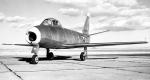
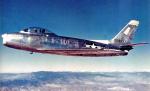
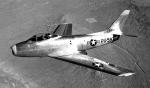
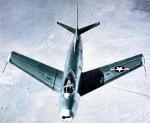
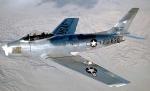
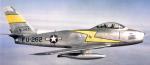
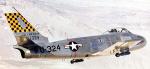
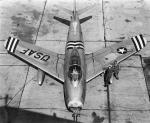
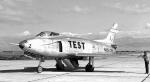
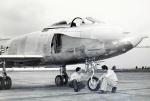
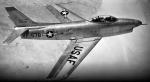
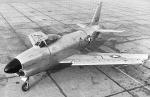
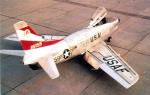
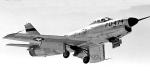
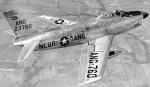
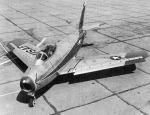
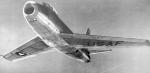
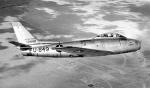
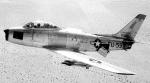
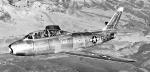
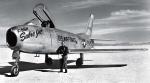
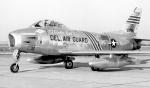
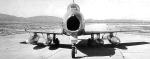
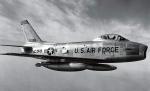
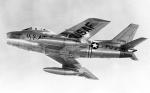
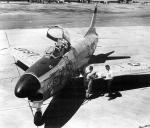
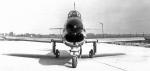
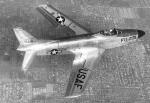
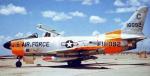
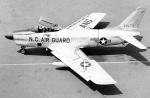
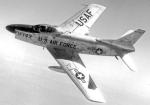
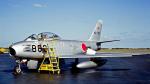
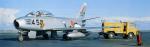
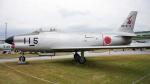
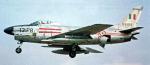
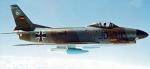
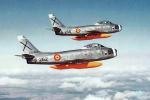
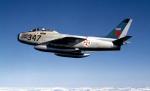
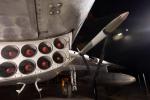
By the closing years of World War II, jet propulsion was clearly the way of the future for high-speed combat aircraft. North American Aircraft (NAA) had achieved great success with their P-51 Mustang, one of the best piston-engine fighters of the war, and wanted to take on the challenge of jet propulsion. In late 1944, NAA began a design study under the designation RD 1265 for the company’s first jet fighter, proposing the aircraft to the US Navy. On 1 January 1945, the company received a contract from the Navy for 100 of these fighters, which was given the company designation Model NA-134 and the Navy designation FJ-1.
While the Model NA-134 was taking shape in 1945, North American was simultaneously investigating a larger derivative, the Model NA-140, for the US Army Air Forces (USAAF, which would be split off from the Army to become the independent USAF in September 1947). This resulted in award of a contract in May 1945 for three prototype aircraft with the designation of XP-86. The USAAF requirements were aggressive, stipulating medium range and a top speed of 965 km/h. (600 mph.). The new fighter was to have several advanced features, such as a pressurized cockpit, hydraulically-boosted controls, and a radar-ranging gunsight for the aircraft’s six 12.7mm. Browning machine guns.
The original NA-140 / XP-86 design strongly resembled the NA-134 / XFJ-1. It had straight wings, the same J35 engine, and the same fit of six Browning machine guns. The major difference was a longer and slenderer fuselage, achieved through the elimination of the structure and gear needed for carrier deck operation.
This design got as far as a full-scale partial wooden mockup, unveiled at the NAA Inglewood, California, plant on 20 June 1945. It went no further, since by this time North American engineers knew that there was no way it could meet USAAF requirements. The straight wing couldn’t achieve the required speed with the engines available at the time.
After the end of the war, aviation engineer George Schairer of the Boeing Company went to Germany to examine German aviation research. He was accompanied by the well-known Theodore Von Karman of the California of Technology, and Robert Jones of the US National Advisory Committee on Aeronautics (NACA, the main precursor organization of the modern US National Aeronautics & Space Administration / NASA). Schairer was extremely enthusiastic about the data he found on swept-wing flight, and not only proposed that Boeing use it on their new XB-47 long-range bomber, but that the information be provided to other US aviation firms.
Larry Green of NAA studied the materials, and came to the conclusion that a swept wing was the answer to improving the performance of the XP-86; he determined that a slat attached to the wing’s leading edge and automatically extended at low speeds would solve the low-speed stability problem. Green and other NAA engineers convinced the president of NAA, «Dutch» Kindelberger, that the swept wing was the way to go, and on 18 August 1945, Kindelberger approved further studies on the concept. Within a few weeks, NAA engineers were performing wind tunnel tests on a 1/23rd scale model of an XP-86 with wings swept at 35 degrees. The results were extremely promising. After further tests, the USAAF approved development of the swept-wing XP-86 on 1 November 1945.
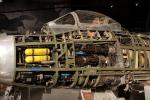
As the work progressed, more changes were made to the design. The wing was lengthened, and the tail, which originally was to have remained straight, was swept back 35 degrees as well. Three hydraulically-operated speed brakes were fitted on the rear fuselage, replacing the wing-mounted «fence» airbrakes. The fuselage was split just behind the wing, allowing the aircraft to be pulled apart to give access to the J35 engine.
The XP-86’s relationship to the FJ-1 Fury was still apparent. The new aircraft had an air intake in the nose, straddled by three 12.7mm. Browning guns on each side, with a high-sitting plexiglas bubble canopy that slid backwards to open. The USAAF was so enthusiastic when they saw the design that on 20 December 1946 the service ordered 33 production P-86As, even though the prototype hadn’t been completed.
The first XP-86 prototype was rolled out on 8 August 1947, and made its initial flight on 1 October 1947. It was powered by a Chevrolet-built J35-C-3 engine with 16.7 kN (1,700 kgp. / 3,750 lbf.) thrust. This was only intended as an interim engine fit, with production aircraft to use the more powerful GE TG-190 / J47 engine, an improved derivative of the J35.
The XP-86 differed from most other aircraft with tricycle landing gear in that the nose gear pivoted forward, instead of backward. This had been done because of a mechanical conflict with the intake ducting. The nosewheel hadn’t gone down because the hydraulics weren’t strong enough to push the leg forward in the face of air resistance. The hydraulics were quickly strengthened. Following tests went smoothly. The climb rate was unsatisfactory, but the design team believed the more powerful J47 engine intended for production aircraft would solve that problem. Even with the J35 engine, the aircraft’s speed was extremely impressive, roughly 150 km/h. (93 mph.) faster than any other operational USAF fighter.
Test pilot Welch flew the first prototype through the sound barrier in a shallow dive on 19 October 1947, making it the first non-experimental aircraft to exceed Mach 1. In fact, although Chuck Yeager had put the X-1 through the sound barrier on 14 October 1947, it is very possible that Welch had exceeded Mach 1 before Yeager. The XP-86’s flight instruments were not capable of determining if the aircraft was moving faster than Mach 1, and so supersonic speed had to be confirmed by ground-based measurements.
The USAF remained very keen on the XP-86. On 16 October 1947, in addition to the 33 P-86As already in the queue, the service ordered 190 P-86s with strengthened landing gear for rough field operation, to be designated P-86B. However, development of new high-pressure tires and improvements in the P-86A design resulted in landing gear that was perfectly capable of meeting the rough field requirement. On 17 December 1947, the order was changed to specify 188 P-86As, and two examples of a drastically modified «deep penetration» variant, the P-86C. No B variant would ever actually be built.
The Air Force began their own flight tests of the XP-86 in early December 1947. The service was thoroughly impressed, finding the aircraft substantially faster than the straight-winged Republic F-84 Thunderjet, which was also powered by the J35 engine.
The second and third prototypes were delivered for flight testing in early 1948. The third prototype differed from the first in many ways, and was closer to production specification. One of the biggest differences was that the number 3 prototype was fully armed, fitted with the six 12.7mm. machine guns as specified in the original requirement. Each gun had a rate of fire of 1,100 rounds a minute, and the aircraft carried 267 rounds per gun.
Production avionics were fitted, including an identification friend or foe (IFF) system, a radio compass system, and a Sperry Mark 18 gyroscopic lead-computing gunsight with manual ranging. Another big difference was that while the number 1 prototype had three air brakes, one on each side of the rear fuselage and one on the bottom, hinged on the rear, the number 3 prototype had two air brakes, one on each side of the redesigned rear fuselage, and hinged on the front.
The first P-86A flew on 20 May 1948. It was powered by a General Electric J47-GE-1 engine with 21.6 kN (2,200 kgp. / 4,850 lbf.) thrust. The USAF placed an order for a third batch of 333 P-86As at the end of the month, bringing the total ordered to 554. In June 1948, the USAF redefined their aircraft designation system, changing the prefix «P» for «pursuit» to «F» for «fighter». The P-86A became the F-86A.
With the more powerful engine, top speed and ceiling of the new fighter increased significantly, and the rate of climb almost doubled. The F-86A was fitted with a T-4E-1 ejection seat, the canopy being manually jettisoned before ejection, plus a self-destruct charge to keep the aircraft from falling into enemy hands.
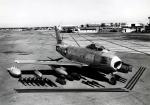
The F-86A also had a stores pylon under each wing that could each carry a 782-liter (206.5 US gallon) drop tank or a 450kg. (1,000lb.) bomb. Internal fuel capacity was 1,650 liters (435 US gallons). Four zero-length stub rocket launchers could be installed under each wing, with each launcher carrying two 12.7cm. (5in.) High Velocity Air Rockets (HVARs) for a total of 16 rockets. Unfortunately, without the drop tanks the combat radius fell from about 530 km. (330 ml.) to 80 km. (50 ml.). In effect, the only armament of the F-86A was its machine guns and so, in the beginning, it was not very useful for close support.
The first production batch of 33 aircraft was designated F-86A-1. The second production batch of 188 was designated F-86A-5, and featured a number of enhancements. While the F-86A-1 had a rounded front windscreen, the F-86A-5 had a flat front armor glass windscreen, and the canopy was now jettisoned using pyrotechnic charges. An improved leading-edge slat scheme was introduced, and there were a number of minor internal changes.
The third batch of 333 aircraft was also designated F-86A-5, but featured further improvements. The most significant was the replacement of the gyroscopic sight by the A-1B radar sight and its AN/APG-5 ranging radar. Although the radar sight had some reliability problems, when it was working it could lock accurately onto a target at long range. Optical sighting still had to be used at low altitudes, since the radar could not pick a target out of ground clutter.
F-86A-1s and early production F-86A-5s actually had little doors that sealed off the muzzles of the six 12.7mm. Brownings; the doors opened automatically in a twentieth of a second for firing. This feature was abandoned at some time during F-86A-5 production because of potential reliability problems.
Up to this time, the USAF hadn’t publicly demonstrated the capabilities of their new fighter, and felt it was time to show it off. On 15 September 1948, an F-86A set a world air speed record of 1,080 km/h. (671 mph.), which was 32 km/h. (20 mph.) faster than the pre-existing record. Unfortunately, that fall technical problems with the J47-GE-1 engine halted F-86A production until General Electric managed to get the difficulties under control in late December 1948, and began delivering the improved J47-GE-7, with 23.7 kN (2,420 kgp. / 5,340 lbf.) thrust.
The first two operational F-86As were delivered to the USAF on 15 February 1949. The crews quickly staged a contest to give their new aircraft a name, and the F-86 became the Sabre, which the news media tended to render as Sabrejet. By the end of 1949, two fighter groups had been equipped with the type, and another was converting to it.
While the Sabre was being delivered to USAF fighter squadrons, new improvements were added. Late production featured the improved A-1CM radar gunsight, resulting in the designation F-86A-6; some had both the A-1CM gunsight and the longer-ranged AN/APG-30 ranging radar, and were designated F-86A-7. A total of 554 F-86As of all subtypes was built.
There were also field upgrades of F-86As to the uprated J47-GE-13 engine, with 24.2 kN (2,470 kgp. / 5,450 lbf.) thrust; these aircraft were not redesignated. Another field change resulted in moving the pitot tube, used to measure airspeed, from the air intake to the right wingtip. Positioning the pitot tube in the air intake had led to false readings due to the additional airflow drawn into the intake.
On 25 June 1950, North Korea crossed the 38th parallel and invaded South Korea in a massive ground offensive, driving South Korean and American forces back in confusion. Although the North Koreans were powerful on the ground, their air assets were weak and antiquated, consisting of Soviet piston aircraft such as the Yak-9 fighter and Il-10 Shturmovik ground-attack aircraft. The USAF had few air assets on the spot to resist the offensive, but long-range North American F-82 Twin Mustangs were able to reach the war zone from bases in Japan and provide air cover for long periods of time. Lockheed F-80 Shooting Star fighters were also able to reach Korean airspace, but their endurance was very short.
By early July, North American F-51D Mustangs were flying close-support missions from forward airfields in Korea to slow down the North Korean offensive. The US Navy was performing carrier-based close-support missions on the enemy rear, and British and other UN forces were contributing air power as well. By August, the USAF was hitting the enemy rear areas hard with B-26 Invader and B-29 Superfortress bombers in an attempt to relieve the pressure on US and South Korean forces boxed in around the city of Pusan, in the southwest corner of Korea.
After the Inchon landings on 15 September 1950, the Chinese ground offensive was followed by the appearance of a new threat in the air: the Soviet-made swept-wing MiG-15, which was more than a match for anything the UN had in the field in Korea. The MiG-15 was a heavily armed interceptor that had been developed at the same time as the Sabre under a Soviet crash program, and had flown for the first time only 13 weeks after the initial flight of the XP-86.
The first encounters between MiGs and UN aircraft were in early November. For the moment, UN pilots were able to cope with the faster MiGs. Unknown to the UN, they were mostly flown by Soviet pilots at the time. Many of these pilots had relatively little experience compared to their UN adversaries, who were often able to escape or even turn the tables on the MiGs. However, the Soviets were bound to learn, and the good luck of UN pilots could not last indefinitely. The MiG-15 outclassed the main USAF jet fighters in the field in Korea, the F-80 and the Republic F-84 Thunderjet, and the USAF needed to get the F-86 into combat immediately.
On 10 December 1950, the escort carrier USS Cape Esperance arrived in Tokyo Bay with a load of F-86As of the USAF 4th Fighter Wing. Unfortunately, due to the haste in which the Sabres were sent over the ocean, they had not been adequately conditioned for the trip, and most were in need of repairs for corrosion damage. Seven were in good enough condition for immediate action, and four went into combat from an advanced Korean airfield on 17 December. On that mission, one of the pilots, Lieutenant Colonel Bruce Hinton, shot down the first MiG-15 to fall victim to the Sabre.
On paper, the F-86A and the MiG-15 were well matched. The Sabre was somewhat underpowered and the MiG-15 could outclimb it. The Soviet aircraft also was more heavily armed, with two 23mm. and one 37mm. cannon. The MiG’s cannon had a relatively low rate of fire, but it only took a few hits from them to kill a Sabre, while the F-86’s six 12.7mm. guns lacked hitting power.
On the plus side, the F-86 was well-crafted, and turned and rolled better than the MiG, though it could by no means fly rings around it. The F-86’s radar gunsight was much superior to the MiG’s eyeball gunsight, the Soviets would copy a captured example of the radar, and if the Sabre’s guns were of relatively small caliber, they were accurate, well focused, and had a high rate of fire. Sabre pilots also had an excellent field of view, sitting high up in a prominent bubble canopy, while MiG pilots sat deeper in their machines. This did give the MiG pilots an advantage of greater protection in air combat, but at the cost of a poorer field of view, compounded by the fact that parts of the MiG-15’s canopy were prone to fogging.
Sabres performed better at low altitudes, MiGs at high. For this reason, fights tended to be brief, since the adversaries would quickly seek the ground where they had the most advantage. The Sabre had been designed primarily for the air superiority role, while the MiG-15 had been designed primarily as a high-altitude bomber destroyer. Each was very well suited to the mission for which it had been specifically designed.
The close balance between the F-86 and the MiG-15 meant that the critical factor in the air battle was pilot training and skill. While there were many skilled Soviet pilots, the Soviets were hampered by the decision to rotate entire units through combat, meaning each new unit had to learn the game all over again. The Americans were in general experienced, and rotated individuals into combat with the help of those that knew the game. Chinese and North Korean pilots were absolutely no match for the Americans. They had little flight experience, and Soviet pilots who worked with them believed many of their Asian counterparts suffered from malnutrition.
Encounters between Sabres and MiGs were rare at first. The Chinese ground offensive seemed unstoppable, and by January 1951 the disorganized UN forces had been thrown back south of the 38th parallel. UN resistance then began to stiffen, while air strikes hammered Chinese combat units and their supply routes. MiGs finally began to come out in force to attack UN strike aircraft, and air combat began in earnest.
The North Korean push south forced the Sabres to withdraw to Japan in January 1951 when their Korean air bases were overrun. The abrupt reversal of the war in March allowed the F-86s to return and renew the battle. Sabre successes against the MiG-15 were so impressive that the Chinese effectively abandoned serious air operations in December 1951, in order to regroup.
The Chinese returned in May 1952, with improved tactics. The US reacted by offering a $100,000 USD bounty for any enemy pilot who defected with a MiG. The effort was codenamed Operation Moolah, «moolah» being obscure antique American slang for «big money». The offer was publicized by leaflet drops over airfields. This effort would eventually be rewarded on 21 September 1953, when North Korean Lieutenant No Kum-Suk flew his MiG-15 south and landed it on an American airstrip, allowing the US to perform a detailed investigation of the aircraft.
While the Sabre was engaged in heavy combat across the Pacific, the design was being updated back in the States. Design work on the NA-157 or XP-86C was begun in late 1947, in response to a USAF requirement for a deep penetration fighter. North American’s XF-86C, as it was redesignated in 1948, won the competition against the Lockheed XF-90 and the McDonnell XF-88 (which would eventually evolve into the F-101 Voodoo), with the Air Force ordering two prototypes.
The XF-86C had a bigger and longer fuselage than the F-86A. The increased size was to accommodate 5,909 liters (1,561 US gallons) of internal fuel to meet the range requirements, while the increased length was to allow fit of a Pratt & Whitney J48-P-6 engine. The J48 was an improved, afterburning version of the Rolls-Royce Nene centrifugal-flow turbojet, manufactured in Britain as the Tay, providing 27.8 kN (2,835 kgp. / 6,250 lbf.) dry thrust and 35.6 kN (3,625 kgp. / 8,000 lbf.) afterburning thrust. The J48’s exhaust had a two-piece clamshell variable-size outlet.
The fuselage was designed using the new «area ruling» concept developed by NACA engineers, which specified that changes in an aircraft’s cross-sectional area should be minimized to ensure smooth airflow at high speeds; this meant that the fuselage was «pinched» slightly along the wing roots. The result was a somewhat inelegant machine compared to the F-86A, with a porpoise-like body and fat appearance. In fact, the aircraft was so clearly different that the USAF redesignated it the YF-93A in 1948.
The nose intake was replaced with air intakes at the sides, leaving the nose available for SCR-720 radar, and the new aircraft was armed with six 20mm. cannon instead of six 12.7mm. Brownings, with 225 rounds per cannon. The YF-93A’s greater weight required reinforced landing gear, with dual wheels on the main gear. The twin air brakes of the Sabre were replaced with a single large air brake under the fuselage.
The YF-93A had excellent performance and range, and it could be fitted with stores pylons for external tanks to give even greater range, or to carry up to 900 kg. (2,000 lb.) of bombs, rockets, or other stores. The Air Force ordered 118 production F-93As in 1948.
The first YF-93A prototype performed its initial flight in January 1950, again with George Welch at the controls. Only two were built, neither being armed; the contract had been canceled a year earlier, since the USAF’s new Boeing B-47 bomber was so fast that it didn’t really need fighter escort, and money was tight anyway. Mid-air refueling would soon kill the «penetration fighter» concept completely. The two YF-93A prototypes were finished as test articles, and flown in this role by NAA, the USAF, and NACA, and eventually scrapped.
Even while the Air Force had building up fighter groups with the F-86A, work was proceeding on an interceptor variant of the F-86. Development of the big Northrop F-89 Scorpion interceptor on which the USAF was resting their hopes had been delayed, and the USAF was desperate to get an aircraft to defend North America from Soviet bombers. The service decided to obtain a derivative of the Lockheed T-33, to become the F-94 Starfire, and a derivative of the Sabre as interim interceptor solutions.
Development of the first Sabre interceptor variant, originally designated the F-95A, was initiated in early 1949, with rollout of the first of two prototypes, lacking armament and combat avionics, in November 1949, and first flight on 22 December 1949.
The second prototype first flew in September 1950, and was fitted with a Hughes E-3 fire-control system (FCS). By this time, the aircraft had a new name. The F-95A was an almost complete redesign of the original F-86, with only about 25% commonality. However, the US Congress would not approve new aircraft at the time; a modification of an existing aircraft wasn’t such a problem, and so the aircraft was redesignated the F-86D in the summer of 1950 to ensure funding.
The prototypes were redesignated YF-86D. The first production F-86D-1 was rolled off the Inglewood assembly line in March 1951, with first flight in June. 37 were built. This was followed by the F-86D-5, featuring the definitive Hughes E-4 FCS, with much longer range radar than the E-3. The first was flown in July 1952, though the new FCS proved unreliable and operational delivery of the subtype was protracted. NAA built a total of 26 F-86D-5s.
The F-86D had only a general resemblance to an F-86A, the most noticeable difference being the F-86D’s big nose radome, and modified air intake to accommodate the radome. Of course, this arrangement required a complete redesign of the Sabre’s forward airframe. Although the F-86D prototype had a standard F-86A sliding canopy, production F-86Ds had a clamshell canopy and a flat armor-glass windscreen. The F-86D also had a «slab» all-moving tailplane with no elevators.
The F-86D was fitted with the J47-GE-17 afterburning turbojet, with 22.3 kN (2,270 kgp. / 5,000 lbf.) dry thrust and 29.6 kN (3,015 kgp. / 6,650 lbf.) afterburning thrust, plus an electronic fuel-control system. The prototypes had been fitted with developmental J47-GE-17 engines, with about 10% less thrust. The rear fuselage was widened and lengthened to accommodate the new engine, with some changes in the design between the prototype and production aircraft.
The J47-GE-17 gave the F-86D impressive performance for the time. In late 1952, an F-86D set a world speed record of 1,124.6 km/h. (698.505 mph.), and in July 1953, another F-86D established a new record of 1,152.3 km/h. (715.7 mph.). The F-86D had no guns. Its armament consisted of 24 70mm. (2.75in.) unguided folding-fin air rockets (FFAR), stored in a belly tray that could be lowered in half a second. The rockets could be fired in salvos of 6, 12, or 24 at intruding bomber formations. Each rocket had a range of over 4 km. (2.5 ml.) and a warhead weighing 3.4 kg. (7.5 lb.).
By the standards of the time, the F-86D was an electronic marvel. Most radar-equipped aircraft were two-seaters, carrying a pilot and a radar operator. The F-86D was a single-seat aircraft. Although early concepts for the aircraft had envisioned a two-seat machine, this led to reductions in performance and range, and new developments in electronics encouraged NAA and the Air Force to think that advanced technology could replace the «back-seater» in guiding the pilot to the target.
In operation, the pilot would be directed to the vicinity of a target by a Ground-Control Intercept (GCI) operator. At a range of about 50 km. (30 ml.), the pilot would acquire the target with the aircraft’s AN/APG-7 radar. The E-4 fire-control system, which integrated the radar with an AN/APA-84 electronic analog computer system, would provide a course to intercept the target. At the appropriate time, the E-4 would indicate that rockets should be fired as the two paths intersected, the F-86D streaking past the target from the side or front. The E-4 would also provide a warning if there were danger of a collision. The F-86D had a manual lead-computing gunsight as a backup.
The small batch of F-86D-5s was followed by another small batch of 36 F-86D-10s, featuring a power-actuated rudder with no trim tab. Earlier Sabre variants had used a manually-actuated rudder with a trim tab. This led in turn to a long sequence of other subvariants with generally minor changes.
The F-86D was known as the Sabre Dog or Dogship. It seems that these two names were not entirely affectionate, and the second undoubtedly led to a cruder nickname when things weren’t going well. The advanced technology used in the interceptor led to painful teething troubles.
Problems continued to plague the F-86D after it was delivered. A rash of 13 fires and explosions grounded them all in late 1953, until changes in the electronic fuel-control system were implemented. Then, in early 1954, another streak of 19 accidents occurred, and the Sabre Dogs were grounded again. The answer was Project Pullout, in which the Air Force, working with North American, implemented a comprehensive set of fixes to the 1,000-plus F-86Ds in service, bringing them up to F-86D-45 standard. The refit took 18 months and cost $100 million USD. After the update, the Sabre Dogs proved much more satisfactory in service. They were deployed in large numbers in the US, Europe, and Far East.
The XF-86C / XF-93 had been a major departure from the F-86A, and a dead end. However, NAA also developed a more evolutionary enhancement of the F-86A, in the form of the F-86E. The F-86E was difficult to distinguish from the F-86A, but featured improved flight controls, an uprated J47-GE-13 engine with 24.2 kN (2,470 kgp. / 5,450 lbf.) thrust. In the F-86A, the tailplane was fixed, but with the all-flying tail the entire tailplane assembly could be rotated; the moving elevator was retained.
The first F-86E flew on 23 September 1950. The first production batch of 60 F-86E-1s began to flow to fighter groups in early 1951, replacing war-weary F-86As in combat beginning in the spring. The next batch was of 51 F-86E-5s, which were identical except for some tweaky changes in switches and the like.
The third batch of 60 F-86E-6s was actually built by Canadair of Canada. Canadair had signed a license agreement with NAA to build the Sabre, and the USAF took advantage of the arrangement to use Canadair as a second source. The F-86E-6, or F-86E-6-CAN as it was sometimes called, was essentially a Canadair Sabre Mark 2.
The first proper F-86F-1 with the J47-GE-27 engine flew in March 1952. The new engine, a J47-GE-27 engine with kN 27.1 kN (2,760 kgp. / 6,090 lbf.) thrust, provided a significant improvement in performance, particularly in terms of rate of climb. 78 were built, with operational deliveries beginning in June 1952.
The F-86F-1 was followed by 16 F-86F-5s, which featured a stronger pylon attachment point on each wing to allow the fighter to carry 758-liter (200 US gallon) drop tanks. The next production batch consisted of 34 F-86F-10s with the new A-4 gunsight. The F-86F-15 featured a redesign to the hydraulics system. This was the last of 404 F-86Es, including the prototype.
The demand for F-86Fs was so great that NAA couldn’t keep up with production at the Inglewood, California, plant, and so the company leased a factory from Curtiss in Columbus, Ohio. The NAA Columbus plant began Sabre production with 100 F-86F-20s, the first flying in March 1952. The F-86F-20 was almost identical to the F-86F-15s from Inglewood, differing only in minor changes to radio fit. The USAF gave Inglewood Sabres an NA suffix and Columbus Sabres an NH suffix, for example, F-86F-15-NA versus F-86F-20-NH.
The next improvement in the F-86F was to make it a better fighter-bomber by adding an extra set of stores pylons, one at the midpoint of each wing, for a total of four. This «dual store» wing allowed the Sabre to carry two drop tanks and two 450kg. (1,000lb.) bombs. 859 of this subvariant were built by Inglewood as the F-86F-30-NA, while 600 were built by Columbus as the F-86F-25-NH. The first was rolled out in October 1952; they were rushed to Korea to replace outmatched North American F-51 Mustangs and Lockheed F-80 Shooting Stars in close-support units.
North American had only begun tinkering with the wing, however. Aerodynamic studies had shown that eliminating the leading-edge slat and providing a sharper leading edge on the wing provided substantial benefits in high-speed flight, though this led to «hotter» landing characteristics. To compensate for the hot landings, the wing was extended 15 cm. (6 in.) at the root and 7.6 cm. (3 in.) at the wingtip. The new wing, which also featured fuel tanks in the leading edge that increased capacity by 264 liters (70 US gallons), was known as the solid 6-3 wing. The wing was incorporated into F-86F-25/30 production in midstream, and was sent to Korea in kit form to upgrade most F-86Fs and a few F-86Es in service there.
Once the USAF got the new and better F-86F into the skies over Korea, the service decided to demonstrate the superiority of the Sabre once and for all. In the summer of 1953 the USAF had a «turkey shoot» against Communist pilots that proved once and for all who was the boss. The final tally for the entire war was estimated by the USAF as 800 MiGs lost to Sabres, with 80 Sabres lost to MiGs, a 10:1 kill ratio. 30 other Sabres were lost in combat, and 114 more were lost to accidents. Even assuming that the MiG losses were exaggerated by a factor of two, that still made the Sabre the clear winner of the contest. If the war on the ground ended in a stalemate, the USAF had reason to feel pleased with themselves in the air.
Although refinements of the aircraft helped, it was still pilot training that gave the Americans the edge. Of the 40 American aces in Korea, 39 flew the F-86. Many of them had extensive World War II experience, and these 39 men tallied over 300 of the 800 MiG-15s claimed destroyed. The top-ranking aces in the war were Captain Joseph D. McConnell JR, with 16 kills; Major James Jabara, with 15 kills; and Captain Manuel «Pete» Fernandez with 14 kills. Jabara had actually been the first jet ace and was in competition with McConnell, but Jabara’s eagerness got the better of him, and his 16th kill turned out to be a Sabre.
Even as the war in Korea bogged down to its inconclusive end, North American was working on new subvariants of the F-86F. The F-86F-35-NA was similar to the F-86F-25, but incorporated a Low Altitude Bombing System (LABS) for delivery of a single 545kg. (1,200lb.) Mark 12 atomic bomb. 264 F-86F-35s were built, becoming nuclear operational in January 1954. They were deployed in NATO bases to help meet the Soviet threat to Europe.
The final production subvariant of the F-86F was the F-86F-40, which was intended for Japanese use. Confronted by the Soviet Union, China, and North Korea in the Far East, the US finally decided to permit Japan to re-arm. The Japanese Air Self-Defense Force (JASDF) was given the highest priority for bringing up to strength, and decided to adopt the F-86F as their first-line fighter. In July 1954, North American came to an agreement with Mitsubishi Heavy Industries of Japan to co-produce a new version of the F-86F, the F-86F-40.
The F-86F-40 was similar to an F-86F-25/30, but incorporated a modified wing, featuring a 30cm. (1-ft.) wingtip extension on the «6-3» wing, plus restored leading-edge slats. The first F-86F-40 was rolled out at the Inglewood plant in October 1955. Performance matched that of the F-86-25/30, while the F-86-40 had tamer landing characteristics. The initial batch of kits had already been sent to Japan in August, with the first JASDF F-86F-40 rolled out a year later. Mitsubishi would assemble a total of 300 F-86F-40s, with the last produced in 1961.
In the meantime, the USAF was in a desperate need for new fighters and also decided to buy F-86F-40s, with a total of 280 built by NAA, and in addition ordered a large number of F-40 wing kits to retrofit to older F-86Fs. These wing kits were also supplied to many US allies who used the Sabre. The F-86F-40 was the final production variant of a total of 2,538 F-86Fs built, not counting some unusual variants.
Following a USAF request for a high-performance trainer to replace the Lockheed T-33 Shooting Star, in 1953 an F-86F was pulled from the production line for conversion to a two-seat TF-86F operational trainer prototypes. Initial flight was on 14 December 1953. The TF-86F featured a 1.6m. (5.3 ft.) fuselage stretch and tandem seating, with a single piece cockpit canopy that hinged up from the rear in a «clamshell» fashion, in contrast to the sliding canopy of most of the fighter F-86 variants. The stretch unsurprisingly shifted the aircraft’s center of gravity, and so the wing was moved forward 20 cm. (8 in.).
The TF-86F had short slatted wings and additional fuel tankage. No armament or gunsight were fitted. The result was that the TF-86F only weighed about 45 kg. (100 lb.) more than a stock F-86F, and had very similar performance. The aircraft made its first flight on 5 August 1954. The second TF-86F was delivered to the Fighter School at Nellis AFB on 31 January 1955, but the program was canceled a week later, with the Air Force settling on the TF-100 Super Sabre instead.
Since the USAF did not have a standard reconnaissance aircraft that could outrun the MiG-15, a small number of F-86As were field-modified to RF-86A photo-reconnaissance aircraft. North American built eight production RF-86Fs, featuring a camera fit including twin K-22 and a single K-14 camera. The K-22s were actually mounted vertically, with new bulged fuselage panels to permit proper fit; the K-14 was fitted between them. These aircraft had no guns, but had fake gun muzzles painted on the nose as a bluff.
The production RF-86Fs never saw combat, but from 1954 to 1957 they performed overflights of eastern Siberia and China that remained secret for decades. The missions were approved at the presidential level. The USAF did not obtain any more RF-86Fs, preferring the Republic RF-84F Thunderflash instead, but a number of RF-86Fs, conversions of fighter variants, were operated by several foreign air forces.
The last fighter, as opposed to interceptor, variant of the Sabre, was the F-86H. The F-86H had the classic lines of the Sabre fighter, but with a muscular appearance due to the fit of a General Electric J73-GE-3 turbojet engine with 41.2 kN (4,195 kgp. / 9,250 lbf.) dry thrust. The bigger engine required expansion of the intake and fuselage, with a 15cm. (6in.) vertical splice to increase depth. The exhaust was extended 60 cm. (2 ft.), and the tailfin was raised by 7.6 cm. (3 in.). Other changes included fit of the «clamshell» canopy designed for the F-86D, making the F-86H the only Sabre fighter variant not to have a sliding canopy.
Two F-86H prototypes were built at Inglewood, with the first rolled out in April 1953 and making its first flight in May. The new engine improved performance in all respects, and provided a particularly impressive rate of climb. The F-86H was intended as a fighter-bomber instead of an air-superiority fighter, and was capable of delivering nuclear weapons, along with conventional bombs, napalm, or rockets. The F-86H had four stores pylons and a LABS systems for nuclear weapons delivery.
475 F-86Hs were manufactured in all, including the two prototypes. However, the advance of aircraft design at the time was so rapid that even though the F-86H was superior in almost all respects to its F-86A ancestor, it was still obsolescent, and the Sabre Hog was phased out of first-line service to the Air National Guard by mid-1958. The F-86H would linger in ANG service until the early 1970s.
The F-86K was a simplified version of the F-86D, developed in response to a 1953 USAF request for an export interceptor intended for Western allies under the US Mutual Defense Assistance Program (MDAP). NAA eliminated the rocket tray in favor of four M24-A-1 20mm. cannon, and replaced the complicated E-4 fire-control system with the simpler new MG-4 fire-control system. Installation of the four cannon required a 20cm. (8in.) fuselage stretch forward of the wings.
Two F-86D-40s were pulled from production and modified to become YF-86K prototypes. First flight was on 15 July 1954. Original F-86K production was by Fiat of Italy for the Italian Air Force, with 50 kits sent from Inglewood to the Fiat factory in Turin for assembly. The first Italian-assembled F-86Ks went into service in mid-1956, and the type would remain in service with the Italians until 1964. Fiat eventually assembled 221 F-86Ks, with 60 going to France and 88 going to West Germany. In the meantime, NAA had received other contracts for the F-86K and put the type into production at Inglewood, building a total of 120, with deliveries split evenly between Norway and the Netherlands.
Late Fiat production of the F-86K featured the F-40 long slatted wing, and some Dutch F-86Ks were refitted with this wing. Many F-86Ks were also fitted with two additional stores pylons just outside of the landing gear for Sidewinder missiles. These aircraft were phased out of service in the mid-1960s, generally being sold to other air arms, where they lingered into the 1970s.
The F-86L was developed under «Project Follow-On». It was essentially an F-86D incorporating a data-link capability for the Semi-Automatic Ground Environment (SAGE) air-intercept control system. SAGE, introduced in 1953, had been developed by the Lincoln Laboratory at the Massachusetts Institute of Technology (MIT). A SAGE ground center used a big ground-based computer to assess target information obtained by ground radar, and relayed target data to the interceptor through an AN/ARR-39 datalink, automatically guiding the interceptor to the target while the targeting information was displayed to the pilot. It was a marvel of the world at the time.
The F-86L was intended as stopgap for SAGE operation until better the better Convair F-102 Delta Dagger and then its successor F-106 Delta Dart came on line. All F-86Ls were rebuilds of low-flight-time F-86Ds, with the first such rebuild flying on 27 December 1955. The rebuilds were brought up to the equivalent of an F-86D-45. 981 F-86Ds were converted to F-86Ls in all. They began to go into USAF Air Defense Command service in late 1957, but were phased out into Air National Guard service by 1960, to be finally obsoleted in 1965.
When Canada joined NATO in 1949, the Canadian government decided to ramp up military aircraft production to meet increased commitments, and so in August of that year, Canadair of Montreal signed an agreement with North American to build 100 Sabres, using plans and parts provided by NAA.
The first Canadair Sabre, the CL-13 Sabre Mark 1, was really an F-86A-5. Only one was built, as a manufacturing exercise. It was assembled from parts supplied by NAA and first flew in August 1950. The first Canadair production variant was the CL-13 Sabre Mark 2, which was effectively an F-86E-1. 350 Mark 2s were completed between January 1951 and August 1952. This number includes the 60 provided to the USAF as the F-86E-6. Most of the Canadian Sabres went to Europe, while the Canadian homeland was protected by the Avro CF-100 Canuck.
The Canadians were interested in fitting their indigenous Avro Canada Orenda Mark 3 engine, with 26.7 kN (2,720 kgp. / 6,000 lbf.) thrust, to the Sabre. NAA installed the Orenda to an F-86A-5 pulled from their own production line as an experiment, giving the modified aircraft the designation F-86J. The experimental fit was very successful, with the F-86J demonstrating substantially improved performance.
Canadair then performed the same transplant on a Sabre Mark 2 pulled from their production, resulting in the CL-13 Sabre Mark 3, which first flew in September 1952. The Sabre Mark 3 was a purely experimental aircraft, since the Orenda was not ready for production at the time. For the moment, Canadair production went on to the CL-13 Sabre Mark 4, which was effectively identical to an F-86E-10. 438 Mark 4s were built in 1952 and 1953. Most of the Mark 4s ended up in the hands of the British Royal Air Force (RAF). Since the British did not have a swept-wing fighter at the time, they obtained some 428 Mark 4 Sabres as an interim measure while awaiting delivery of the new Hawker Hunter. The RAF gave their Sabres the designation Sabre F.4. The RAF Sabres only served into 1955 and 1956, when the Hunter finally began to be delivered to RAF squadrons.
The CL-13A Sabre Mark 5 first flew in the summer of 1953. The Mark 5 was the first truly Canadian Sabre, using the Avro Orenda 10 engine, with 29.8 kN (2,950 kgp / 6,500 lbf) thrust. The new engine provided significantly improved performance, including a doubled climb rate. The Mark 5 also incorporated the solid 6-3 stretched wing, which was retrofitted to many Mark 4s and even some Mark 2s. 370 Mark 5s were built, with 75 delivered to the West German Luftwaffe.
The final Canadair variant was the CL-13B Sabre Mark 6, with first flight in October 1954. The Mark 6 was fitted with an Orenda 14 engine with 32.4 kN (3,300 kgp. / 7,275 lbf.) thrust, giving it better performance than any subvariant of the F-86F. 647 Sabre Mark 6s were completed, with the last rolled out in October 1958. 382 went to the RCAF, 225 to West Germany, 34 to South Africa, and 6 to Colombia. Total Canadair Sabre production amounted to 1,807 aircraft.
A small number of Sabres, 112 in all, were built by Commonwealth Aircraft Corporation (CAC) in Australia. Although they were externally very similar to other Sabre fighter variants, they featured major structural redesign to accommodate the powerful Rolls-Royce RA.7 Avon engine with 33.4 kN (3,400 kgp. / 7,500 lbf.) thrust, and revised armament of two 30mm. Aden revolver cannon, with a total of 162 rounds of ammunition.
The major visible difference of the Aussie Sabres was that they had two big gun ports on the nose, instead of six relatively little ones. The Avon was lighter than the J47 and required substantial airframe changes to balance center of gravity and provide more intake airflow. The fit of the twin Aden cannon was not only very different from that of the six Brownings, but the cannon mounts had to be very sturdy since the weapons were hefty, powerful, and had a high rate of fire.
The first of these Australian Sabres was the single CA-26, which featured a standard F-86E/F short-slatted wing and all-flying tail with the redesigned fuselage. It first flew on 3 August 1953, leading to an RAAF order for 70 CAC Sabres. The production batch was of 22 CA-27 Sabre Mark 30s, similar to the CA-26 prototype and with imported Avon engines. The first of them flew in July 1954, with initial service delivery in August 1954. The CA-27 Sabre Mark 31 featured the Australian-built Avon Mark 20 engine and the solid 6-3 wing. Some sources claim this was a slatted wing. 20 Mark 31s were built.
The definite Australian Sabre was the CA-27 Sabre Mark 32, which had the Australian-built Avon 26 engine and four stores pylons. The Avon 26 had a throttle scheme in which fuel flow was automatically reduced when the cannon were fired, reducing the chance of a flame-out due to gun gas ingestion. A total of 69 Mark 32s was built, in three batches. After experiments with launching Sidewinder AAMs in 1959, all surviving Mark 31s and Mark 32s were refitted to launch the missile. The Sidewinder-equipped CAC Sabres remained in service with the RAAF through the 1960s, with the last phased out in 1971.
After first-line service in the US, Canada, Australia, Japan, Italy, Britain, France, West Germany, the Netherlands, Norway, Pakistan, and Columbia, used Sabres were passed on to dozens of nations. The bulk were ex-USAF F-86Fs, which were generally updated to F-86F-40 standard, but the exports included good numbers of Canadair Sabres of various marks, plus some F-86Ds, F-86Ks, CAC Sabres, and small quantities of other variants.
Second-hand Sabre users included Argentina, Bangladesh, Bolivia, Burma, Denmark, Ethiopia, Greece, Honduras, Indonesia, Iran, Iraq, Malaysia, Peru, the Philippines, Portugal, Saudi Arabia, South Korea, Spain, Taiwan, Thailand, Tunisia, Turkey, Venezuela, and Yugoslavia. For the most part, these Sabres saw little action.
However, Pakistani Sabres particularly distinguished themselves in the 1965 war with India. On 7 September 1965, Pakistani Squadron Leader Mohammed Mahmood Alam engaged a set of Indian Hawker Hunters, shooting one down and then, after a few minutes of maneuver, destroying four more in 30 seconds, becoming an ace in a single sortie. Squadron Leader Alam shot down nine Indian aircraft in the short war, taking out the last with a Sidewinder missile. He personally claimed almost half the aircraft India lost during the conflict, though it should be mentioned that Indian sources strongly dispute Alam’s story. The Sabre saw action again with Pakistan during their 1971 war with India.
Sabres also saw combat in Taiwanese service. In 1958, the Communist Chinese blockaded the island of Quemoy, and Nationalist Chinese F-86Fs, armed with the new Sidewinder heat-seeking missiles, were sent into the sky to engage Red MiG-15s and MiG-17s. This was the first combat use of the Sidewinder.
FUENTES Y REFERENCIA – SOURCES & REFERENCE
airvectors.net
Ugolok Neba
silverhawkauthor.com
©jmodels.net
 jmodels.net
Debe estar conectado para enviar un comentario.