
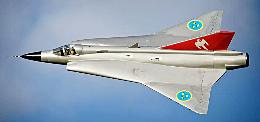
| DATOS TÉCNICOS (J 35F Draken) |
TECHNICAL DATA (J 35F Draken) |
| TIPO: Caza interceptor. | TYPE: Fighter-interceptor. |
| TRIPULANTES: 1 | CREW: 1 |
| ENVERGADURA: 9,42 m. | SPAN: 30.11 ft. |
| LONGITUD: 15,35 m. | LENGTH: 50.4 ft. |
| ALTURA: 3,89 m. | HEIGHT: 12.9 ft. |
| SUPERFICIE ALAR: 49,2 m². | WING AREA: 530 ft². |
| PESO EN VACÍO: 7.865 kg. | EMPTY WEIGHT: 17,339 lb. |
| MOTOR: Un turborreactor con poscombustión Svenska Flygmotor RM6C de 56,5 kN (5.761 kgf) de empuje en seco y 78,4 kN (7.994 kgf.) con posquemador. | ENGINE: One Svenska Flygmotor RM6C afterburning turbojet engine, 56.5 kN (12,700 lbf) thrust dry, 78.4 kN (17,600 lbf) with afterburner. |
ARMAMENTO:
|
ARMAMENT:
|
| VELOCIDAD MÁX.: 2.450 km/h a 11.000 m. | MAX. SPEED: 1,520 mph at 36,000 ft. |
| TECHO: 20.000 m. | CEILING: 66,000 ft. |
| ALCANCE: 2.750 km (1.480 m. náut.) con depósitos externos. | RANGE: 1,710 mi (1,480 nmi) with external drop tanks. |
| PRIMER VUELO: 25 de octubre de 1955. | FIRST FLIGHT: 25 October 1955. |
| VERSIONES: 11 | VERSIONS: 11 |
| CONSTRUIDOS: 651 | BUILT: 651 |
En 1949, el Comité Aéreo Real Sueco emitió una solicitud, denominada Proyecto 1200, para un nuevo interceptor que sucedería al SAAB 29 Tunnan, que entonces estaba a punto de entrar en servicio con la Flygvapnet (Fuerza Aérea Sueca). Este nuevo avión debía alcanzar una velocidad mínima de Mach 1,4; ser capaz de operar en tramos de carreteras públicas especialmente construidas, según el plan Base Aérea 90; y debía ser robusto, de fácil mantenimiento y económico.
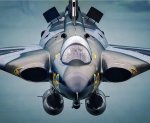
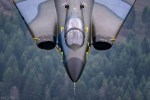
Un equipo de ingenieros de SAAB, dirigido por Erik Bratt, examinó diversas opciones, pero finalmente se centró en un diseño de ala delta, en el marco del Proyecto 1250, con una flecha radical de 70 grados. Estudios de diseño posteriores dieron como resultado un esquema de doble delta, con un delta interior grueso con una curva de 80 grados para alojar el combustible y el tren de aterrizaje, y un delta exterior delgado con una curva de 57 grados que proporcionaba sustentación adicional para vuelos a baja velocidad y operaciones en pistas cortas, a la vez que conservaba características de baja resistencia aerodinámica para vuelos a alta velocidad.
Nadie había volado nunca un avión de doble delta. Tras experimentos en túnel de viento y vuelos de modelos propulsados por pulsorreactores, el esquema alar se validó utilizando un avión de demostración a escala reducido en un 70%, el SAAB 210, apodado LillDraken (Pequeño Dragón).
El primer vuelo completo del LillDraken tuvo lugar el 21 de enero de 1952, con el piloto de pruebas de SAAB, Bengt Olow, a los mandos. El SAAB 210 estaba propulsado por un turborreactor Armstrong Siddeley Adder con un empuje de 3,92 kN (400 kgp. Esa potencia no era suficiente porque el sistema de admisión no proporcionaba suficiente flujo de aire, por lo que finalmente se rediseñó todo el fuselaje delantero, modificándolo con un morro largo y desplazando las tomas de aire hacia atrás. La configuración final recibió la denominación SAAB 210B; las configuraciones anteriores se convirtieron retroactivamente en SAAB 210A.
En agosto de 1953, el gobierno sueco encargó tres prototipos y tres cazas SAAB 35 Draken de preproducción, basados en el diseño del LillDraken. El turborreactor británico Avon 200 fue seleccionado como motor para el avión de producción. Svenska Flygmotor (posteriormente Volvo Flygmotor) obtuvo la licencia para fabricar el Avon.
El primero de los tres prototipos SAAB 35 voló el 25 de octubre de 1955, de nuevo con Olow a los mandos. Originalmente estaba propulsado por un motor Svenska Flygmotor RM5A sin postcombustión, una copia del Avon Mark 21 y el mismo motor utilizado para propulsar al SAAB 32 Lansen. Sin embargo, el prototipo fue posteriormente equipado con un motor más potente Avon Mark 43 sin postcombustión, uno de los seis proporcionados por Rolls-Royce. Con el motor mejorado, el prototipo inicial superó la velocidad de Mach 1 en vuelo nivelado el 26 de enero de 1956.
Desafortunadamente, el primer prototipo sufrió daños durante un aterrizaje de panza el 19 de abril de 1956. El segundo prototipo, con un motor Avon Mark 46 aún más potente, había realizado su primer vuelo en marzo de 1956, pero se había parado una semana antes del accidente que lo dejó fuera de servicio, y por el momento, el programa de pruebas de vuelo quedó en suspenso. El tercer prototipo voló en septiembre de 1956 y se reanudaron las pruebas de vuelo; las otras dos máquinas fueron finalmente reparadas y reincorporadas al programa.
El modelo fue aprobado para su producción completa en 1956 con el nombre de J 35A (Adam), donde J significaba Jakt (caza). Para entonces, las especificaciones se habían ampliado, estableciendo un caza con una velocidad máxima de Mach 1,8. Se construyeron dos prototipos más con características del J 35A, ambos volados en 1958. El primero, que en realidad era el quinto prototipo en la secuencia numérica, estaba equipado originalmente con un motor Avon Mark 48A importado, pero posteriormente se le instaló el motor RM6B equivalente, de fabricación sueca, que sería el motor del J 35A de producción. El segundo, el cuarto prototipo en la secuencia numérica, llevaba el motor RM6B desde el principio. Tras una evaluación satisfactoria de los prototipos, el J 35A entró en producción en serie. Las primeras entregas a la Flygvapnet se realizaron en marzo de 1960.
El Draken demostró tener un rendimiento excelente y, para ser una máquina tan potente, era relativamente fácil de volar. Sin embargo, presentaba algunas peculiaridades desagradables que debían solucionarse. Por ejemplo, en sus inicios en servicio, resultó ser muy sensible en el eje de cabeceo (morro arriba/abajo), lo que provocaba oscilaciones desagradables que provocaron algunos accidentes. Se incorporaron modificaciones menos sensibles al sistema de control de vuelo en las primeras aeronaves y se logró controlar el problema.
Las únicas limitaciones fundamentales del modelo, comunes en los aviones a reacción de la época, eran su alcance y autonomía limitados, y, al ser un delta, su recorrido de despegue era relativamente largo, ya que era difícil conseguir que los flaps funcionaran eficazmente. El Draken era fácil de mantener, con el fuselaje atornillado en la sección central para facilitar su desmontaje y acceso al motor. Las secciones exteriores del ala se podían desmontar fácilmente para el transporte o almacenamiento de la aeronave.
El control de vuelo se proporcionaba mediante un timón y elevones que recorrían la parte trasera del ala a lo ancho. Los elevones operaban al unísono para controlar el cabeceo y en oposición para el alabeo. Los elevones estaban divididos, uno en la sección interior de cada ala y el otro en la sección exterior. Las superficies de control de vuelo eran accionadas por un sistema hidráulico redundante doble. Había un pequeño aerofreno a cada lado del fuselaje, cerca del extremo del ala. El Adam de producción inicial incorporaba el motor RM6B con un postquemador EBK 65 de diseño sueco, que proporcionaba 47,1 kN (4.800 kgp) de empuje en seco y 66,7 kN (6.800 kgp) de empuje en postcombustión.
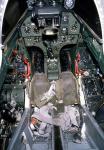
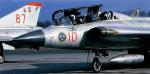
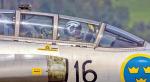
El piloto se sentaba en un sencillo asiento eyectable diseñado por SAAB, reclinado 30 grados para facilitar la gestión de las fuerzas G, bajo una cubierta que se abatía en la parte trasera. La cabina estaba presurizada y climatizada. El Draken contaba con tren de aterrizaje triciclo, con ruedas individuales en cada conjunto. El tren de aterrizaje delantero contaba con un guardabarros para operaciones en terrenos difíciles y se retraía hacia atrás, mientras que el tren principal se articulaba desde la raíz del ala para retraerse hacia afuera. Las patas del tren principal se contraían durante la retracción. Se instaló un paracaídas de frenado en la base del alerón de cola para reducir el balanceo de aterrizaje. Se proporcionó una turbina de aire de impacto emergente como potencia de emergencia.
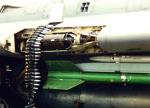
El J 35A estaba armado con dos cañones británicos tipo revólver Aden de 30 mm, uno en cada sección interior del ala, fuera de la entrada del motor. Cada cañón tenía 90 proyectiles. Un aspecto confuso del Draken es el número de pilones de almacenamiento, sobre todo porque cambió durante la evolución del avión. Parece que el J 35A originalmente tenía un solo pilón central y un pilón debajo de cada ala exterior. Cada pilón normalmente transportaba un misil aire-aire (MAA) Rb24, un MAA de búsqueda de calor AIM-9B Sidewinder estadounidense fabricado con licencia. Mientras que el pilón central era «húmedo» y solía usarse para transportar un tanque externo con una capacidad de 530 litros. El depósito contaba con dos aletas de cola. Se podía instalar un soporte de lanzamiento doble en el pilón central para que el Adam pudiera transportar un total de cuatro Rb24.
Las fotos de los Adam parecen mostrar que, en servicio, generalmente se conservaban con acabado metálico natural. Sin embargo, con el tiempo, la Flygvapnet dotó a la mayoría de sus Draken de un esquema de pintura de camuflaje conocido como «campos y prados», con un patrón disruptivo de verde oscuro y azul en la parte superior y azul grisáceo claro en la parte inferior.
El Adam era esencialmente un interceptor diurno, diseñado para la persecución de cola. Contaba con un radar PS-02/A, integrado en un sistema de control de fuego (FCS) francés Thomson-CSF Cyrano S6, fabricado por Ericsson, junto con un sistema IFF (identificación amigo-enemigo) PN-793/A. También se le instaló una copia sueca del piloto automático Lear L-14, fabricado en EE. UU. Algunos J 35A se modificaron posteriormente con el FCS SB6, que incluía un sensor infrarrojo de búsqueda y seguimiento (IRST) bajo el morro.
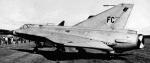
Se construyeron 90 J 35A en total. Los tres primeros eran aviones de preserie, mientras que los diecisiete siguientes eran máquinas de evaluación operativa que carecían de radar y otros elementos esenciales, por lo que no fue hasta el 21.º J 35A que el tipo alcanzó un estándar estable. Los últimos 28 fueron equipados con un postquemador EBK 66 mejorado, lo que, por cierto, resultó en un conjunto de motor largo. Esto exigió un fuselaje trasero más largo con contornos revisados. El cambio, a su vez, requería la instalación de un par de pequeñas ruedas de cola retráctiles para evitar que la parte trasera del avión rozara la pista durante despegues o aterrizajes con ángulos de ataque elevados. Los J 35A anteriores contaban con un pequeño parachoques sólido para este fin.
Las aeronaves con el postquemador EBK 66 podían equiparse con tres pilones cortos en el extremo de cada ala, cada uno de los cuales transportaba dos cohetes no guiados Bofors de 135 mm para una función secundaria de ataque terrestre.
El J 35A dio origen al siguiente modelo, el J 35B (Bertil). De hecho, el trabajo en el Bertil se había iniciado en 1956, incluso antes de que el Adam entrara en producción, con el plan de introducir una nueva variante del Draken con mayor empuje y aviónica mejorada lo antes posible. El prototipo J 35B, un J 35A modificado, realizó su primer vuelo el 29 de noviembre de 1959 y entró en servicio con la Flygvapnet en 1961.
Todos los J 35B se entregaron con el motor RM6B y sin aviónica de combate. Al parecer, se utilizaron simplemente para entrenamiento y evaluación hasta que se ajustaron a las especificaciones operativas, entre 1964 y 1965. El Bertil era casi idéntico al Adam, de fabricación tardía, con el fuselaje trasero más largo y las ruedas de cola dobles, pero incorporaba el sistema de control de vuelo SAAB S7, que introdujo la compatibilidad con la red sueca STRIL 60 (Stridsledning och Luftbevakning, Guiado de Combate y Vigilancia Aérea). Mientras que el J 35A se limitaba a interceptaciones de cola, el SAAB 37 FCS y la red STRIL 60 permitían al J 35B realizar intercepciones en curso de colisión, impactando al objetivo desde el frente o el lateral.
Dado que el Rb24 Sidewinder debía ser alineado con el escape del objetivo, era inútil para interceptaciones en curso de colisión, por lo que los J 35B equipados para la función de interceptor generalmente llevaban dos vainas de cohetes no guiados Bofors de 75 mm con aletas plegables y capacidad para 19 proyectiles, en un portacargas doble instalado en el soporte central. Estas vainas tenían un carenado en el morro, que los cohetes simplemente atravesaban. Este carenado dificultaba la distinción de la vaina de un depósito externo, salvo por su menor tamaño. El Bertil también podía utilizarse en una función secundaria de ataque terrestre, transportando cohetes de 135 mm.
Se construyeron un total de 73 J 35B, y SAAB conservó uno para pruebas y evaluación. Los J 35B recibieron algunas actualizaciones durante su servicio, entre las que destaca un nuevo asiento eyectable con mejor capacidad a baja altura y baja velocidad.
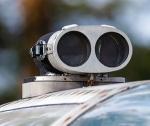
El J 35 era un avión bastante potente, por lo que se desarrolló una versión de entrenamiento biplaza en tándem, el Sk 35C (Caesar), cuyo primer vuelo tuvo lugar el 30 de diciembre de 1959. Sk significaba Skol, que significaba «escuela» o «entrenamiento». El instructor se sentaba en el asiento trasero, en una posición elevada, detrás del piloto cadete, y contaba con un periscopio estereoscópico para mejorar su visibilidad frontal, aunque aparentemente dejaba algo que desear.
Había una pantalla antiviento entre los asientos del alumno y del instructor para proteger al instructor en caso de impacto con aves u otro accidente que rompiera el parabrisas. La cubierta se abría lateralmente. El segundo asiento se instaló reduciendo el tamaño de los tanques de combustible del fuselaje, pero en compensación se eliminaron los dos cañones Aden, lo que permitió depósitos más grandes en las alas. El radar de intercepción aérea también se eliminó, pero el Caesar conservó los pilones de almacenamiento, y se podían transportar Sidewinders u otros MAA para entrenamiento.
Se reconstruyeron un total de 26 Caesar, incluyendo el prototipo, a partir de los primeros J 35A de producción, con el sistema de postcombustión Modelo 65 y fuselaje corto. A diferencia de los monoplazas, los Caesar no estaban camuflados, sino que volaron con acabado metálico natural durante toda su vida útil. En 1966, todos los Sk 35C fueron modificados con radios mejoradas, un radar de navegación y otros pequeños cambios. Un elemento particularmente visible de este programa de modificación fue la adición de una pequeña aleta bajo cada ala para mejorar la estabilidad de guiñada, que se había visto afectada por la nueva y amplia cabina.
Como se ha mencionado, SAAB esperaba obtener un motor mejorado para el J 35B, denominado RM6C, que era una copia del motor Rolls-Royce Avon 300, sustancialmente mejorado, equipado con el sistema de postcombustión sueco EBK 66. El RM6C podía proporcionar 56,4 kN (5.750 kgp) de empuje en seco y 76,8 kN (7.830 kgp) de empuje en postcombustión.
Cuando el RM6C finalmente estuvo disponible, se creó una nueva variante del Draken, el J 35D (David), que fue el primer Draken capaz de alcanzar Mach 2. El único cambio externo realmente notable con respecto al J 35B fue la modificación de las entradas de aire del motor, que se extendieron hacia adelante bajo la cubierta. Como era de esperar, el nuevo motor consumía más combustible que el anterior, por lo que el David contaba con una mayor capacidad de combustible. El J 35D también reemplazó el pilón central por dos pilones de fuselaje contiguos, ambos de tipo «húmedo»; los pilones de las alas también eran húmedos, lo que significaba que el David podía transportar cuatro tanques externos en lugar de uno.
Otras mejoras incluyeron un piloto automático SAAB FH5 que reemplazó la unidad Lear fabricada bajo licencia; un sistema de control de vuelo SAAB S7A mejorado con radar Ericsson PS-03; y un nuevo asiento eyectable propulsado por cohete SAAB 73SE-F, que podía operar desde altitud cero, pero requería una velocidad mínima de avance de 100 km/h para una eyección segura. El J 35D se actualizó posteriormente con el asiento eyectable SAAB RS35, un auténtico dispositivo de eyección cero-cero que permitía al piloto salir de forma segura incluso con el avión en la pista. Todos los Draken posteriores incorporarían este asiento de eyección cero-cero.
El prototipo J 35D, un J 35A modificado, realizó su primer vuelo el 27 de diciembre de 1960, pero las entregas a la Flygvapnet no comenzaron hasta 1963. Se construyeron 92 David. Algunos de los primeros J 35D de producción se entregaron sin radar, ya que el PS-03 no estaba listo para el servicio en ese momento.
SAAB desarrolló entonces una versión desarmada de reconocimiento fotográfico del J 35D, denominada S 35E (Erik), donde S significaba Spaning (Reconocimiento). Llevaba un total de siete cámaras OMERA de visión estrecha o gran angular, de diseño francés.
El cono frontal estaba montado sobre rieles, lo que facilitaba su extracción para acceder a las cámaras. El piloto contaba con una mira periscópica orientada hacia abajo para facilitar la toma de fotografías, y también contaba con una grabadora de voz en cabina que le permitía proporcionar comentarios junto con las imágenes de la misión. Por supuesto, el S 35E carecía de radar, pero, salvo estos cambios y la ausencia de cañón, era en general idéntico a un David. Podía llevar cuatro tanques externos, al igual que el David. También incorporaba un dispensador de bengalas en lugar de uno de los depósitos laterales.
Los primeros Erik de producción contaban con el motor RM6C con postcombustión EBK 66 y la misma cúpula utilizada en las versiones anteriores del Draken. Los Erik de producción tardía incorporaron el motor RM6C con el postquemador EBK 67 mejorado, que proporcionaba 78,5 kN (8.000 kgp de empuje de postcombustión, y también estaban equipados con una cubierta abultada introducida en el J 35F.
El prototipo S 35E, una conversión de un J 35D, realizó su primer vuelo el 27 de junio de 1963. El primer Erik de producción realizó su primer vuelo el 13 de mayo de 1965, y las entregas a la Flygvapnet comenzaron ese mismo verano. Se construyeron un total de 60 Erik. 28 de ellos se encargaron originalmente como David, pero se convirtieron en Erik en la línea de producción.
En la década de 1970, los Erik recibieron una actualización que incluía un conjunto de cámara de película modernizado; la posibilidad de transportar la cápsula de fotografía nocturna Vinten Blue Baron en un pilón central; y la instalación de un moderno y sofisticado sistema de contramedidas, con dispensadores de bengalas antiaéreas fijados a los laterales del escape del motor, además de dos pequeños módulos de interferencias en pilones especiales en el exterior de las alas.
El J 35D también dio origen a la variante definitiva del J 35, el J 35F (Filip), teniendo lugar el primer vuelo de un prototipo, un Adam modificado, el 22 de diciembre de 1961 y su entrada en servicio en 1965. El desarrollo se llevó a cabo con tres J 35A modificados, uno de los cuales se adaptó a una especificación de producción aproximada al J 35F completo.
El Filip era muy similar a un J 35D de producción tardía, con el motor RM6C y el postquemador EBK 67, así como la cubierta abombada. La principal mejora fue un sistema de control de vuelo (FCS) SAAB S37B en curso de colisión con radar Ericsson PS-01/A, utilizado junto con un nuevo esquema de armamento. El J 35F llevaba dos misiles guiados por radar semiactivos (SARH) Rb27 y un único Rb28 con guiado térmico o un Rb24 Sidewinder bajo cada ala. El Rb27 y el Rb28 eran misiles antiaéreos Hughes Falcon estadounidenses, construidos con licencia en Suecia. El SARH Rb27 era demasiado pesado para transportarlo en los pilones del ala, por lo que solo se podían transportar dos. El sistema de control de vuelo S37B trabajaba en conjunto con la red de control terrestre STRIL 60 a través de un enlace de datos para ayudar a apuntar los misiles Rb27.
El cañón Aden izquierdo se eliminó para dar cabida a nuevos sistemas de aviónica. El misil aire-aire Falcon tuvo poco uso en combate y su eficacia ha sido debatida, aunque hay que reconocer que la eficacia de todos los primeros MAA fue mediocre. No está claro cuán útil habría sido el armamento del J 35F si la situación hubiera llegado a un punto crítico; parece que el Draken nunca disparó un tiro en un ataque real. Sin embargo, los Falcon suecos no eran en absoluto simples copias de los modelos estadounidenses, y se hicieron grandes esfuerzos para mejorar su eficacia.
El Filip también contaba con una disposición mejorada de la cabina y sistemas actualizados de navegación, piloto automático y comunicaciones. Los J 35F de producción posterior se equiparon con un Hughes AN/AAR-4 (S-71N) IRST, construido bajo licencia por Ericsson. Los aviones con el IRST se designaron J 35F2, y los primeros, retroactivamente, J 35F1.
Se construyeron un total de 230 Filips. Fueron los últimos Draken de nueva construcción que sirvieron en Suecia. A finales de la década de 1960, SAAB propuso una nueva variante de caza de ataque, el JA 35 (JA significaba Jakt Attack). Incorporó un nuevo radar y otros equipos, y se realizaron pruebas en el túnel de viento con la configuración modificada. Sin embargo, la Flygvapnet se comprometió con el SAAB 37 Viggen, un avión multifunción de mayor capacidad, y el JA 35 no se materializó.
Los Draken de la Flygvapnet prestaron un excelente servicio durante las décadas de 1960 y 1970, pero el modelo comenzó a ser retirado a mediados de esa década comenzando por los primeros Adam y Bertil. La retirada gradual se aceleró a finales de la década de 1970 y principios de la de 1980, a medida que el Viggen se convertía en la columna vertebral del poder aéreo de la Flygvapnet.
Se aprobó un programa de actualización para mantener la utilidad del J 35F en la defensa aérea. Los aviones mejorados se denominaron originalmente J 35F Mod, pero cuando el primero regresó al servicio tras su ingreso en la fábrica, se les dio la designación J 35J (Johan). Lógicamente, el siguiente código de variante debería haber sido J 35G, pero estos aviones actualizados debían ir todos al Ala F10, y dado que la J es la décima letra del alfabeto, los mando de la Flygvapnet escogieron ese código.
Se realizaron un total de 67 actualizaciones de los J 35F-2 de baja potencia, siendo la última entregada en agosto de 1991. El J 35J recibió una actualización integral de aviónica, que incluyó mejoras en el radar, el FCS, el IRST, el equipo de navegación, la computadora y la modernización de la electrónica de la cabina. El único cambio realmente visible en el J 35J con respecto al J 35F fue la adición de un nuevo pilón de almacenamiento en la sección interior del ala, lo que dio un total de seis pilones.
Mientras los Draken monoplaza estuvieron en servicio, los Sk 35C debían estar presentes para brindar apoyo al entrenamiento, por lo que el Caesar también tuvo una vida útil más larga. No parece que el Sk 35C haya recibido actualizaciones importantes.
El último J 35J fue dado de baja en la Flygvapnet el 8 de diciembre de 1998, más de 40 años después del vuelo inicial del primer prototipo del Draken. Incluso en su vejez, el Draken era considerado una montura de consideración por los pilotos, ya que su rendimiento seguía siendo impresionante, y el hecho de que no fuera tan fácil de volar como aviones posteriores, como el Viggen, lo convertía en un desafío mayor.
Si bien los suecos, con una tradición de neutralidad militar, no suelen ser exportadores de armas agresivos, el Draken fue adquirido por varias naciones europeas. Las ventas tardaron un tiempo. En 1960, Suiza evaluó un J 35H Draken (H de Helvetia) como sustituto de sus anticuados De Havilland Vampire en la función de interceptor. El J 35H iba a estar equipado con el sistema de radar de rumbo de colisión Ferranti AI.23 Airpass, utilizado en el English Electric Lightning La evaluación del J 35H fue satisfactoria, pero Suiza optó por el Dassault Mirage III francés. Sin embargo, Dinamarca sí adquirió un Draken dedicado al ataque terrestre, junto con aviones de reconocimiento y entrenamiento. En 1968, el gobierno danés seleccionó un derivado del J 35F, denominado J 35X, para la Fuerza Aérea Danesa. El J 35X era similar al J 35F, pero contaba con mayor capacidad de combustible; una carga de combate externa máxima de 4.500 kg; refuerzo estructural; un nuevo ala exterior; un tren de aterrizaje más resistente para soportar mayores pesos; y un gancho de detención de pista. Curiosamente, este gancho había formado parte del diseño del Draken desde el principio, pero SAAB no lo había instalado en los aviones de la Flygvapnet.
Los daneses acabaron adquiriendo un total de 51 Draken. Se adquirieron tres variantes diferentes: la variante de ataque 35XD, conocida como F 35 en Dinamarca; el S 35XD, una variante de caza de reconocimiento designada RF 35; y el Sk 35XD, un entrenador biplaza codificado como TF 35.
Se entregaron 20 F-35 entre 1970 y 1971. El F-35 se adquirió para reemplazar al North American F-100D Super Sabre en la función de ataque terrestre. El F-35 carecía de radar. Contaba con dos cañones Aden, el nuevo pilón de almacenamiento en el ala interior, similar al del J-35J, y un segundo pilón de almacenamiento en cada ala exterior, lo que sumaba un total de ocho pilones de almacenamiento. Podía transportar cápsulas de cohetes no guiados y bombas, así como misiles antiaéreos Sidewinder para defensa propia y grandes tanques externos de 1.275 litros. Los daneses modificaron algunos de los grandes tanques externos para transportar el equipaje del piloto.
El F-35 recibió una serie de mejoras durante su servicio. A principios de la década de 1970, se instaló un receptor de alerta de radar (RWR) estadounidense AN/ALR-45, seguido posteriormente por dispensadores de señuelos en el cono de cola. El RWR se actualizó posteriormente al AN/ALR-65. En la década de 1980, los F 35 se sometieron a un exhaustivo programa de actualización del Sistema de Entrega y Navegación de Armas (WDNS), que los convirtió en aviones de ataque altamente capaces y modernos.
En 1971-72 se entregaron 20 cazas de reconocimiento RF 35 para reemplazar a los RF-84F Thunderflash de Dinamarca. Estos Draken de reconocimiento contaban con un morro con cámara, derivado del instalado en el S 35E, y también se les proporcionaron cápsulas de reconocimiento infrarrojo Vinten Red Baron a mediados de la década de 1970. Los RF 35 no tenían cámaras en las alas. Conservaron dos cañones Aden y contaban con pilones de almacenamiento, lo que les otorgaba una capacidad de ataque secundario. Recibieron la actualización WDNS en la década de 1980, aunque no recibieron el LRMTS Ferranti.
Se adquirieron once entrenadores TF 35 en dos lotes. Seis se entregaron en 1971-72 como parte del pedido de los F 35 y RF 35, y un lote adicional de cinco se entregó en 1976-77. Estas aeronaves eran similares a los Sk 35C suecos, con una cubierta doble y un periscopio estereoscópico para el asiento trasero, pero estaban equipadas con motores RM6C y postcombustión EBK 67, y tenían capacidad de combate, conservando un solo cañón Aden. Podían transportar módulos de interferencia A-38K para misiones de contramedidas electrónicas. Los TF 35 también recibieron la actualización completa WDNS, incluyendo el LRMTS en el morro modificado.
Además, los daneses adquirieron cinco S 35E y dos J 35F, todos ellos antiguos aviones de la Flygvapnet, como cascos de repuesto. Se esperaba que los Draken daneses siguieran en servicio hasta bien entrada la década de 1990, pero en 1993 dejaron de operar oficialmente, ya que el fin de la Guerra Fría había provocado recortes en el presupuesto de defensa.
En 1970, Finlandia decidió adquirir los Draken, gestionando la compra de doce J 35S, conocidos como interceptores J 35XS, desmontados para su ensamblaje local por Valmet. La S significaba Suomi (Finlandia). Estos aviones eran similares al J 35F, pero contaban con dos cañones Aden y un sistema de aviónica revisado. El vuelo inicial tuvo lugar en 1974, y las entregas se completaron en 1975. Los Draken finlandeses sirvieron tanto como interceptores como cazabombarderos.
Como medida provisional para proporcionar experiencia de entrenamiento antes de que los cazas J 35XS estuvieran disponibles, los finlandeses alquilaron seis J 35B a Suecia, designándolos J 35BS. Al parecer, a estos aviones se les despojó de la mayor parte de su aviónica de combate. El primero se entregó en 1972.
En 1975, los finlandeses adquirieron un segundo lote de J 35FS Draken en 1984, todos ellos aviones de la Flygvapnet reacondicionados. Además de ellos, en 1975 los finlandeses adquirieron tres aviones de entrenamiento Sk 35C adaptados, con la designación Sk 35CS, y adquirieron dos Caesar más en 1984, junto con el segundo lote de J 35FS Draken. Esta historia, algo compleja, resultó en una fuerza total de 48 Draken.
Los Draken finlandeses prestaron servicio hasta el siglo XXI, siendo finalmente retirados en favor de los nuevos cazas F/A-18 Hornet. El último Draken finlandés fue retirado del servicio en agosto de 2000.
El último usuario del Draken fue Austria. Tras considerar diversas opciones para reemplazar los SAAB 29 Tunnan, que habían dejado de operar en 1972, Austria optó por el J 35D, adquiriendo 24 de ellos en 1985. Los aviones fueron acondicionados y modernizados en cierta medida, por ejemplo, equipándolos con cúpulas abombadas similares a las del J 35F. Se entregaron entre 1987 y 1989.
Los Draken austriacos recibieron la designación J 35Ö (Ö significaba Öesterreich, Austria). Austria no adquirió ningún Sk 35C, ya que el entrenamiento de vuelo se impartió en Suecia como parte del paquete de venta. Algunos Sk 35C se mantuvieron en servicio en Suecia tras la retirada del J 35J para este fin.
Los J 35Ö se utilizaron principalmente como interceptores, aunque Austria también adquirió cápsulas de reconocimiento. Los Draken austriacos solían pintarse con un impecable camuflaje de superioridad aérea en dos tonos de gris. Inicialmente, los J 35Ö estaban armados únicamente con sus dos cañones Aden, ya que los acuerdos de neutralidad de Austria impedían que los cazas llevaran el Sidewinder u otros MAA. Tras la caída de la URSS, las normas se flexibilizaron y, en 1993, Austria adquirió Sidewinder suecos sobrantes para armar sus J 35Ö. Los Draken austriacos también fueron equipados con RWR y dispensadores de bengalas, recuperados de Draken daneses retirados. La actualización fue realizada por Valmet de Finlandia.
Se suponía que los J 35Ö serían retirados del servicio en 1998, pero encontrar un sustituto resultó una tarea ardua. Los últimos Draken fueron retirados del servicio en noviembre de 2005, siendo reemplazados a corto plazo por cazas Northrop F-5E Tiger II alquilados a Suiza, y posteriormente por Eurofighter de los primeros modelos.
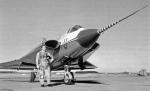
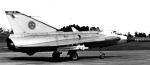
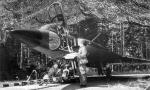
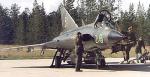
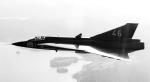
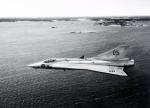
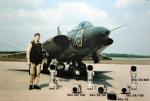
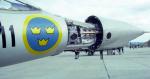
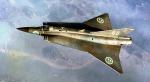
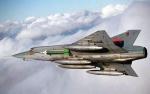
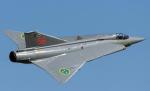
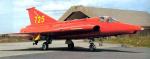
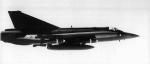
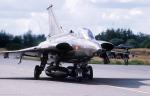

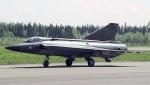
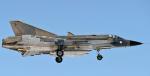
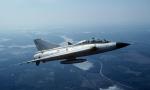
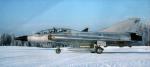
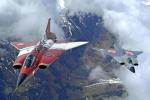
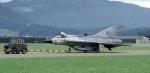
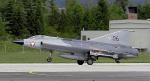
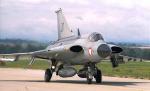
In 1949, the Royal Swedish Air Board issued a request with the designation Project 1200 for a new interceptor that would follow the SAAB 29 Tunnan, then about to go into service with the Flygvapnet (Swedish Air Force). This new aircraft was to have a speed of at least Mach 1.4; be able to operate off specially-built sections of public roadway under the Swedish Base 90 distributed airbase scheme; and was to be rugged, easily maintained, and cheap to operate.
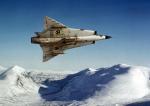
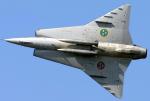
A SAAB engineering team under Erik Bratt examined a number of options, but finally focused on a delta-wing design under the follow-on Project 1250, with the aircraft a radical sweepback of 70 degrees. Further design studies led to a double delta scheme, featuring a thick inner delta with a sweep of 80 degrees providing accommodation for fuel and landing gear, and a thin outer delta with a sweep of 57 degrees providing additional lift for low-speed flight and short-field operation, while retaining low-drag characteristics for high-speed flight.
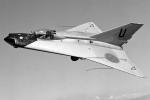
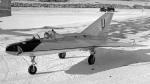
Nobody had ever flown a double delta aircraft before. After some wind tunnel experiments and flights of pulsejet-powered models on pivot line around a pole, the wing scheme was validated using a 70% scale demonstrator aircraft, the SAAB 210, nicknamed the LillDraken (Little Dragon).
The first full flight of the LillDraken was on 21 January 1952, with SAAB test pilot Bengt Olow at the controls. The SAAB 210 was powered by an Armstrong Siddeley Adder turbojet with 3.92 kN (400 kgp / 880 lbf) thrust. That wasn’t enough power because the intake scheme did not provide enough airflow and so the entire forward fuselage was finally redesigned, modifying it with a long nose and moving the intakes back. The final configuration was given the designation of SAAB 210B, earlier configurations retroactively becoming the SAAB 210A.
In August 1953, the Swedish government ordered three prototype and three preproduction SAAB 35 Draken fighters, based on the LillDraken design. The British Avon 200 turbojet was selected as the powerplant for the production machine. A license was obtained by Svenska Flygmotor (later Volvo Flygmotor) to manufacture the Avon.
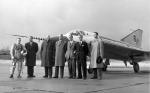
The first of the three SAAB 35 prototypes flew on 25 October 1955, again with Olow at the controls. It was originally powered by a non-afterburning Svenska Flygmotor RM5A engine, a copy of the Avon Mark 21 and the same engine used to power the SAAB 32 Lansen, but the prototype was later re-engined with a more powerful non-afterburning Avon Mark 43 engine, one of six provided by Rolls-Royce. With the improved engine, the initial prototype broke Mach 1 in level flight on 26 January 1956.
Unfortunately, the first prototype suffered damage during a belly landing on 19 April 1956. The second prototype, with a still more powerful Avon Mark 46 engine, had performed its first flight in March 1956, but it had bellied in a week before the accident that laid up the first prototype, and for the moment the program was dead in the water as far as flight tests were concerned. The third prototype was in the air in September 1956 and flight tests resumed, with the other two machines eventually repaired and rejoining the program.
The type was approved for full production in 1956 as the J 35A (Adam) where J stood for Jakt (Fighter). By that time the specifications had been raised, dictating a fighter with a top speed of Mach 1.8. Two more prototypes were built with J 35A features, both flying in 1958. The first, which was actually the fifth prototype in the number sequence, was originally fitted with an imported Avon Mark 48A engine, but later refitted with the equivalent Swedish-built RM6B engine, which was to be the production J 35A powerplant. The second, the fourth prototype in the number sequence, had the RM6B engine from the outset. Following successful evaluation of the prototypes, the J 35A was put into series production. First deliveries to the Flygvapnet were in March 1960.
The Draken proved to have excellent performance and was, for such a «hot» machine, relatively straightforward to fly. It did have some unpleasant quirks that needed to be worked out. For example, in initial service it proved to be touchy around the pitch (nose up / down) axis, resulting in nasty oscillations that led to some crashes. Less sensitive flight control system modifications were retrofitted to early aircraft and got the problem under control.
The only fundamental limitations of the type, common to jet aircraft of that era, were that it had limited range and endurance, and as a delta it had a relatively long takeoff run, since it was difficult to get flaps to work effectively with it. The Draken was easy to maintain, with the fuselage bolted together at midsection to make it straightforward to pull apart for engine access. The outer wing sections could be easily removed for shipping or storing the aircraft.
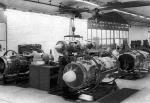
Flight control was provided by a rudder and elevons running the width of the rear of the wing. The elevons operated in unison for pitch control and in opposition for roll control. The elevons were split, with one on the inboard section of each wing and the other on the outboard section. The flight control surfaces were driven by a dual redundant hydraulic system. There was a small airbrake on either side of the fuselage, near the end of the wing. Initial production Adams featured the RM6B engine with a Swedish-designed EBK 65 afterburner, providing 47.1 kN (4,800 kgp / 10,600 lbf) dry thrust and 66.7 kN (6,800 kgp / 15,000 lbf) afterburning thrust.
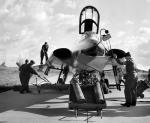
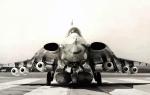
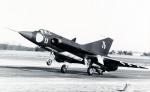
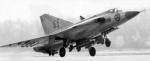
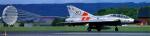
The pilot sat in a simple SAAB-designed ejection seat, reclined 30 degrees to help deal with gee forces, under a clamshell-style canopy that hinged on the rear. The cockpit was pressurized and air-conditioned. The Draken had tricycle landing gear, with single wheels on each assembly. The nose gear had a mudguard for rough field operation and retracted backward, while the main gear hinged from the wing root to retract outward into the wing. The main gear legs contracted during retraction. A drag chute was fitted at the base of the tailfin to reduce landing roll. A pop-up ram-air turbine was provided for emergency power.
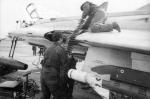
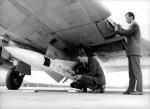
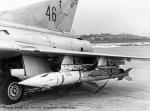
The J 35A was armed with twin 30mm British Aden revolver-type cannon, with one cannon in each inner wing section, outboard of the engine intake. There were 90 rounds per gun. One confusing issue about the Draken is the number of stores pylons, particularly since it changed during the aircraft’s evolution. It appears that the J 35A originally had a single centerline pylon and a pylon under each outer wing. Each wing pylon normally carried a single Rb24 air-to-air missile (AAM), which was a license-built US AIM-9B Sidewinder heat-seeker AAM; while the centerline pylon was «wet» and was usually used to carry an external tank with a capacity of 530 liters (140 US gallons). The tank featured twin tailfins. A dual launch rack could be fitted to the centerline pylon to permit the Adam to carry a total of four Rb24s.
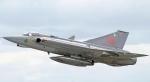
Photos of Adams seem to show that they were generally left in natural metal finish in service. However, eventually the Flygvapnet would give most of their Drakens a camouflage paint scheme known as «fields & meadows», with a disruptive pattern of dark green and blue on top and light blue-gray on the belly.
The Adam was essentially a day interceptor, intended for tail chase pursuit. It featured PS-02/A radar, integrated into an Ericsson-built French Thomson-CSF Cyrano S6 fire-control system (FCS) along with a PN-793/A IFF (identification friend or foe) system. A Swedish copy of the US-built Lear L-14 autopilot was also fitted. A few J 35As were later modified with the SB6 FCS, which included an infrared search and track (IRST) sensor under the nose.
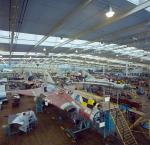
90 J 35As were built in all. The first three were pre-series aircraft, while the next seventeen were operational evaluation machines lacking radar and other essentials, and so it wasn’t until the 21st J 35A that the type reached a stable standard. The last 28 were fitted with an improved EBK 66 afterburner, which incidentally resulted in a long engine assembly, demanding a longer rear fuselage with revised contours. This in turn demanded fit of a pair of small retractable «roller skate» tailwheels to keep the rear of the aircraft from scraping the runway during high angle of attack takeoffs or landings. Earlier J 35As had a small solid bumper for this purpose.
Machines with the EBK 66 afterburner could be fitted with three stub pylons at the end of each wing, with each pylon carrying two Bofors 135mm (5.3in) unguided rockets for a secondary ground attack role.
The J 35A led to the next model, the J 35B (Bertil). Work on the Bertil had actually been initiated in 1956, even before the Adam went into production, the plan being to introduce a new Draken variant with more thrust and improved avionics as soon as possible. The J 35B prototype, a modified J 35A, performed its initial flight on 29 November 1959, and the type entered service with the Flygvapnet in 1961.
All J 35Bs were delivered with the RM6B engine and no combat avionics. Apparently they were simply used for training and evaluation until they could be brought up to operational spec, in the 1964-1965 timeframe. The Bertil looked almost identical to the late-build Adam, with the longer rear fuselage and twin tailwheels, but featured the SAAB S7 FCS, which introduced support for the Swedish STRIL 60 (Stridsledning och Luftbevakning / Combat Guidance & Air Surveillance) network. While the J 35A had been limited to tail-chase intercepts, the SAAB 37 FCS and the STRIL 60 network allowed the J 35B to perform «collision course» intercepts, hitting the target from the front or the side.
Since the Rb24 Sidewinder had to be boresighted on a target’s exhaust, it was useless for collision course intercepts, and so J 35Bs fitted for the interceptor role generally carried two 19-round Bofors 75mm (3in) folding-fin unguided rocket pods on a dual stores rack fitted to the centerline pylon. These rocket pods had a «frangible» fairing on the nose that the rockets simply blasted through, with the fairing making the pod hard to distinguish from an external tank, except that it was smaller. The Bertil could also be used in a secondary ground-attack role, carrying 135mm rockets.
73 J 35Bs were built in all, with one retained by SAAB for test and evaluation purposes. J 35Bs received some updates in service, most significantly a new ejection seat with improved low-level, low-speed capability.
The J 35 was a fairly hot aircraft, and so a tandem two-seat trainer version, the Sk 35C (Caesar) was developed, first flying on 30 December 1959. The Sk stood for Skol, meaning of course «school» or «training». The instructor sat in the rear seat in a raised position behind the cadet pilot, and had a stereoscopic periscope to improve his forward visibility, though it apparently left something to be desired.
There was a windblast screen between the student and instructor seats to protect the instructor in case of a bird strike or other accident broke the windscreen. The canopy opened to the side. The second seat was fitted by reducing the size of the fuselage fuel tanks, but in compensation the two Aden cannon were deleted, allowing larger fuel tanks in the wings. Air-intercept radar was deleted as well, but the Caesar retained stores pylons, and Sidewinders or other AAMs could be carried for training.
A total of 26 Caesars, including the prototype, were rebuilt from early production J 35As, with the Model 65 afterburner and short fuselage. Unlike the single-seat Flygvapnet Drakens, the Caesars were not camouflaged, flying in natural metal finish through their careers. In 1966, all the Sk 35Cs were modified with improved radios, a navigation radar, and other small changes. A particularly visible element of this modification program was the addition of a small fin under each wing to improve yaw stability, which had been degraded by the new big canopy.
As mentioned, SAAB had been hoping to obtain an uprated engine for the J 35B, designated the RM6C, which was a copy of the substantially uprated Rolls-Royce Avon 300 «big bore» engine, fitted with the Swedish EBK 66 afterburner. The RM6C could provide 56.4 kN (5,750 kgp / 12,700 lbf) dry thrust, and 76.8 kN (7,830 kgp / 17,260 lbf) afterburning thrust.
When the RM6C finally became available, it resulted in a new Draken variant, the J 35D (David), which was the first Mach 2 Draken. The only really noticeable external change from the J 35B was that the engine inlets were modified, being extended forward under the canopy. The new engine was unsurprisingly thirstier than the old, and so the David featured increased fuel capacity. The J 35D also replaced the centerline pylon with twin side-by-side fuselage pylons, both of which were «wet»; the wing pylons were also wet, meaning the David could carry four external tanks instead of one.
Other improvements included a SAAB FH5 autopilot replacing the license-built Lear unit; an improved SAAB S7A FCS with Ericsson PS-03 radar; and a new SAAB 73SE-F rocket-boosted ejection seat, which could operate from zero altitude but required a minimum forward speed of 100 km/h (62 mph) for safe ejection. The J 35D was later updated with the SAAB RS35 ejection seat, which was a true zero-zero device that could get the pilot out safely even if the aircraft was sitting on the runway. All later Drakens would feature this zero-zero seat.
The prototype J 35D, a modified J 35A, performed its first flight on 27 December 1960, but deliveries to the Flygvapnet only began in 1963. 92 Davids were built. Some early production J 35Ds were delivered without radar, since the PS-03 was not ready for service at the time.
SAAB then developed an unarmed photo-reconnaissance version of the J 35D, designated the S 35E (Erik), where S stood for Spaning (Reconnaissance). It carried a total of seven French-designed OMERA narrow-view or wide-angle cameras.
The nose cone was mounted on rails so it could be easily slid out for access to the cameras. The pilot had a downward-staring periscopic sight to help target photographs, and also had a cockpit voice tape recorder to allow him to provide a commentary along with mission imagery. Of course, the S 35E had no radar, but aside from these changes and the lack of cannon, it was generally identical to a David. It could carry four external tanks, just like the David. A chaff-flare dispenser could be carried in place of one of the wing tanks.
Early production Eriks had the RM6C engine with the EBK 66 afterburner, and the same canopy used on earlier Draken variants. Late production Eriks featured the RM6C engine with the improved EBK 67 afterburner, which provided 78.5 kN (8,000 kgp / 17,640 lbf) afterburning thrust, and were also fitted with a bulged canopy introduced on the J 35F.
The S 35E prototype, a conversion of a J 35D, performed its first flight on 27 June 1963. The first production Erik performed its initial flight on 13 May 1965, with deliveries to the Flygvapnet beginning that summer. A total of 60 Eriks was built. 28 of these were originally ordered as Davids, but converted to Eriks on the production line.
In the 1970s, the Eriks were given an «apparat 15» upgrade that included a modernized film-camera suite; the ability to carry the Vinten Blue Baron night-photography pod on a centerline pylon; and fit of a modern, sophisticated countermeasures system, with chaff-flare dispensers tacked onto the sides of the engine exhaust, plus two small jammer pods on special pylons on the outer wings.
The J 35D also led to the definitive J 35 variant, the J 35F (Filip), with first flight of a prototype, a modified Adam, on 22 December 1961 and service introduction in 1965. Development was conducted with three modified J 35As, one of which was brought up to an approximation of full J 35F production specification.
The Filip was much like a late-production J 35D, with the RM6C engine and EBK 67 afterburner, as well as the bulged canopy. The major improvement was a SAAB S37B collision-course FCS with Ericsson PS-01/A radar, used in conjunction with a new armament scheme, with the J 35F carrying two semi-active-radar-homing (SARH) Rb27 AAMs and a single heat-seeking Rb28 AAM or an Rb24 Sidewinder AAM under each wing. The Rb27 and Rb28 were US Hughes Falcon AAMs built under license in Sweden. The SARH Rb27 was too heavy to be carried on the wing pylons, which is why only two could be carried. The S37B FCS worked in conjunction with the STRIL 60 ground-control network over a datalink to help target the Rb27 missiles.
The left Aden cannon was deleted to accommodate new avionics systems. The Falcon air-to-air missile (AAM) saw little combat use and its effectiveness has been debated, though it must be acknowledged the effectiveness of all early AAMs was unimpressive. It is unclear how useful the J 35F’s armament would have been if things had come to a shooting match; it appears the Draken never fired a shot in anger. However, the Swedish Falcons were by no means simple copies of the American models, and much was done to improve the weapon’s effectiveness.
The Filip also featured an improved cockpit layout and updated navigation, autopilot, and communications systems. Later production J 35Fs were fitted with a Hughes AN/AAR-4 (S-71N) IRST, built under license by Ericsson. Machines with the IRST were designated J 35F2, with the early machines retroactively designated J 35F1.
A total of 230 Filips was built. They were the last new-build Drakens for Swedish service. In the late 1960s, SAAB proposed a new-build fighter-attack variant, the JA 35, where JA stood for Jakt Attack. It featured new radar and other kit, and wind-tunnel tests were performed on the modified configuration. However, the Flygvapnet was committed to the more capable multirole SAAB 37 Viggen, and the JA 35 was a non-starter.
The Flygvapnet’s Draken force provided excellent service through the 1960s and 1970s, but the type began to be removed in service in the mid-1970s with the retirement of the early Adams and Bertils. The phasing out of the Draken force accelerated in the late 1970s and early 1980s as the Viggen became the backbone of Flygvapnet air power.
A Filip update program was approved to maintain the J 35F’s usefulness in the air defense role. The upgraded aircraft were originally referred to J 35F Mod, but by the time the first of them were returned to service after their trip back to the factory, they were given the designation of J 35J (Johan). Logically speaking the next variant code should have been J 35G, but these updated machines were to all go to F10 Wing, and since J is the tenth letter of the alphabet Flygvapnet brass decided that would be the best suffix code.
67 upgrades from low-time J 35F-2s were performed in all, with the last re-delivered in August 1991. The J 35J received a comprehensive avionics upgrade, including improved radar, FCS, IRST, navigation gear, computer, and some modernized cockpit electronics. The only really visible change in the J 35J from the J 35F was the addition of a new stores pylon on the inner section of the wing, giving a total of six pylons.
Incidentally, as long as single-seat Drakens were in service, Sk 35Cs had to be around to provide training support, and so the Caesar had an extended service life as well. It doesn’t appear that the Sk 35C was ever given any major updates.
The last J 35J was phased out of formal service with the Flygvapnet on 8 December 1998, over 40 years after the initial flight of the first Draken prototype. Even in its old age, the Draken was regarded as a prize mount by Flygvapnet pilots, since its performance was still impressive, and the fact that it wasn’t as easy to fly as later aircraft, such as the Viggen, made it more of a challenge.
While the Swedes, with a custom of military neutrality, are not traditionally aggressive arms exporters, the Draken was purchased several European nations. It took some time to make sales. In 1960, the Swiss evaluated a J 35H Draken, where H stood for «Helvetia», as a replacement for their antiquated de Havilland Vampires in the interceptor role. The J 35H was to be fitted with Ferranti AI.23 Airpass collision-course radar system, used in the English Electric Lightning. The evaluation of the J 35H went well, but the Swiss opted for the French Dassault Mirage III instead. However, Denmark did acquire a dedicated ground-attack Draken, along with reconnaissance and trainer machines. In 1968, the Danish government selected a J 35F derivative designated the J 35X for the Danish Air Force. The J 35X was similar to the J 35F, but had greater fuel capacity; a maximum external warload of 4,500 kg (10,000 lb); structural reinforcement; a new outer wing; stronger landing gear to handle greater weights; and a runway arresting hook. Interestingly, the runway arresting hook had been part of the Draken design from the start, but SAAB hadn’t fitted it to Flygvapnet aircraft.
The Danes ended up buying a total of 51 Drakens. Three different variants were obtained: A 35XD atttack variant, known as F 35 in Danish service; the S 35XD, a reconnaissance-fighter variant designated RF 35; and the Sk 35XD, a two-seat trainer coded as TF 35.
20 F 35s were delivered in the 1970-71 timeframe. The F 35 was bought to replace the North American F-100D Super Sabre in the ground attack role. The F 35 lacked radar. It had two Aden cannon, the new stores pylon on the inner wing as fitted on the J 35J, and a second stores pylon on each outer wing, giving a total of eight stores pylons. It could carry unguided rocket pods and bombs, as well as Sidewinder AAMs for self-defense and large 1,275 liter (336 US gallon) external tanks. The Danes modified some of the large external tanks to carry pilot luggage.
The F 35 received a series of upgrades during its service career. In the early 1970s, a US AN/ALR-45 radar warning receiver (RWR) was installed, to be followed later in the decade by chaff-flare dispensers, fitted in the tailcone. The RWR was later updated to the AN/ALR-65. In the 1980s, the F 35s were put through a comprehensive «Weapons Delivery & Navigation System (WDNS)» upgrade program that made them highly capable and modern strike aircraft.
20 RF 35 reconnaissance-fighters were delivered in 1971-72 to replace Denmark’s Republic RF-84F Thunderflashes. These reconnaissance Drakens featured a camera nose, a derivative of that fitted to the S 35E, and were also provided with Vinten Red Baron infrared reconnaissance pods in the mid-1970s. The RF 35s did not have wing cameras. They retained twin Aden cannon and had stores pylons, giving them a secondary attack capability. They were given the WDNS upgrade in the 1980s, though of course they did not get the Ferranti LRMTS.
Eleven TF 35 trainers were purchased in two batches. Six were delivered in 1971-72 as part of the order for the F 35s and RF 35s, with an additional batch of five delivered in 1976-77. These machines were similar to Swedish Sk 35Cs, with a tandem canopy and a stereoscopic periscope for the back-seater, but were fitted with RM6C engines and EBK 67 afterburners, and were combat-capable, retaining a single Aden cannon. They could carry A-38K jammer pods for electronic countermeasures missions. The TF 35s were also given the complete WDNS upgrade, including the LRMTS in the modified nose.
In addition, the Danes acquired five S 35Es and two J 35Fs, all ex-Flygvapnet machines, as spares hulks. The Danish Drakens were expected to serve well into the 1990s, but they were out of formal service by 1993, since the end of the Cold War had led to defense cutbacks.
In 1970, Finland decided to obtain the Draken, arranging to buy twelve J 35S known as J 35XS interceptors in kit form for local assembly by Valmet. S stood for Suomi (Finland). These machines were similar to the J 35F, but had twin Aden cannon and a revised avionics suite. Initial flight was in 1974, with deliveries completed in 1975. The Finnish Drakens served in both the interceptor and fighter-bomber roles.
As an interim measure to provide training experience before the J 35XS fighters were available, the Finns leased six J 35Bs from Sweden, giving them the designation J 35BS. These aircraft were apparently stripped of most of their combat avionics. The first was delivered in 1972.
In 1975, the Finns bought a second batch of J 35FS Drakens in 1984, again all refurbished Flygvapnet aircraft. In addition to the refurbished fighters, in 1975 the Finns obtained three refurbished Sk 35C trainers with the designation of Sk 35CS, and purchased two more refurbished Caesars in 1984, along with the second batch of J 35FS Drakens. This somewhat complicated history gave a total Finnish Draken force of 48 aircraft.
Finnish Drakens served into the 21st century, finally being withdrawn in favor of Finland’s new F/A-18 Hornet fighters. The last Finnish Draken was removed from service in August 2000.
The final user of the Draken was Austria. After considering a number of options for a replacement for the country’s SAAB 29 Tunnans, which had gone out of service in 1972, the Austrians settled on used Flygvapnet J 35Ds, buying 24 of them in 1985. The aircraft were refurbished and modernized to an extent, for example being fitted with bulged J 35F-style canopies. They were delivered in the 1987-89 timeframe.
The Austrian Drakens were given the designation of J 35Ö (Ö stood for Öesterreich, Austria). Austria did not buy any Sk 35Cs, flight training being provided in Sweden as part of the sales package. A few Sk 35Cs were retained in operation in Sweden after retirement of the J 35J for this purpose.
The J 35Ös were used as primarily as interceptors, though the Austrians did obtain reconnaissance pods as well. Austrian Drakens were usually painted in a very tidy two-tone gray air-superiority camouflage scheme. Initially, the J 35Ös were solely armed with their twin Aden cannon, since Austria’s neutrality agreements prevented the fighters from carrying Sidewinders or other AAMs. After the fall of the USSR the rules were relaxed, and in 1993 the Austrians acquired surplus Swedish Sidewinders to arm their J 35Ös. The Austrian Drakens were also then fitted with RWRs and chaff-flare dispensers, salvaged from retired Danish Drakens. The upgrade was performed by Valmet of Finland.
The J 35Ös were supposed to be retired from service in 1998, but finding a replacement proved time-consuming. The last Drakens were withdrawn from service in November 2005, being replaced over the short term by Northrop F-5E Tiger II fighters leased from Switzerland, and later by early-model Eurofighters.
FUENTES Y REFERENCIA – SOURCES & REFERENCE
airvectors.net
Ugolok Neba
commons.wikimedia.org
aviadejavu.ru
©jmodels.net
 jmodels.net
Debe estar conectado para enviar un comentario.