
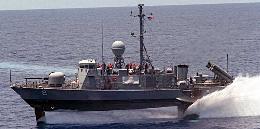
| DATOS TÉCNICOS | TECHNICAL DATA |
| TIPO: Hidroala rápida de ataque. | TYPE: Fast attack hydrofoil. |
| CONSTRUCTOR: Boeing Marine Systems, Renton (Washington, EE.UU. | BUILDER: Boeing Marine Systems, Renton (Washington, USA). |
| BOTADURA: 1974-1982 | LAUNCHED: 1974-1982 |
DESPLAZAMIENTO:
|
DISPLACEMENT:
|
| ESLORA: 41 m. | LENGTH: 133 ft. |
| MANGA: 8,5 m. | BEAM: 28 ft. |
| PUNTAL: 7,10 m. | DRAUGHT: 23.29 ft. |
VELOCIDAD MÁX.:
|
MAX. SPEED:
|
| AUTONOMÍA: 600 mil. náut. (1.111 km) a 40 nudos (74 km/h). | RANGE: 600 nm (690 ml) at 40 knots (46 mph). |
PROPULSIÓN:
|
PROPULSION:
|
ARMAMENTO:
|
ARMAMENT:
|
CONTRAMEDIDAS:
|
COUNTERMEASURES:
|
SENSORES:
|
SENSORS:
|
| TRIPULACIÓN: 21 | CREW: 21 |
| CONSTRUIDOS: 6 | BUILT: 6 |
Los hidroplanos de la clase Pegasus fueron una clase de seis embarcaciones de ataque rápido construidos para la Marina de los EE. UU. entre 1973 y 1982. Estos barcos se describen como el punto culminante del desarrollo de los hidroplanos en la Marina, ya que, de hecho, fueron la primera clase y la única de hidroplanos en servicio que constaban de varias unidades, ya que las clases anteriores que tenían capacidades de hidroplano solo contaban con solo una unidad.
Los orígenes de esta clase se remontan a los años 60, cuando la OTAN vio la necesidad de una clase de buques de guerra pequeños y rápidos que fueran capaces de hacer frente a la gran cantidad de naves con misiles que utilizaba el Pacto de Varsovia, como las clases Komar y Osa, y concluyeron que un hidroplano sería el mejor tipo de buque para cumplir esta función. En los años 70, el almirante Elmo Zumwalt, el nuevo Jefe de Operaciones Navales de la Armada de los Estados Unidos, interesado en construir más buques de superficie de una manera rentable para la Armada, decidió seguir adelante con el programa de hidroplanos que la OTAN había iniciado y, como resultado, la Armada propuso que el diseño PHM fuera un estándar de la OTAN, mediante un programa liderado por la Armada de los EE. UU., que realizó un pedido de dos prototipos en 1972. Después de esto, las armadas italiana y alemana occidental firmaron acuerdos de colaboración para participar en el programa junto con la Royal Navy y las Marina canadiense. El acuerdo suponía que los EE. UU. adquirirían 30 barcos, mientras que Alemania compraría entre 10 y 12, e Italia otras cuatro unidades, aunque durante las primeras etapas del proyecto se había previsto que se construirían 100 buques para las armadas de la OTAN.
Sin embargo, el programa dio un giro fatal poco después, ya que, una vez que Zumwalt se retiró, la Armada de los EE. UU. decidió reducir drásticamente el programa debido a la falta de fondos disponibles y, en su lugar, invertir el dinero en buques más grandes, lo que básicamente terminaría siendo el principal factor para acabar con el programa, ya que la reducida financiación causó que el costo del proyecto fuera cada vez más caro. Todo ello provocó que en 1974 solo se había construido el Pegasus, primera unidad de la serie. Sin poder botar más buques, la Armada estaba a punto de quedarse con un único barco de su clase.
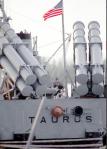
El programa sería rescatado por el Congreso de Estados Unidos, que se había cansado del ritmo del programa y obligó a la Armada a completar el Pegasus y otros cinco buques. Las armadas alemana e italiana se retiraron del programa debido al aumento de los costos y, como resultado, solo se construirían finalmente las seis unidades iniciales, que fueron bautizadas Pegasus (PHM-1) (anteriormente se iba a denominar Delphinus), Hércules (PHM-2), Taurus (PHM-3), Aquila (PHM-4), Aries (PHM-5) y Gemini (PHM-6), además del Pegasus, que se había puesto en grada en 1973. El resto de los barcos se pusieron en grada en 1979 o 1980. El Pegasus entraría en servicio en 1977 y el resto de los barcos harían lo propio entre 1981 y 1982.
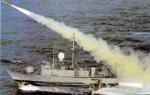
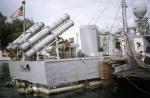
Los barcos estaban armados con un cañón OTO Melara de 76 mm y dos lanzadores de misiles superficie-superficie Harpoon de cuatro celdas, aunque, si era necesario, los barcos podían reducir el número de misiles a tres, dos o incluso uno por lanzador. Debido a que el Pegasus fue el primero en ser botado, tenía sistemas ligeramente diferentes en su equipo electrónico. Los barcos estaban propulsados por motores diésel Mercedes-Benz biturbo de 2.800 hp (600 kW) cuando navegaban, utilizando hidrojets fabricados por Aerojet, que proporcionaban una velocidad de 12 nudos (22 km/h; 14 mph). Sin embargo, cuando utilizaban sus hidroplanos, empleaban una turbina de gas General Electric LM2500 y un chorro de agua muy grande, lo que les daba una velocidad de más de 48 nudos (89 km/h; 55 mph). Los hidroplanos tenían una tripulación de 4 oficiales y 17 soldados, lo que hacía un total de 21 miembros.
Pasarían su servicio activo la base aeronaval de Key West y, aunque nunca tendrían que lidiar con la gran cantidad de naves con misiles del Pacto de Varsovia, demostraron ser excelentes buques en operaciones antidroga gracias a su velocidad. Operaban cerca de su base o en aguas de Sudamérica.
Hubo algunos incidentes notables durante sus carreras. El Pegasus se vio involucrado en una colisión con el buque de desembarco USS Newport, aunque pudo ser reparado después del accidente. En 1991, el Aquila sufrió un incidente más significativo cuando navegaba con sus hidroplanos y chocó con una ballena, lo que provocó, según las fuentes, daños importantes en el casco y varios miembros de la tripulación, incluido el capitán, necesitaron atención médica y evacuación. El agua entró la sala de máquinas y sus bombas no eran lo suficientemente potentes para lidiar con la inundación. Afortunadamente, la Guardia Costera de los EE. UU. lo salvó de hundirse.
Por lo demás, la clase tuvo un servicio bastante tranquilo y todas sus unidades serían dadas de baja el 30 de julio de 1993. La Marina asumió que los barcos eran caros de mantener y, en ese momento, no se consideró que valiera la pena mantenerlos en servicio. Cinco de los seis barcos fueron desguazados, aunque el Aries pudo salvarse como barco museo.
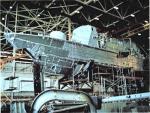
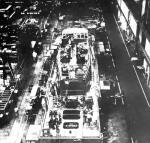
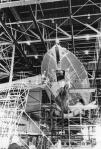
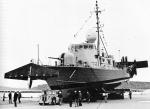
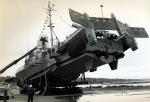
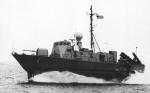
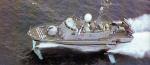
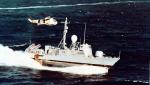
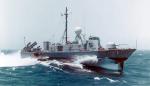
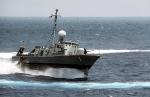

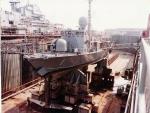
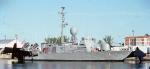
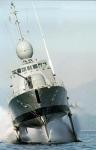
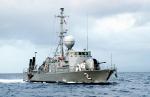
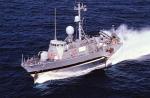
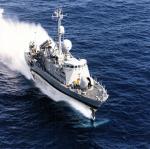
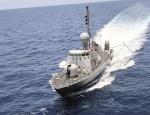
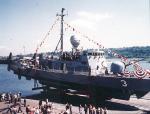
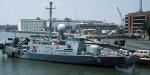
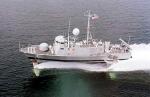
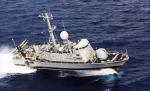
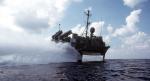
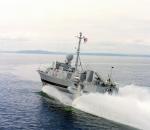
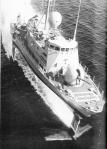
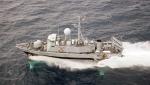
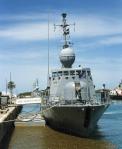
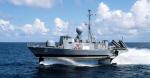
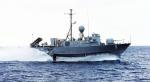
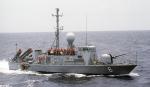
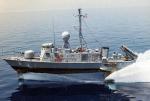
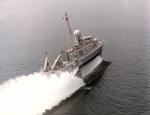
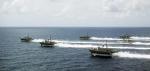
The Pegasus Class hydrofoils were a class of six fast attack craft hydrofoils built for the U.S. Navy from 1973 to 1982, these ships by far described as the peak of the hydrofoil development in the Navy as they were in fact the first class and only of hydrofoils in the service to consist of multiple ships as previous ships that had hydrofoil capabilities only consisted of a single ship.
The class origins can be traced back to 1960s as at the time NATO saw the need for a class of small fast warships which would be capable of dealing with the large numbers of missile craft that were used by the Warsaw Pact such as the Komar and Osa classes and they concluded that a hydrofoil would be the best type of vessel to fulfill this role.
In the 1970s Admiral Elmo Zumwalt, the new Chief of Naval Operations for the United States Navy, who was keen of building more surface vessels in a cost effective manner for the Navy, decided to go through with the hydrofoil program NATO had started and, as a result, the Navy proposed that the PHM design as a NATO standard, with the program being led by the U.S. Navy, and an order placed for two prototypes in 1972. Following this, the Italian and West German navies signed letters of intent of taking part in the program with the Royal Navy and Canadian Forces studying the project which originally called for the U.S. to buy 30 ships, German buying another 10 to 12, and Italy buying another 4 vessels though during the projects earlier stages it was conceptualized that 100 vessels would be built for the NATO navies.
However, the program took a fatal turn soon after as, once Zumwalt retired, the U.S. Navy decided drastically reduce the program due to the lack of available funds and instead putting the money into larger vessels, which basically would end up being the main driving factor to killing the program as the reduced funding resulted in the projects cost becoming more and more expensive, which resulted in by 1974 only Pegasus herself being laid down. With no other vessel being laid down, the Navy was near the point of having only her as the only ship of her type built.
The program would be salvaged by none other than the U.S. Congress who had become tired of the program pace and forced the Navy to complete the Pegasus and five other vessels. By the point the German and Italian navies both had pulled out of the program due to the increasing cost and as a result only the six ships would finally be built, being named Pegasus (PHM-1) (formerly was to be named Delphinus), Hercules (PHM-2), Taurus (PHM-3), Aquila (PHM-4), Aries (PHM-5), and Gemini (PHM-6) and other than Pegasus which had been laid down in 1973, the rest of the ships were laid down in either 1979 or 1980. Pegasus would enter service in 1977 with the rest of the ships entering into service from 1981 to 1982.
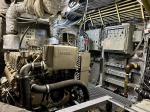
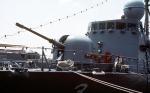
The ships themselves were armed with one OTO Melara 76mm gun in a single mount and this was backed up by two quad cell Harpoon SSM launchers though if needed the ships could reduce the number of missiles per launcher to either three, two, or even one per launcher, and due to the fact Pegasus was started first she would end up having slightly different systems in terms of her electronic equipment. The ships were powered by 2,800 hp (600 kW) twin turbo-charged Mercedes-Benz diesel engines when waterborne, using water jets built by Areojet, which provided a speed of 12 knots (22 km/h; 14 mph). However, when using their hydrofoils they employed one General Electric LM2500 gas turbine and a very large water jet, giving them a speed of over 48 knots (89 km/h; 55 mph). The hydrofoils had a crew of 4 officers and 17 enlisted personnel, making for a total of 21 crew members.
They would spend their service being based out of NAS Key West and though they would never have to deal with the vast number of Warsaw pact missile craft during their service, these ships proved high excellent vessels in counter drug operations thanks to the speed they provided. They operated near home or off South America.
There were some notable incidents during their careers. Pegasus was involved in collision with the landing ship USS Newport though she was able to be repaired after the accident. In 1991, Aquila suffered a more significant event when she was traveling with her hydrofoils and a whale breached out of the water in front of her, which resulted according to sources in her forward foil skipping off the back of the whale. The hull took major damaged and several of the crew, including the captain, required medical attention and evacuation. The boat took on water in her engine room and her pumps were not powerful enough to deal with the flooding. Fortunately, the US Coast Guard saved her from sinking.
The class otherwise had a fairly uneventful service and would all be decommissioned on July 30th, 1993. The Navy assumed the ships were expensive to maintain, and by that point not considered to be worth keeping in service. Five out of six ships were scrapped, with Aries being saved as a museum ship.
FUENTES Y REFERENCIA – SOURCES & REFERENCE
warthunder.com
navsource.org
©jmodels.net
 jmodels.net
Debe estar conectado para enviar un comentario.