
| DATOS TÉCNICOS | TECHNICAL DATA |
| TIPO: Submarino diésel-eléctrico. | TYPE: Diesel-electric submarine. |
| CONSTRUCTOR: Astillero Wuchang (Wuhan, China). | BUILDER: Wuchang Shipyard (Wuhan, China). |
| BOTADURA: 1978 | LAUNCHED: 1978 |
DESPLAZAMIENTO:
|
DISPLACEMENT:
|
| ESLORA: 76,6 m. | LENGTH: 251 ft. |
| MANGA: 6,7 m. | BEAM: 22 ft. |
| PUNTAL: 5 m. | DRAUGHT: 16.2 ft. |
VELOCIDAD MÁX.:
|
MAX. SPEED:
|
| PROPULSIÓN: Dos motores diésel de 2,94 MW (4.000 shp), dos motores eléctricos y dos ejes. | PROPULSION: Two diesel engines delivering 2.94 MW (4000 shp) with two electric motors driving two shafts. |
| AUTONOMÍA: 14,484 km a 9 nudos (17 km/h). | RANGE: 9,000 miles at 9 knots (5.59 mph). |
ARMAMENTO:
|
ARMAMENT:
|
SENSORES:
|
SENSORS:
|
| TRIPULACIÓN: 54 | CREW: 54 |
| CONSTRUIDOS: 1 | BUILT: 1 |
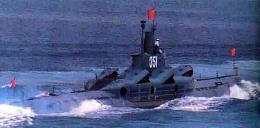
En 1976, el Instituto Nº701 (ahora Instituto de Diseño y Desarrollo de Buques de Wuhan) añadió experimentalmente el sistema de misiles antibuque YJ-8 (C-801) y su radar de control de fuego Tipo 358G asociado al submarino Tipo 033. A cada lado de la vela se instalaron tres contenedores lanzamisiles y tras ella se situó el radar de control de tiro. El diseño del nuevo submarino designado Tipo 033G se completó en 1978, y la construcción de la primera unidad (número de gallardete 351) comenzó en 1980 en el Astillero Wuchang en Wuhan. El submarino fue entregado a la Armada china en octubre de 1983 y la inteligencia occidental le dio el nombre en código de clase Wuhan-A.
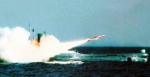
A principios de 1985, el submarino 351 llevó a cabo tres rondas de pruebas del misil YJ-8 con fuego real, y todas ellas tuvieron éxito. A finales de los años 1980, el diseñador estudió cómo reducir el ruido del submarino y el alcance de detección de su sonar. El diseño finalizó en 1986.
Una debilidad importante del Tipo 033G es el hecho de que el submarino no podía lanzar sus misiles bajo el agua. Para lanzar sus seis misiles YJ-8, el submarino debía salir completamente a la superficie, con una velocidad inferior a 8 nudos. Los seis misiles se podían lanzar en un espacio de 6 a 7 minutos. Esto limitó seriamente la efectividad y la capacidad de supervivencia del submarino en combate real. Como resultado, el submarino sirvió como experimento y no se construyó ninguna unidad posterior. Es posible que el sumergible 351 haya estado fuera de servicio desde finales de la década de 1990.
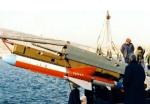

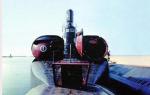
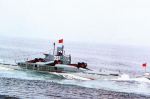
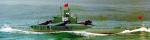
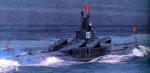
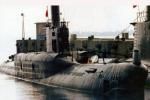
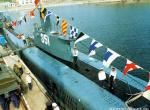
In 1976, No.701 Institute (now Wuhan Ship Development and Design Institute) experimentally added the YJ-8 (C-801) anti-ship missile system and its associated Type 358G fire-control radar to the Type 033 submarine. Three missile launcher containers were installed on each side of the sail, with the fire-control radar was located behind the sail. Design of the new submarine designated Type 033G was completed in 1978, and the construction of the first boat (pennant number 351) began in 1980 at Wuchang Shipyard in Wuhan. The submarine was delivered to the PLA navy in October 1983, and was codenamed Wuhan-A class by Western intelligence.
In early 1985, Boat 351 carried out three rounds of live fire test of the YJ-8 missile, with all tests being successful. In late 1980s, the designer studied to reduce the submarine’s underwater noise and the detection range of its sonar. The design of the submarine was finalised in 1986. This variant was known as Wuhan-A class by Western intelligence.
A major weakness with the Type 033G is the fact that the submarine cannot launch its missiles from underwater. To launch its six YJ-8 missiles, the submarine must fully surface, with its speed less than 8 knots. The six missiles can be launched within 6-7 minutes. This seriously limited the submarine’s effectiveness and survivability in real combat. As a result, the submarine served as an experiment, with no subsequent unit built. Boat 351 may have been out of service since the late 1990s.
FUENTES Y REFERENCIA – SOURCES & REFERENCE
sinodefense.com
©jmodels.net
 jmodels.net
Debe estar conectado para enviar un comentario.