
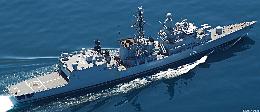
| DATOS TÉCNICOS | TECHNICAL DATA |
| TIPO:Fragata. | TYPE:Frigate. |
| CONSTRUCTOR: AG Weser, Bremer Vulkan, Blohm + Voss, Nordseewereke, Howaldtswerke. | BUILDER: AG Weser, Bremer Vulkan, Blohm + Voss, Nordseewereke, Howaldtswerke. |
| BOTADURA:1979-1990. | LAUNCHED:1979-1990. |
| DESPLAZAMIENTO:3.680 toneladas. | DISPLACEMENT:3,680 tonnes. |
| ESLORA:130,50 m. | LENGTH:428.2 ft. |
| MANGA:14,60 m. | BEAM:47.11 ft. |
| PUNTAL:6,30 m. | DRAUGHT:20.8 ft. |
| VELOCIDAD MÁX.:30 nudos (56 km/h.). | MAX. SPEED:30 knots (34.79 mph.). |
PROPULSIÓN:
|
PROPULSION:
|
| AUTONOMÍA:Más de 4.000 mil. náut. (7.400 km.) a 18 nudos (33 km/h.). | RANGE:More than 4,000 nmi. (4,600 ml.) at 18 knots (20.7 mph.). |
ARMAMENTO:
|
ARMAMENT:
|
SENSORES:
|
SENSORS:
|
| TRIPULACIÓN:202 | CREW:202 |
| CONSTRUIDOS:8 | BUILT:8 |
Desde la decisión de 1980 de permitir que las unidades de la Armada alemana operaran al norte de los 61 grados, operaron habitualmente en el Mar de Noruega. Los seis barcos de la nueva fragata Clase Bremen Tipo 122 se adaptaron bien a las arduas condiciones ambientales de esta región y demostraron ser excelentes plataformas ASW (Anti-Submarine Warfare, Lucha Antisubmarina) con una potencia de fuego ofensiva sustancial y capacidad de defensa antiaérea.
El barco líder de la versión alemana de la fragata estándar de la OTAN, Bremen, se puso en servicio en mayo de 1982. Las fragatas de la clase Bremen se diseñaron como buques antisubmarinos, basados en las fragatas holandesas Kortenaer. Contaban con un excelente equipo de sonar de proa y el sonar de inmersión de sus helicópteros. Pero entre los barcos más antiguos, la capacidad no era nada buena, p. ej. para mantener el contacto del sonar, deben reducir un poco la velocidad para aminorar los niveles de ruido.
Inicialmente, se esperaba construir 12 barcos de este tipo para proporcionar reemplazos uno por uno de los destructores de la clase Z y las fragatas de la clase Köln. Sin embargo, los problemas financieros, en particular los sobrecostos en los programas de fragatas y aviones Tornado y la casi quiebra del contratista principal de las fragatas, impidieron la construcción de unidades más allá de las seis completadas.
Durante la Guerra Fría, los destructores y fragatas alemanes tenían tres misiones principales de seguridad área y convoy en el Mar del Norte y las aguas del sur del Mar de Noruega: defensa aérea, defensa submarina y ataques a objetivos de superficie. En caso de conflicto, se puede suponer que la primera amenaza a enfrentar vendrá en el aire. Además, habría una amenaza constante de submarinos desde el principio; pero dependería de la profundidad del agua. El sistema de defensa aérea de las fragatas de la clase Bremen, que comprendía misiles Sea Sparrow, cañones de 76 mm. y los RAM (Rolling Airframe Missile), fue satisfactorio; pero su uso principal era para la autoprotección.
Las fragatas de la clase Bremen estaban en general bien cualificadas para atacar objetivos de superficie. Estaban equipadas con ocho misiles Harpoon y un cañón de 76 mm., armas muy adecuadas para atacar objetivos de superficie. Estas fragatas también podían alojar helicópteros a bordo para la orientación sobre el horizonte o la orientación de terceros. Para ello transmitían por radio los datos del objetivo que se encontraba más allá del horizonte del radar del buque. Dado que estos mensajes, entre otras cosas, deben estar codificados, el procedimiento llevaba aún mucho tiempo en la Guerra Fría, razón por la cual la Marina esperaba la pronta entrada en servicio del Helicóptero Naval 90, que permitía que la selección de objetivos de terceros proceda automáticamente, p. ej. mediante transmisión automática de datos entre el helicóptero y el barco. La unidad Link-11 utilizada para este propósito todavía era demasiado pesada en la década de 1980 para incorporarla al pequeño helicóptero Sea Lynx.
El Sea Lynx fue el único helicóptero de la Marina utilizable para operaciones tácticas. El Sea Lynx se podía emplear para operaciones antisubmarinas más allá del alcance de las armas de las fragatas. Cada uno de estos helicópteros está equipado con dos torpedos para este fin. Además, el alcance del sonar del barco se amplió en términos prácticos con la ayuda del sonar de inmersión del helicóptero. El tráfico de comunicaciones entre el helicóptero y el barco se realiza en UHF y en HF, este último sólo en largas distancias. El Sea Lynx tiene una tripulación de tres: piloto, copiloto y operador de sonar, donde este último es responsable de recopilar los datos del objetivo. Los torpedos son lanzados por el piloto.
El componente de aviación a bordo (Sección 500) era de 18 personas. Administrativamente hablando, tenía dos oficiales al mando: a bordo, era el primer oficial o comandante del barco y en tierra, era el líder de escuadrón / comodoro del Escuadrón de Aviación Naval 3 con base en Nordholz donde los helicópteros constituían el tercer escalón aerotransportado del escuadrón. Antes de la salida de cada barco, el componente de aviación (lo cual era una clara desventaja) se trasladaba en autobús desde Nordholz a Wilhelmshaven. Solo los helicópteros volaban directamente al barco. Una vez completada una operación, todo el procedimiento se repetía a la inversa. Esto continuó durante algunos años más hasta que la base de helicópteros planeada en el astillero naval de Wilhelmshaven se terminó en 1990.
La planta de energía de doble eje en barcos del tipo Bremen incluía dos turbinas de gas LM2500 con una potencia de 25.800 hp. cada una. Para aumentar la autonomía, las turbinas de gas se colocaban en el compartimiento de proa, y los motores diésel y las transmisiones de engranajes reductores de propulsión, en el compartimiento de popa adyacente.
Al diseñar fragatas de misiles guiados del tipo Bremen (su prototipo era la fragata de misiles guiados Kortenaer), se cambió la composición de la planta de energía. En lugar de las turbinas de gas Olympus TM3B, se seleccionó la LM2500 ya que, según datos de la prensa extranjera, su costo de operación es menor por la mayor temperatura del gas, aunque su precio era mayor.
Además, en lugar de la turbina de velocidad de crucero RM1C Tyne se seleccionó un diésel de la firma MTÜ, más económico de fabricar y operar. La potencia se transmitía desde la turbina de gas a los ejes de la hélice a través de un engranaje reductor planetario separado, un embrague autosincronizador y un engranaje reductor de propulsión (a través de un solo engranaje reductor), y desde un motor diésel, a través de un embrague similar y un engranaje de reducción doble. Las turbinas diésel y de gas, que se encendían automáticamente, eran módulos separados que incluían dispositivos de recepción de aire y escape de gas. Se instalaron sobre soportes insonorizantes y resistentes a los golpes.
Había mucho que elogiar de estos barcos y muy poco que criticar. La ingeniería recibió elogios especiales porque se dijo que representaba un salto generacional con respecto al modelo anterior. La instalación COD0G con sus turbinas de gas General Electric y motores diesel MTÜ funcionó muy bien en términos de estabilidad bajo carga y ninguna de las turbinas de gas tuvo que ser puesta fuera de servicio antes de tiempo en ninguno de los seis barcos. Con motores diésel, la fragata alcanzaba unos 20 nudos y con turbinas de gas 28 nudos. En conjunto, la operación era muy económica, aunque las turbinas de gas usaban relativamente más combustible a velocidades más bajas.
El barco funcionaba muy silenciosamente debido a una muy buena insonorización y una planta de propulsión silenciosa. El sistema de ventilación, que no es del todo lo que debería ser, es el que más ruido hacía a bordo. La automatización de sistemas aumentó en cierta medida la necesidad de personal más cualificado. Gracias a un dispositivo registrador y un sistema de control remoto, las salas de máquinas no tenían que estar atendidas en todo momento.
Los camarotes de la tripulación eran una gran mejora con respecto a los de los barcos más antiguos. Los camarotes de los marineros alojaban hasta 12 hombres en comparación con los destructores de la clase Luetjens, donde los camarotes todavía eran compartidos por hasta 80 hombres. Las taquillas para ropa y efectos personales son sorprendentemente pequeños. Los soldados en los cuarteles del ejército tienen aproximadamente el doble de espacio. Las instalaciones sanitarias, incluidas las duchas, están ubicadas cerca de las áreas de descanso a proa y popa. Solo hay una bañera en el dispensario del barco.
El hangar ofrece mucho espacio para dos helicópteros con los rotores plegados. Frente al hangar hay espacio para los dos torpedos MK 44 y MK 46, que pueden lanzarse tanto desde el barco como desde el helicóptero. Para proporcionar combustible a los helicópteros, el barco lleva un suministro de combustible de aviación especial, mientras que las turbinas de gas del propio barco funcionan con gasóleo.
Aunque fue diseñada como fragata antisubmarina, la fragata bien podría denominarse fragata polivalente gracias a sus sensores y al equipamiento de su centro de operaciones (con un total de nueve consolas). En comparación con la fragata más pequeña de la clase Köln, este buque en particular tenía una signatura de radar más pequeña, ya que los nichos y las esquinas se eliminaron en gran medida. Por esta razón, la fragata no era particularmente hermosa.
El 31 de julio de 2012, la fragata Karlsruhe fue el primer barco de la clase Bremen (F122) en ser dado de baja. Esto creó una reserva de personal y, por otro lado, se ahorraron recursos financieros, de este modo la Armada alemana contribuyó a la consolidación del presupuesto de la Bundeswehr. Al mismo tiempo, se aumentó la disponibilidad operativa de las fragatas restantes hasta la entrada de las nuevas fragatas de la clase Baden-Württemberg (clase F 125) a partir de 2016. Los buques de esta clase fueron dados de baja gradualmente desde 2013 hasta diciembre de 2022.


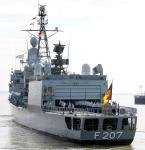
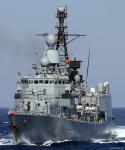
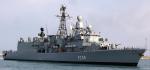
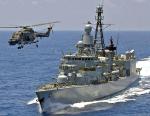
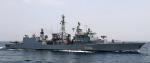
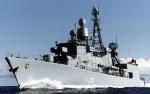


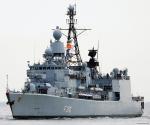
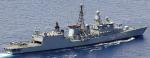
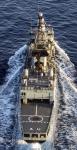
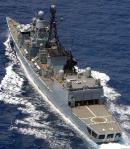





Since the 1980 decision to permit German Navy units to operate north of 61 degrees, German Navy units routinely operated in the Norwegian Sea. The six ships of the new Bremen Class Type 122 frigate class were well suited to the arduous environmental conditions of this region and proved to be superb ASW (Anti-Submarine Warfare) platforms with substantial offensive firepower and anti-air defense capability.
The lead ship of the German version of the NATO Standard Frigate, Bremen, was commissioned in May 1982. The Bremen class frigates were designed as antisubmarine frigates, based on the Dutch Kortenaer frigates. They had excellent bow sonar equipment and the dunking sonar of their helicopters. But among the older ships the capability is not at all good, e.g. in order to maintain sonar contact, they must slow down somewhat to reduce noise levels.
It was initially hoped to build 12 ships of this type to provide one-for-one replacements of the Z class destroyers and the Köln class frigates. However, financial problems, notably cost overruns in the frigate and the Tornado aircraft programs and the near bankruptcy of the frigates’ prime contractor, prevented construction of any units beyond the six completed.
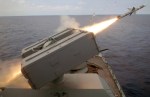
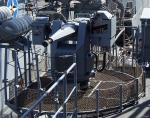
During the Cold War German destroyers and frigates had three primary area and convoy security missions to perform in the North Sea and the southern waters of the Norwegian Sea: air defense, submarine defense and attacks on surface targets. In case of conflict, it may be assumed that the first threat to be met would come in the air. In addition, there would be a constant threat from submarines from the start; but it would depend on water depth. The Bremen class frigates’ air defense system, consisting of Sea Sparrows, 76-mm. guns and the planned RAMs (Rolling Airframe Missile), was satisfactory; but its primary use is for self-protection.
The Bremen class frigates got generally good marks for attacking surface targets. They are equipped with eight Harpoon missiles and a 76-mm. gun well suited for attacking surface targets. These particular frigates can also accomodate onboard helicopters for over the horizon targeting or third party targeting, which meant that target data were transmitted by radio which lie beyond the radar horizon of a particular ship. Since these messages must among other things be encoded, this procedure still took a lot of time in the Cold War, which is why the flotilla was pinning its hopes on the Naval Helicopter 90 which allows third party targeting to proceed automatically, e.g. by means of automatic data transmission between the helicopter and the ship. The Link-11 unit used for this purpose was still too heavy in the 1980s to be built into the small Sea Lynx.
The Sea Lynx was the only navy helicopter usable for tactical operations. The Sea Lynx can be used for antisubmarine operations beyond the weapons range of the frigates. Each of these helicopters is equipped with two torpedoes for this purpose. In addition, the range of the ship’s sonar was enlarged in practical terms with the help of the helicopter’s dunking sonar. Communications traffic between the helicopter and the ship takes place over UHF and on HF, the latter only over long distances. The Sea Lynx has a crew of three: pilot, copilot and sonar operator, where the latter is responsible for collecting target data. The torpedoes are launched by the pilot.
The onboard aviation component (Section 500) numbers 18. Administratively speaking, it had two commanding officers: onboard, it is the ship’s first officer or commander and on land, it is the squadron leader/commodore of Naval Aviation Squadron 3 based in Nordholz where the helicopters constitute the squadron’s third airborne echelon. Prior to the departure of every ship, the aviation component (which is a distinct disadvantage) is moved by bus from Nordholz to Wilhelmshaven. Only the helicopters fly directly to the ship. Upon completion of an operation, the entire procedure is repeated in reverse. This continued for a few years more until the helicopter base planned at Wilhelmshaven navy yard was completed in 1990.
The twin-shaft power plant on ships of the Bremen type includes two LM2500 gas turbines with a power of 25,800 hp. each. To increase, endurance the gas turbines are placed in the forward compartment, and the diesels and propulsion reduction gear transmissions, in the adjacent stern compartment.
When designing guided missile frigates of the Bremen type (its prototype was the guided missile frigate Kortenaer), the composition of the power plant was changed. Instead of the TM3B Olympus gas turbines, the LM2500 was selected since, according to data in the foreign press, its operating cost is less because of the higher temperature of the gas although it is more expensive.
In addition, instead of the RM1C Tyne cruising speed turbine a diesel of the MTU firm was selected, cheaper to manufacture and operate. Power is transmitted from the gas turbine to the propeller shafts through a separate planetary reduction gear, self-synchronizing clutch, and propulsion reduction gear (through a single reduction gear), and from a diesel, through a similar fluid clutch and double-reduction gear. The diesel and gas turbines, which are turned on automatically, are separate modules which include air-receiving and gas exhaust devices. They are installed on sound-insulating supports on shock-resistant seats.
There was much to praise about these ships and very little to criticize. The engineering came in for special praise because it was said to represent a generation jump from the previous model. The COD0G installation with its General Electric gas turbines and MTÜ diesel engines performed very well in terms of stability under load and none of the gas turbines have had to be taken out of service ahead of time on any of the six ships. Running on diesel engines, the frigate will make about 20 knots and on gas turbines 28 knots. Altogether, operation is very economical although the gas turbines do use relatively more fuel at slower speeds.
The ship runs very quietly due to very good soundproofing and a quiet propulsion plant. The ventilating system, which is not quite what it should be, makes the most noise on board ship, A great deal on board has been automated which to some extent increases the need for more highly qualified personnel. Thanks to a logger device and a remote control system the engine rooms do not have to be staffed at all times.
The crew’s quarters are a great improvement on those of the older ships. The seamen’s quarters will accomodate up to 12 men as compared to the Luetjens class destroyers where quarters are still shared by up to 80 men. The lockers for clothing and personal belongings are surprisingly small. Soldiers in army barracks have about twice as much room. The sanitary facilities, including showers, are located close to the sleeping areas fore and aft. There is only one bathtub in the ship’s dispensary.
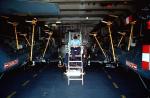
The hangar provides plenty of room for two helicopters with their rotors folded. In front of the hangar there is the space for the two MK 44 and MK 46 torpedoes, which can be launched both from the ship and, if equipped with a tailgate and a parachute, from the helicopter. To provide fuel for the helicopters, the ship carries a supply of special aviation fuel whereas the ship’s own gas turbines run on diesel oil.
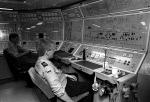
Although it was designed as an antisubmarine frigate, the frigate may just as well be called a multi-purpose frigate thanks to its sensors, effectors and the equipment of its operations center (with a total of nine consoles). As compared to the smaller Köln class frigate, this particular ship has a smaller radar reflecting area, since niches and corners have been eliminated to a large extent. For this reason, the frigate does not look particularly beautiful.
As of July 31, 2012, the frigate Karlsruhe was the first ship of the Bremen class (F122) out of service. This firstly created a personnel reserve, on the other hand financial resources were saved. The Navy contributed to the consolidation of the Bundeswehr budget. At the same time, the operational availability of the remaining frigates was increased up to the inlet of the new frigates of the Baden-Württemberg class (class F 125) starting in 2016. The ships of this class were gradually decommissioned from 2013 to December 2022.
FUENTES Y REFERENCIA – SOURCES & REFERENCE
globalsecurity.org
seaforces.org
©jmodels.net
 jmodels.net
Debe estar conectado para enviar un comentario.