

| DATOS TÉCNICOS | TECHNICAL DATA |
| TIPO:Destructor de misiles guiados. | TYPE:Guided missile destroyer. |
| CONSTRUCTOR:Vickers Shipbuilding & Engineering, Barrow-in-Furness, Cumbria (Gran Bretaña). | BUILDER:Vickers Shipbuilding & Engineering, Barrow-in-Furness, Cumbria (U.K.). |
| BOTADURA:10 de junio de 1971. | LAUNCHED:10 June 1971. |
| DESPLAZAMIENTO:4.820 toneladas. | DISPLACEMENT:4,820 tonnes. |
| ESLORA:125 m. | LENGTH:410 ft. |
| MANGA:14,3 m. | BEAM:47 ft. |
| PUNTAL:5,8 m. | DRAUGHT:19 ft. |
| VELOCIDAD MÁX.:30 nudos (56 km/h.). | MAX. SPEED:30 knots (34.52 mph.). |
PROPULSIÓN:
|
PROPULSION:
|
ARMAMENTO:
|
ARMAMENT:
|
SENSORES:
|
SENSORS:
|
| TRIPULACIÓN:287-312 | CREW:287-312 |
| CONSTRUIDOS:14 (Clase Sheffield). | BUILT:14 (Sheffield Class). |
El HMS Sheffield fue un destructor de misiles guiados Tipo 42 y el segundo barco de la Royal Navy en llevar el nombre de la ciudad de Sheffield en Yorkshire. Encargado el 16 de febrero de 1975, el Sheffield formó parte de la Task Force 317 durante la Guerra de las Malvinas. Fue tocado y gravemente dañado por un misil antibuque Exocet lanzado desde un avión argentino Super Étendard el 4 de mayo de 1982 y se hundió mientras estaba a remolque el 10 de mayo de 1982.
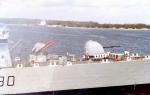
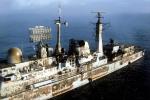
Primero de la clase Tipo 42, el Sheffield fue equipado inicialmente con las extrañas „Orejas de Mickey Mouse» en la parte superior de su chimenea, que en realidad eran deflectores de escape para las turbinas de gas Rolls-Royce Olympus TM3B, para guiar el escape de alta temperatura hacia los lados y minimizar el daño a las antenas. Como esto proporcionaba un objetivo prominente para los entonces nuevos misiles guiados por infrarrojos, solo el Sheffield y los dos siguientes en la clase, los argentinos Hércules y Santísima Trinidad, tenían estos dispositivos. El Sheffield fue el único de su clase que no estaba equipado con tubos de torpedos antisubmarinos triples STWS II.
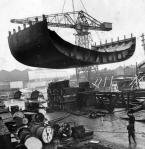
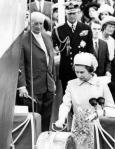
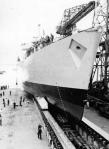
Ordenado en 1968, el Sheffield fue puesto en grada el 15 de enero de 1970 y construido por Vickers Shipbuilding and Engineering en Barrow-in-Furness. Una explosión durante la construcción mató a dos trabajadores del astillero y dañó una sección del casco que fue reemplazada por una sección de un barco idéntico, el Hércules, que se estaba construyendo para la Armada Argentina. El Sheffield fue botado el 10 de junio de 1971 por la reina Isabel II y se estimó que su construcción costó 23.200.000 libras.
Como el primero de su clase en la Royal Navy, el Sheffield pasó sus primeros años probando los nuevos sistemas y el sistema de misiles Sea Dart, particularmente cuando el buque de prueba previsto para probarlo, el HMS Bristol, sufrió graves incendios y problemas con sus sistemas de vapor que limitaron su uso a finales de la década de 1970. No fue hasta 1980 cuando el Sheffield entró en servicio con sus misiles Sea Dart y la instalación parcial de los sistemas de guerra electrónica Abbey Hill. Luego de una remodelación a principios de la década de 1980, se identificaron importantes problemas de diseño en el radar Tipo 909 del barco (que era responsable del control y la orientación de los misiles Sea Dart). El barco carecía de un bloqueador de contramedidas electrónicas (ECM).
En junio de 1981 participó en el Ejercicio Roebuck, tras lo cual disparó cinco misiles Sea Dart. Después de participar en el Ejercicio Ocean Safari, navegó en noviembre de 1981 para realizar patrullas en el Océano Índico y el Golfo Pérsico.
Estaba en mantenimiento en Mombasa cuando el capitán James Salt asumió el mando el 26 de enero de 1982. Tanto Salt (cuyo servicio más reciente había sido en submarinos) como su segundo al mando (que había sido observador de helicópteros antisubmarinos) tenían poca o ninguna experiencia relevante en buques de superficie y poca experiencia en defensa aérea.
En marzo de 1982, el barco transitó hacia el norte por el Canal de Suez para participar en el Ejercicio Spring Train, que se llevó a cabo en el Océano Atlántico.
En respuesta a la invasión argentina de las Islas Malvinas, el 2 de abril de 1982 se ordenó al Sheffield que se uniera al grupo de combate que se estaba formando para recuperar las islas. Se cargaron municiones y suministros y se desembarcaron objetos innecesarios. Se quitaron todas las alfombras, excepto las de la cubierta 1 y superiores (que posteriormente se incendiaron cuando fue atacado). Para evitar la confusión con el Hércules y el Santísima Trinidad argentinos, se pintó una marca negra vertical en la chimenea y hacia el costado de su línea de flotación para ayudar al reconocimiento.
Tras partir hacia el Atlántico Sur el 10 de abril, el Sheffield llegó a la Isla Ascensión el 14 de abril, acompañado por el HMS Arrow, el HMS Brilliant, el HMS Coventry, el HMS Glasgow y más tarde se le uniría el RFA Appleleaf. Se unieron a otros buques de la Task Force 317 y comenzaron operaciones en la Zona de Exclusión Total alrededor de las Malvinas el 1 de mayo de 1982.
Era política británica que cualquier buque de la Royal Navy que sospechara que estaba bajo un ataque con misiles se volviera hacia la amenaza, acelerara a la velocidad máxima y disparara señuelos para evitar que el barco quedara indefenso. La palabra clave utilizada para iniciar este procedimiento era ‘freno de mano’, que debía transmitirse una vez captada la señal del radar Super E Agave del avión Super Étendard. Dentro del grupo de combate, la amenaza del submarino Tipo 209 se consideraba de mayor prioridad que la amenaza en el aire. Tras el hundimiento del General Belgrano, el Capitán Salt había ordenado que el barco cambiara de rumbo cada 90 segundos para contrarrestar cualquier posible amenaza submarina argentina.
El Sheffield fue detectado por primera vez por un avión de patrulla Lockheed SP-2H Neptune (2-P-112) de la Aviación Naval Argentina a las 07:50 el 4 de mayo de 1982. El Neptune mantuvo a los barcos británicos bajo vigilancia, verificando la posición del Sheffield nuevamente a las 08:14 y 08:43. Dos Super Étendard de la Armada Argentina, ambos armados con misiles AM39 Exocet, despegaron de la base aérea naval de Río Grande a las 09:45 y se encontraron con un avión cisterna KC-130H Hércules de la Fuerza Aérea Argentina para repostar a las 10:00. Las dos aeronaves eran la 3-A-202, pilotado por el comandante de misión Capitán de Fragata Augusto Bedacarratz, y la 3-A-203, pilotado por el Teniente Armando Mayora.
En las dos semanas previas al ataque, los pilotos argentinos habían estado practicando tácticas contra sus propios barcos, incluidos los destructores Tipo 42 de la misma clase que el Sheffield, y por lo tanto conocían el horizonte del radar, las distancias de detección y los tiempos de reacción del radar del barco. así como el procedimiento óptimo para programar el misil Exocet. La técnica que utilizaron se conoce coloquialmente como «picotear los lóbulos», en referencia a la aeronave que sondea los lóbulos laterales del radar emisor utilizando el receptor de advertencia de radar. La aeronave podría evitar la detección evitando el lóbulo principal del radar emisor.
A las 10:35, el Neptune subió a 1.170 m. y detectó un contacto grande y dos de tamaño mediano. Unos minutos más tarde, el Neptune mandó las posiciones a los Super Étendard. Volando a muy baja altura, aproximadamente a las 10:50 ambos Super Étendard subieron a 160 m. para verificar estos contactos, pero no pudieron localizarlos y regresaron a baja altura. Más tarde volvieron a subir y después de unos segundos de exploración, los objetivos aparecieron en sus pantallas de radar.
Ambos pilotos cargaron las coordenadas en sus sistemas de armas, regresaron al nivel bajo y, después de verificaciones de última hora, cada uno lanzó un misil Exocet AM39 a las 11:04 mientras se encontraban a una distancia de entre 32 a 48 km. de sus objetivos. Los Super Étendard no necesitaron volver a repostar del el KC-130, que había estado esperando, y aterrizaron en Río Grande a las 12:04.
Apoyando la misión había un Learjet 35 de la Fuerza Aérea Argentina como señuelo y dos IAI Daggers como escoltas del KC-130.
Aproximadamente a las 10:00 del 4 de mayo, el Sheffield estaba de vigilancia (preparación de segundo grado). Era la unidad situada más al sur de los tres destructores Tipo 42 (los otros eran el HMS Glasgow y Coventry) operando como un piquete antiaéreo avanzado entre 29 y 48 km.) al oeste de la fuerza principal que se encontraba al sureste de las Malvinas. El HMS Invincible era responsable de la Coordinación de Guerra Antiaérea (AAWC). El Sheffield había relevado a su gemelo Coventry ya que este último tenía problemas técnicos con su radar Tipo 965.
Antes del ataque, los operadores de radar del Sheffield habían tenido dificultades para distinguir los aviones Mirage y Super Étendard, y es posible que el destructor careciera de IFF efectivo o interferencia de radar. A pesar de los informes de inteligencia que identificaron como posible un ataque con Exocet por parte de Super Étendard, el Sheffield había determinado esta amenaza Exocet como sobrevalorada durante los dos días anteriores y descartó otra como una falsa alarma.
Como el Tipo 965 no podía detectar aviones en vuelo bajo, los dos aviones enemigos que se aproximaban volando a 30 m. sobre el agua no aparecieron en el radar. Ambos fueron detectados a una distancia de solo 40 millas náuticas (74 km.) por el UAA1, un receptor de alerta de radar. Esto luego fue confirmado por el radar de advertencia de aeronaves de largo alcance 965M del Glasgow cuando la aeronave apareció a 37 m. sobre el nivel del mar para una verificación de radar a 45 millas náuticas (83 km). El Glasgow comunicó la palabra clave de advertencia por UHF y HF a todos los barcos del grupo de combate. Los contactos de radar también fueron vistos por el Invincible, que envió Sea Harriers para investigar, pero no detectaron nada. El AAWC del Invincible señaló que los contactos del radar eran falsos y dejó la alerta aérea en amarillo, en lugar de elevarla a rojo.
En respuesta a la advertencia del Glasgow, se emitió una orden de atención a las tripulaciones del cañón de 4,5 pulgadas, misiles Sea Dart y armas de 20 mm. Las aeronaves fueron detectadas en el radar delantero Tipo 909 pero no en el de popa. Luego, el sensor UAA1 del Sheffield fue bloqueado por una transmisión no autorizada de los sistemas de comunicaciones por satélite (SCOT) del barco. No se recibió información a través del enlace de datos del Glasgow. Siete segundos después, se disparó el primer misil Exocet, en respuesta a lo cual el Glasgow lanzó señuelos. A bordo del Sheffield, no fue hasta que los vigías vieron el humo del misil cuando la tripulación se dio cuenta de que estaban siendo atacados. Los oficiales del puente no llamaron al capitán, no llamaron a las estaciones de acción, no tomaron medidas evasivas y no hicieron ningún esfuerzo por preparar el cañón de 4,5 pulgadas, los misiles Sea Dart u ordenar que se disparasen señuelos. El oficial de guerra antiaérea fue llamado a la sala de operaciones por el oficial de guerra principal, que llegó justo antes del impacto del primer misil.
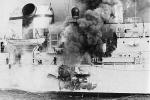
Se habían lanzado dos Exocet, el segundo misil fue avistado por el Yarmouth y cayó al mar a 800 m. a babor del Sheffield. El Exocet que impactó en el Sheffield tocó en el lado de estribor en el nivel 2 de la cubierta, y abrió una brecha en el mamparo de la sala de máquinas auxiliares delantera de 2,4 m. por encima de la línea de flotación, creando un agujero en el casco de aproximadamente 1,2 m. por 3 m. Los relatos contemporáneos sugirieron que el misil no explotó, a pesar de deshabilitar los sistemas de distribución eléctrica del barco y romper la tubería principal contra incendios de agua de mar presurizada. El daño al sistema contra incendios obstaculizó severamente cualquier respuesta de extinción y finalmente condenó al barco a ser consumido por el fuego.
El buque insignia, el HMS Hermes, envió a los escoltas Arrow y Yarmouth a investigar y se lanzó un helicóptero. La confusión reinó hasta que el helicóptero Lynx del Sheffield aterrizó inesperadamente a bordo del Hermes con el oficial de operaciones aéreas y el oficial de operaciones que confirmaron el ataque.
Con los principales sistemas de extinción de incendios fuera de servicio debido a la pérdida de la tubería principal, la tripulación se vio obligada a combatir el incendio utilizando bombas y baldes portátiles eléctricos. El control de la extinción de incendios carecía de cohesión y estaba descoordinado sin que se estableciera un cuartel general de emergencia, mientras que los miembros de la tripulación no tenían claro dónde se encontraba el centro de mando. El Arrow y el Yarmouth ayudaron a combatir el fuego desde el exterior (con poco efecto) al colocarse a babor y estribor respectivamente.
La tripulación del Sheffield luchó durante casi cuatro horas para salvar el barco antes de que el capitán Salt tomara la decisión de abandonar el buque debido al riesgo de incendios en el polvorín de los Sea Dart, la pérdida de la capacidad de combate del destructor y la posición expuesta del Arrow y el Yarmouth a un ataque aéreo.
Durante los siguientes seis días a partir del 4 de mayo de 1982, mientras el barco iba a la deriva, se realizaron cinco inspecciones para ver si valía la pena salvar algún equipo. Se emitieron órdenes para apuntalar el agujero en el lado de estribor y remolcar el barco a Georgia del Sur. Antes de que se emitieran estas órdenes, el Yarmouth ya estaba remolcando el casco quemado. El mar encrespado provocó una inundación lenta a través del orificio en su costado, lo que causó una escora a estribor que finalmente hizo que el Sheffield volteara y se hundiera en el límite de la Zona de Exclusión Total a 1.000 brazas (1.800 m.) de profundidad a 53°04′S 56°56′W el 10 de mayo de 1982. Fue el primer buque de la Royal Navy hundido en acción desde la Segunda Guerra Mundial.
De los 281 miembros de la tripulación, 20 (principalmente de servicio en el área de la cocina y la sala de computadoras) murieron en el ataque y otros 26 a 63 resultaron heridos, en su mayoría por quemaduras, inhalación de humo o descargas eléctricas. Solo se recuperó un cuerpo. Los sobrevivientes fueron llevados a la isla Ascensión en el petrolero británico Esk. El naufragio es una tumba de guerra y está designado como un lugar protegido por la Ley de Protección de Restos Militares de 1986.
El hundimiento del Sheffield a veces se atribuye a una superestructura hecha total o parcialmente de una aleación de magnesio y aluminio, cuyo punto de fusión y temperatura de ignición son significativamente más bajos que los del acero. Sin embargo, esto es incorrecto ya que la superestructura del Sheffield estaba hecha completamente de acero dulce. La confusión está relacionada con el abandono de las aleaciones de aluminio por parte de las armadas estadounidense y británica después de varios incendios en la década de 1970 que involucraron al USS Belknap y al HMS Amazon y otros barcos que tenían superestructuras de aleación de aluminio. El hundimiento de las fragatas Tipo 21 Antelope y Ardent, ambas con superestructuras de aleación de aluminio, probablemente también influyó en esta creencia, aunque estos casos nuevamente son incorrectos y la presencia de aleación de aluminio no tuvo nada que ver con su pérdida.
Los incendios en el Sheffield y otros barcos dañados por el fuego provocaron un cambio posterior por parte de la Royal Navy en las telas de nailon y sintéticas que usaban los marineros británicos. Los sintéticos tienen tendencia a derretirse sobre la piel, causando quemaduras más graves que si la tripulación hubiera usado ropa no sintética.
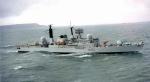
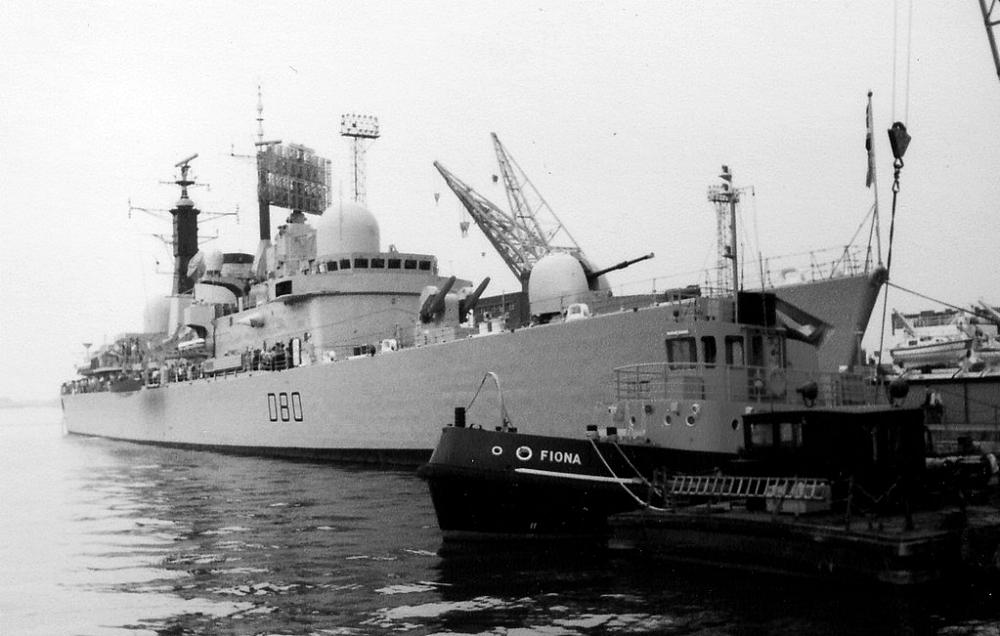
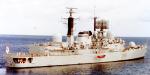

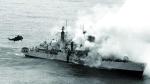
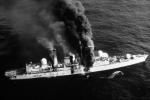
HMS Sheffield was a Type 42 guided missile destroyer and the second Royal Navy ship to be named after the city of Sheffield in Yorkshire. Commissioned on 16 February 1975 the Sheffield was part of the Task Force 317 sent to the Falkland Islands during the Falklands War. She was struck and heavily damaged by an Exocet air-launched anti-ship missile from an Argentine Super Étendard aircraft on 4 May 1982 and foundered while under tow on 10 May 1982.
The first of the Type 42 class, Sheffield, was initially fitted with the odd-looking «Mickey Mouse» ears on her funnel tops which were in fact exhaust deflectors for the Rolls-Royce Olympus TM3B gas turbines, to guide the high-temperature exhaust efflux sidewards and minimise damage to overhead aerials. As this provided a prominent target for then-new infrared homing missiles, only Sheffield and the next two in the class, the Argentinian Hércules and Santísima Trinidad, had these ‘ears’. Sheffield was the only one of her class to not be fitted with STWS II triple anti-submarine torpedo tubes.
Ordered in 1968 Sheffield was laid down on 15 January 1970 and built by Vickers Shipbuilding and Engineering at Barrow-in-Furness. An explosion during construction killed two dockyard workers and damaged a section of hull which was replaced with a section from an identical ship, Hércules, being built for the Argentine Navy. Sheffield was launched on 10 June 1971 by Queen Elizabeth II and was estimated to have cost £23,200,000 to build.
As the first of her class of Royal Navy destroyers, Sheffield spent her first years trying out the new systems and the Sea Dart missile system, particularly as the intended Sea Dart trials ship, HMS Bristol, suffered serious fires and problems with its steam systems restricting its use in the late 1970s. It was not until 1980 that Sheffield became effective, with Sea Dart and partial installation of electronic warfare Abbey Hill systems. Following a refit in the early 1980s, significant design issues with the ship’s Type 909 radar (which was responsible for control and targeting of the Sea Dart missiles) were identified. The ship lacked an electronic countermeasures (ECM) jammer.
In June 1981 she participated in Exercise Roebuck, following which she fired five Sea Dart missiles. Following participation in Exercise Ocean Safari she sailed in November 1981 to undertake patrols in the Indian Ocean and Persian Gulf.
She was undergoing maintenance at Mombasa when Captain James Salt took over command on 26 January 1982. Both Salt (whose most recent service had been in submarines) and his second in command (who had been an anti-submarine helicopter observer) had little or no relevant experience in surface ships and little experience in air defence.
In March 1982 the ship transited north through the Suez Canal to participate in Exercise Spring Train, which was held in the Atlantic Ocean.
In response to the Argentine invasion of the Falklands Islands, Sheffield was ordered on 2 April 1982 to join the task force being assembled to retake the islands. Ammunition and supplies were loaded, loose fittings stowed, and unnecessary memorabilia disembarked. All carpets were removed except for those on Deck 1 and above (which subsequently caught fire when she was hit). To avoid her being mistaken for the Argentine Hércules and Santísima Trinidad, a vertical black marking was painted on the funnel and down to the side to her waterline to aid recognition.
Departing for the South Atlantic on 10 April, Sheffield reached Ascension Island on 14 April, accompanied by HMS Arrow, HMS Brilliant, HMS Coventry, HMS Glasgow to be later joined by RFA Appleleaf. They joined other vessels of the Task Force 317 and commenced operations in the Total Exclusion Zone around the Falklands on 1 May 1982.
It was British policy that any Royal Navy vessel that suspected itself to be under missile attack turn toward the threat, accelerate to maximum speed and fire chaff to prevent the ship being caught defenceless. The codeword used to start this procedure was ‘handbrake’, which had to be broadcast once the signal of the Super E Agave radar of Super Étendard aircraft was picked up. Within the task force, the threat from the Type 209 submarine was seen as a higher priority than the threat from the air. Following the sinking of General Belgrano, Captain Salt had ordered the ship to change course every 90 seconds to counter any potential Argentine submarine threat.
Sheffield was first detected by an Argentine Naval Aviation Lockheed SP-2H Neptune (2-P-112) patrol aircraft at 07:50 on 4 May 1982. The Neptune kept the British ships under surveillance, verifying Sheffield’s position again at 08:14 and 08:43. Two Argentine Navy Super Étendards, both armed with AM39 Exocets, took off from Río Grande naval air base at 09:45 and met with an Argentine Air Force KC-130H Hercules tanker to refuel at 10:00. The two aircraft were 3-A-202, piloted by mission commander Capitán de Fragata (Commander) Augusto Bedacarratz, and 3-A-203, piloted by Teniente (Lieutenant) Armando Mayora.
In the two weeks leading up to the attack, Argentinian pilots had been practising tactics against their own ships, including Type 42 destroyers of the same class as Sheffield, and therefore knew the radar horizon, detection distances, and reaction times of the ship radar, as well as the optimal procedure to programme the Exocet missile for a successful attack profile. The technique they used is known colloquially as «Pecking the Lobes», in reference to the aircraft probing the side lobes of the emitting radar using the radar warning receiver. The aircraft could avoid detection by avoiding the main lobe of the emitting radar.
At 10:35, the Neptune climbed to 1,170 metres (3,840 ft) and detected one large and two medium-sized contacts. A few minutes later, the Neptune updated the Super Étendards with the positions. Flying at very low altitude, at approximately 10:50 both Super Étendards climbed to 160 metres (520 ft) to verify these contacts, but failed to locate them and returned to low altitude. They later climbed again and after a few seconds of scanning, the targets appeared on their radar screens.
Both pilots loaded the coordinates into their weapons systems, returned to low level, and after last minute checks, each launched an AM39 Exocet missile at 11:04 while 20 to 30 miles (32 to 48 km.) away from their targets. The Super Étendards did not need to refuel again from the KC-130, which had been waiting, and landed at Río Grande at 12:04.
Supporting the mission were an Argentine Air Force Learjet 35 as a decoy and two IAI Daggers as the KC-130 escorts.
At approximately 10:00 on 4 May, Sheffield was at defence watches (second degree readiness), the southernmost of three Type 42 destroyers (the others being HMS Glasgow and Coventry) operating as a forward anti-aircraft picket 18 to 30 miles (29 to 48 km.) to the west of the main task force which were south-east of the Falklands. HMS Invincible, which was with the main task force, was responsible for Anti-Air Warfare Coordination (AAWC). Sheffield had relieved her sister ship Coventry as the latter was having technical trouble with her Type 965 radar.
Prior to the attack, Sheffield‘s radar operators had been experiencing difficulty distinguishing Mirage and Super Étendard aircraft, and the destroyer may have lacked effective IFF or radar jamming. Despite intelligence briefings that identified an Exocet attack by Super Étendards as possible, Sheffield had assessed the Exocet threat as overrated for the previous two days, and disregarded another as a false alarm.
As the Type 965 could not detect low-flying aircraft, the two incoming enemy aircraft were not detected flying at 98 feet (30 m.). The two planes were detected at a distance of only 40 nautical miles (74 km.) by the UAA1, a radar warning receiver. This was then confirmed by the 965M long range aircraft warning radar of Glasgow when the aircraft popped up to 120 ft. (37 m.) above sea-level for a radar check at 45 nautical miles (83 km.). The Glasgow immediately went to action stations, and communicated the warning codeword ‘Handbrake’ by UHF and HF to all task force ships. The radar contacts were also seen by Invincible, which directed Sea Harriers on combat patrol to investigate, but they detected nothing. The AAWC on Invincible declared the radar contacts as false and left the Air Warning at yellow, instead of raising it to red.
In response to Glasgow‘s warning, an order to stand to was issued to the crews of the 4.5 inch gun, Sea Dart and 20 mm. guns. The aircraft were detected on the forward Type 909 radar but not on the aft set. Sheffield‘s UAA1 sensor was then blocked by an unauthorised transmission by the ship’s satellite communications systems (SCOT). No information was received via data link from Glasgow. Seven seconds later, the first Exocet missile was fired, in response to which Glasgow fired its chaff. Onboard Sheffield, it was not until smoke from the missile was sighted by lookouts that the crew realised they were under attack. The bridge officers did not call the captain to the bridge, made no call to action stations, made no evasive measures, and made no effort to prepare the 4.5-inch gun, the Sea Dart missiles, or order chaff to be fired. The antiair warfare officer was called to the operations room by the principal warfare officer, arriving just before the first missile hit.
Two Exocets had been launched, the second missile being sighted by Yarmouth and missing Sheffield, splashing into the sea 0.5 miles (0.43 nmi.) off her port beam. The Exocet that struck Sheffield hit her on the starboard side at deck level 2, travelling through the junior ratings’ scullery and breaching the Forward Auxiliary Machinery Room/Forward Engine Room bulkhead 2.4 m. (7.9 ft.) above the waterline, creating a hole in the hull roughly 1.2 m. (3.9 ft.) by 3 m. (9.8 ft.). Contemporary accounts suggested that the missile failed to explode, despite disabling the ship’s electrical distribution systems and breaching the pressurised sea water fire main. The damage to the fire system severely hampered any firefighting response and eventually doomed the ship to be consumed by the fire.
The flagship, HMS Hermes, dispatched the escorts Arrow and Yarmouth to investigate, and a helicopter was launched. Confusion reigned until Sheffield‘s Lynx helicopter unexpectedly landed aboard Hermes carrying the air operations officer and operations officer, confirming the strike.
With the principal fire fighting systems out of action due to the loss of the fire main, the crew were reduced to fighting the fire using portable electrically powered pumps and buckets. The control of firefighting lacked cohesion and was uncoordinated with no emergency HQ being established, while crew members were unclear as to where Command was located. Arrow and Yarmouth assisted in fighting the fire from the outside (to little effect) by stationing themselves to port and starboard respectively.
The crew of Sheffield fought for almost four hours to save the ship before Captain Salt made the decision to abandon ship due to the risk of fires igniting the Sea Dart magazine, the loss of the combat capability of the destroyer, and the exposed position to air attack of Arrow and Yarmouth.
Over the next six days from 4 May 1982, as the ship drifted, five inspections were made to see if any equipment was worth salvaging. Orders were issued to shore up the hole in Sheffield‘s starboard side and tow the ship to South Georgia. Before these orders were issued, the burnt-out hulk had already been taken under tow by Yarmouth. The high seas that the ship was towed through caused slow flooding through the hole in the ship’s side, causing a list to starboard and which eventually caused Sheffield to roll over and sink on the edge of the Total Exclusion Zone in 1,000 fathoms (6,000 ft; 1,800 m) of water at 53°04′S 56°56′W on 10 May 1982, the first Royal Navy vessel sunk in action since World War II.
Of the 281 crew members, 20 (mainly on duty in the galley area and computer room) died in the attack with another 26–63 injured, mostly from burns, smoke inhalation or shock. Only one body was recovered. The survivors were taken to Ascension Island on the tanker British Esk. The wreck is a war grave and designated as a protected place under the Protection of Military Remains Act 1986.
The sinking of Sheffield is sometimes blamed on a superstructure made wholly or partially from magnesium-aluminium alloy, the melting point and ignition temperature of which are significantly lower than those of steel. However, this is incorrect as Sheffield‘s superstructure was made entirely of mild steel. The confusion is related to the US and British navies abandoning aluminium alloys after several fires in the 1970s involving USS Belknap and HMS Amazon and other ships that had aluminium alloy superstructures. The sinking of the Type 21 frigates Antelope and Ardent, both of which had aluminium alloy superstructures, probably also had an effect on this belief, though these cases are again incorrect and the presence of aluminium alloy had nothing to do with their loss.
The fires in Sheffield and other ships damaged by fire caused a later shift by the Royal Navy from the nylon and synthetic fabrics then worn by British sailors. The synthetics had a tendency to melt onto the skin, causing more severe burns than if the crew had been wearing non-synthetic clothing.
FUENTES Y REFERENCIA – SOURCES & REFERENCE
Wikipedia
seaforces.org
©jmodels.net
 jmodels.net
Debe estar conectado para enviar un comentario.