
| DATOS TÉCNICOS | TECHNICAL DATA |
| TIPO:Automóvil blindado. | TYPE:Armored car. |
| TRIPULANTES:6 | CREW:6 |
| ANCHURA:2.16 m. | WIDTH:7.1 ft. |
| LONGITUD:6.26 m. | LENGTH:20.6 ft. |
| ALTURA:2.56 m. | HEIGHT:8.5 ft. |
| PESO:12 toneladas. | WEIGHT:12 tons. |
| MOTOR:Un motor de 6 cilindros Austro-Daimler M612 de 12 litros y 150 CV (110 kW). | ENGINE:One 6-cylinder 12-litre Austro-Daimler M612 providing 150 hp (110 kW). |
| AUTONOMÍA:450 km. | RANGE:280 ml. |
ARMAMENTO:
|
ARMAMENT:
|
MUNICIÓN:
|
AMMO:
|
| BLINDAJE:11 mm. | ARMOR:0.43 in. |
VELOCIDAD MÁX.:
|
MAX. SPEED:
|
| VERSIONES:1 | VERSIONS:1 |
| CONSTRUIDOS:49 | BUILT:49 |
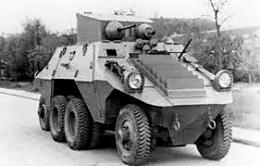
En 1934 el ejército austríaco (Bundesheer) necesitaba un nuevo vehículo blindado pesado para tareas policiales. Steyr ya había desarrollado un vehículo diseñado para operaciones urbanas, con un blindaje inclinado y una carrocería simétrica que lo ayudaban a maniobrar rápidamente y retirarse sin tener que dar la vuelta. El prototipo se probó con éxito y entró en servicio en 1935. La producción se prolongó hasta 1937 con la entrega de 27 vehículos al ejército y la policía. Todos fueron capturados por los alemanes y empleados después del Anschluss. En las siglas «ADGZ», AD significa «Austro-Daimler», la designación oficial era «M35 Mittlere Panzerwagen«.
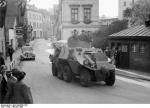
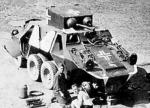
El ADGZ era un enorme vehículo blindado de doce ruedas, los dos ejes externos con suspensión independiente de ballestas y el eje central gemelo, con ruedas dobles (ocho en total), acopladas a una suspensión común. Estaba pensado para maniobras todoterreno, pero también para uso urbano. La carrocería blindada e inclinada, de 6 mm de espesor uniforme (excepto la parte superior e inferior), estaba soldada y era casi completamente simétrica, con el motor en la parte trasera y dos conductores que podían operar el vehículo desde cada lado, cambiando casi de inmediato gracias a la transmisión dual. Poseía una torreta circular central con una doble escotilla en la parte superior que albergaba un cañón automático KwK 35 L/45 de 20 mm. Estaba dotado de cuatro puertas a los lados divididas en dos superficies que podían abrirse o cerrarse por separado. Cada uno de los conductores tenía una pequeña mira en un lado con una escotilla blindada, y en el otro lado un soporte de bola desde el que podían manejar una ametralladora MG 34. Así, cada extremo presentaba un conductor y un ametrallador. También se instalaron cuatro faros, dos en cada extremo del vehículo, montados en los guardabarros integrados en la carrocería.
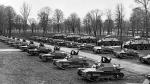
Se entregaron 26 (28 según otras fuentes) Steyr ADGZ, además del prototipo. Doce fueron utilizados por el ejército austríaco en marzo de 1938 en la división rápida y 14 unidades formaban parte de la Gendarmería. Después del Anschluss en 1938, todos estos vehículos se distribuyeron en unidades de las SS y la policía militar. En 1939, un destacamento participó en las operaciones en Danzig (Gdansk, hoy Polonia) al comienzo de la guerra. Tres vehículos blindados de la unidad SS Heimwehr Danzig fueron atacados y uno se perdió en acción mientras se tomaba la oficina de correos. En 1941, las SS encargaron 25 vehículos adicionales y los utilizaron en varias unidades destacadas en los Balcanes para operaciones policiales y para luchar contra los partisanos (como la división Prinz Eugen). Algunos de ellos probablemente fueron probados con torretas de carros rusos T-26 tras capturar muchos de ellos en 1941.
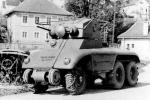

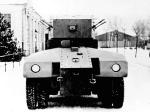


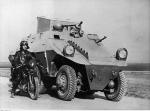

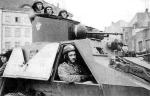

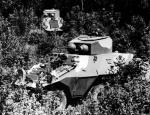




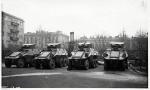




In 1934, the Austrian Army (Bundesheer) needed a new heavy armored car for police duties. Steyr had already developed a vehicle tailored for urban operations, with sloped armor and symmetric body helping the vehicle to maneuver quickly and retreat without having to turn around. The prototype was successfully tested and accepted into service in 1935. Production spanned until 1937 with 27 vehicles being given to the army and the police. All were captured by the Germans and pressed into service after the Anschluss. In «ADGZ», AD stands for «Austro-Daimler», the official designation was «M35 Mittlere Panzerwagen«.
The ADGZ was a massive, twelve-wheeled armored car, the two external axles with their independent leaf spring suspension, and the central twin axle, with double wheels (eight in all), mated on a common suspension. It was intended for maneuvering off-road, but also for urban usage. The sloped armored body, uniformly 6 mm (0.23 in) thick (except the top and bottom) was welded and almost entirely symmetrical, with the engine at the rear, and two drivers whom could operate the vehicle from each side, switching almost immediately thanks to the dual transmission. There was a central circular turret with a double hatch on top, which could be fully opened to dominate the crowd, housing a 20 mm (0.79 in) KwK 35 L/45 autocannon. Four half-doors punctuated the sides, with the upper and lower parts opening independently. The drivers each had a small sight opening on their side, with an armored hatch and on the other side a ball mount, from which they could operate a single MG 34 machine-gun. So each end presented a driver and machine-gunner. Four headlights were also fitted, two on each end of the vehicle, mounted on the body-integrated mudguards.
27 (28 from other sources) Steyr ADGZs were delivered and 12 used by the Austrian Army in March 1938 in the fast division; 14 were part of the Gendarmerie. The prototype was the 27th. After the Anschluss in 1938, all these vehicles were distributed among SS units and military police. In 1939, a detachment took part in the operations in Danzig, (Gdansk, Poland today), at the opening of the war. Three SS Heimwehr Danzig armored cars were engaged and one lost in action while taking the post office. In 1941, 25 additional vehicles were ordered by the SS and used in various units in the Balkans, for police operation and fighting partisans (like the Prinz Eugen division). Some of them were likely tested with T-26 turrets after capturing many of these tanks in 1941.
FUENTES Y REFERENCIA – SOURCES & REFERENCE
tank-afv.com
©jmodels.net
 jmodels.net
Debe estar conectado para enviar un comentario.