
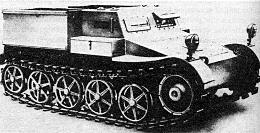
| DATOS TÉCNICOS | TECHNICAL DATA |
| TIPO: Transporte de munición. | TYPE: Ammo carrier. |
| TRIPULANTES: 2 | CREW: 2 |
| ANCHURA: 1,82 m. | WIDTH: 5.97 ft. |
| LONGITUD: 3,10 m. | LENGTH: 10.17 ft. |
| ALTURA: 1,28 m. | HEIGHT: 4.19 ft. |
| PESO: 3.700 kg. | WEIGHT: 8,157 lb. |
| MOTOR: Un motor de gasolina refrigerado por agua Borgward 6 M 2.3 RTBV de 44 hp (32,36 kW) a 3.000 rpm. | ENGINE: One water-cooled 2.247 liter Borgward 6 M 2.3 RTBV gasoline engine providing 44 hp (32.36 kW) at 3,000 rpm. |
| BLINDAJE: 14,5-6,5 mm. | ARMOR: 0.57-0.25 in. |
| VELOCIDAD MÁX.: 30 km/h. | MAX. SPEED: 18.64 mph. |
| VERSIONES: 4 | VERSIONS: 4 |
| CONSTRUIDOS: 47 | BUILT: 47 |
El V.K.3.02, también conocido como gepanzerter Munitionsschlepper (abreviado como gep.Mun.-Schlepper), fue un vehículo de transporte de municiones con orugas desarrollado a finales de los años 40. El V.K.3.02 tenía un depósito de municiones reorganizado y era una versión ligeramente más grande del V.K. 3.01, también producido por Borgward en Bremen tras una petición de la Werhmacht de 1937 donde solicitaba un vehículo de transporte de municiones con orugas capaz de transportar 500 kg en un depósito de almacenamiento situado en la parte trasera del vehículo.
En abril de 1940, tras una demostración del V.K.3.01, se realizaron revisiones al diseño. Esto dio lugar al V.K.3.02. El V.K.3.02 tenía un movimiento y un blindaje satisfactorios, sin embargo, la sala de la tripulación y la organización de la munición necesitaban mejoras. El motor tenía problemas con el exceso de revoluciones, por lo que se redujo la velocidad máxima.
Borgward recibió un contrato para producir 400 ejemplares del V.K.3.02. Las entregas estaban programadas para comenzar en octubre de 1941, a un ritmo de 12 por mes. La producción real fue menor, 4 vehículos en octubre de 1941, 14 en noviembre, 4 en diciembre, 4 en enero de 1942 y 2 en febrero.
El 16 de diciembre de 1941, la producción se canceló debido al cambio de las condiciones sobre el terreno. En su lugar, el V.K.3.02 se convertiría en el Spreng Ladungsträger (vehículo de demolición). El 9 de septiembre de 1942, se ordenaron 19 unidades adicionales con fines de prueba en Magdeburgo.
En noviembre de 1942 se desarrolló una nueva rueda motriz, ya que la existente era propensa a bloquearse con arena y barro. Las unidades recién fabricadas ya contaban con estas nuevas ruedas y las unidades existentes fueron reconvertidas en la Infanterie Schule de Döberitz.
El 4 de marzo de 1943, 45 unidades fueron agrupadas en una Kompanie en la Infanterie Schule de Döberitz. Estos vehículos carecían de sus Winter-schutzgerät (dispositivos de protección invernal). El 15 de abril de 1943, 38 unidades estaban disponibles y las últimas 7 fueron aceptadas y recogidas de la fábrica de Borgward en los siguientes días. De ellas, 16 fueron reconvertidas con la nueva rueda motriz además de las 7 que había en la fábrica. El resto estaba en proceso de conversión.
La Gepanzerter Munitions-Schlepper-Kompanie 801 fue organizada el 18 de marzo de 1943). El 19 de junio de 1943, fue enviada a Mga en la región de Leningrado, donde fueron asignadas a la 1.ª División de Infantería.
Del 17 de junio al 20 de agosto de 1943, al sur del lago Ladoga, se emplearon 40 unidades de la 801 Kompanie en los combates. El 28 de julio de 1944 se informó de que, desde el verano de 1943, los vehículos habían sido utilizados con éxito bajo el mando de la 1.ª División de Infantería, pero que habían sido completamente aniquilados durante la retirada de esta unidad.
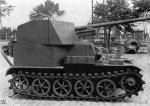
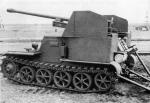
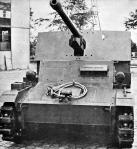
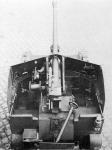
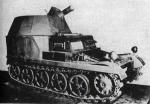
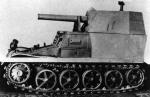
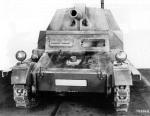
El chasis del V.K.3.02 se utilizó para el Panzerselbstfahrlafette 1a 5 cm PaK 38 auf Gepanzerter Munitionsschlepper o Pz. Sfl. Se trataba de un cazacarros ligero encargado en julio de 1940 que estaba armado con el cañón PaK 38 de 5 cm. Estaba destinado principalmente a ser empleado por las tropas aerotransportadas alemanas, que necesitaban un vehículo de este tipo que pudiera transportarse en avión. El cañón estaba montado en la parte superior del compartimento del motor y lo manejaban una tripulación de tres personas, más el conductor dentro del vehículo. Se planeó producir unos 200 vehículos, pero solo se construyeron dos, que se enviaron a pruebas en el frente en julio de 1942. Sin embargo, para entonces, el PaK 38 ya no era un cañón anticarro viable y se abandonó todo el proyecto. Poco se sabe sobre su rendimiento en combate.
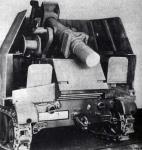
En septiembre de 1941 se encargó otro prototipo de vehículo de combate ligero. Este debía estar armado con el cañón sin retroceso LG de 10,5 cm diseñado por Rheinmetall-Borsig para uso de los paracaidistas. Solo se completó un modelo de prueba.
En octubre de 1941, Borgward también comenzó a trabajar en un nuev vehículo basado en su transporte de munición, el VK 302 / B III, un vehículo de demolición controlado a distancia designado oficialmente como Schwerer Ladungsträger Borgward B IV (Sd.Kfz. 301).
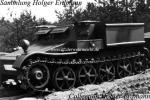
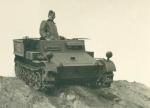
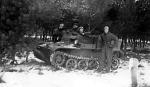
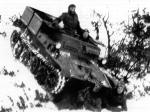
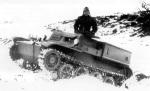
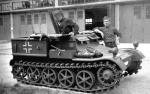
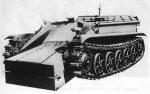
The V.K.3.02, also known as the gepanzerter Munitionsschlepper (abbreviated as gep.Mun.-Schlepper), was a German fully-tracked ammunition carrier developed in the late 1940s. The V.K.3.02 had a re-organized ammunition storage and was a slightly larger version of the V.K. 3.01, also produced by Borgward from Bremen after a 1937 request of the Werhmacht for a fully tracked ammunition transport vehicle capable of carrying 500 kg in a storage bin positioned to the rear part of the vehicle.
In April 1940, following a demonstration of the V.K.3.01, revisions were to be made to the design. This lead to the V.K.3.02. The V.K.3.02 had satisfactory movement and armour, however the crew room and the organization of the ammunition was in need of improvement. The engine did have issues with over-revving, so the maximum speed was to be lowered.
Borgward was awarded the contract to produce 400 examples of the V.K.3.02. Deliveries were scheduled to start in October 1941, with the rate of 12 per month. Actual production was less than this, with 4 in October 1941, 14 in November, 4 in December, 4 in January, and 2 in February.
On the 16th of December 1941, production was cancelled due to changing field conditions. Instead, the V.K.3.02 was to be developed into the Spreng Ladungsträger (explosive charge carrier). On the 9th of September 1942, 19 additional units were ordered for trial purposes in Magdeburg.
A new drive wheel was developed in November 1942, as the existing wheel was prone to sand and mud blockages. Newly produced units already had these new wheels, and the existing units were converted at the Infanterie Schule in Döberitz.
On 4 March 1943, 45 units were assembled into a Kompanie at the Infanterie Schule in Döberitz. These vehicles lacked their Winter-schutzgerät (winter protection devices). By 15 April 1943, 38 units were available, and the last 7 were to be accepted and picked up from the Borgward factory in the coming days. Of these, 16 were converted with the new drive wheel in addition to the 7 in the factory. The rest were in the process of being converted.
The Gepanzerter Munitions-Schlepper-Kompanie 801 was organized on 18 March 1943. On 19 June 1943, they were sent to Mga in Leningrad Oblast, where they were assigned to the 1st Infantry Division.
40 units of the 801 Kompanie were used in a battle from 17 June to 20 August 1943, south of Lake Ladoga. On 28 July 1944, it was reported that since the Summer of 1943, the vehicles had been used successfully under the 1st Infantry Division, but had been completely annihilated during the retreat of this unit.
The V.K.3.02 chassis was used for the Panzerselbstfahrlafette 1a 5 cm PaK 38 auf Gepanzerter Munitionsschlepper or Pz. Sfl. This was a light tank destroyer ordered in July 1940 which was armed with the 5 cm PaK 38 gun. It was primarily intended for use by German airborne troops, who needed such vehicle that could be transported by plane. The gun was mounted on top of the engine compartment and was served by a crew of three plus the driver inside the vehicle. t was planned to produce some 200 vehicles, but only two were ever built and these were sent off for troop trials in July 1942. However, by that time the 5 cm PaK 38 was no longer a viable anti-tank gun and the whole project was abandoned. Little is known about their combat performance.
In September 1941, another light fighting vehicle prototype was ordered. This was to be armed with the 10.5 cm LG recoilless gun designed by Rheinmetall-Borsig for paratroops use. Only one mock-up model was completed.
In October 1941, Borgward also began work on a new machine based on its ammunition transporter, the VK 302 / B III, a remote-controlled demolition vehicle offically designated as Schwerer Ladungsträger Borgward B IV (Sd.Kfz. 301)
FUENTES Y REFERENCIA – SOURCES & REFERENCE
firearmcentral.fandom.com
wikipedia.org
tanks-encyclopedia.com
©jmodels.net
 jmodels.net
Debe estar conectado para enviar un comentario.