
| DATOS TÉCNICOS | TECHNICAL DATA |
| TIPO:Automóvil blindado. | TYPE:Armored car. |
| TRIPULANTES:3 | CREW:3 |
| ANCHURA:2,46 m. | WIDTH:8.1 ft. |
| LONGITUD:4 m. | LENGTH:13.1 ft. |
| ALTURA:2,26 m. | HEIGHT:7.5 ft. |
| PESO:7,6 toneladas. | WEIGHT:7.6 tonnes. |
| MOTOR:Un motor de gasolina y 6 cilindros Daimler 27 (4,1 litros) de 95 hp. (71 kW). | ENGINE:One Daimler 27 4.1 litre 6-cylinder petrol engine developing 95 hp. (71 kW). |
| AUTONOMÍA:320 km. | RANGE:200 ml. |
ARMAMENTO:
|
ARMAMENT:
|
MUNICIÓN:
|
AMMO:
|
| BLINDAJE:7-16 mm. | ARMOR:0.27-0.62 in. |
| VELOCIDAD MÁX.:80 km/h. | MAX. SPEED:50 mph. |
| VERSIONES:4 | VERSIONS:4 |
| CONSTRUIDOS:2.694 | BUILT:2,694 |
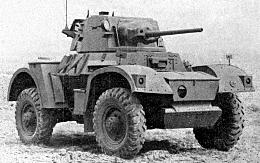
Cuando el BSA Scout Car estaba pasando por sus pruebas iniciales, se decidió utilizar el diseño como base para un nuevo vehículo que se conocería como Tank, Light, Wheeled. Al igual que con el Scout Car, Daimler se hizo cargo del desarrollo del proyecto y el resultado fue un vehículo que exteriormente se parecía al pequeño Scout Car pero era casi el doble de pesado y tenía una torreta para dos ocupantes. El trabajo en el proyecto comenzó en agosto de 1939 y los primeros prototipos estaban funcionando a finales de año, aunque pronto surgieron problemas ya que el peso extra de la torreta y el blindaje sobrecargaron la transmisión. Pasó algún tiempo antes de que se superaran estos problemas, y no fue hasta abril de 1941 que aparecieron los primeros ejemplos de producción. Para entonces, el vehículo era conocido como Vehículo Blindado, Daimler Mk I.
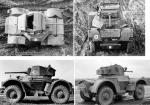
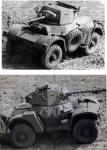
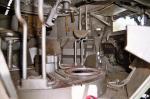
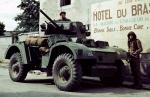
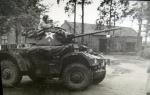
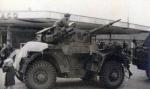
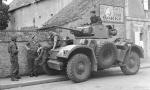
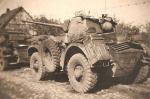
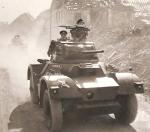
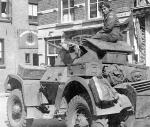
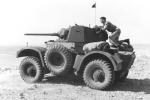
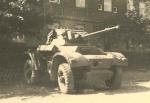
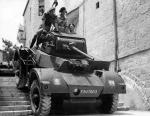
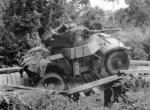
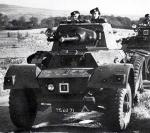
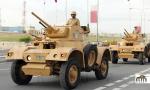
El Daimler Armored Car era básicamente un Scout Car ampliado para acomodar una torreta que montaba un cañón de 2 libras (40 mm.). La torreta era la misma que la diseñada para el tanque ligero Tetrarch destinado a las fuerzas aerotransportadas, pero cuando se colocó en el Daimler, fue la primera instalación de este tipo en un vehículo blindado británico. La torreta también montaba una ametralladora coaxial Besa de 7,92 mm., y muchos vehículos también tenían lanzadores de humo montados a los lados de la torreta. La tracción en las cuatro ruedas usaba amortiguadores helicoidales dobles en cada rueda, aunque la idea inicial de usar la dirección en las cuatro ruedas se descartó por ser demasiado compleja sin un beneficio operativo real. Una característica avanzada fue el uso de frenos de disco hidráulicos Girling, mucho antes de su empleo general en otros lugares. Se utilizó un volante fluido en lugar de la disposición de embrague más habitual. Se proporcionó un volante duplicado y controles simples para que el comandante los usara en caso de emergencia para conducir hacia atrás. El comandante también debía actuar como cargador del arma principal.
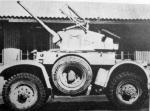
El Daimler experimentó sorprendentemente pocos cambios una vez en servicio. Más tarde se introdujo el Daimler Mk II con un nuevo armamento, un radiador ligeramente modificado y una nueva escotilla de escape a través del compartimiento del motor para el conductor. También se fabricó un vehículo blindado experimental, Daimler Mk I CS (Apoyo cercano) que tenía un cañón de 76,2 mm. en lugar del cañón de 2 libras (40 mm.) para proporcionar fuego de apoyo cercano con proyectiles de alto poder explosivo y humo (el cañón de 2 libras/40 mm. solo podía disparar proyectiles perforantes), pero solo se produjeron solo unos pocos. Algunos Mk I operativos fueron equipados con el adaptador Littlejohn, un accesorio de boca de ánima apretada que permitía que el arma de 2 libras disparara pequeños proyectiles que podían penetrar un blindaje más grueso que el proyectil de calibre normal.
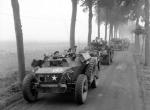
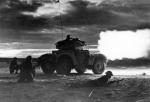
Cuando los primeros Daimler Armored Car llegaron al norte de África durante 1941 y 1942, pudieron asumir muchas de las funciones operativas de los vehículos Marmon-Herrington desplegados en ese teatro. Pronto se ganaron una reputación envidiable por su buen rendimiento y fiabilidad en todos los aspectos, que se mantendría durante muchos años. Al final de la guerra, no todos estaban todavía en uso como vehículos blindados, algunos se emplearon como vehículos de exploración o de mando con sus torretas retiradas, pero esto fue solo una medida temporal y los vehículos con torreta sirvieron durante muchos años después de 1945.
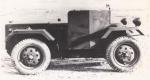
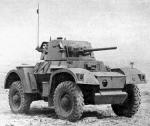
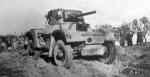
When the BSA Scout Car was undergoing its initial trials, it was decided to use the basic design as the foundation for a new vehicle to be known as the Tank, Light, Wheeled. As with the Scout Car, Daimler took over the development of the project, and the result was a vehicle that outwardly resembled the little Scout Car but was nearly twice as heavy and had a two-man turret. Work started on the project in August 1939 and the first prototypes were running by the end of the year, although troubles soon arose as the extra weight of the turret and armour overloaded the transmission. It took some time before these problems were overcome, and it was not until April 1941 that the first production examples appeared. By then the vehicle was known as the Armoured Car, Daimler Mk I.
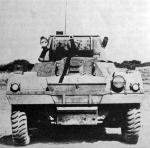
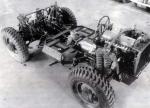
The Daimler Armoured Car was basically a Scout Car enlarged to accommodate a turret mounting a 2-pdr (40-mm.) gun. The turret was the same as that designed for the Tetrarch light tank intended for use by airborne forces, but when this was placed on the Daimler it was the first such installation on a British armoured car. The turret also mounted a co-axial 7.92-mm. (0.31-in.) Besa machine-gun, and many vehicles also had smoke dischargers mounted on the sides of the turret. The four-wheel drive used double-coil springs on each wheel station although the early idea of using four-wheel steering was discarded as being too complex an idea without real operational benefit. One advanced feature was the use of Girling hydraulic disc brakes, well in advance of general use elsewhere. A fluid flywheel was used in place of the more usual clutch arrangement. A duplicate steering wheel and simple controls were provided for use by the commander in an emergency to drive to the rear. The commander also had to double as loader for the main gun.
The Daimler underwent surprisingly few changes once in service. An Armoured Car, Daimler Mk II version was later introduced with a new gun mounting, a slightly revised radiator arrangement and a new escape hatch through the engine compartment for the driver. There was also an experimental Armoured Car, Daimler Mk I CS (Close Support) which had a 76.2-mm. (3-in.) howitzer in place of the 2-pdr (40-mm.) gun to provide close support fire with high explosive and smoke projectiles (the 2-pdr/40-mm. gun could fire only armour-piercing projectiles), but only a few were produced, Another armament alteration was to a small number of operational Mk Is, which were fitted with the Littlejohn Adaptor, a squeeze-bore muzzle attachment that enabled the 2-pdr (40-mm.) gun to fire small projectiles that could penetrate thicker armour than the normal-calibre projectile.
When the first Daimler Armoured Cars arrived in North Africa during 1941 and 1942 they were able to assume many of the operational roles of the Marmon-Herrington vehicles currently deployed in that theatre. They soon gained for themselves an enviable reputation for good all-round performance and reliability which was to remain for many years. By the end of the war not all were still in use as armoured cars, some being employed as scout or command vehicles with their turrets removed, but this was only a temporary measure and turreted vehicles served for many years after 1945.
FUENTES Y REFERENCIA – SOURCES & REFERENCE
Chris Bishop, The Encyclopedia of Weapons of WWII, Barnes & Noble., 1998.
daimler-fighting-vehicles.co.uk
©jmodels.net
 jmodels.net
Debe estar conectado para enviar un comentario.