
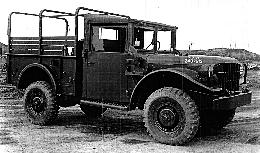
| DATOS TÉCNICOS | TECHNICAL DATA |
| TIPO:Hehículo de transporte. | TYPE:Utility truck. |
| TRIPULANTES:1-2 | CREW:1-2 |
| ANCHURA:1,88 m. | WIDTH:6.2 ft. |
| LONGITUD:4,83 m. | LENGTH:15.10 ft. |
| ALTURA:2,26 m. | HEIGHT:7.5 ft. |
| PESO:2.684 kg. | WEIGHT:5,917 lb. |
| MOTOR:un motor Dodge T-245 de 78 hp. (58 kW). | ENGINE:One Dodge T-245 developing 78 hp (58 kW). |
| AUTONOMÍA:362 km. | RANGE:225 ml. |
| VELOCIDAD MÁX.:89 km/h. | MAX. SPEED:55 mph. |
| VERSIONES:14 | VERSIONS:14 |
| CONSTRUIDOS:115,838 (Todos los modelos). | BUILT:115,838 (All variants). |
Los planes para la flota de vehículos tácticos de EE.UU. después de la Segunda Guerra Mundial incluían desde el principio un camión 4×4 de ¾ de tonelada. El vehículo del tamaño de una camioneta había demostrado ser indispensable durante la Segunda Guerra Mundial, y la serie de camionetas G-502 (WC) era muy apreciada por las fuerzas usuarias y, naturalmente, un buen negocio para Dodge.
Sin embargo, la falta de piezas comunes en toda la flota de vehículos tácticos durante la Segunda Guerra Mundial había dado lugar a la necesidad de una gran cantidad de piezas de repuesto y a cuellos de botella ocasionales en el suministro. Además, la lección aprendida en la guerra supuso avances notables en toda la gama de vehículos tácticos estadounidenses.
Dodge estaba naturalmente interesado en mantener su relación con el Ejército y, en consecuencia, creó una camioneta que aún hoy incorpora lo mejor de ambos mundos, los componentes probados del vehículo de la Segunda Guerra Mundial, así como los avances de la estandarización de la serie M.
El metal de calibre más pesado, incluidas las puertas de metal con ventanas enrollables, el sistema eléctrico sellado a prueba de agua de 24 voltios y una transmisión sincronizada fueron mejoras notables con respecto a los vehículos WC. Los nuevos camiones también eran un poco más angostos y tenían una altura ligeramente más baja que los camiones anteriores.
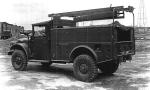
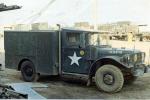
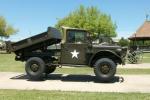
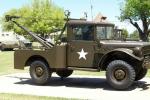
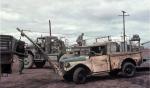
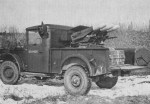
Denominada serie G-471, cuya piedra angular fue el camión de carga M37, la familia incluía una ambulancia (M43), un vehículo de mando (M42), una versión de mantenimiento de líneas telefónicas (M201 / V41), con variante de mantenimiento de contacto, una camioneta con caja cerrada (M43), dos tipos de camionetas de reparación y un puñado de variantes de volquete y grúa. El vehículo también se fabricó como M283 Long Wheel Base (LWB) con un chasis más largo.
El motor Dodge Modelo T-245 de 6 cilindros en línea y 230.2 pulgadas cúbicas impulsaba las nuevas camionetas, con un embrague Borg and Beck modelo 11828 que lo conectaba a una transmisión de cuatro velocidades y una caja de transferencia separada de dos velocidades.
Dos modelos piloto del nuevo vehículo se completaron en diciembre de 1950, a escasos (al menos en términos de Detroit) 19 meses después de que se firmó el contrato. El primer vehículo de producción se completó en enero de 1951, con aproximadamente 11.000 vehículos fabricados a fines de ese año, y más camionetas continuaron saliendo de las líneas de ensamblaje establecidas en la planta Route Van de Dodge hasta julio de 1954. A mediados de 1954 se habían terminado 63.000 unidades. En ese momento, el utillaje de fabricación se almacenó, con una incertidumbre considerable sobre si alguna vez se volverían a emplear. Esta inquietud resultó ser infundada, ya que en menos de tres años se reanudó la producción, y la primera camioneta de la nueva serie se completó en febrero de 1958.
Este segundo grupo de camionetas difería en detalle de la producción inicial. La variante de carga se designó M37B1. Se pueden distinguir rápidamente de la primera serie por la reubicación de la rueda de repuesto en el exterior de la puerta del conductor, utilizando el sistema de montaje desarrollado inicialmente para la ambulancia M43. También se realizaron mejoras en el sistema eléctrico, así como una mejora en la transmisión. El M37B1 permaneció en producción hasta 1968 y fue ampliamente utilizado en Vietnam como vehículo utilitario.
En total, entre 1951 y 1968 se fabricaron unos 115.000 Dodge M37. A partir de 1968, el ejército de EE.UU. los reemplazó con la familia de vehículos M-715, que también prestó servicio en la Guerra de Vietnam.
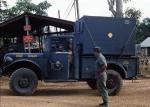
El camión 4×4 M37 de 3/4 de tonelada fue seleccionado por el ejército canadiense y la Real Fuerza Aérea Canadiense como reemplazo de los camiones CMP de 15 cwt y Dodge APT en servicio después de la Segunda Guerra Mundial. El vehículo tenía una disposición estándar de cabina y caja que también se podía producir con una carrocería de furgoneta si se deseaba.
Después de mucha negociación, se llegó a un acuerdo con los Estados Unidos en el que Canadian Industry ensamblaría los camiones en Canadá utilizando una combinación de piezas suministradas por Estados Unidos y Canadá. El diseño también fue adoptado por la Royal Canadian Air Force al mismo tiempo para reemplazar sus obsoletos camiones Dodge de 3/4 de tonelada. En marzo de 1951, Chrysler Corporation of Canada recibió un modelo piloto de los Estados Unidos para usarlo como referencia. En octubre de ese año, el primer M37 CDN, como ahora se le conocía, salió de la línea de producción en Windsor, Ontario.
Los camiones canadienses eran similares a las versiones fabricadas en EE.UU. excepto por el motor más grande de 251 pulgadas cúbicas producido en Canadá y la transmisión mejorada. Otras diferencias incluyeron el ajuste estandarizado de una cabina de metal en lugar de la parte superior de lona que se ve en los ejemplares norteamericanos. Al igual que con las versiones estadounidenses, los camiones canadienses se fabricaron con y sin cabrestantes montados en la parte delantera. También se planeó una versión M42 CDN de mando, que era esencialmente una oficina instalada en la caja trasera de un M37, pero este proyecto se canceló a favor de la plataforma M152 cerrada.
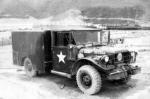
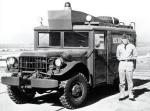
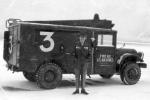
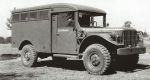
En 1952, se introdujo la versión de ambulancia con una carrocería de furgoneta de metal aislada con grandes puertas en la parte trasera. Este modelo se conocía como M43 CDN. 1952 también vio la introducción del camión M152 CDN. El M152 CDN se empleó en lugar de la camioneta M42 CDN de mando desechada y se basó en el modelo norteamericano experimental XM152. Este camión era similar al M43 pero presentaba ventanas laterales en la parte trasera de la carrocería con cubiertas de malla de alambre.
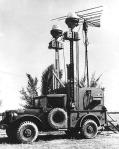
El M152 CDN se emplearía como base de varios vehículos con equipos especializados, incluido el modelo de radio, y entró en plena producción en 1954. El último modelo de camioneta que adquirió Canadá fue el M56 CDN. Estos poseían un chasis que presentaba el chasis más largo del M152 y el M43 pero con la chapa del M37. La intención era utilizarlos para el montaje de unidades móviles de soldadura y camiones cisterna. En última instancia, estas funciones fueron realizadas por el M37 o remolques regulares y los seis M56 CDN fabricados en 1954 superaban los requisitos en 1957. La última de las 4.524 camionetas de 3/4 de tonelada fue entregado por Chrysler de Canadá al ejército canadiense en 1955.
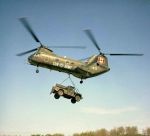
Las camionetas canadienses de 3/4 de tonelada sirvieron en Francia, Alemania y Noruega como parte del compromiso del país con la OTAN, y en el Medio Oriente con contingentes canadienses en misiones de las Naciones Unidas. El último Dodge M37 CDN se retiró a fines de la década de 1970 y la mayoría se vendió al mercado civil.
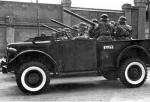
Algunos M37 excedentes llegaron a los ejércitos griego e israelí en las décadas de 1960 y 1970 después del retiro del modelo por parte del ejército de los EE.UU.
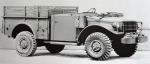

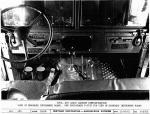
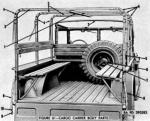
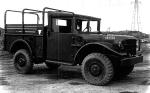
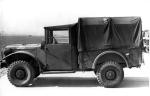
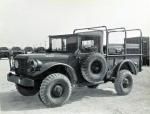
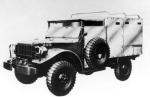
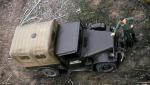
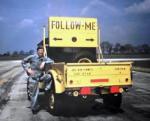
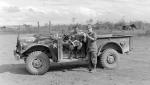
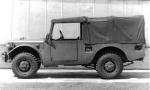
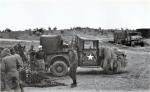
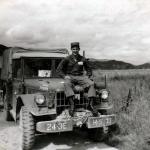
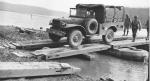
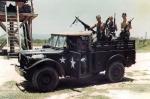
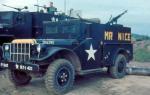
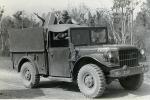
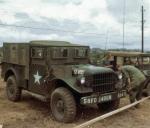
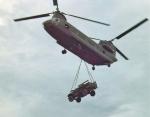
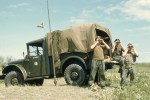
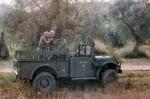
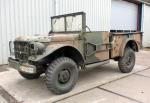
Plans for the post WWII US tactical vehicle fleet included from the outset a 3/4-ton 4×4 truck. The “pick-up” truck-sized vehicle had proven indispensable during WWII, and the G-502 (WC) series of trucks had been well-liked by the using forces, and naturally a good seller for Dodge.
However, the lack of commonality of parts throughout the tactical vehicle fleet during WWII had resulted in vast numbers of spare parts being required, and occassional bottlenecks in supply. Also, the lesson learned in the war brought about notable advances across the entire range of US tactical vehicles.
Dodge was naturally interested in maintaining their relationship with the Army, and accordingly created a truck that even today incorporates the best of both worlds, the proven components of the WWII vehicle as well as the advances of the M-series standardization.
Heavier gauge metal, including metal doors with roll-up windows, 24-volt sealed waterproof electrical system and a synchronized transmission were notable improvements over the WC vehicles. The new trucks were also slightly narrower and had a slightly lower height than the earlier trucks as well.
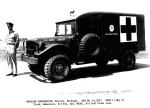
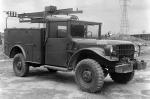
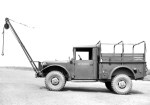
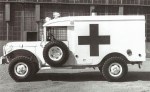
Dubbed the G-471 series, the cornerstone of which was the M-37 cargo truck, in U.S. use the family inluded an ambulance (M43), a command truck (M42), a telephone line maintenance truck (M201 / V41), and contact maintenance variant, a panel truck (M43), two types of crash trucks and a handful of dump and wrecker truck variants. The truck was also built as the M283 Long Wheel Base (LWB) with a longer chassis.
The Dodge Model T-245 inline 6-cylinder 230.2 cubic in. engine powered the new trucks, with a Borg and Beck model 11828 clutch connecting it to a four-speed transmission and separate two-speed transfer case.
Two pilot models of the new vehicle were completed in December 1950, a scant (at least in Detroit terms) 19 months after the contract for it had been signed. The first production truck was completed in January 1951, with approximately 11,000 vehicles made by the end of that year, and the vehicles continued to roll from the assembly lines established in Dodge’s Route Van plant until July 1954. By mid-1954 63,000 of the vehicles had been produced. At that time the tooling for the vehicles was placed into storage, with considerable uncertainty as to whether it would ever be used again. This trepidation proved to be unfounded, for in less than three years the tooling was retrieved and production resumed, with the first of the new series being completed in February 1958.
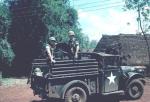
This second group of trucks differed in detail from the initial production, and the cargo variant was designated the M37B1. They can be mostl quickly distinguished from the first series by the spare tire’s relocation to outboard of the driver’s door, utilizing the mounting hardware initially developed for the M43 ambulance. Improvements were also made to the electrical system, as well as an improved transmission. The M37B1 remained in production until 1968, and was widely used in Vietnam as a utility vehicle.
In total, between 1951 and 1968, some 115,000 Dodge M37s were produced. From 1968 onwards, the U.S. military replaced them with the M-715 family of vehicles, which also saw service in the Vietnam War.
The M37 3/4 ton 4×4 truck was selected by the Canadian Army and Royal Canadian Air Force as the replacement for the 15cwt CMP and Dodge APT trucks in service after WWII. The vehicle was a standard cab and box arrangement that could also be produced with a van body if desired.
After much negotiation, an agreement with the United States was made where the trucks would be assembled in Canada by Canadian Industry using a mixture of US and Canadian supplied parts. The design was also adopted by the Royal Canadian Air Force at the same time to replace its outdated Dodge 3/4 ton trucks. In March 1951, Chrysler Corporation of Canada received a pilot model M37 from the United States to use as a reference sample. By October of that year, the first M37 CDN as they were now known, rolled off the production line in Windsor, Ontario.
The Canadian trucks were similar to the US made versions except for the larger, Canadian produced 251 cubic inch engine and improved transmission. Other differences included the standardized fitting of a metal cab instead of the canvas top seen on US examples. As with the US versions, Canadian trucks were made with and without, front mounted PTO driven winches. There was also a M42 CDN Command version planned, which was essentially an office kit installed in the rear bed of an M37, but this project was cancelled in favour of the enclosed M152 platform.
In 1952, the ambulance version of the fleet was introduced featuring an insulated metal van body with large barn doors in the rear. This model was known as the M43 CDN. 1952 also saw the introduction of the pilot model M152 CDN panel truck. The M152 CDN took over from shelved M42 CDN Command truck project and was based on the US XM152. This truck was similar to the M43 but featured side windows in the rear body with wire mesh covers.
The M152 CDN was to be used for the basis of several specialised equipment vehicles including the Radio Van and entered full production in 1954. The final model of 3/4 ton truck that Canada acquired was the M56 CDN. These were a cab and chassis only that featured the longer frame of the M152 and M43 but with the sheet metal of the M37. The intent was to use them for the mounting of mobile welder units and water tankers. Ultimately these roles were carried out by regular M37’s or trailers and the six M56 CDN manufactured in 1954 were surplus to requirements by 1957. The last of 4524 3/4 ton trucks were delivered by Chrysler of Canada to the Canadian military in 1955.
Canadian made 3/4 ton trucks went on to serve with Canada in France, Germany and Norway as part of the country’s NATO commitment, and in the middle east with Canadian contingents on United Nations missions. The last of the Dodge M37 CDN was retired in the late 1970’s with the majority being sold onto the civilian market.
Some surplus M37s made their way into the Greek and Israeli armies in the 1960s and 70s after the retirement of the type by the U.S. Army.
FUENTES Y REFERENCIA – SOURCES & REFERENCE
Wikipedia
canadianarmsandarmour.ca
g741.tumblr.com
David Doyle, Gun Trucks. A Visual History of the U.S. Army’s Vietnam-Era Wheeled Escort Platforms, Ampersand Publishing Company, 2015
©jmodels.net
 jmodels.net
Debe estar conectado para enviar un comentario.