
| DATOS TÉCNICOS | TECHNICAL DATA |
| TIPO: Vehículo anfibio de carga. | TYPE: Amphibious cargo vehicle. |
| TRIPULANTES: 3 (+20 pasajeros). | CREW: 3 (+ 20 passengers). |
| ANCHURA: 3 m. | WIDTH: 10 ft. |
| LONGITUD: 11 m. | LENGTH: 35 ft. |
| ALTURA: 3,09 m. | HEIGHT: 10.16 ft. |
| PESO: 8.618 kg. | WEIGHT: 19,000 lb. |
| MOTOR: Un motor diésel V8 Cummins V8-300 de 12,9 litros y 300 hp (220 kW). | ENGINE: One Cummins V8-300 785 cu in (12.9 L) diesel V8 providing 300 hp (220 kW). |
| AUTONOMÍA: 402,3 km. | RANGE: 250 ml. |
VELOCIDAD MÁX.:
|
MAX. SPEED:
|
| CONSTRUIDOS: Unos 968. | BUILT: Around 968. |
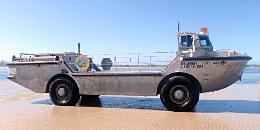
El LARC-V (Lighter Amphibious Resupply Cargo) es un vehículo anfibio del Ejército norteamericano utilizado originalmente en la década de 1960 para transportar suministros desde los barcos a la costa. Su carga total posible es de 5 toneladas (de ahí el número cinco después de LARC). El jefe del Cuerpo de Transporte, el Mayor General Paul Yount, ordenó al Comando de Investigación del Ejército de los EE. UU. en 1956 que construyera una embarcación con la capacidad de desplazarse en tierra. El prototipo se construyó en julio de 1959 y el diseño final se produjo en 1963.
Los LARC-V no tuvieron las prestaciones esperadas, por lo que muchos fueron entregados a alrededor de 35 compañías de reserva. Las compañías de transporte en servicio activo 165ª, 305ª, 344ª, 458ª y 461ª también los recibieron. El LARC-V es utilizado principalmente por las unidades de desembarco del Grupo de Playa en funciones de salvamento, recuperación, mando y control, y para el transporte de personal y equipo. Las embarcaciones tienen más de 35 años y requieren un mantenimiento y una reparación exhaustivos, sin embargo, su conservación o sustitución se considera esencial.
El LARC-V es un anfibio de una sola hélice, con cuatro ruedas, autónomo y propulsado por un motor diésel. Tiene una capacidad de carga de 10.000 libras y una capacidad de tropas de 20. Tiene un alcance de 250 ml en tierra y 40 millas náuticas en el agua. Puede alcanzar velocidades de hasta 30 mph en tierra y 9,5 nudos en el mar. En la actualidad, hay 12 embarcaciones LARC-V embarcadas a bordo de buques de la Fuerza de Preposicionamiento Marítimo (MPF).
El LARC-V es un aligeramiento anfibio construido en aluminio, de 11 m de largo, 3 m de ancho y 3,09 m de alto. El peso de la embarcación es de aproximadamente 9.000 kg (sin carga). La potencia la proporciona un motor Cummins V8-300 de 8 cilindros con una potencia nominal de 300 hp a 26.000 rpm.
La embarcación es capaz de operar en climas templados, tropicales y árticos, de atravesar playas de arena y coral, caminos no pavimentados, terrenos abruptos y maniobrar a través de olas de 3 m. El motor está ubicado en la popa sobre la hélice y conectado a una caja de transferencia ubicada en el centro donde la potencia se transmite a las cuatro ruedas motrices y a la hélice.
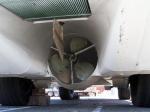
La suspensión es rígida y los neumáticos todoterreno sin cámara de 18 x 12 capas proporcionan la única absorción de impactos. La hélice opera en un túnel del casco que está equipado con una boquilla para mejorar la eficiencia. Las velocidades de referencia de la embarcación son de 15,3 km/h en el agua y 40 km/h en tierra con una carga completa de 4,5 toneladas.
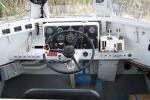
Se han identificado treinta y cinco modificaciones que forman el núcleo del programa SLEP (Programa de Extensión de la Vida Útil) de la embarcación. Este programa SLEP tiene como objetivo mejorar la seguridad, reducir la fatiga de la tripulación, mejorar la confiabilidad, reducir los costos de mantenimiento y aumentar la vida útil. El SLEP implicó cambiar la transmisión mecánica por una hidráulica, actualizar el sistema eléctrico y mejorar otros sistemas de a bordo. Estos LARC-V modificados comenzaron a entregarse en junio de 2006 para ser empleados por las Unidades de Mando de Playa de la Armada de los EE. UU., los Equipos de Construcción Submarina y los buques de Preposicionamiento Marítimo. Un total de 42 LARC-V fueron modificados en el programa SLEP. La capacidad de remolque en tierra se mejoró a aproximadamente a 13.500 kg y la tracción a punto fijo en el agua se duplicó a 3.500 kg. El vehículo funciona con tracción en las cuatro ruedas mientras está en modo tierra o remolque. Actualmente está propulsado por un motor diésel turboalimentado John Deere de 375 CV.
El LARC-V ha sido utilizado por las fuerzas militares de Alemania, Australia, Argentina, Portugal, Filipinas, Singapur e Islandia. Alrededor de 100 de ellos tienen propietarios privados y se utilizan principalmente para el turismo.


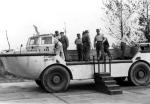





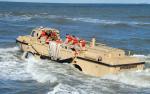

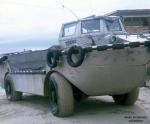

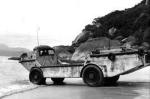
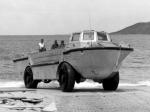
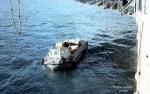


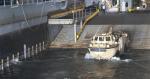

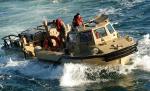
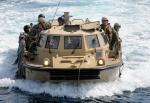


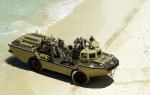

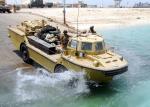


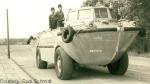
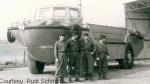
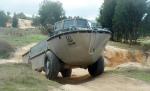


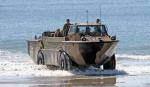


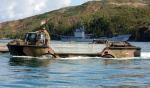


The LARC-V (Lighter Amphibious Resupply Cargo) is an Army amphibious vehicle originally used in the 1960’s to ferry supplies from ships to shore. Its total possible load is 5 tons (hence the five after LARC). The head of the Transportation Corps, Mayor General Paul Yount, directed the US Army Research Command in 1956 to build a boat with the ability to drive on land. The prototype was built in July 1959 with final design produced in 1963.
They LARC-V did not handle the way it was expected so, many were given to around 35 reserve companies. The active duty 165th, 305th, 344th, 458th, and 461st Transport Companies received them. The LARC-V is primarily used by the Beach Group in surf-zone salvage, recovery, and command and control roles, and for the transportation of personnel and equipment. The craft are in excess of 35 years old and require extensive maintenance and repair, nevertheless their retention or replacement is considered essential.
The LARC-V is a single-screw, four-wheeled, self-propelled, diesel-powered amphibian. It has a cargo capacity of 10,000 pounds and a troop capacity of 20. It has a range of 250 ml on land and 40 nautical miles on water. It can attain speeds up to 30 mph on land and 9.5 knots at sea. 12 LARC-V craft are presently embarked aboard Maritime Prepositioning Force (MPF) ships.
The LARC-V is an amphibious lighter constructed of aluminum, 35 ft long, 10 ft wide, and 10.2 ft high. The current weight of the craft is approximately 20,000 pounds (without cargo). Power is furnished by an 8 cylinder Cummins V8-300 engine (rated at 300 hp at 26,000 rpm).
The craft is capable of operation in temperate, tropic, and arctic climates, of transversing sand and coral beaches, unimproved roads, off-road terrain and maneuvering through a surf of 10-ft breakers. The engine is located in the stern over the propeller and drives forward to a centrally located transfer case where power is transmitted to all four driving wheels and/or the propeller.
The suspension is rigid and the 18 x 12 ply off-road tubeless tires provide the only shock absorption. The propeller operates in hull tunnel, which is fitted with a nozzle to improve efficiency. Baseline speeds for the craft were 9 mph in water and 30 mph on land with full rated load of 5 short tons.
Thirty-five modifications have been identified that form the nucleus of a SLEP (Service Life Extension Program) for the craft. This SLEP is intended to improve safety, reduce crew fatigue, improve reliability, reduce maintenance costs, and increase service life. The SLEP involved changing from a mechanical to an hydraulic transmission, updating the electrical system, and improving other on-board systems. These reworked LARC-Vs began delivery in June 2006 for use by U.S. Navy Beach Master Units, Underwater Construction Teams and the Maritime Pre-positioned Force ships. A total of 42 LARC-Vs were for the SLEP process. Towing capacity on land was improved to approximately 29,000 lb and bollard pull in water was doubled to 7,600 lb. The vehicle operates in all-wheel drive while in land or tow modes. The craft is powered now by a 375hp John Deere turbo-charged diesel engine.
The vehicle has been employed by other military forces in Germany, Australia, Argentina, Portugal, the Philippines, Singapore and Iceland. Around 100 have private owners and are mainly used for tourism.
FUENTES Y REFERENCIA – SOURCES & REFERENCE
globalsecurity.org
panzerbaer.de
tanknutdave.com
©jmodels.net
 jmodels.net
Debe estar conectado para enviar un comentario.