
| DATOS TÉCNICOS (M16) |
TECHNICAL DATA (M16) |
| TIPO:Vehículo AA autopropulsado. | TYPE:Self-propelled AA vehicle. |
| TRIPULANTES:5 | CREW:5 |
| ANCHURA:2,16 m. | WIDTH:7.1 ft. |
| LONGITUD:6,5 m. | LENGTH:21.4 ft. |
| ALTURA:2,34 m. | HEIGHT:7.8 ft. |
| PESO:9.000 kg. | WEIGHT:19,841 lb. |
| MOTOR:Un motor White 160AX de 6.330 cc. y 6 cilindros con una potencia de 128 hp. (95 kW). | ENGINE:One White 160AX, 386 in3 (6,330 cc) 6-cylinder, gasoline developing 128 hp. (95 kW). |
| AUTONOMÍA:282 km. | RANGE:175 ml. |
ARMAMENTO:
|
ARMAMENT:
|
MUNICIÓN:
|
AMMO:
|
| BLINDAJE:1,3-0,64 cm. | ARMOR:0.50-0.25 in. |
| VELOCIDAD MÁX.:67,1 km/h. | MAX. SPEED:41.7 mph. |
| VERSIONES:4 | VERSIONS:4 |
| CONSTRUIDOS:3.550 | BUILT:3,550 |
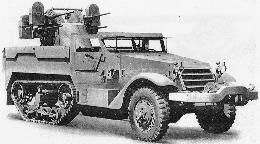
El M16 Multiple Gun Motor Carriage estaba armado con cuatro ametralladoras antiaéreas de 0,50 pulgadas en una torreta Maxson transportada en un semioruga M3 y reemplazó al vehículo M13 de dos cañones en la producción.
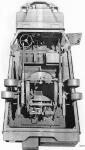
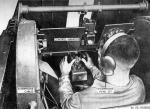
El M13 había sido aceptado para la producción en julio de 1942 después de un proceso de desarrollo que había comenzado en octubre de 1940 con el T1 Multiple Gun Motor Carriage. La torreta Maxson se montó en la parte trasera del compartimento de combate, que retuvo sus lados (la parte superior de los lados y la parte trasera se podían plegar para permitir que el arma disparara a elevaciones bajas sin una montura muy alta). La torreta en sí se transportaba en una plataforma giratoria motorizada, con el artillero sentado en el centro. Llevaba una ametralladora de 50 pulgadas a cada lado del artillero.
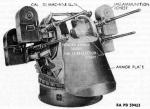
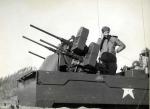
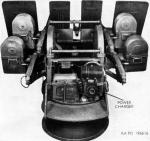
Se construyeron un total de 1.103 M13 y algunos entraron en combate en Italia durante 1943, pero pronto se evidenció que carecía de potencia de fuego. Se comenzó a trabajar en la nueva versión T61 de cuatro cañones en la torreta Maxson, y en noviembre de 1942 se aceptó para producción como montura M45. La nueva montura era muy similar a la versión de dos ametralladoras, pero con dos ametralladoras de 0,50 pulgadas a cada lado del artillero. Las armas adicionales se montaron debajo y más atrás para dejar espacio para un segundo tambor de munición en cada lado.
La nueva montura se probó en el semioruga M3 con la designación T58 y luego se aceptó para la producción como M16 Multiple Gun Motor Carriage. La producción del M16 comenzó en mayo de 1943. Le siguió el M17 MGMC, que combinó la montura M45 con el semioruga M5 y reemplazó al anterior M14 MGMC. La producción del M17 comenzó en diciembre de 1943.
El M16 MGMC se produjo en mayor número que los otros cañones autopropulsados en semiorugas. Se construyeron un total de 2.877 en 1943-44, 2.323 en 1943 y 554 en 1944. Esta cifra puede incluir los 568 M13 que se actualizaron al estándar M16 antes de ser entregados al Ejército de EE.UU. y los 109 T10 MGMC que tenían cañones de 20 mm. que se reemplazaron por el soporte M16 estándar en diciembre de 1944, pero no incluye los M16 que se produjeron sobre el terreno montando torretas M45 remolcadas en semiorugas estándar.
El M16 se usaba normalmente junto con el M15 MGMC. Sirvieron con las compañías de armas de artillería antiaérea de las Divisiones Blindadas de EE.UU., que estaban equipadas con ocho unidades cada una. También se utilizaron en batallones de armas antiaéreas a nivel de cuerpo y ejército, equipados con treinta y dos cada uno. Estos batallones se utilizaron para defender lugares de alto valor, como puestos de mando, puentes o cruces ferroviarios.
Cuando el M16 entró en combate, la Luftwaffe era casi una fuerza agotada y el M16 se usaba normalmente como arma de apoyo en tierra. Fue muy eficaz en este papel y se ganó el apodo bastante espantoso de picadora de carne.
El M16 entró en combate en Italia a principios de 1944. En abril de 1944, algunos llegaron a la cabeza de playa de Anzio, donde por primera vez se utilizaron como armas antiaéreas para ayudar a repeler los fuertes ataques de la Luftwaffe.
El M16 tuvo su mayor uso en la campaña en el noroeste de Europa, luchando desde el Día D hasta la rendición final alemana. Los planes para el Día D habían asumido que la Luftwaffe lanzaría todo lo que tenía contra la cabeza de playa, pero esta amenaza nunca se desarrolló realmente y en julio el M16 ya se usaba principalmente como arma de apoyo de la infantería.
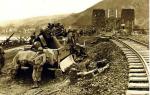
Hubo más actividad de la Luftwaffe cuando los aliados se acercaron a la frontera alemana a fines de 1944, pero durante la batalla de las Ardenas, el M16 se usó una vez más como arma de apoyo de la infantería. El M16 se empleó de nuevo como arma antiaérea a principios de 1945. El 1 de enero de 1945, los alemanes lanzaron la Operación Bodenplatte, un ataque masivo contra los aeródromos aliados en los Países Bajos y Francia. Esto fue un desastre para la Luftwaffe, que perdió pilotos insustituibles en un ataque que no tuvo impacto en el resultado de la guerra. El segundo y último uso importante del M16 como arma antiaérea se produjo en marzo de 1945 después de que las tropas estadounidenses capturaran el puente Ludendorff en Remagen. La Luftwaffe realizó una serie de ataques contra el puente y varios M16 participaron en la decidida defensa estadounidense del área.
El M16 también fue utilizado por la 1ª División Blindada Polaca durante la campaña en Francia en 1944, apareciendo con los colores británicos. El M16 tuvo un uso limitado en el Pacífico, pero luchó en Luzón durante 1945, donde fue utilizado por el 209º Batallón de Artillería Antiaérea.
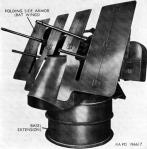
El M16 fue una de las pocas armas semioruga que permaneció en uso hasta la década de 1950 y entró en combate en Corea. En 1947, la mayoría de las variantes del M3 se declararon obsoletas y muchos M3 sobrantes se convirtieron en armas antiaéreas como el M16A1. El M3 estándar carecía de los lados plegables del M16, por lo que en el M16A1 la torreta estaba montada en un pedestal más alto. Algunos M16A1 también recibieron escudos blindados de «ala de murciélago» que se extendían más allá de los lados de la torreta para brindar protección a los cargadores.
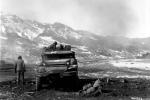
El M16 se usó ampliamente durante la Guerra de Corea, normalmente como arma de apoyo terrestre. Fue muy efectivo contra los ataques masivos de infantería china. Después de la Guerra de Corea, el M16 fue reemplazado por el M42 Duster, armado con dos cañones gemelos de 40 mm., pero permaneció en la Guardia Nacional hasta la década de 1960 y algunos se desplegaron durante los disturbios de Newark de 1967.
Solo se exportaron un puñado de M16 durante la Segunda Guerra Mundial. Los franceses libres recibieron la mayor cantidad, con 70, mientras que solo dos fueron al Reino Unido. Después de la guerra, se exportaron en grandes cantidades y, a menudo, se entregaron a los aliados de Estados Unidos, donde algunos permanecieron en uso durante muchos años.
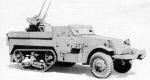
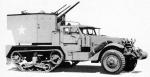
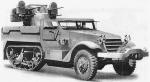
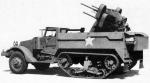
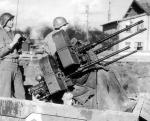

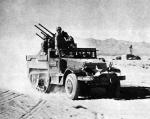
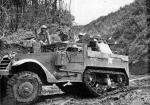
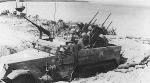
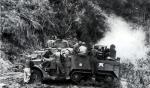
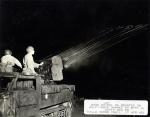
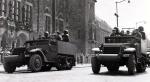
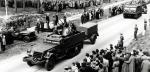
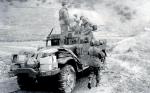
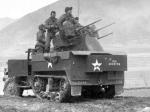
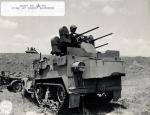
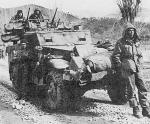
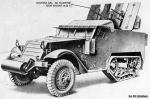
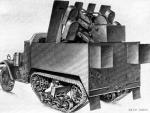
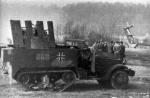
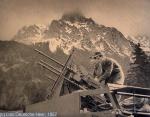
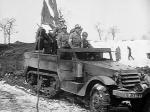
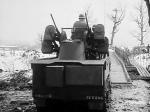
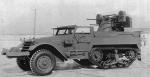
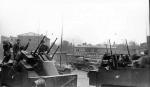
The M16 Multiple Gun Motor Carriage was armed with four .50in anti-aircraft machine guns in a Maxson turret carried on a M3 half-track and replaced the twin-gun M13 in production.
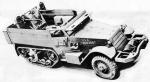
The M13 had been accepted for production in July 1942 after a development process that had begun in October 1940 with the T1 Multiple Gun Motor Carriage. The Maxson turret was mounted in the back of the fighting compartment, which retained its sides (the top part of the sides and back could be folded down to allow the gun to fire at low elevations without a very high mount). The turret itself was carried on a powered turntable, with the gunner sitting in the centre. One .50in. gun was carried to each side of the gunner.
A total 1,103 M13s were built, and some saw combat in Italy during 1943, but it was soon realised that it lacked firepower. Work began on a new T61 four-gun version of the Maxson turret, and in November 1942 this was accepted for production as the M45 mount. The new mount was very similar to the two-gun version, but with two .50in. machine guns on each side of the gunner. The second gun was mounted below and behind the upper gun in order to make space for a second ammo drum on each side.
The new mount was tested on the M3 half-track with the designation T58, and then accepted for production as the M16 Multiple Gun Motor Carriage. Production of the M16 began in May 1943. It was followed by the M17 MGMC, which combined the M45 mount with the M5 half-track and replaced the earlier M14 MGMC. Production of the M17 began in December 1943.
The M16 MGMC was produced in greater numbers than of the other self-propelled guns on half-tracks. A total of 2,877 were built in 1943-44, 2,323 in 1943 and 554 in 1944. This figure may include the 568 M13s that were upgraded to the M16 standard before being issued to the US Army and the 109 T10 MGMCs that had their 20mm. guns removed and replaced with the standard M16 mount in December 1944, but doesn’t include those M16s that were produced in the field by mounting towed M45 turrets on standard half-tracks.
The M16 was normally used alongside the M15 Combination Gun Motor Carriage. They served with the anti-aircraft artillery weapons companies of US Armoured Divisions, which were equipped with eight of each type. They were also used in anti-aircraft weapons battalions at corps and army level, equipped with thirty-two of each type. These battalions were used to defend high value locations such as headquarters, bridges or rail junctions.
By the time the M16 entered combat the Luftwaffe was almost a spent force and the M16 was normally used as a ground support weapon. It was very effective in this role and earned the rather gruesome nickname of meat-chopper.
The M16 entered combat in Italy early in 1944. By April 1944 some had reached the Anzio beachhead, where for once they were used as anti-aircraft weapons to help repel heavy Luftwaffe attacks on the beachhead.
The M16 saw most use in the campaign in north-western Europe, fighting from D-Day to the final German surrender. The plans for D-Day had assumed that the Luftwaffe would throw everything it had at the beachhead, but this threat never really developed and by July the M16 was already mainly used as an infantry support weapon.
There was more Luftwaffe activity as the Allies approached the German border late in 1944, but during the battle of the Bulge the M16 was once again used as an infantry support weapon. The M16 did see use as an anti-aircraft weapon early in 1945. On 1 January 1945 the Germans launched Operation Bodenplatte, a massed attack on Allied airfields in the Low Countries and France. This was a disaster for the Luftwaffe, which lost irreplaceable pilots in an attack that had no impact on the outcome of the war. The second and final major use of the M16 as an anti-aircraft weapon came in March 1945 after US troops captured the Ludendorff Bridge at Remagen. The Luftwaffe made a series of attacks on the bridge, and a number of M16s took part in the determined American defence of the area.
The M16 was also used by the Polish 1st Armoured Division during the campaign in France in 1944, appearing in British colours. The M16 saw limited use in the Pacific, but it did fight on Luzon during 1945, where it was used by the 209th Anti-Aircraft Artillery Battalion.
The M16 was one of the few half-track weapons to remain in use after the war, remaining in use into 1950s and seeing combat in Korea. In 1947 most variants on the M3 were declared obsolete, and many surplus M3s were converted into anti-aircraft weapons as the M16A1. The standard M3 lacked the folding sides of the M16, and so on the M16A1 the turret was mounted on a higher pedestal. Some M16A1s was also given ‘bat-wing’ armoured shields which extended past the sides of the turret to provide protection for the loaders.
The M16 was used extensively during the Korean War, normally as a ground support weapon. It was very effective against Chinese massed infantry attacks. After the Korean War the M16 was replaced in Army service by the M42 Duster twin 40mm. gun vehicle, but it remained in use with the National Guard into the 1960s and some were deployed during the 1967 Newark Riots.
Only a handful of M16s were exported during the Second World War. The Free French received the most, getting 70, while only two went to the UK. After the war they were exported in large numbers, and were often given to America’s allies, where some remained in use for many years.
FUENTES Y REFERENCIA – SOURCES & REFERENCE
historyofwar.org
afvdb.50megs.com
©jmodels.net
 jmodels.net
Debe estar conectado para enviar un comentario.