
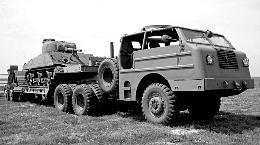
| DATOS TÉCNICOS (M25) |
TECHNICAL DATA (M25) |
| TIPO: Transporte de recuperación de carros 6×6 de 40 toneladas. | TYPE: 40 ton 6×6 Tank recovery truck-trailer. |
| TRIPULANTES: 7 | CREW: 7 |
ANCHURA:
|
WIDTH:
|
LONGITUD:
|
LENGTH:
|
| ALTURA: (M26) 3,48 m. | HEIGHT: (M26) 11.5 ft. |
PESO (vacío):
|
WEIGHT (empty):
|
| MOTOR: Un motor en línea de gasolina de 6 cilindros Hall.Scott 440 de 230 hp a 2.100 rpm. | ENGINE: One 6-cylinder Hall-Scott 440 in-line gasoline engine providing 230 hp at 2,100 rpm. |
| AUTONOMÍA: 193 km. | RANGE: 120 mi. |
ARMAMENTO:
|
ARMAMENT:
|
MUNICIÓN:
|
AMMO:
|
| BLINDAJE: 19-6,4 mm. | ARMOR: 3/4-1/4 in. |
VELOCIDAD MÁX.:
|
MAX. SPEED:
|
| VERSIONES: 2 | VERSIONS: 2 |
| CONSTRUIDOS: 753 (M26), 629 (M26A1) | BUILT: 753 (M26), 629 (M26A1) |
El camión tractor M26 de 12 toneladas (11.000 kg) 6×6 fue diseñado por Knuckey Truck Company de San Francisco como un vehículo de ruedas para la recuperación de carros que pudiera participar en operaciones en el desierto. Sin embargo, la fabricación se asignó a la empresa Pacific Car and Foundry, ya que no se esperaba que Knuckey pudiera satisfacer la demanda. La producción comenzó en enero de 1943 y, en junio de 1943, la combinación del M26 y el semirremolque M15 se estandarizó como el camión-remolque transporte de carros de 40 toneladas (36.000 kg) M25. Sin embargo, la práctica de nombrar al camión tractor y al remolque juntos se interrumpió en octubre de 1944. El M26 presentaba una cabina blindada y un soporte de anillo para una ametralladora de calibre 50. Las ruedas traseras dobles del camión eran impulsadas por cadenas de rodillos que hacían girar ruedas dentadas unidas a los cubos de las ruedas. La combinación de la transmisión principal y la transmisión auxiliar de tres velocidades permitía el uso de doce velocidades hacia adelante y tres hacia atrás. En la parte delantera del camión se montó un cabrestante Gar Wood modelo 5M 713K con capacidad de arrastrar 16.000 kg, provisto de 91 m de cable de 1,9 cm de grosor. Detrás de la cabina había un grupo de cabrestantes en tándem Gar Wood modelo 60-823B con 91 m de cable de 1,9 cm de grosor y una capacidad de 27.000 kg. La carga útil del M26 era de 25.000 kg y su carga remolcada normal era de 52.200 kg.
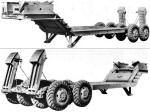
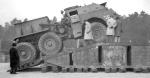
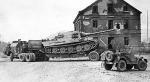
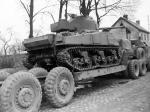
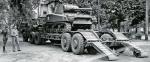
Diseñado por Fruehof Trailer Company, el semirremolque M15 tenía una carga útil máxima de 36.000 kg a 42 km/h. Sus ocho ruedas individuales estaban suspendidas con vigas móviles que operaban sobre ejes de muñón, y cualquiera de las ruedas podía superar un obstáculo de 23 cm sin que ninguna de las otras ruedas se levantara del suelo. El remolque presentaba frenos de aire internos expandibles operados por el tractor. Los rieles de deslizamiento, los rieles de la plataforma y las cubiertas protegían las ruedas del semirremolque y facilitaban la carga de vehículos averiados. Las ruedas del remolque se podían mover lateralmente para acomodar cargas de diferentes anchos. El semirremolque M15A1 fue diseñado en 1944 para transportar el carro pesado T26E3. Este presentaba una plataforma reforzada y rampas con bisagras sobre las ruedas para que el carro más ancho pudiera cargarse sin dañar los neumáticos. La carga útil del M15A1 se aumentó a 40.800 kg. Después de la Segunda Guerra Mundial, el remolque se perfeccionó aún más en el M15A2, con refuerzo adicional y un marco más ancho, así como la eliminación de las cajas de estiba sobre la conexión de la quinta rueda. El M15A2 se ensanchó cerca de las ruedas para que ya no quedaran expuestas desde el frente. El M15A2 pesaba 19.300 kg netos y la carga útil se incrementó a 45.000 kg.
Estandarizado en octubre de 1944, el M26A1 cambió la cabina blindada por una cabina abierta de menor sin blindaje, ya que las operaciones de recuperación con frecuencia no se producían en combate. Se mantuvo el montaje de anillo y la ametralladora de calibre 50 y la altura hasta la parte superior de la cabina permaneció en 290 cm. Con el peso ahorrado por la omisión de la cabina blindada, la carga útil del M26A1 se incrementó a 26.000 kg y la carga remolcada normal aumentó a 60.181 kg.
A partir de 1955, el M25 fue reemplazado en el inventario del ejército de EE.UU. por el tractor 6×6 de 10 toneladas M123/M125 fabricado por Mack. Este vehículo se fabricó hasta 1969. El M25 también se utilizó en industrias pesadas civiles donde su rendimiento de transporte podía ser de gran ayuda. El camión también fue utilizado en el extranjero por las fuerzas de Japón (JGSDF), Gran Bretaña y la ex Yugoslavia.
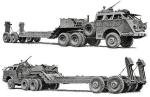
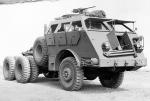
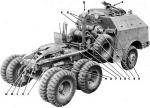
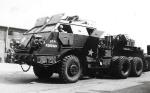
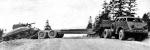
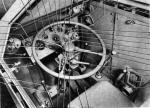
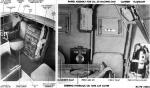
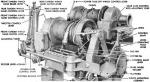
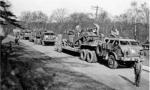
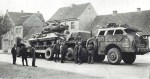
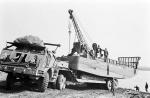
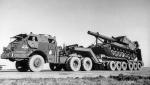
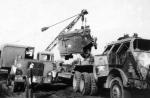
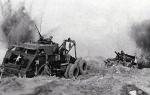
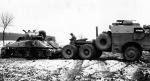
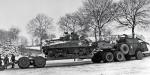
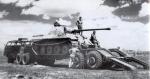
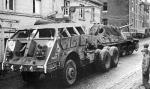
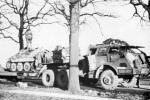
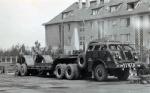
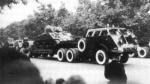
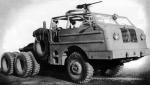
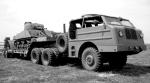
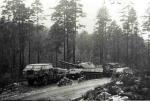
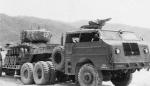
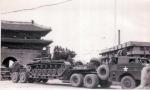
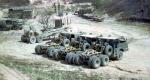
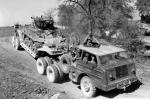
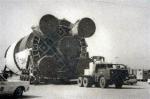
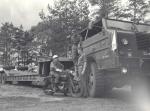
The 6×6 12-ton (11,000kg) tractor truck M26 was designed by the Knuckey Truck Company of San Francisco as a wheeled tank recovery vehicle that could participate in desert operations. Manufacture was assigned to the larger Pacific Car and Foundry, however, as Knuckey was not anticipated to be able to meet demand. Production began in January 1943, and in June 1943 the combination of the M26 and the semitrailer M15 was standardized as the 40-ton (36,000kg) tank transporter truck-trailer M25. The practice of naming the tractor truck and trailer together was discontinued in October 1944, however. The M26 featured an armored cab and a ring mount for a .50cal machine gun. The dual rear wheels of the truck were driven by roller chains that spun sprockets attached to the wheel hubs, and the combination of the main transmission and the three-speed auxiliary transmission enabled the use of twelve forward and three reverse speeds. A 35,000lb (16,000kg) Gar Wood model 5M 713K winch was mounted at the front of the truck, and was provided with 300 ft (91m) of ¾in (1.9cm) cable. A tandem set of Gar Wood model 60-823B winches behind the cab also each had 300 ft (91m) of ¾in (1.9cm) cable, and had a capacity of 60,000lb (27,000kg) on the cable’s first layer. The payload of the M26 was 55,000lb (25,000kg), and its normal towed load was 115,000lb (52,200kg).
Designed by the Fruehof Trailer Company, the semitrailer M15 had a maximum payload of 40 tons (36,000kg) at 26 mph (42 km/h). Its eight single wheels were suspended with walking beams operating on trunnion shafts, and any one wheel could surmount a 9in (23cm) obstacle without any of the other wheels leaving the ground. The trailer featured internal expanding air brakes operated by the tractor. Skid rails, bed rails, and wheel covers protected the semitrailer wheels and eased loading disabled vehicles, and the trailer wheels could be moved laterally to accommodate loads of differing widths. The semitrailer M15A1 was designed in 1944 to carry the heavy tank T26E3. This featured a strengthened bed and hinged ramps over the wheels so the wider tank could be loaded without damage to the tires. Payload of the M15A1 was increased to 90,000 lb (40,800 kg). After World War II, the trailer was further refined into the M15A2, with additional reinforcement and a wider frame, as well as the elimination of the stowage boxes above the fifth wheel connection. The M15A2 widened near the wheels so that they were no longer exposed from the front. The M15A2 weighed 42,600 lb (19,300 kg) net, and payload was increased to 50 tons (45,000 kg).
Standardized in October 1944, the M26A1 eschewed the armored cab for a soft-skinned open-topped cab since recovery operations frequently did not occur under fire. The .50cal ring mount was retained, and height to the top of the cab remained 9’6 in (290 cm). With the weight saved from the omission of the armored cab, the M26A1’s payload was increased to 58,000 lb (26,000 kg), and the normal towed load jumped to 132,675 lb (60,181.4 kg).
From 1955 the M25 was replaced in US in the U.S. Army inventory by the M123/M125 10-ton 6×6 tractor from Mack. This new design was manufactured into 1969. The M25 was also used in heavy industries where its hauling performance could be of great help. The truck was also used abroad by the forces of Japan (JGSDF), Great Britain, and the former Yugoslavia.
FUENTES Y REFERENCIA – SOURCES & REFERENCE
afvdb.50megs.com
©jmodels.net
 jmodels.net
Debe estar conectado para enviar un comentario.