

| DATOS TÉCNICOS | TECHNICAL DATA |
| TIPO: Cazacarros. | TYPE: Tank destroyer. |
| TRIPULANTES: 5 | CREW: 5 |
| ANCHURA: 2,22 m. | WIDTH: 7.29 ft. |
| LONGITUD: 6,24 m. | LENGTH: 20.46 ft. |
| ALTURA: 2,49 m. | HEIGHT: 8.17 ft. |
| PESO: 8,25 toneladas. | WEIGHT: 20,000 lb. |
| MOTOR: Un motor de 6 cilindros White 160AX y 6.330 cc de 147 hp (110 kW). | ENGINE: One White 160AX, 386 in3 (6,330 cc), 6-cylinder, developing 147 hp (110 kW). |
| AUTONOMÍA: 240 km. | RANGE: 150 mi. |
ARMAMENTO:
|
ARMAMENT:
|
MUNICIÓN:
|
AMMO:
|
| BLINDAJE: 6,4–15,9 mm | ARMOR: 0.25–0.625 in. |
| VELOCIDAD MÁX.: 75 km/h. | MAX. SPEED: 47 mph. |
| VERSIONES: 2 | VERSIONS: 2 |
| CONSTRUIDOS: 2.202 | BUILT: 2,202 |
El M3 Gun Motor Carriage (GMC) fue uno de los primeros cazacarros diseñados para llevar el cañón M1897A4 de 75 mm, convertido a partir del White M3 Half Track por Autocar Company. Se fabricó durante un tiempo limitado, hasta que se idearon mejores soluciones. Sin embargo, no se consideró una solución provisional, al contrario del similar M6 GMC. Este último combinaba un transporte multifunción Dodge WC 55 (Dodge 4×4 de 3/4 toneladas) con un cañón M3 de 37 mm de 1940 Ordnance de 1,46 pulgadas, montado en la plataforma trasera. Recibió el apodo de «Fargo» por la empresa que realizó la conversión. Más de 5.300 fueron convertidos en un tiempo récord, a un bajo coste (4.265 dólares cada uno), e integraron los recién creados Batallones de Cazacarros de los EE. UU., que se enviaron al norte de África desde diciembre de 1942.
El M3 sirvió en la Campaña de Filipinas por primera vez en enero de 1942, con la Brigada Provisional de Artillería de Campaña, combinando funciones anticarro y de apoyo. Los que se emplearon más tarde en el norte de África a finales de 1942 en batallones cazacarros, como se pretendía inicialmente, tuvieron resultados dispares. Fueron ineficaces en el Paso de Kasserine, pero tuvieron éxito en El Guettar. También participaron en la invasión aliada de Sicilia, reemplazados lentamente por el M10 durante la campaña de Italia. Del total de 2.203 modificados hasta abril, 1.361 de los que no se perdieron en combate fueron reconvertidos como semiorugas M3A1 estándar en 1943.
Sin embargo, el M3 GMC siguió adelante en el Pacífico, mejor preparado para enfrentarse a los generalmente débiles tanques japoneses. Se destacaron en la batalla de Saipán y en otros enfrentamientos como Peleliu hasta Okinawa, enfrentándose sin problemas a los Type 95 Ha-Go y Type 97 Chi-Ha.
Las unidades de cazacarros fueron una parte vital de la doctrina de guerra de carros desarrollada a partir de 1937. Fue solo con el comienzo de la Segunda Guerra Mundial y el uso decisivo de vehículos blindados por ambos bandos durante la campaña francesa de 1940 cuando el ejército estadounidense creyó haber dado con la clave de la eficacia de la campaña alemana. En particular, se destacó el uso de artillería autopropulsada por parte de los alemanes, el Stug fue el vehículo más famoso, pero ya existían los Panzerjäger-I y vehículos de apoyo como el siG 33 Bison, también basado en el obsoleto chasis del Panzer I. Ningún vehículo de este tipo estaba en el inventario estadounidense en ese momento.
Al mismo tiempo, se calculó el espesor del blindaje de los vehículos franceses y alemanes para los calibres de antes de la guerra, por lo que ya se decidió cambiar del calibre 37 mm, considerado medio, al más potente calibre 75 mm. Pronto surgió la idea de que para llevar un cañón más grande y pesado, se necesitaba un vehículo más robusto. Ese armamento existía, se trataba del M1897A4, un derivado largo del legendario Schneider francés ’75’ (3 pulgadas) producido en grandes cantidades antes y durante la Primera Guerra Mundial y también adoptado por los norteamericanos en 1917. El ejército tenía de hecho muchos cañones M1897A5 en su inventario. Eran de tiro rápido, pero con una velocidad media, pero se pensaba que utilizaban municiones mejores. Más importante aún, estaba disponible en cantidades al menos equivalentes a la pieza de 37 mm y, por lo tanto, adecuadas para lanzar una producción en masa.
A partir de ahí, se decidió, tras cierto debate, que el semioruga White M3, que acababa de entrar en producción, podría ser un buen cañón autopropulsado en terrenos difíciles con carga pesada. Era menos costoso que un vehículo totalmente sobre orugas (cuyo chasis era demasiado valioso como carro de combate en ese momento), con una buena movilidad general y una protección mínima para la tripulación. La unión realizada entre el cañón y el chasis M3 fue inicialmente conocida y probada en Aberdeen con la denominación de T12. Sin embargo, pronto se reconoció que la tripulación del cañón no estaba bien protegida, especialmente de frente, y se decidió adoptar el escudo del cañón utilizado en el carro M2A3 para el M1897A4.
El cañón M1897A5 se colocó en un primer momento en una caja soldada remachada al chasis del T12, detrás del compartimento del conductor. Fue aceptado como tal por el Ejército el 31 de octubre de 1941. Finalmente, después de muchas pruebas realizadas ese año, el nuevo vehículo entró en producción, estandarizado como M3, Gun Motor Carriage. Se simplificó como M3 GMC en artillería. Los escudos de cañón M2A3 escaseaban cuando se aprobó un pedido de 2.000 vehículos a fines de 1941. Por lo tanto, para la producción se diseñó un escudo completamente nuevo y específico, dando origen a la única variante del modelo, que también supuso la mayor parte de la producción, el M3A1 GMC.
En cuanto a la producción, el primer lote de 36 T12 se utilizó para pruebas, y 50 M3 GMC (agosto-septiembre de 1941) de preproducción se transportaron de inmediato a Filipinas. Allí tomaron parte en numerosos combates. Los T12 restantes fueron mejorados de muchas maneras, hasta el final de la producción. Las modificaciones incluyeron la instalación de un montaje que elevaba el escudo del cañón así como el cañón principal, la instalación del nuevo escudo del cañón M2A3 y la instalación de una ametralladora Browning coaxial M2 adicional de 0,5 pulgadas (12,7 mm), aunque esta última era difícil de manejar y más tarde se eliminó.
Tras estas mejoras, el prototipo final M3 fue enviado a Autocar Company, que inició la mayor parte de la producción. La fabricación continuó hasta principios de 1942, cuando el inventario de escudos del cañón M2A3 se agotó, lo que llevó a adoptar el nuevo escudo del cañón M5, dando nacimiento (junto con otras mejoras menores) al nuevo modelo M3A1. Este último constituyó la mayor parte de la producción, finalizando su entrega en abril de 1943. El período total fue desde febrero de 1942 hasta esa fecha, es decir, quince meses. El M3 fue reemplazado por el M10 GMC Wolverine a finales de 1942.
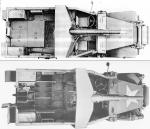
El M3 GMC era idéntico al modelo White original, de 6,24 m de largo, 2,22 m de ancho, 2,49 m de alto hasta la parte superior del escudo del cañón, un peso de 9,1 t y una distancia al suelo de 280 mm. Su suspensión combinaba ballestas longitudinales semielípticas para las ruedas direccionales, pero también ballestas de volutas verticales para las orugas. Para la transmisión contaba con una caja de cambios de engranaje constante.
La propulsión delantera consistía en un motor de gasolina White 160AX, con una cilindrada de 6.330 cc. Se trataba de un motor de 6 cilindros, con una relación de compresión de 6,44:1. Tenía una potencia nominal de 147 hp (110 kW), con un gran par motor y una relación de 14,7 hp por tonelada. La autonomía estaba limitada a 240 km en carretera, menos fuera de ella y llevaba un tanque de combustible principal de 230 l, completado por dos bidones externos. Su velocidad máxima era de 75 km/h debido a la alta resistencia de las orugas. El vehículo tenía el mismo blindaje, sin cambios respecto del original, y diseñado para proteger parcialmente a la tripulación contra el fuego de armas menores y la metralla. La parte trasera, los lados y la parte delantera pasaron de 6,4 a 15,9 mm. La parte superior no estaba protegida y el escudo del cañón M5 tenía 15 mm de espesor como el M2A3.
El M3 (montaje M2A3) podía girar 19° a la izquierda y 21° a la derecha, elevarse 29° y deprimirse -10°. El M3A1 (montaje M5) también podía girarse 21°, pero deprimirse solo −6,5°. El M1897A4 usaba una munición mejorada, adaptada para esa función, el proyectil perforante de blindaje (AP) M61, capaz de penetrar hasta 76 mm de blindaje a 910 m. La velocidad inicial era de 610 m/seg, lo que no era espectacular. Llevaba 59 proyectiles. El AP de 9,0 kg en total (o 6,32 kg solo para el proyectil) podía penetrar 69 mm, 61 mm, 56 mm, y 48 mm a 457 m, 914 m, 1.300 m y 1.800 m respectivamente. Esto era equivalente al blindaje frontal de la mayoría de los carros alemanes en 1943.
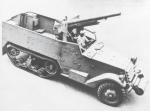
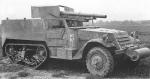
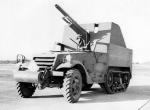
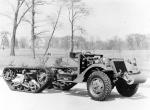
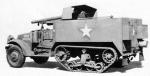


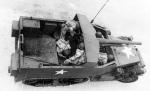

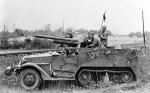
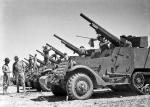
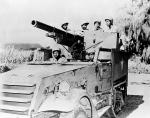
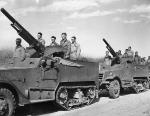

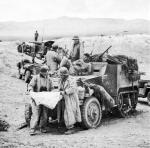
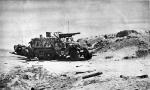

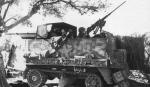
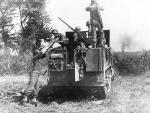
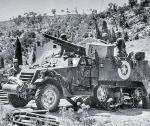

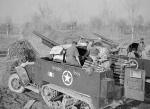
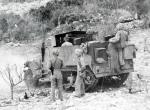


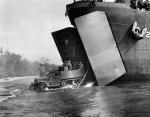

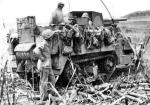

The M3 Gun Motor Carriage (GMC) was an early tank destroyer designed to carry the 75 mm M1897A4 gun, converted from the regular White M3 Half Track by the Autocar Company. It was produced for a limited time, until better solutions were devised. But it was not however seen as a stopgap or interim, contrary to its related cousin, the M6 GMC. The latter married a Dodge WC 55 multirole transport (3/4ton 4×4 Dodge), with a 37 mm 1940 ordnance 1.46 in M3 gun, mounted in the rear flatbed. Nicknamed the «Fargo» after the company which made the conversion. Over 5,300 were so converted in record time, at cheap cost (4,265 $ apiece), filling the ranks of the newly created US Tank Destroyer Batallions, engaged in North Africa from December 1942.
The M3 served in the Philippines Campaign first in January 1942, with the Provisional Field Artillery Brigade, mixing antitank and support roles. Thosed engaged later in North Africa by late 1942 in tank destroyer battalions as first intended had mixed results. They were ineffective at Kasserine Pass but successful at El Guettar. They also took part in the Allied invasion of Sicily, slowly replaced by the M10 tank destroyer during the campaign of Italy. Of the total of 2,203 modified until April, 1,361 of those not lost in combat were converted back as regular M3A1 half-tracks in 1943.
The M3 GMC however soldiered on in the Pacific, better suited to deal with the generally weak Japanese Tanks. They distinguished themselves at the Battle of Saipan and other engagements like Peleliu right until Okinawa, dealing without issue with the Type 95 Ha-Go and Type 97 Chi-Ha.
Tank Destroyers units were a vital part of the tank warfare doctrine developed from 1937. It’w only with the start of WW2 and the decisive use of armored vehicles on both sides during the French campaign of 1940 that the US Army believed to have nailed the effectiveness of the German campaign against the allies. In particular it was stressed the use of self propelled artillery by the Germans, the Stug was the most famous, but there was already the Panzerjäger-I and support vehicles such as the siG 33 Bison, also based on the obsolete Panzer I chassis. No such vehicle was in US inventory at the time.
At the same time armour thickness of French and German vehicles were estimated for prewar calibers, so it was decided already to shift from the 37 mm caliber, considered average, to the more potent 75 mm caliber. The idea emerged soon that to carrier a larger, heavier gun, a sturdier vehicle was needed. Such ordnance existed, this was the M1897A4, a long derivative of the French legendary Schneider ’75’ (3 in) produced in very large quantities before and during WWI and also adopted by the US ordnance in 1917. The Army indeed had many M1897A5 guns in the inventory. They were rapid-fire, but with average velocity, but it was though of using better ammunitions. More importantly, it was available in quantities at least equivalent to the 37mm and so well adequate to launch a mass-production.
From this, it was decided, after some debate, that a good self-propelled gun could be at an advantage on rough terrain with this heavy load, the White M3 Half-track, just coming into production. It was les costly than a fully tracked vehicle (chassis of which were too precious as tanks for the moment), with good overall mobility and minimal protection for the crew. The marriage made between the gun and the M3 chassis was initially known and tested at Aberdeen as the T12. Soon however it was recoignese the gun crew was not well protected, especially frontally, and it was decided to adopt notably the gun shield used on the M2A3 carriage for the M1897A4.
The M1897A5 gun was placed at first in a welded box riveted to the chassis of the T12, behind the driver’s compartment. It was accepted as such by the Army on 31 October 1941. Eventually after many tests performed that year, the new vehicle entered production, standardized as the M3, Gun Motor Carriage. It was simplified as M3 GMC in ordnance. M2A3 gun shields were in short supply when an order was passed for 2,000 vehicles in late 1941. Therefore for production a brand new and specific gun shield was designed, giving birth to the only variant of the type, also representing the bulk of the production, the M3A1 GMC.
Production wise, the first batch of 36 T12s were used for testing, and 50 M3 GMC (August–September 1941) of pre-production were transported right away to the Philippines. They would saw heavy action. The remaining T12s were improved in many ways, until the end of the production. The instalation of a mount raising the gun shield as well as the main gun, installation of the new M2A3 gun shield, and installation of an extra 0.5 in (12.7 mm) M2 coaxial Browning machine gun. But the latter was unwieldy to operate and later removed.
Final improvements led to the final prototype M3 sent to the Autocar Company which started the bulk of the production, which went on until early 1942, when the stock of M2A3 gun shields dried out, conducting to adopt the new M5 gun shield, giving birth (alng other minir improvements) to the new M3A1 standard. The latter constituted the largest part of the production, ceasing in April 1943. Total span was from february 1942 to that date, so fifteen months. The M3 was replaced by the M10 GMC Wolverine in late 1942.
The M3 GMC was identical to the original White model, 20.46 feet (6.24 m) long, 7.29 feet (2.22 m) wide, 8.17 feet (2.49 m) high to the gun shield top for weighed 20,000 pounds (9.1 t) and with a Ground clearance of 11.2 in (280 mm). Its suspension combined semi-elliptical longitudal leaf springs for the directional wheels but also vertical volute springs for the tracks. For transmission it had a constant mesh gearbox.
Propulsion at the front consisted in a White 160AX gasoline engine, with a 386 cubic inch (6,330 cc) capacity. It was 6-cylinder engine, with a compression ratio of 6.44:1. It was rated for 147 hp (110 kW), with a lot of torque and 14.7 hp per ton ratio. Range was limited to 150-mile (240 km) on road, less offroad, from its 60 US gal (230 l) main fuel tank, completed by two external jerrycans. Top speed was a moderate 47 mph (75 km/h) due to the tracks high drag. The vehicle had the same armor, unchanged from the iriginal, and designed to partially protect the crew against small arms fire and shrapnels. The back, sides and front went from 0.25–0.625 in (6.4–15.9 mm). The top was unprotected and the M5 gun shield was 15 mm thick (0.55 in) as the M2A3.
The M3 (M2A3 mount) could traverse 19° left and 21° right, elevate 29° and depress −10°. The M3A1 (M5 mount) could traverse 21° also but depress only −6.5°. The M1897A4 used an improved ammunition, tailored for that role, the M61 armor piercing (AP) round, able to penetrate up to 3 inches (76 mm) of armor at 1,000 yards (910 m). Muzzle velocity was 2000 feets/sec. or 610 m/sec, which was not brillant. 59 rounds were carried. The 19.9 lb AP (9.0 kg) total (13.93 lb or 6.32 kg for the projectile alone) could penetrate 2.7 in (69 mm), 2.4 in (61 mm), 2.2 in (56 mm), 1.9 in (48 mm) at 500, 1000, 1500 and 2000 yards respectively. Needless to say this was just equivalent to the frontal armor of most German Tanks in 1943.
FUENTES Y REFERENCIA – SOURCES & REFERENCE
tank-afv.com
afvdb.50megs.com
©jmodels.net
 jmodels.net
Debe estar conectado para enviar un comentario.