
| DATOS TÉCNICOS | TECHNICAL DATA |
| TIPO: Cazacarros ligero. | TYPE: Light tank hunter. |
| TRIPULANTES: 2 | CREW: 2 |
| ANCHURA: – | WIDTH: – |
| LONGITUD: – | LENGTH: – |
| ALTURA: 1,50 m. | HEIGHT: 4.92 ft. |
| PESO: 3,5-5 toneladas. | WEIGHT: 3.5-5 tonnes. |
| MOTOR: Un motor de gasolina BMW de 90 hp 66,19 kW). | ENGINE: One BMW gasoline engine developing 90 hp. (66.19 kW). |
| AUTONOMÍA: – | RANGE: – |
ARMAMENTO:
|
ARMAMENT:
|
| MUNICIÓN: – | AMMO: – |
| BLINDAJE: 14,5-20 mm. | ARMOR: 5.7-7.97 in. |
| VELOCIDAD MÁX.: – | MAX. SPEED: – |
| VERSIONES: 1 | VERSIONS: 1 |
| CONSTRUIDOS: 2 prototipos. | BUILT: 2 prototypes. |
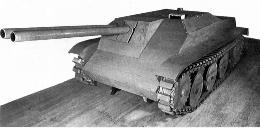
El Panzerkleinzerstörer Rutscher (pequeño cazacarros Rutscher) fue un intento alemán de desarrollar un cazacarros pequeño y ligero con un peso máximo de cinco toneladas.
A finales de 1943, la Waffen Prüfungsamt 6 (WaPrüf 6), una oficina de diseño de vehículos blindados y equipos motorizados dependiente del Heereswaffenamt (Departamento de Artillería del Ejército), solicitó a las empresas BMW y Weserhütte que produjeran varios diseños conceptuales para un nuevo cazacarros pequeño. A principios de 1944, el proyecto se abandonó porque el Jagdpanzer 38(t) iba a cumplir la función prevista. Se estudiaron unos veinte diseños presentados, incluido un diseño de 3,5 toneladas de Weserhütte con componentes especialmente diseñados y un diseño de 5 toneladas de Büssing con componentes existentes.
Aproximadamente un año después de que se cancelara el proyecto, el 23 de enero de 1945, la Entwicklungskommission Panzer decidió reanudar el programa. El papel que se le asignaría al vehículo se describió como un pequeño cazacarros con velocidad y maniobrabilidad, para ser utilizado con la infantería como apoyo en el combate cuerpo a cuerpo. El vehículo buscaba un equilibrio entre infligir el mayor daño posible al enemigo con el menor uso posible de materias primas. Como pauta para el diseño, las especificaciones proponían un peso de 3,5 a 5 toneladas, una altura de aproximadamente 1,5 m, la distancia al suelo debería ser de aproximadamente 35 cm. El vehículo tendría una tripulación de dos, un blindaje ligero de 20 mm en el frente y 14,5 mm en los lados, un motor de aproximadamente 90 hp que debería darle al vehículo una alta velocidad. El armamento debería consistir en una ametralladora MG 42 y dos cañones anticarro Panzerabwehrwerfer 8H63 de 81,4 mm. Se esperaba que se pudieran fabricar cinco vehículos de prueba lo antes posible. El comité decidió realizar un diseño con componentes existentes y otro con componentes diseñados especialmente. El vehículo estaría armado con el nuevo cañón de ánima lisa PWH 8H63, que disparaba proyectiles estabilizados por aletas a una velocidad de 520 m por segundo. Los proyectiles anticarro especiales con carga hueca tenían una penetración de 140-150 mm de blindaje con una inclinación de 30 grados, pero el alcance efectivo de disparo era de solo 700 m, con un alcance máximo de 1.500 m.
El 19 de marzo de 1945 se realizó un análisis de los avances. Éste demostró que si el vehículo cumplía las especificaciones, habría que diseñar nuevos componentes, lo que llevaría de uno a dos años. Solo con los componentes existentes se podría poner en producción rápidamente un vehículo, pero entonces pesaría entre 7 y 10 toneladas. Un vehículo de más de 5 toneladas no cumpliría con los requisitos tácticos, ya que el arma tenía que ser capaz de atacar y retroceder rápidamente debido al limitado alcance de tiro de 700 m; un vehículo demasiado pesado no podría hacer esto con la suficiente rapidez. Se continuó con la producción de dos vehículos de prueba, un vehículo de 3,5 toneladas de Weserhütte y otro de 7,5 toneladas de Daimler-Benz, pero se detuvo el desarrollo posterior. Sin embargo, se solicitó que se estudiara la posibilidad de equipar los vehículos con un cañón KwK L/48 de 7,5 cm además del PWK, para poder atacar objetivos a más de 700 m.
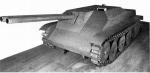
The Panzerkleinzerstörer Rutscher (small tank destroyer Rutscher) was a German attempt to develop a small and light tank destroyer with a maximum weight of five tons.
In late 1943, Waffen Prüfungsamt 6 (WaPrüf 6), a German design office for armoured vehicles and motorized equipment under the Heereswaffenamt (Army Ordnance Department), requested the BMW and Weserhütte companies to produce several conceptual designs for a new small tank destroyer. In early 1944, the project was abandoned because the Jagdpanzer 38(t) was to fulfill the intended role. About twenty submitted designs were studied, including a 3.5-ton design by Weserhütte with specially designed components and a 5-ton design by Büssing with existing components.
About a year after the project was canceled, on January 23, 1945, the Entwicklungskommission Panzer decided to resume the program. The role that was to be assigned to the vehicle was described as a small tank destroyer with speed and maneuverability, to be used with the infantry as a weapon carrier in close combat. The vehicle would be a trade-off between being able to inflict as much damage as possible on the enemy with the least possible use of raw materials. As a guideline for the design, specifications proposed a weight of 3.5 to 5 tons, a height of approximately 1.5 meters, ground clearance should be approximately 35 cm. The vehicle would have a crew of two, light armor of 20 mm on the front and 14.5 mm on the sides, an engine of approximately 90 hp that should give the vehicle a high speed. The armament should consist of a MG 42 machine gun and two 3.20in Panzerabwehrwerfer 8H63 anti-tank guns.
It was hoped that five test vehicles could be produced as quickly as possible. The committee decided to make both a design with existing components and a design with specially designed components. The vehicle would be armed with the newly developed PWH 8H63, a smoothbore gun that fired fin-stabilized projectiles at a speed of 520 m per second. The special anti-tank shells with hollow charge had a penetration of 140-150 mm of armor with a 30 degree slope, but the effective range of fire was only 700 m, with a maximum range of 1500 m.
On March 19, 1945, an analysis of the progress was made. This showed that if the vehicle would meet the specifications, new components would have to be designed, which would take one to two years. Only using existing components would a vehicle be put into production quickly, but it would then weigh 7 to 10 tons. A vehicle heavier than 5 tons would not meet the tactical requirements, because the weapon had to be able to attack and retreat quickly due to the limited range of fire of 700 m, a vehicle that was too heavy would not be able to do this quickly enough. Production of two test vehicles, a 3.5 ton vehicle by Weserhütte and a 7.5 ton by Daimler-Benz, was continued but further development was stopped. However, it was requested to look into the possibility of equipping the vehicles with a 7.5 cm KwK L/48 gun in addition to the PWK, in order to be able to attack targets further than 700 m.
FUENTES Y REFERENCIA – SOURCES & REFERENCE
wikipedia.org
topwar.ru
©jmodels.net
 jmodels.net
Debe estar conectado para enviar un comentario.