
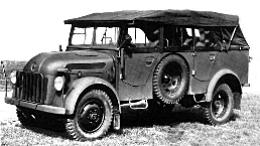
| DATOS TÉCNICOS (Steyr 1500A/S) |
TECHNICAL DATA (Steyr 1500A/S) |
| TIPO:Camión ligero y vehículo de personal. | TYPE:Light truck and personnel carrier. |
| TRIPULANTES:3-11 | CREW:3-11 |
| ANCHURA:2,03 mm. | WIDTH:6.66 ft. |
| LONGITUD:5,03 mm. | LENGTH:16.50 ft. |
| ALTURA:2,30 mm. | HEIGHT:7.54 ft. |
| PESO:4 toneladas. | WEIGHT:4 tonnes. |
| MOTOR:Un motor Otto V8 de 3.517 cm³ de 85 hp. (63 kW). | ENGINE:One V8 Otto 3,517 cm³ V8 developing 85 hp. (63 kW). |
| AUTONOMÍA:420 km. | RANGE:261 ml. |
| VELOCIDAD MÁX.:105 km/h. | MAX. SPEED:65.24 mph. |
| VERSIONES:3 | VERSIONS:3 |
| CONSTRUIDOS:Unos 30.000 (Todos los modelos). | BUILT:Around 30,000 (All versions). |
El Steyr 1500 fue un camión ligero o transporte pesado de personal fabricado por Steyr Daimler Puch con un motor en V de ocho cilindros refrigerado por aire (motor Otto), que se fabricó a gran escala para la Wehrmacht a partir de 1942 durante la Segunda Guerra Mundial. El Steyr 1500 (A: tracción total, S: tracción trasera estándar) con una carga útil de 1,5 toneladas fue el primero de una serie de camiones con capó Steyr fabricados hasta 1968, es decir, durante más de 27 años. La designación de fábrica era Steyr 270.
Desde mediados de 1942 hasta 1945, Steyr y el licenciatario Auto Union fabricaron casi 30.000 vehículos en varias versiones, principalmente el Steyr 1500A. Desde agosto de 1944 hasta abril de 1945 se construyeron más de 7.000 vehículos a partir del Steyr 2000A, que tenía una carga útil de más de dos toneladas. Varios otros Steyr 270 se construyeron después de la Segunda Guerra Mundial.
En el Rautenschlepper Ost, construido a partir de septiembre de 1942, también se utilizaron componentes esenciales, como el motor V8 refrigerado por aire. Por lo tanto, éste pudo fabricarse en la fábrica de Steyr, en la misma línea que el camión 1500.
El origen del posterior Grupo Steyr se encuentra en la compañía Österreichische Waffenfabriks-Gesellschaft. Después de la Primera Guerra Mundial, cuando el negocio de armas ya no funcionaba, la empresa comenzó en 1920 con la producción de automóviles, ampliando sus productos, que se habían iniciado en 1894 con la fabricación de bicicletas. A partir de 1926, la empresa se denominó inicialmente Steyr-Werke AG y, tras la fusión con Austro-Daimler-Puchwerke AG en 1934, el grupo pasó a denominarse Steyr-Daimler-Puch AG. Después de la anexión de Austria al Reich alemán en marzo de 1938, Georg Meindlnew Steyr, director general de la empresa, recibió instrucciones de seguir las especificaciones del plan Schell. La tarea consistía en desarrollar vehículos de motor con tracción total que satisficieran las necesidades militares en materia de movilidad todoterreno. Desde el punto de vista actual, el Plan Schell fue una preparación estratégica para una economía de guerra, en la que el reabastecimiento debía simplificarse reduciendo la variedad de modelos. El plan, que entró en vigor el 1 de enero de 1940, redujo el número de modelos de camiones de 114 a 19 y el de modelos de turismos de 52 a 30.
Para el Grupo Steyr se aprobó la producción del automóvil Steyr 220 y de un camión con una carga útil de 1,5 toneladas. Primero, en 1937 se construyeron los tipos Steyr 640 y 740, y a partir de 1942 se construyó el Steyr 1500A, que sustituyó a sus predecesores, así como al todoterreno medio y pesado estándar de la Wehrmacht y a otros vehículos como el Krupp Protze. Después del final de la guerra en 1945, sobre la base del Steyr 1500 se fabricaron los camiones Steyr 370 (1,5 toneladas de carga útil) y Steyr 380 (3,5 toneladas).
Ferdinand Porsche se dedicaba a la producción en serie rentable en la construcción de vehículos, por lo que Steyr involucró a Porsche en el desarrollo de sus vehículos en 1940. Los modelos recibieron las denominaciones Porsche Tipo 146 (sólo tracción trasera, 4×2) y Tipo 147 (tracción a las cuatro ruedas, 4×4). Los modelos básicos eran vehículos de personal y de transporte con una carga útil de 1,5 toneladas. De 1942 a 1944, Auto Union (Chemnitz) produjo con licencia en sus dos plantas 12.450 vehículos y más de 10.000 entre 1943 y 1945. El Tipo A/01 con rueda de repuesto interior se fabricó hasta aproximadamente agosto de 1942, y el Tipo A/02 con rueda de repuesto exterior a partir de agosto de 1942. Para ahorrar material, a medida que avanzaba la guerra se suprimió el guardabarros trasero.
Una versión especial del Steyr 1500A fue equipada con superestructuras de la empresa de Dresde Gläser-Korosserie. Gläser tenía una larga trayectoria como fabricante de carrocerías y fue el proveedor de una forma de carrocería especial y popular para el turismo Steyr 220. Las carrocerías descapotables de Gläser fueron consideradas por los fabricantes de automóviles europeos y estadounidenses como un refinamiento premium en sus vehículos.
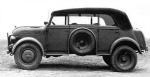
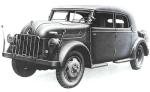
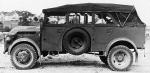
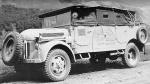
Ante un mercado de lujo civil inexistente, la producción se adaptó a las necesidades de la guerra. Un proyecto que se acercaba especialmente a las actividades originales de la empresa era la construcción de una carrocería descapotable para el vehículo Steyr. La ejecución de estos vehículos militares era lujosa para un vehículo militar y mostraba formas suaves. Detrás de los asientos del conductor y del acompañante se encontraba un asiento trasero bien acolchado y detrás de él un maletero que se extendía hacia atrás. En los primeros modelos y prototipos se incorporaba una rueda de repuesto en un hueco de la carrocería en el lado derecho e izquierdo del vehículo. Esto hacía que la puerta trasera fuera muy estrecha. En este modelo, ambas puertas se podían girar hacia adelante y el asiento estaba casi en el eje más atrás. La mayor parte de la segunda versión del vehículo de mando se entregó sin ruedas de repuesto laterales. Las puertas se ensancharon y el asiento trasero se adelantó, lo que aumentó significativamente el maletero. A partir de 1943, el vehículo reemplazó al automóvil estándar de tamaño mediano (Kfz.11 y 12).
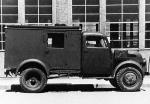
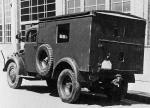
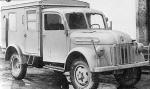
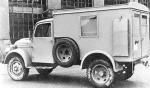
Otras variantes fueron los vehículos de radio y los sanitarios. En el primer caso, el vehículo podría albergar un pequeño equipo de radio. Las (muy raras) carrocerías sanitarias complementaron el parque de vehículos sanitarios ligeros todoterreno. Se podrían transportar hasta cuatro soldados heridos.
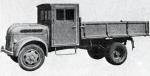
Algunos cambios dieron como resultado el modelo Steyr 2000A en 1944 con una carga útil mayor de dos toneladas. Se construyeron más de 7.000 vehículos de este modelo desde 1944 hasta abril de 1945. Los cambios técnicos en el Steyr 2000A comprendían una distancia entre ejes más larga (3.265 mm.) y una plataforma más larga, gracias a la cual la carga útil se podía aumentar a 2 toneladas y la capacidad total a plena carga a 4,6 toneladas. Para hacer frente a la falta de materias primas, Steyr también utilizó en los últimos meses antes del final de la guerra la nueva cabina de conductor estándar, que estaba hecha en gran parte de madera y cartón prensado.
A diferencia de las de Auto-Union, las fábricas de Steyr no fueron desmanteladas después de la Segunda Guerra Mundial. El Steyr 2000 A, ahora llamado 2000 S sin tracción total, se siguió fabricando después del armisticio para uso civil y como vehículo de bomberos, y también se realizaron algunas transformaciones a partir de coches de la Wehrmacht. En 1946 apareció el Steyr 370 como variante de tres toneladas, inicialmente con el motor de ocho cilindros del Steyr 270 y a partir de 1948 con un motor diésel.
La producción de estos vehículos también la realizó Rosenbauer en Austria. Varias unidades de bomberos austriacos emplearon el Steyr 1500A como LFA (camión de bomberos con tracción total) reformado. Para ello, el Steyr 1500 dispuso de diferentes variantes de vehículos de bomberos con estructura abierta y tipos de cabina.
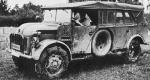
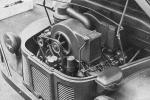
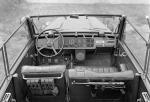
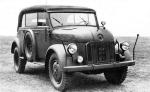
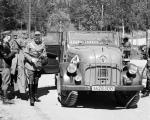
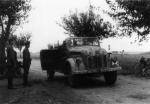
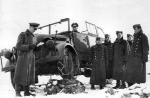
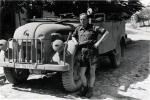
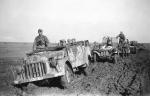
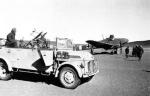
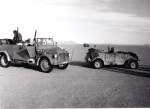
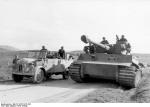
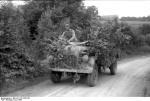
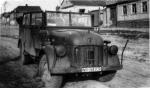
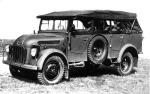
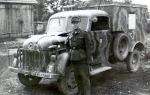
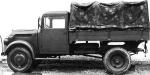
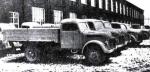
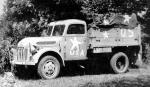
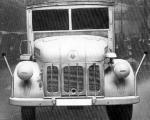
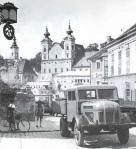
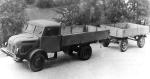
The Steyr 1500 was a light truck or heavy personnel carrier made by Steyr Daimler Puch with an air-cooled eight-cylinder V-engine ( Otto engine), which was manufactured on a large scale for the German Wehrmacht from 1942 during World War II. The Steyr 1500 (A: all-wheel drive, S: standard rear-wheel drive) with a payload of 1.5 tons was the first in a series of Steyr hooded trucks built until 1968, that is over 27 years. The factory designation was Steyr 270.
From mid-1942 to 1945, Steyr and licensee Auto Union manufactured almost 30,000 vehicles in various versions, mostly as the Steyr 1500A. From August 1944 to April 1945 over 7,000 vehicles were then built from the resulting Steyr 2000A with a higher payload of two tons. A number of other Steyr 270s were built after World War II.
Essential components such as the air-cooled V8 engine were also used in the Rautenschlepper Ost built from September 1942. This could therefore be manufactured in the Steyr factory on the same line as the Steyr truck.
The origin of the later Steyr Group can be found in the Österreichische Waffenfabriks-Gesellschaft. After the First World War, when the arms business was no longer running, the company started with the production of automobiles in 1920 via an interim step starting in 1894 with bicycles. From 1926 the company was initially known as Steyr-Werke AG and after the merger with Austro-Daimler-Puchwerke AG in 1934 the group became Steyr-Daimler-Puch AG. After the annexation of Austria to the German Reich in March 1938, Georg Meindlnew Steyr, the company’s general director, was instructed to follow the specifications of the Schell plan. The task was to develop motor vehicles with all-wheel drive, which better met the requirements of the military for off-road mobility. From today’s point of view, the Schell Plan was a strategic preparation for a war economy, in which replenishment was to be simplified by reducing the variety of types. The plan, effective January 1, 1940, reduced the number of truck models from 114 to 19 and that of passenger car models from 52 to 30.
The production of the Steyr 220 car and a truck with a payload of 1.5 tons was approved for the Steyr Group. First the types Steyr 640 and 740 were built since 1937, from 1942 the later Steyr 1500A, which was to replace its predecessors as well as the medium and heavy cross-country standard car of the Wehrmacht and other vehicles such as the Krupp Protze. After the end of the war in 1945, the Steyr 370 (1.5 t payload) and Steyr 380 (3.5 t) truck types were later manufactured on the basis of the Steyr 1500.
Ferdinand Porsche had been engaged in cost-effective series production in vehicle construction, so Steyr involved Porsche in the development order in 1940. The types were given the designation Porsche Type 146 (only rear axle drive, 4×2) and Type 147 (four-wheel drive, 4×4). The basic models were crew and flatbed vehicles for a payload of 1.5 tons. From 1942 to 1944, 12,450 vehicles and more than 10,000 vehicles from 1943 to 1945 were manufactured under license by Auto Union (Chemnitz) in their two plants. The Type A/01 with internal spare wheel was manufactured until around August 1942, and the Type A/02 with external spare wheel from August 1942. In order to save material, the rear fender was omitted as the war progressed.
A special version of the Steyr 1500A was fitted with superstructures from the Dresden company Gläser-Korosserie. Gläser had a long company history as a body manufacturer and was the supplier of a special and popular body shape for the Steyr 220 passenger car. Cabriolet bodies from Gläser were regarded by European and US car manufacturers as a premium refinement for their vehicles.
In view of this non-existent market, the production was adapted to the needs of the war. The construction of a cabriolet body for the Steyr vehicle was another project that came particularly close to the company’s original activities. The execution of these staff cars was luxurious for a military vehicle and showed soft shapes. Behind the driver’s and front passenger’s places there was a well-padded rear seat and behind it a trunk pulled out to the rear. In an early model or the prototype, a spare wheel was incorporated into a recess in the body on the right and left side of the vehicle. This made the rear door very narrow. Both doors on this model could be swiveled forward and the seat was almost on the axle further back. The majority of the second version of the commander’s car was delivered without the side deployment wheels. The doors became wider and the rear bench seat moved forward, which significantly increased the trunk. From 1943, the vehicle replaced the medium-sized standard car (Kfz.11 and 12).
Other variants were the radio and medical cars. In the fisrt case, the vehicle could accommodate a small radio squad. The (very rare) medical box bodies supplemented the stock of light off-road medical vehicles. Up to four injured soldiers could be transported.
Some changes resulted in the Steyr 2000A model in 1944 with a higher payload of two tons. More than 7,000 vehicles of this model were built from 1944 to April 1945. The technical changes to the Steyr 2000A were a longer wheelbase (3,265 mm.) and a longer flatbed, through which the payload could be increased to 2 t and the total loaded weight to 4.6 t. To face the lack of raw materials, Steyr also used the new standard driver’s cab in the last few months before the end of the war, which was largely made of wood and pressed cardboard.
In contrast to those of Auto-Union, the Steyr works were not dismantled after the Second World War. The Steyr 2000 A, now called the 2000 S without all-wheel drive, was continued to be built after the armistice for civilian use and as a fire service vehicle, and some conversions were also made from Wehrmacht cars. In 1946, the Steyr 370 appeared as a three-ton variant, initially with the eight-cylinder engine of the Steyr 270 and from 1948 with a diesel engine.
Production of these vehicles was also carried out by Rosenbauer in Austria. A number of Austrian fire brigades use the Steyr 1500A as a converted LFA ( fire engine with four-wheel drive). For this purpose, the Steyr 1500 had different fire engine variants with an open structure and cab types.
FUENTES Y REFERENCIA – SOURCES & REFERENCE
Wikipedia
zuckerfabrik24-de
©jmodels.net
 jmodels.net
Debe estar conectado para enviar un comentario.