
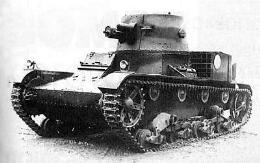
| DATOS TÉCNICOS | TECHNICAL DATA |
| TIPO: Carro ligero. | TYPE: Light tank. |
| TRIPULANTES: 3 | CREW: 3 |
| ANCHURA: 2,41 m. | WIDTH: 7.11 ft. |
| LONGITUD: 4,88 m. | LENGTH: 16 ft. |
| ALTURA: 2,16 m. | HEIGHT: 7.1 ft. |
| PESO: 7,3 toneladas. | WEIGHT: 7.2 long tons |
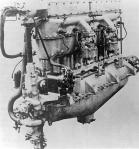
| MOTOR: Un motor de gasolina de 4 cilindros Armstrong Siddeley de 80-98 hp (60-73 kW). | ENGINE: One Armstrong Siddeley 4-cylinder petrol engine providing 80–98 hp (60–73 kW). |
| AUTONOMÍA: 160 km. | RANGE: 99 mi. |
ARMAMENTO:
|
ARMAMENT:
|
MUNICIÓN:
|
AMMO:
|
| BLINDAJE: 19-25 mm. | ARMOR: 0.75-0.98 in. |
| VELOCIDAD MÁX.: 35 km/h. | MAX. SPEED: 22 mph. |
| VERSIONES: 2 | VERSIONS: 2 |
| CONSTRUIDOS: 153 (Todos los modelos). | BUILT: 153 (All types). |
Uno de los carros de combate más importantes en la historia fue el carro ligero británico Vickers Mark E (Mk. E), también conocido como Vickers 6-Ton. Irónicamente, también es uno de los carros de combate más olvidados, probablemente porque se utilizó en combate en los conflictos anteriores a la Segunda Guerra Mundial. Aunque no fue apreciado por el Ejército británico, el Vickers 6-Ton tuvo una carrera internacional impresionante. El número de carros de combate Vickers Mk. E producidos no fue grande, pero antes de la Segunda Guerra Mundial probablemente fue el tipo de carro más extendido en el mundo, después del Renault FT-17 francés. Además, su licencia dio origen a 12.000 carros de combate de la familia del T-26 soviético y al carro polaco 7TP.
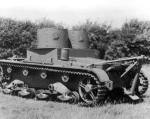
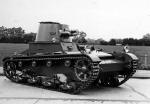
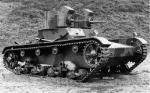
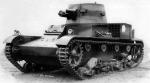
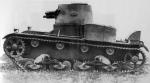
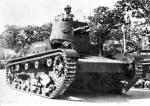
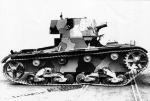
Un prototipo del carro ligero Vickers-Armstrongs 6-Ton (Mark E) se construyó en 1928 en la fábrica británica Vickers-Armstrongs Ltd como proyecto privado. Entre sus diseñadores se encontraban los famosos John Carden y Vivian Loyd. El carro fue diseñado en dos variantes: el Tipo A de torreta doble, armado con sólo dos ametralladoras, y el Tipo B de torreta única. La novedad mundial fue que el carro Tipo B estaba armado con un cañón y una ametralladora coaxial en una torreta (llamada «montaje dúplex» en ese momento). Los carros de combate anteriores estaban armados con un solo arma (como la familia Renault), o con diferentes armas colocadas en diferentes lados de la torreta, que no podían ser manejadas por un solo hombre a la vez. El montaje dúplex, que ahora parece obvio, permitía cambiar instantáneamente el empleo del cañón o la ametralladora, dependiendo del objetivo. Ambas armas también tenían las mismas miras. Gracias a la torreta para dos hombres, la tripulación no estaba sobrecargada con tareas. Con su cañón de 47 mm de tubo corto, el carro Mark E Tipo B tenía una buena potencia de fuego, especialmente con proyectiles de gran explosivo (HE). Sin embargo, su blindaje resultó insatisfactorio aunque, en el momento de su diseño, era incluso mejor que el del carro británico Medium Mk II. También era más pequeño y más rápido que un carro mediano. La suspensión era de nuevo diseño, bastante simple y ofrecía una conducción relativamente suave. Consistía en dos conjuntos independientes de carretones dobles a cada lado, equipados con muelles. Cada unidad de la suspensión pivotaba sobre su propio eje. Las orugas de acero al manganeso tenían una muy buena durabilidad de 3.000 millas.
El Carro de 6 toneladas fue evaluado por el ejército británico, pero fue rechazado. Aparentemente, se debió a que la suspensión se consideraba un elemento débil en el diseño. Por otro lado, esta decisión abrió una posibilidad de exportación. Debido a una amplia publicidad, en los años siguientes estos carros de combate fueron comprados por (cronológicamente): la URSS, Grecia, Polonia, Bolivia, Siam, Finlandia, Portugal, China y Bulgaria. La mayoría de los carros de combate exportados entraron en combate durante su servicio. También se probaron algunos ejemplares en varios otros países. Por último, también llegaron al inventario del ejército británico, ya que en 1939 el gobierno de dicho país incautó cuatro carros Mk E del pedido tailandés. La fábrica Vickers en Elswick fabricó 153 carros de combate Mk E. La URSS y Polonia compraron una licencia para fabricarlo. Basándose en ella, la URSS produjo más de 12.000 carros de combate de la familia T-26, mientras que en Polonia se desarrolló el carro 7TP. Tal éxito fue el resultado tanto del diseño y producción como de la eficiente promoción de ventas de Vickers. A pesar de que se diseñaron nuevos carros de combate en el mundo a mediados y finales de los años treinta, el Vickers Mk E mantuvo su valor como vehículo de combate hasta el comienzo de la Segunda Guerra Mundial. Su cañón de 47 mm, aunque obsoleto, todavía era capaz de destruir la mayoría de los carros de combate de principios de la Segunda Guerra Mundial a corta distancia y a algunos a media distancia. Solo el blindaje del Vickers Mk E era completamente insuficiente debido al desarrollo de los cañones anticarro.
Las características del Vickers Mk E, especialmente su suspensión, influyeron en muchos diseños de carros de combate posteriores, incluidos los carros de combate medianos italianos desde el M-11/39 hasta el P-40, y los carros de combate checos Skoda LT vz.35 (PzKpfw-35(t)) y T-21 (Turan húngaro). Casi todos los carros de combate construidos después del Vickers Mk E adaptaron el «montaje dúplex» de armas en una sola torreta (es digno de mención que los carros de combate modernos también tienen todas las armas y todos los miembros de la tripulación, excepto el conductor, en una torreta).
Un desarrollo previsto del carro Mark E fue el Mark F, desarrollado en 1934 para Bélgica. Uno de los defectos del Vickers Mk E era su motor Armstrong-Siddeley refrigerado por aire, que se calentaba demasiado y era bastante débil. El carro Mark E original Tipo B tenía una torreta desplazada hacia la izquierda del compartimento de combate, ya que a la derecha se encontraba el asiento del conductor. En el carro Mark F se instaló un nuevo motor refrigerado por agua Rolls-Royce Phantom II (125 hp). Como no cabía en la parte trasera, donde iba el antiguo motor Armstrong-Siddeley, el motor del Mark F se instaló en el lado izquierdo del compartimento de combate, por lo que la torreta tuvo que desplazarse hacia la derecha. Debido a que el asiento del conductor estaba a la derecha, la torreta se colocó detrás del conductor, lo que exigió la prolongación del compartimento de combate. Solo se construyó y probó un prototipo del Mark F en Bélgica, pero fue rechazado.
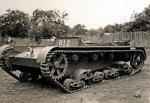
Aunque el Mark F no entró en producción, los carros de combate Mark E de producción tardía fueron equipados con un casco modificado, conservando el antiguo motor Armstrong-Siddeley en la parte trasera. Por lo tanto, tenían un compartimento de combate alargado y la torreta a la derecha. Estos carros de combate se construyeron para Siam y Finlandia.
Los Vickers Mark E podían tener un armamento diferente según las demandas del comprador. Un armamento común del Tipo A de doble torreta eran dos ametralladoras Vickers de 7,7 mm refrigeradas por agua en dos torretas. Los radiadores de agua de los cañones estaban protegidos con cubiertas cilíndricas blindadas. En las variantes de exportación se podían instalar diferentes ametralladoras. La munición era de aproximadamente 6.000 proyectiles.
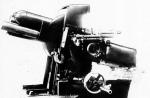
Un armamento típico del Tipo B de una sola torreta era un cañón de tubo corto Vickers QF (Quick Firing) de 47 mm, con una ametralladora Vickers coaxial de 7,7 mm refrigerada por agua. En el lado izquierdo del cañón había una mira telescópica. La munición del cañón consistía en 50 proyectiles anticarro y de alto poder explosivo y había entre 4.000 y 6.000 cartuchos para la ametralladora. Los carros finlandeses se entregaban sin armamento y los carros polacos tenían ametralladoras de 7,92 mm wz.30 en lugar de la ametralladora Vickers.
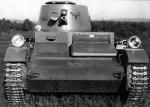
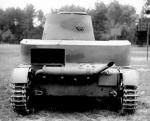
El carro era de construcción clásica, con un compartimento de transmisión en la parte delantera, un compartimento de combate con torreta o torretas en el medio y el compartimento del motor en la parte trasera. El casco estaba hecho de placas de blindaje, remachadas a un marco. La tripulación era de tres hombres. El asiento del conductor estaba delante del compartimento de combate, en el lado derecho. Delante del conductor había una gran escotilla de dos piezas, con una ranura para la visión (la visión desde el asiento del conductor en condiciones de combate no era muy buena). El Vickers Mk E Tipo A tenía dos torretas pequeñas idénticas para un solo tripulante, cada una con una escotilla encima. En esta variante, el comandante-artillero y el artillero iban sentados sobre cinturones de tela. El Tipo B tenía una gran torreta cónica para dos hombres. En los carros de combate de la variante de producción principal, la torreta estaba desplazada hacia el lado izquierdo. Los carros de combate de los últimos lotes de producción tenían un casco con la torreta desplazada hacia la derecha y hacia atrás, detrás del conductor. El comandante y el artillero tenían sus puestos en la torreta, que tenía una escotilla de dos partes en el techo. Algunos carros de combate Tipo B tenían una torreta con un nicho trasero para un equipo de radio Marconi. Los lados de la torreta estaban provistos de ranuras de visión.
El motor de serie era un Armstrong-Siddeley de gasolina, 4 tiempos, 4 cilindros en línea horizontales, refrigerado por aire, con una potencia nominal de entre 80 y 98 hp (60-73 kW) y un depósito de combustible de 182 litros. La suspensión de cada lado consistía en una rueda dentada motriz en la parte delantera y una rueda tensora en la parte trasera con suspensión Vickers que comprendía dos juegos de carretones dobles con ballestas y cuatro rodillos de retorno. Los carretones tenían ruedas dobles de acero, con borde de caucho, a excepción del último par, que era solo de acero. Cada oruga tenía entre 102 y 103 eslabones y una anchura de 23 cm.
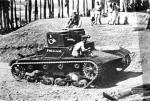
La Unión Soviética fue el primer comprador del Mk.E. En mayo de 1930, la URSS compró 15 carros de dos torretas Tipo A con licencia para su fabricación. Se entregaron entre finales de 1930 y 1932 y estaban armados con las ametralladoras Vickers originales de 7,71 mm. El armamento de la variante de dos torretas se consideró inicialmente adecuado para el apoyo a la infantería, que era el uso previsto del carro. Los carros de combate Vickers se conocían en la URSS como V-26 (al parecer, V de Vickers). Las pruebas se realizaron en enero de 1931 y más tarde fue aceptado como carro estándar de infantería y producido con la designación de T-26.
En julio de 1931 se inició una producción de pre-serie del T-26. Los soviéticos fabricaron carros de combate de dos torretas con solo pequeños cambios, principalmente con torretas diferentes, pero luego desarrollaron muchas otras variantes del carro. Los diseñadores soviéticos intentaron inicialmente crear su propio carro mejorado con un motor Hércules de 95 hp refrigerado por agua y una ametralladora adicional en el casco, pero los dos prototipos, llamados TMM-1 y TMM-2, probados en 1932, resultaron insatisfactorios. No hay información específica sobre el destino de los carros de combate Vickers soviéticos originales.
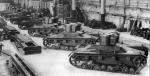
Los primeros T-26 de la serie (modelo 1931) eran de doble torreta, armados con dos ametralladoras DT de 7,62 mm refrigeradas por aire. A partir de 1932 se produjeron algunos carros de combate de doble torreta armados con un cañón de 37 mm y una ametralladora. En 1933, los soviéticos comenzaron la producción de su propia variante del T-26 de una sola torreta, con un cañón de 45 mm de tubo largo y una ametralladora coaxial en una gran torreta (el llamado modelo 1933). Se convirtió en el modelo básico de la familia del T-26. En esa época, el blindaje se incrementó ligeramente (hasta 15 mm). A partir de 1937-1938, los carros se fabricaron con una nueva torreta cónica. La potencia del motor aumentó un poco. En 1939, también se adoptó el casco con lados ligeramente inclinados y un blindaje más grueso. El T-26 también fue la base para producir variantes lanzallamas y de otros vehículos especiales, incluidos carros teledirigidos. Hasta 1941, se fabricaron alrededor de 12.000 T-26 y sus variantes especiales, principalmente en Leningrado. Lucharon en todos los conflictos de la URSS, en algunos teatros incluso hasta 1945. También lucharon en la Guerra Chino-Japonesa y en la Guerra Civil Española.
Grecia compró dos Vickers Mark E, un Tipo A de torreta doble y un Tipo B de torreta única, pedidos el 20 de noviembre de 1930, siendo su segundo comprador. Portugal también compró un carro de dos torretas Tipo A y un carro de una torreta Tipo B para realizar pruebas antes de la Segunda Guerra Mundial. Llevaban sus nombres pintados en los costados del casco: el de dos torretas «Portugal» y el de una torreta «República«.
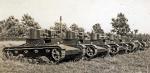
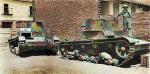
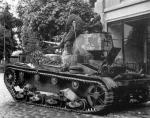
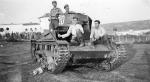
Polonia fue el mayor usuario del Mk E. Ya en septiembre de 1931 encargó 38 carros de dos torretas Tipo A, que se entregaron en 1932-33. En 1934, fueron modificados añadiéndoles grandes tomas de aire detrás del compartimento de la tripulación, lo que mejoró la refrigeración del motor. Era una característica importante solo de los Vickers polacos. También en 1934, 22 vehículos fueron reconstruidos según el estándar de una torreta Tipo B, utilizando las torretas compradas en Gran Bretaña; los 16 carros de combate restantes eran de dos torretas. Aparte de las tomas de aire, los carros polacos de doble torreta se diferenciaban de otros Vickers Mk E Tipo A por tener tapas de cargadores en forma de caja sobre los techos de las torretas. Su armamento fue cambiado durante el servicio, y la variante final tenía dos ametralladoras polacas wz.30 de 7,92 mm refrigeradas por agua, que también era el armamento secundario de los carros de combate de una sola torreta. Todos los carros polacos Vickers Mk. .E combatieron y se perdieron en septiembre de 1939. Aparte de los carros de combate, Polonia compró una licencia de fabricación. Sin embargo, la producción no se inició porque los diseñadores polacos mejoraron mucho su diseño, creando el carro 7TP.
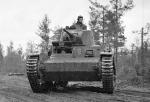
Finlandia compró el primer Mk E Tipo B para realizar pruebas el 6 de julio de 1933. Tenía una configuración estándar, con una sola torreta a la izquierda y estaba armado con un cañón Vickers de 47 mm. Tras las pruebas, en julio de 1936, los finlandeses decidieron encargar una serie de 32 carros al precio de 4.500 libras cada uno. Los carros de combate debían entregarse entre julio de 1937 y enero de 1939, pero hubo retrasos y solo se entregaron 26 carros de combate entre julio de 1938 y 1939, mientras que los seis restantes se entregaron solo después de la Guerra de Invierno. Por lo tanto, Finlandia obtuvo 33 Vickers Mk E en total (aunque no de una sola vez). Los Mark E recién adquiridos tenían nuevos cascos Mark F y torretas a la derecha. Según las pruebas soviéticas, su blindaje del casco era de hasta 17,5 mm, más grueso que el de los carros de combate Mark E estándar anteriores. Las torretas tenían un nicho trasero, pero no se compraron las radios ni parte del resto del equipamiento para abaratar los costes. Los carros de combate también se compraron sin armamento, porque el cañón original de 47 mm se consideró insatisfactorio. Se decidió armar estos carros de combate con el cañón antitanque sueco Bofors L/45 de 37 mm, fabricado en Finlandia y denominado 37 Psv.K/36.
Los carros finlandeses fueron reconstruidos en gran medida durante su servicio. Como la fabricación de los cañones en la recién construida fábrica VTT llevó un tiempo, los vehículos estuvieron desarmados durante el primer período de su servicio. Solo algunos fueron equipados temporalmente con una ametralladora M/09-31 de 7,62 mm refrigerada por aire en una torreta. Entre diciembre de 1939 y febrero de 1940, una parte de los carros fueron finalmente equipados con el cañón Bofors de 37 mm y una ametralladora coaxial. El montaje, con un mantelete común, fue diseñado por Bofors. Sin embargo, sólo tenían miras colimadoras simples, porque los alemanes no entregaron las miras especiales Zeiss que habían pedido. Sólo un carro estaba listo en diciembre de 1939, siete en enero de 1940 y 10 en febrero, 18 en total, al final de la Guerra de Invierno.
Durante la Guerra de Invierno, los finlandeses capturaron una gran cantidad de carros soviéticos T-26. Para facilitar el mantenimiento, los finlandeses decidieron rearmar sus Vickers Mk E con cañones de carro soviéticos de tubo largo de 45 mm 20K, utilizados en el T-26. Se instalaron montajes completos de estos cañones con ametralladoras coaxiales DT de 7,62 mm y miras en las torretas Vickers. Además, se tomaron algunas otras piezas de los T-26. Algunas de ellos fueron equipados posteriormente con radios. Los finlandeses los rebautizaron como T-26E («E» de «English»).
La única unidad finlandesa de Vickers formada durante la Guerra de Invierno (noviembre de 1939 – marzo de 1940) fue la 4.ª Compañía de carros de combate (4./Pans.P), con 13 carros armados con cañones Bofors de 37 mm. Las pérdidas totales en la Guerra de Invierno fueron siete carros perdidos y uno dañado.
Los que quedaron después de la Guerra de Invierno fueron reconstruidos según el estándar T-26E y luego utilizados junto a T-26 capturados en la Guerra de Continuación contra los soviéticos (1941-44). Ambos modelos eran los carros de combate finlandeses más numerosos en ese momento. En 1945, a Finlandia le quedaban 19 T-26E que se utilizaron para entrenamiento hasta 1959.
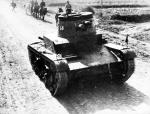
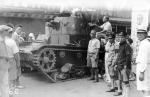
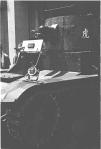
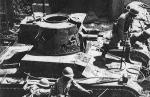
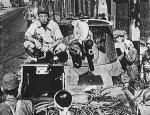
En 1935, el gobierno chino compró 16 carros de una sola torreta Tipo B del modelo estándar. Al año siguiente se compraron cuatro más, equipados con radios Marconi. Los carros de combate chinos Mark E se agruparon en dos batallones y se utilizaron intensamente en la lucha contra las unidades japonesas en Shanghai, entre el 13 de septiembre y el 9 de noviembre de 1937. Sin embargo, no eran adecuados para el combate urbano y los carristas chinos, mal entrenados, sufrieron grandes pérdidas: se perdieron aproximadamente la mitad de ellos en combate. Los restantes probablemente se reunieron en un batallón e integraron en la 200ª División Mecanizada, formada en 1938 con carros soviéticos T-26.
En noviembre de 1932, Siam compró 10 carros de una sola torreta Tipo B, entregados en 1933. En 1938, se encargaron otros 12, pero lo más probable es que solo se entregaran ocho antes de la guerra, y el resto fue incautado por el gobierno británico. Los carros de este segundo lote tenían cascos Mark F con un compartimento de combate más largo, pero torretas a la izquierda. Siam también compró 26 cañones antiaéreos autopropulsados sobre chasis del Mark E. Los carros tailandeses se utilizaron en la guerra con Francia en Indochina (diciembre de 1940 – enero de 1941). En diciembre de 1941, Tailandia cayó bajo control japonés, y se desconoce el destino de los Vickers.
En septiembre de 1936, Bulgaria compró ocho carros de combate Vickers Tipo B de una sola torreta, entregados a principios de 1937. Algunas fotos muestran que tenían cascos Mark F tardíos, con torretas a la izquierda. En septiembre de 1943, estos vehículos, junto con carros más modernos, se incluyeron en la recién formada Brigada Blindada. A pesar de ser aliada de Alemania, Bulgaria no participó en la guerra con la Unión Soviética. En septiembre de 1944, Bulgaria entró en la guerra del lado aliado y la Brigada se utilizó contra los alemanes en Serbia y Kosovo. Se sabe que tres Mk E fueron retirados del servicio en abril de 1945.
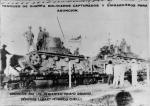
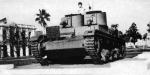
Bolivia fue el menor comprador del Mk E, pero los carros bolivianos fueron los primeros empleados en combate (también fueron los primeros usados en operaciones en toda América). En octubre de 1932, Bolivia ordenó tres Vickers Mk E, un carro de dos torretas Tipo A y dos carros de una torreta Tipo B. En 1933, fueron utilizados en la guerra del Gran Chaco con Paraguay (1932-35). Las condiciones del Gran Chaco eran desfavorables para ellos, el terreno era difícil y las altas temperaturas hacían que los carristas abrieran todas las escotillas. El «cuerpo» de carros de combate bolivianos (que incluía también dos tanquetas Carden-Loyd Mk.VIb) estaba comandado por el «asesor» alemán Capt. von Krier. Uno de los carros fue destruido en combate y los otros dos fueron capturados por los paraguayos en diciembre de 1933. No se sabe si los dos carros capturados fueron utilizados en Paraguay. El carro de dos torretas Mk E Tipo A capturado fue finalmente colocado como monumento en la capital de Paraguay, Asunción. En 1994 fue devuelto a Bolivia, como señal de paz. Actualmente se exhibe en la Escuela Militar de La Paz, junto con una torreta de un carro Tipo B destruido. El carro de una sola torreta capturado fue vendido a España en 1937.
Tras el estallido de la Segunda Guerra Mundial, el gobierno británico se hizo con cuatro carros de combate del pedido tailandés. Todos tenían cascos Mark F, con un compartimento de combate más largo, pero una sola torreta en el lado izquierdo. Se utilizaron para entrenamiento hasta el final de la guerra. Uno de ellos se conserva en el Museo de Bovington. El modelo de una sola torreta también fue probado por Japón, Estados Unidos e Italia.
En 1928, Vickers también diseñó el Vickers Medium Tractor sobre el chasis del carro Vickers de 6 toneladas. Estaba destinado tanto al mercado militar como al civil. El ejército británico evaluó el tractor entre 1930 y 1932, pero finalmente lo rechazó. En 1934, Vickers desarrolló un tractor de artillería mejorado, propulsado por un motor diésel más potente. El ejército británico encargó 12 unidades, con la designación Dragon, Medium Mk.IV. Fueron asignados a uno de los regimientos de artillería pesada y utilizados para remolcar cañones de 60 libras (127 mm). En 1939, fueron incluidos en la Fuerza Expedicionaria Británica y enviados a Francia, donde fueron capturados por los alemanes. También se exportaron pequeñas series de tractores de artillería. En 1932, la empresa alemana Siemens-Schuckert compró un vehículo, en 1935 China compró 23 tractores y en 1937 India compró 18.
Sobre el chasis del tractor de artillería Dragon se desarrolló un cañón antiaéreo autopropulsado, del que se fabricaron 26 unidades para Siam. El vehículo tenía una superestructura abierta y estaba equipado con un cañón antiaéreo automático Vickers de 40 mm con una cadencia de fuego de 120 disparos por minuto.
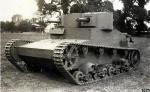
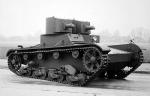
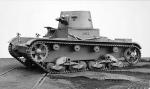
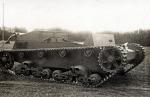
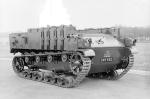
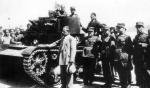
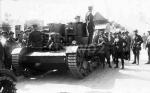
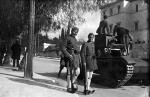
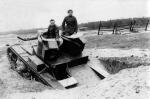
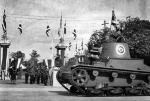
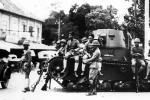
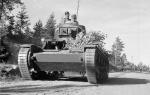
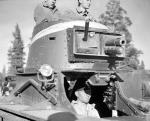
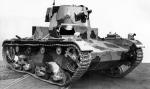
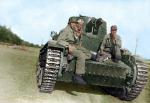
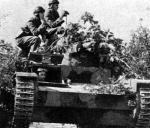
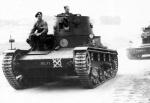
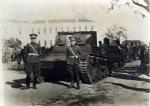
One of the most significant tanks in the history of armoured weapons was the British light tank Vickers Mark E (Mk. E), also known as the Vickers 6-Ton. Ironically, it is also one of most forgoten tanks, probably because it was used in combat in the lesser conflicts before WWII. Though it was not appreciated by the British Army, the Vickers 6-Ton made an impressive international career. The number of Vickers Mk. E tanks produced was not big, but before World War II it was probably the most widespread tank type in the world, after the French Renault FT-17. Moreover, its licence gave birth to 12,000 tanks of the Soviet T-26 family and to the Polish 7TP tank.
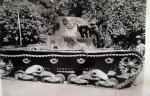
A prototype of the Vickers-Armstrongs 6-Ton (Mark E) light tank was built in 1928 in the British Vickers-Armstrongs Ltd factory as a private venture. Among its designers were the famous John Carden and Vivian Loyd. The tank was designed in two variants: the twin-turret Type A (Alternative A), armed with two machine guns only, and the single-turret Type B (Alternative B). The novelty in the world was that Type B tank was armed with a gun and a co-axial machine gun in a turret (called a «duplex mounting» at that time). Earlier tanks were either armed with only one weapon (like the Renault family), or different weapons placed in different sides of the turret, which could not be manned by one man at a time. The duplex mounting, which now seems obvious, allowed instant change between a gun or machine gun fire, depending on the target. Both weapons had the same sights as well. Thanks to two-men turret, the crewmen were not overloaded with tasks. With its short-barrel 47mm gun, Mark E Type B tank had a good firepower, especially with HE shells. However its armour proved unsatisfactory, and at the moment of design it was even better than that of the British Medium Mk II tank. It was also smaller and faster than a Medium tank. The patented suspension was a new design, quite simple and offering a relatively smooth ride. It consisted of two independent sets of double bogies on each side, fitted with cantilever springs. Each suspension unit pivoted on its own axle. Manganese steel tracks had a very good durability of 3000 miles.
The 6-ton tank was evaluated by the British Army but it was rejected. Apparently this was because the suspension was considered to be a weak element in the design. On the other hand, this decision opened an export possiblity. Due to a wide advertising, in the following years these tanks were bought by (chronologically): the USSR, Greece, Poland, Bolivia, Siam, Finland, Portugal, China and Bulgaria. Most of the exported tanks saw combat during their service. Single tanks were also tested in several other coutries. Finally, these tanks were also found in the British Army because in 1939 the British Government took four tanks Mk.E from the Thai order. Vickers works in Elswick manufactured 153 tanks Mark E. The USSR and Poland bought a licence to manufacture the Vickers Mk.E. Basing on it, the USSR produced over 12,000 tanks of the T-26 family, while in Poland the 7TP tank was developed. Such a success resulted both from modern tank construction and Vickers efficient sales promotion. Despite new tanks were designed in the world in the mid and late thirties, Vickers Mk. E retained a real combat value until the beginning of the WWII. Its 47mm gun, though obsolete, was still capable of destroying most of early-WWII tanks at a short distance, some at a medium distance. Only the armour of Vickers Mk.E was completely insufficient due to the development of anti-tank guns.
The features of Vickers Mk.E, especially its suspension, had influence on many later tank designs, including Italian medium tanks from M-11/39 to P-40, and Czech tanks Skoda LT vz.35 (PzKpfw-35(t)) and T-21 (Hungarian Turan). Almost all the tanks built after Vickers Mk.E adapted the «duplex mounting» of weapons in one turret (it is noteworthy, that modern tanks also have all weapons and all crew members but a driver, in a turret, like Vickers Mk.E).
A projected development of Mark E tank was the Mark F, developed in 1934 for Belgium. One of the faults of the Vickers Mk. E was its overheating and quite weak air-cooled engine Armstrong-Siddeley Puma. The original Mark E Type B tank had a turret offset to the left of the combat compartment because on the right, there was a driver seat. In the Mark F tank a new water-cooled engine Rolls-Royce Phantom II (125 hp) was fitted. Because it would not fit at the back, where the old Armstrong-Siddeley engine went, the engine in the Mark F was fitted on the left side of the fighting compartment, which is why the turret had to be moved to the right. Because of the driver’s seat on the right, the turret was placed behind the driver,and this demanded the lengthening of the combat compartment. Only one prototype of the Mark F was built and tested in Belgium but rejected.
Though the Mark F didn’t enter production, the late production Mark E tanks were fitted with such modified hull, retaining the old Armstrong-Siddeley engine at the back. Therefore, they had a lengthened combat compartment and the turret on the right. Such tanks were built for Siam and Finland. Sometimes they are called Mark F in publications, but it is not a correct designation of this variant.
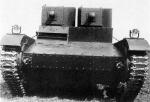
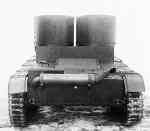
Vickers Mark E tanks might have a different armament, according to buyer demands. A typical armament of the twin-turret Type A were two water-cooled machine guns Vickers 7.7mm in two turrets. The water radiators of the guns were protected with armoured cylindrical covers. In export variants different machine guns could be fitted. The ammunition was about 6000 rounds.
A typical armament of the single-turret Type B was a short-barrel tank gun 47mm Vickers QF (Quick Firing), with a coaxial water-cooled 7.7mm Vickers machine gun. A telescopic sight was on the left side of the gun. Gun ammunition was 50 anti-tank and high explosive shells and there were about 4000-6000 rounds for the machine-gun. The Finnish tanks were delivered without armament and the Polish tanks had a 7.92mm wz.30 weapon instead of the Vickers machine-gun.
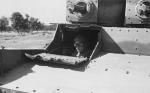
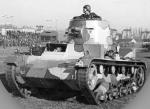
The tank was of a classic construction, with a transmission compartment in front, a combat compartment with turret or turrets in the middle, and an engine compartment in the rear. The hull was made of armour plates, riveted to a frame. The crew was three. The driver’s seat was in front of the combat compartment, on the right side. Before the driver there was a large two-part hatch, with a vision slot (vision from the driver’s seat in combat conditions was not very good). Vickers Mk.E Type A had two identical small one-man «dust-bin» turrets, each with a hatch above. In this variant, the commander-gunner and gunner were sitting on fabric belts. Type B had one big conical two-men turret. In tanks of the main production variant, the turet was offset to the left side. The tanks of the late production batches had a hull with the turret offset to the right and to the rear, behind the driver. The commander and gunner both had their stations in the turret, which had a two-part hatch on the roof. Some tanks Type B had a turret with a rear niche for a Marconi radio set. The turret sides were provided with were vision slots.
The standard powerplant was a 4-stroke, 4-cylinder inline horizontal, air-cooled Armstrong-Siddeley petrol engine rated between 80 and 98 hp (60-73 kW) with a fuel tank of 182 l (48 US gal / 40 Imp gal). The suspension on each side consisted of a drive sprocket in the front and an idler in the rear with Vickers paired bogie-type suspension comprising two sets of double bogies with cantilever leaf springs and four return rollers on each side. Each suspension set pivoted on its own axle. The bogies had double steel roadwheels, rubber rimmed, apart from the last pair, which was steel only. Each track had 102-103 links and a width of 23 cm (9 in).
The Soviet Union was the first buyer of Vickers Mk.E tanks. As early as May 1930, the USSR bought 15 twin-turret tanks Vickers Mk.E Type A with a licence to manufacture. They were delivered between late 1930 and 1932 and were armed with the original Vickers 7.71 mm machine-guns. The armament of the twin-turret variant was initially considered suitable for infantry support, which was the tank’s projected use. Vickers tanks were known in the USSR as the V-26 (apparently V for Vickers). Trial took place in January 1931 and was later accepted as a standard infantry tank and produced under the designation of T-26.
In July 1931 a production of the pre-series T-26 batch was started. The Soviets manufactured twin-turret tanks with only small changes, most notably different turrets, but next they developed numerous other variants of the tank. The Soviet designers initially tried to create their own improved tank, basing on the Vickers Mk.E, with a 95hp water-cooled Hercules engine and an additional hull machine gun, but the two prototypes, called TMM-1 and TMM-2, tested in 1932, proved unsatisfactory. There is no specific information on fate of original Soviet Vickers tanks.
The first series T-26s (model 1931) were twin-turret, armed with two DT 7.62 mm air-cooled machine guns. From 1932 some twin-turret tanks armed with a 37 mm gun and a machine-gun were produced. In 1933, the Soviets started production of their own developed single-turret T-26 variant, with a long-barrel 45mm gun and a coaxial machine gun in a big turret (the so-called model 1933). It became the basic model of the T-26 family. Around this time, the armour was increased a bit (up to 15 mm). Since 1937/38, the tanks were produced wih a new, conical turret. The engine power increased a bit as well. In 1939, the hull with lightly sloped sides, and thicker armour was also adopted. The T-26 was also a base to produce several variants of flamethrower tanks and other special vehicles, including remote-controlled tanks. Until 1941, about 12.000 of T-26 tanks and their special variants were made, mostly in the Bolshevik factory in Leningrad. They fought in all conflicts of the USSR, on some theatres even until 1945. They also fought in the Sino-Japanese War and the Spanish Civil War.
Greece bought two Vickers Mark Es, a twin-turret Type A and a single-turret Type B, ordered on 20 November 1930, being their second buyer. Portugal also bought a twin-turret Type A and a single-turret Type B for tests before the World War. They carried their names painted on the hull sides, the twin-turret «Portugal«, and the single-turret «República«.
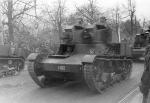
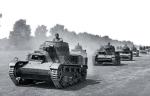
Poland was the biggest user of Vickers Mk. E tanks. As early as September 1931 Poland ordered 38 twin-turret tanks Vickers Mk. E Type A, delivered in 1932-33. In 1934, the tanks were modified by adding large air intakes behind the crew compartment, which improved engine cooling. It was a significant feature of the Polish Vickers tanks only. Also in 1934, 22 tanks were rebuilt to single-turret Type B standard, using the turrets bought in Great Britain, the remaining 16 tanks were twin-turreted. Apart from the air intakes, Polish twin-turret tanks differed from other Vickers Mk.E Type A tanks having box magazine covers upon the turret roofs. Their armament was changed during service, and the final variant had two Polish water-cooled 7.92 mm wz.30 machine guns, which was also the secondary armament of single-turret tanks. All Polish Vickers Mk.E tanks fought and were lost in September 1939.Apart from the tanks, Poland bought a manufacturing licence. However, production was not started as Polish designers greatly improved its design, creating the 7TP tank.
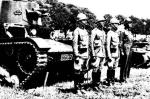
Finland bought the first Vickers Mk.E Type B for testing on 6 July 1933. It was in a standard configuration, with a single turret on the left and armed with a 47mm Vickers gun. Following the tests, in July 1936, the Finns decided to order a series of 32 tanks, for £4500 per tank. The tanks were to be delivered between July 1937 and January 1939, but there were delays, and only 26 tanks were delivered between July 1938 and 1939, while the remaining 6 were delivered only after the Winter War. Therefore, Finland had 33 tanks Vickers Mk. E in total (not at one time, though). The newly acquired tanks Mark E had new Mark F hulls and turrets on the right. According to the Soviet tests, their hull armour was up to 17.5 mm, thicker than on standard ealier Mark E tanks. Their turrets had a rear niche for a radio, but the radios and part of other equipment weren’t bought in order to lower costs. The tanks were also bought without any armament, because the original 47mm gun was considered unsatisfactory. It was decided to arm these tanks with the Swedish 37mm Bofors L/45 anti-tank gun produced in Finland and designated 37 Psv.K/36.
The Finnish tanks were much rebuilt during their service. Since it took a time to manufacture the guns in the newly-built VTT factory, the tanks were unarmed for the first period of their service. Only several tanks were temporarily fitted with one air-cooled 7.62 mm M/09-31 machine-gun in a turret. Between December 1939 and February 1940, part of the tanks were finally fitted with the 37mm Bofors gun and a coaxial machine-gun. The mount, with a common shield, was designed by Bofors. However, the Finnish tanks had only simple colimator gun sights, because the Germans failed to deliver the ordered special Zeiss sights. Only one tank was ready in December 1939, 7 in January 1940 and 10 in February,18 in total, by the end of the Winter War.
During the Winter War, the Finns captured a great number of Soviet T-26 tanks. In order to make easier maintenance, the Finns decided to rearm Vickers Mk.E tanks with Soviet long-barrel 45mm 20K tank guns, used in the T-26. Complete 45mm gun mounts, with coaxial 7.62 mm DT machine guns and sights, were installed in Vickers turrets. Also, some other parts were taken from T-26s. Some of them were later fitted with radios. The Finns redesignated rebuilt Vickers Mk.E tanks as the T-26E («E» for ‘English’).
The only Finnish Vickers unit formed during the Finnish-Soviet Winter War (November 1939 – March 1940) was the 4th Tank Company (4./Pans.P), with 13 Vickers Mk.E tanks armed with 37mm Bofors guns. Total losses in the Winter War were seven Vickers tanks lost and one damaged.
Vickers Mk.E tanks, which remained after the Winter War, were rebuilt to T-26E standard, and then used with captured T-26 tanks in the Continuation War against the Soviets (1941-44). Both types were the most numerous Finnish tanks at that time. In 1945, Finland had 19 tanks T-26E left, which were used for training until 1959.
In 1935, the Chinese government bought 16 single-turret tanks Vickers Mark E Type B of the standard model. In the following year four more were bought, fitted with Marconi radios in a turret niche. The Chinese tanks Mark E were grouped in two battalions and were intensively used in fighting against the Japanese units in Shanghai, between 13 September and 9 November 1937. However, the tanks were ill-suited to urban fighting, and poorly trained Chinese tankers suffered big losses, about half of tanks being lost in total. The remaining tanks were probably gathered in one battalion and included into the 200th Mechanized Division, formed in 1938 with Soviet T-26 tanks.
In November 1932, Siam bought 10 single-turret tanks Vickers Mk.E Type B, delivered in 1933. In 1938, further 12 tanks were ordered, but most probably only 8 tanks were delivered before the war, and the rest was taken by the British government. The tanks from this second batch had Mark F hulls with longer combat compartment, but turrets on the left. Siam also bought 26 self-propelled anti-aircraft guns on Mark E chassis. The Thai tanks were used in a war with France in Indochina (December 1940 – 28 January 1941). In December 1941, Thailand fell under the Japanese control, and the fate of the Vickers tanks is not known.
In September 1936 Bulgaria bought eight single-turret Vickers Mk.E Type B tanks, delivered in early 1937. Rare photos show that they had late Mark F hulls, with turrets on the left. In September 1943, these vehicles, along with newer tanks, were included into the newly formed Armoured Brigade. Despite being a German ally, Bulgaria did not take part in the war with the Soviet Union. In September 1944, Bulgaria entered the war on the Allied side, and the Brigade was used against the Germans in Serbia and Kosovo. It is known that 3 Mk.Es were withdrawn from service in April 1945.
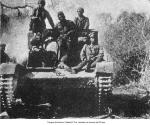
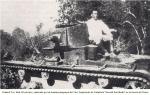
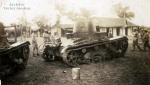
Bolivia was the smallest active user of Vickers Mk.E tanks, but the Bolivian tanks were first used in combat (it was also the first combat use of tanks in America). In October 1932, Bolivia ordered three tanks Vickers Mk. E, one twin-turret tank Type A and two single-turret tanks Type B. In 1933, the Bolivian tanks were used in the Gran Chaco war with Paraguay (1932-35). The conditions of the Gran Chaco were unfavourable for tanks, the terrain was difficult and high temperatures made the tankers open all hatches. The Bolivian tank «corps» (including also two Carden-Loyd Mk.VIb tankettes) was commanded by the German «advisor» Cpt. von Krier. One of the tanks was destroyed in combat and the other two were captured by the Paraguayans in December 1933. There is no information, if the two captured tanks were used in Paraguay. The captured twin-turret tank Mk.E Type A was finally put as a monument in Paraguay’s capital Asunción. In 1994 it was returned to Bolivia, as a sign of peace. It is currently exhibited at Military School in La Paz, along with a turret of a destroyed Type B tank. The captured single-turret tank was sold to Spain in 1937.
After the outbreak of World War II, the British government took four tanks from the Thai order. All had Mark F hulls, with longer combat compartment, but single turret on the left side. They were used for training until the end of the war. One of them is preserved in the Tank Museum in Bovington. Single tanks Mk.E were also tested by Japan, USA and Italy.
In 1928 Vickers also designed the Vickers Medium Tractor on the Vickers 6-ton tank chassis. It was meant for the military and the civilian market as well. The British Army evaluated the tractor between 1930 and 1932, but finally rejected it. In 1934, Vickers developed an improved artillery tractor, powered by a stronger diesel engine. The British Army ordered 12 new tractors, with the designation Dragon, Medium Mk.IV. They were assigned to one of the heavy artillery regiments and used for towing 60-pdr guns (127 mm). In 1939, they were included into the British Expeditionary Force and sent to France, where they were seized by the Germans. Small series of artillery tractors were also exported. In 1932 one vehicle was bought by the German company Siemens-Schuckert, in 1935 China bought 23 tractors and in 1937 India bought 18.
A self-propelled anti-aircraft gun was developed on the chassis of the Dragon artillery tractor. 26 such vehicles were produced for Siam. The vehicle had an open superstructure, with 40mm Vickers automatic AA gun mounted, with a rate of fire 120 rds/min.
FUENTES Y REFERENCIA – SOURCES & REFERENCE
derela.republika.pl
tankarchives.ca
jaegerplatoon.net
facebook.com/groups/mdchacop
aquellasarmasdeguerra.wordpress.com
©jmodels.net
 jmodels.net
Debe estar conectado para enviar un comentario.