
| DATOS TÉCNICOS | TECHNICAL DATA |
| TIPO:Vehículo cazacarros. | TYPE:Tank destroyer. |
| TRIPULANTES:4 | CREW:4 |
| ANCHURA:2,24 m. | WIDTH:7.34 ft. |
| LONGITUD:4,52 m. | LENGTH:14.82 ft. |
| ALTURA:2,10 m. | HEIGHT:6.88 ft. |
| PESO:3.334 kg. | WEIGHT:7,350 lb. |
| MOTOR:Un motor de gasolina de 6 cilindros en línea Dodge T-214 de 99 hp. (74 kW). | ENGINE:One Dodge 6-cylinder in-line T-214 gasoline engine developing 99 hp. (74 kW). |
AUTONOMÍA:
|
RANGE:
|
ARMAMENTO:
|
ARMAMENT:
|
MUNICIÓN:
|
AMMO:
|
| BLINDAJE:(escudo del cañón) 6,4 cm | ARMOR:(gun shield) 0.25 in. |
VELOCIDAD MÁX.:
|
MAX. SPEED:
|
| CONSTRUIDOS:5.380 (1942). | BUILT:5,380 (1942). |
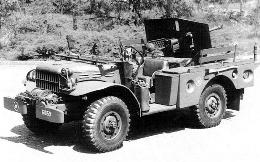
El M6 Gun Motor Carriage (GMC) de 37 mm. fue el primer cazacarros estadounidense de la guerra. Fue diseñado a toda prisa al comienzo de la Segunda Guerra Mundial. El ejército de los Estados Unidos necesitaba equipar a sus unidades de infantería con un arma de apoyo anticarro móvil. En esa etapa, el cañón M3 de 37 mm., introducido en 1940, era el arma anticarro estándar. Se pensó que el calibre era efectivo contra los vehículos blindados japoneses y la generación de tanques alemanes de 1940 que se utilizaron para invadir Polonia y Francia.
Era el único vehículo disponible en grandes cantidades que podía convertirse rápidamente en un arma anticarro. También era el más barato, a solo $ 4,265 por pieza. Un cazacarros M10 GMC Wolverine de 3 pulgadas costaba $ 47,905. El M6 Fargo se empleó hasta el final de la guerra. Otras empresas participaron en su construcción. Dodge construyó más de 5.300 vehículos, aunque no todos estaban armados con el cañón de 37 mm.
En noviembre de 1941, se crearon formaciones de «atacacarros» en el Ejército de EE.UU. para apoyar a las unidades de infantería. Fueron probados en ejercicios de juegos de guerra en las Carolinas con cierto éxito. A fines de 1941, se propuso que se crearan batallones de Destructores de Carros (TD). Se asignaría uno a cada división, más 165 adicionales a disposición del Cuartel General del Ejército (GHQ). El 27 de noviembre de 1941 se creó el primero de los 53 batallones TD, controlados por el GHQ, encabezados por el general Leslie McNair. El Estado Mayor prefirió sistemas de armas más baratos para este propósito y no carros de combate. El ímpetu agresivo de una unidad blindada se veía obstaculizado por el empleo de cañones anticarro remolcados, por ello se pensó que el cañón autopropulsado (SPG) era la mejor solución.
Después de las pruebas fallidas de montar el cañón M3 en un Jeep, se montó en camiones de 3/4 de tonelada más largos y resistentes, con un mejor alcance, espacio e instalaciones de almacenamiento de municiones. En el verano de 1941, el prototipo recibió el nombre de proyecto T21. También se desarrollo al par el T22, un vehículo blindado 6×6 más grande cuyo desarrollo conducirá al vehículo blindado M8 Greyhound.
Las diversas pruebas en el T21 incluyeron cañones montados en la parte trasera y delantera. El modelo de producción se iba a llamar ‘Gun Motor Carriage M4 de 37 mm.‘, pero se cambió rápidamente a ‘Gun Motor Carriage M6 de 37 mm.’ para evitar confusiones con el ‘transporte M4 de 37 mm‘, que era un cañón anticarro remolcado. La serie Dodge/Fargo de camiones militares ligeros se produjo en masa: se produjeron más de 255.000, de los cuales 5.380 se convirtieron en M6 GMC de 37 mm.
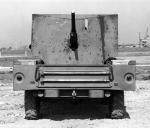
El M6 final se desarrolló a partir de un Dodge WC52 4×4 de 3/4 de tonelada, una combinación designada de fábrica como WC55. El vehículo estaba totalmente desarmado, excepto por el gran escudo de 6,4 mm. de espesor, que solo protegía a la tripulación cuando se enfrentaba al enemigo. Atrapados por el costado o por la parte trasera, la tripulación estaba expuesta a lesiones por fuego de armas pequeñas y explosión de metralla de proyectiles de alto explosivo.
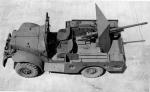
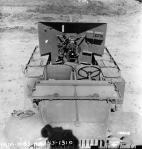
La parte trasera del chasis estaba equipada con un pivote remachado en forma de estrella y el arma normalmente se disparaba hacia atrás. Cuando se disparaba hacia adelante, la explosión podría romper el parabrisas y lesionar al conductor y al copiloto. Disparando hacia atrás, el escudo del arma también protegía al conductor y facilitaba un escape rápido o un cambio de ubicación. El vehículo era capaz de transportar ochenta proyectiles.
El M3 de 37 mm. de 1940 fue producida principalmente por Watervliet Arsenal. Disparaba el proyectil perforante M74, capaz de penetrar 36 mm. de blindaje a 460 m. Para mejorar el rendimiento, se disparaba el proyectil perforante recubierto M51. Podría penetrar 61 mm. de blindaje a 460 m. El proyectil de alto explosivo M63 también se utilizaba como proyectil antipersonal. El arma podía moverse de -10° a +15°, tenía un giro de 60° y una velocidad de disparo de 25 disparos por minuto con una tripulación bien entrenada. Las dimensiones de la munición eran de 37 mm. × 223 mm. La recámara tenía un bloqueo vertical y el retroceso disminuido por un hidroresorte. La velocidad inicial era de 884 m/s. y tenía un alcance máximo de 6,9 km.
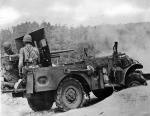
El diseño se estandarizó en febrero de 1942, la producción comenzó en marzo y duró hasta octubre, cuando el vehículo numero 5.380 salió de fábrica. Era el primer cazacarros estadounidense y el más moderno cuando la 1ª División, “Big Red One», llegó a Túnez, África del Norte, para la Operación Torch. Dos unidades los utilizaron, los batallones de cazacarros 601 y 701, hasta principios de 1943. La idea inicial de utilizar tres unidades de cazacarros, una ligera, una pesada y una remolcada pronto se abandonó. Se introdujo una unidad mixta pesada (dotada con M3 GMC de 75 mm.) y ligera (que empleaba el M6 GMC de 37 mm.) antes del desembarco en el norte de África. A principios de 1942, el 8° Ejército británico informó que sus cañones de 2 libras. (40 mm.) ya no eran suficientes y preferían los de 6 libras, por ello pronto fue copiado por los EE.UU. con la denominación de M1 de 57 mm). Se descubrió que el arma de menor calibre no podía penetrar los carros alemanes. El ejército de los EE.UU. estaba al tanto de estos informes, pero aun así desplegó estas armas ahora obsoletas en el norte de África. El M6 GMC no fue del agrado de sus tripulaciones y el vehículo fue enviado al Pacífico, donde sirvió en 1943 y 1944.
Sabiendo que el cañón estándar M3 estaba obsoleta, el ejército de los EE.UU. planeó su sucesor. Lo reemplazaron el M3 GMC y el T12 GMC, ambos basados en el semioruga White M3 estándar (M3 GMC con cañón de 37 mm.). El M6 GMC fue declarado «estándar limitado» en septiembre de 1943, pero su uso duró hasta enero de 1945, cuando finalmente se declaró obsoleto y se retiró definitivamente. Su servicio en el norte de África dejó una impresión de fracaso, siendo su arma descrita en los informes como «lamentablemente inadecuada» contra los blindados alemanes. A mediados de 1943, los M6 restantes se convirtieron nuevamente en vehículos de transporte, mientras que los cañones de 37 mm. se montaron en semiorugas M2 y empleados por la infantería acorazada. Otros fueron entregados a las Fuerzas Francesas del Interior (FFI), que los usaron debido a la falta de mejores medios desde la liberación hasta 1945. Comparativamente, los M3 GMC dieron resultados mucho mejores.

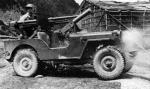


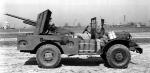


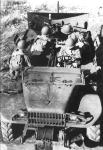


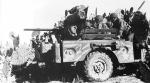


The 37 mm Gun Motor Carriage M6 (GMC) was the first American tank destroyer of the war. It was designed in a rush at the beginning of WWII. The United States Army needed to equip its infantry units with a mobile anti-tank support weapon. At that stage, the 37 mm. (1.46 in.) Gun M3, introduced in 1940, was the standard anti-tank gun of the day. The 37 mm. calibre was thought to be effective against Japanese armored fighting vehicles and the 1940 generation of German tanks that were used to invade Poland and France.
It was the only vehicle available in large numbers that could be quickly converted into an anti-tank weapon. It was also the cheapest at only $4,265 a piece. A 3-inch GMC M10 Wolverine tank destroyer cost $47,905. The M6 Fargo soldiered on to the end of the war. Other companies were involved in its construction. Dodge built over 5,300 vehicles, although not all were armed with the 37 mm.
By November 1941, US Army ‘tank attacker‘ formations were created to support infantry units. They were tested in war game exercises in the Carolinas with some success. By late 1941, it was proposed that Tank Destroyer (TD) battalions be created. One was to be assigned to each division plus 165 additional ones at the disposal of the US Army General Head-Quarters (GHQ). On 27th November 1941, the first of the 53 TD battalions were created, controlled by GHQ, headed by Leslie McNair. They preferred cheaper gun carriers for this purpose and not tanks. The impetus of an aggressive armored fighting unit’s mobility was hindered by the use of towed anti-tank guns. The en portee self-propelled gun (SPG) solution was believed to be the best solution.
After the unsuccessful trials of mounting the M3 gun on Jeeps, the same gun was mounted on longer, sturdier 3/4 trucks, with a better range, room and ammunition storage facilities. In the summer of 1941, the prototype was given the project name of the T21. The T22 was the developed alongside, a larger armored 6×6 vehicle that will lead to the M8 Greyhound armored car.
The various tests on the T21 included rear-mounted and forward-mounted guns. The production model was going to be called the ‘M4 37mm Gun Motor Carriage‘ but this was quickly changed as the ‘M6 37mm Gun Motor Carriage‘ to avoid confusion with the ‘M4 37 mm gun carriage‘ which was a towed anti-tank gun. The Dodge/Fargo series of light military trucks were mass-produced: over 255,000 were produced and 5,380 were converted into M6 37 mm GMCs.
The final M6 was developed from a 3/4ton 4×4 Dodge WC52 truck, a combination that was factory designated the WC55. The vehicle was totally unarmored, except for the large 0.25 in. (6.4 mm.) thick gun shield, which only protected the crew when facing the enemy. Caught from the side or the rear, the crew were open to injury from small arms fire and exploding high explosive shell shrapnel.
The rear of the vehicle’s chassis was fitted with a star-type riveted pivot and the gun was normally fired to the rear. When fired forward, the gun could not be fully depressed, and the blast could shatter the windshield and injure the driver and co-driver. Firing from the rear, the gun shield also protected the driver and it facilitated a quick escape or change of location. The vehicle was capable of carrying eighty rounds.
The 1940 37 mm. (1.46 in.) M3 gun was produced mainly by the Watervliet Arsenal. It fired the M74 Armor Piercing (AP) shot, which could penetrate 1.4 inches (36 mm.) of armor at 500 yds. (460 m.). In order to improve performance, the Armor Piercing Capped (APC) M51 projectile was fielded. It could penetrate 2.4 in. (61 mm.) of armor at 500 yds. The High Explosive (HE) M63 Projectile was also used as an anti-personal round. The gun could depress from -10° to +15°, had a 60° traverse, and a 25 rate of fire per minute with a well-trained crew. The ammunition round’s dimensions were 37 mm. × 223 mm. The breech had a vertical block, the recoil lessened by an hydrospring. The muzzle velocity was 884 m/s. (2,900 ft/s.) and it had a maximum range of 6.9 km. (4.3 miles).
The design was standardized in February 1942, production started in March, and lasted until October, when the 5,380th came out of the factory floor. It was the first and most current American tank destroyer when the 1st Division, the «Big Red One», landed in Tunisia, North Africa, for Operation Torch. Two units used them, the 601st and 701st Tank Destroyer Battalions, until early 1943. The initial idea of using three tank destroyer units, one light, one heavy and one towed was soon abandoned. A mixed heavy (M3 75mm. GMC) and light (M6 37mm. GMC) unit was introduced before the landing in North Africa. By early 1942, the British 8th Army reported that their 2 pdr. (40 mm.) gun was already no longer sufficient and their 6-pdr. was preferred (soon copied by the US and called the 57 mm. M1). It was found the smaller caliber gun could not penetrate the uparmored German tanks. The US Army was aware of these reports but still deployed these now obsolete guns in North Africa. The M6 GMC rapidly became disliked by its crews and the vehicle was sent on to the Pacific Theatre, where it served in 1943 and 1944.
Knowing the standard M3 gun was now obsolete, the US Army planned its successor. The M3 GMC and T12 GMC replaced it, based on the standard White M3 half-Track. The M6 GMC was declared ‘limited standard’ in September 1943 but its use lasted until January 1945 when it was finally declared obsolete and retired for good. Its North African service left the impression of a failed expedient, its gun described in reports as «woefully inadequate» against German armor. By mid-1943, remaining M6s were converted back into WC carriers, while the 37 mm. guns were mounted onto M2 halftracks as the M2 w/ M3 37 mm. These were used by the armored infantry, and were others given to the French Army, which later made their way with FFI (Interior French Forces) in France. They were used due to a lack of better solutions from the liberation until 1945. Comparatively, the M3 GMCs gave far better results.
FUENTES Y REFERENCIA – SOURCES & REFERENCE
tanks-encyclopedia.com
afvdb.50megs.com
©jmodels.net
 jmodels.net
Debe estar conectado para enviar un comentario.