
| DATOS TÉCNICOS | TECHNICAL DATA |
| TIPO:Vehículo blindado de transmisiones. | TYPE:Armored radio car. |
| TRIPULANTES:4 | CREW:4 |
| ANCHURA:1,99 m. | WIDTH:6.52 ft. |
| LONGITUD:4,83 m. | LENGTH:15.84 ft. |
| ALTURA:1,78 m. | HEIGHT:5.83 ft. |
PESO:
|
WEIGHT:
|
| MOTOR:Un motor Horch V8 de 3,8 litros de 81 hp. a 3.600 rpm. | ENGINE:One Horch V8 3.8litres providing 81 hp. at 3,600 rpm. |
| AUTONOMÍA:310 km. | RANGE:192 ml. |
| BLINDAJE:5-8 mm. | ARMOR:0.19-0.31 mm. |
| VELOCIDAD MÁX.:85 km/h. | MAX. SPEED:52.81 mph. |
| VERSIONES:2 | VERSIONS:2 |
| CONSTRUIDOS:493 (SdKfz 260 y 261) | BUILT:493 (SdKfz 260 & 261) |
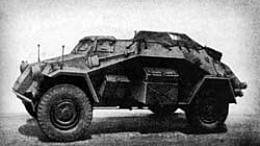
Desde mediados de la década de 1930, se introdujo en el armamento del ejército alemán una familia de vehículos blindados ligeros construidos sobre el chasis Einheitsfahrgestell I de cuatro ruedas de la compañía Horch. Esta familia incluía los vehículos blindados SdKfz 221, SdKfz 222 y el vehículo de radio SdKfz 223. En 1940, se crearon dos tipos más de vehículos de radio, que siguieron a la familia de blindados mencionada y su producción comenzó un año después. Estas eran máquinas con la designación oficial kleine Panzerfunkwagen (SdKfz 260) y kleine Panzerfunkwagen (SdKfz 261).
El chasis y el casco del SdKfz 222, versión Ausf B, sirvieron de base para su construcción. El casco del vehículo estaba hecho de placas de blindaje planas soldadas entre sí en varios ángulos agudos, de modo que prácticamente no había superficie en todo el vehículo sobre la que pudiera impactar perpendicularmente un proyectil enemigo. Las mitades superior e inferior del fuselaje tenían paredes inclinadas opuestas.
La pared frontal del habitáculo estaba provista de dos mirillas para el conductor que sobresalían de la plancha frontal. La izquierda era significativamente más grande y, a diferencia de la derecha, se podía abrir.
El conductor se sentaba en la parte delantera del automóvil ligeramente a la izquierda de su línea central y controlaba el vehículo con un volante estándar. Ambos ejes eran orientables para facilitar los giros. Sin embargo, la dirección de las ruedas traseras se podía bloquear, lo que quizás también se recomendaba para conducir a velocidades más altas. Para entrar y salir del blindado, el conductor podía optar por una de las trampillas situadas en ambas paredes laterales junto a su puesto, concretamente en la parte inferior. Las escotillas tenían la forma de un trapezoide irregular. Su cubierta de una pieza se abría hacia la parte trasera. El techo sobre la cabeza del conductor estaba ligeramente elevado en comparación con el resto del techo.
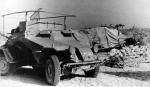
Detrás del puesto del conductor, en la parte más ancha del casco, estaba el habitáculo. No había torreta en el techo de la cabina, como en los vehículos de la familia del SdKfz 221. La parte delantera del techo estaba cerrada. En la parte trasera, una gran abertura estaba cubierta por un marco elevado con malla. Los lados del marco se podían levantar en sentidos opuestos. La malla proporcionaba algún tipo de protección contra las granadas de mano. Los soldados de la torre tenían que protegerse del mal tiempo mediante una lona impermeable.
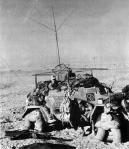
Ni el SdKfz 260 ni el 261 tenían armamento incorporado. el única «arma» del automóvil era su equipo de radio. Consistía en estaciones Fu7 y Fu Spr.Ger para el SdKfz 260 y estaciones Fu12 y Fu Spr.Ger para el SdKfz 261. El SdKfz 261 tenía una antena de marco (Rahmenantenne) que se elevaba sobre el fuselaje mediante cuatro soportes. Los soportes estaban equipados con juntas, por lo que toda la estructura podía inclinarse hacia atrás hasta que el marco de la antena alcanzaba el nivel del techo de la cabina. También se instaló una gran antena de varilla extensible, la llamada Stabantenne, en al menos algunos de los automóviles. Sin embargo, debido a su longitud, solo podía erigirse por completo cuando el vehículo estaba detenido. El SdKfz 260 utilizaba una antena de varilla. La antena también suele ser el único elemento por el que se pueden distinguir los dos modelos en las fotografías, ya que por lo demás tenían una apariencia similar. Además del conductor ya mencionado, la tripulación del automóvil estaba compuesta por otros tres hombres. Dos operadores de radio y un comandante. Todos ellos usaban las escotillas en los costados al lado del puesto del conductor y la escotilla en el techo de la cabina principal para entrar y salir.
El motor SdKfz 260 y 261 era un Horch V8 3.8l con una cilindrada de 3.823 litros. La unidad proporcionaba una potencia máxima de 81 hp. a 3.600 rpm. La caja de cambios Horch Einheits tenía cinco marchas hacia adelante y una hacia atrás. El peso era de 4,26 toneladas para el SdKfz 260 y de 4,3 toneladas para el SdKfz 261.
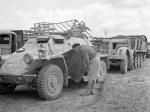
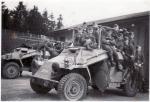
El espacio libre a los lados del casco entre los guardabarros delantero y trasero se aprovechaba para colgar diferentes elementos. Una gran caja de herramientas iba colocada en el lado izquierdo del automóvil, detrás de la escotilla del conductor. Una rueda de repuesto colgaba del lado derecho. A veces los vehículos estaban literalmente cargados con otras cajas, un gato, un extintor, bidones de gasolina y agua, y lonas, incluso en el techo ya que el vehículo estaba desarmado.
Weserhuette y Ritscher produjeron 493 vehículos en cuatro series desde noviembre de 1940 hasta abril de 1943. Entraron en servicio en la primavera de 1940 con las unidades se señales (Nachrichten) y permanecieron en servicio hasta el final de la guerra.


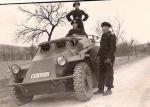


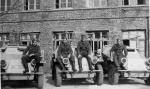


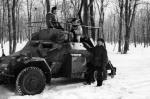

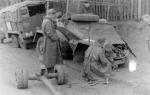
From the mid-1930s, a family of light armored vehicles built on the four-wheeled Einheitsfahrgestell I chassis of the Horch company was introduced into the armament of the German army. This family included armored cars SdKfz 221, SdKfz 222 and the radio car SdKfz 223. In 1940, two more types of radio cars were created, which followed on from the mentioned family of armored cars and their production started a year later. These were machines with the official designation kleine Panzerfunkwagen (SdKfz 260) and kleine Panzerfunkwagen (SdKfz 261).
The chassis and hull of the SdKfz 222, the Ausf B version, served as the basis for their construction. The hull of the radio car was made of flat armor plates welded to each other at various sharp angles, so that there was practically no surface on the entire vehicle on which an enemy round could fall perpendicularly. The upper and lower halves of the fuselage had oppositely inclined walls.
The front wall of the cabin was provided with two windows for the driver that protruded from the front hood. The left window was significantly larger and, unlike the right one, it was openable. After one window, the driver also had his station in the side walls. They were also equipped with an openable cover and a slot.
The driver sat in the front of the car slightly to the left of its centerline and controlled the car using a standard steering wheel. Both axles were steerable for easier turning. However, the rear wheel steering could be locked, which was perhaps also recommended for driving at higher speeds. To get in and out of the car, the driver could choose one of the hatches in both side walls next to his station, specifically in the lower part of the side walls. The hatches had the shape of an irregular trapezoid. Their one-piece cover opened towards the rear of the car. The ceiling above the driver’s head was slightly raised compared to the rest of the roof.
Behind the driver’s station, in the widest part of the hull, was the main cabin of the car. There was no turret on the ceiling of the cabin, as in the fprmer SdKfz 221 family. The front part of the ceiling was closed. In the back, a large opening was covered by a raised frame with mesh. The frame sides could be lifted up, facing each other. The mesh provided some kind of protection against hand grenades. The soldiers in the tower had to protect themselves from bad weather by pulling over a waterproof tarp.
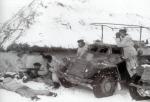
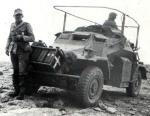
Neither the SdKfz 260 nor the 261 had any built-in armament. The car’s only «weapon» was its radio equipment. It consisted of Fu7 and Fu Spr.Ger stations for the SdKfz 260 and Fu12 and Fu Spr.Ger stations for the SdKfz 261. The SdKfz 261 had a frame antenna (Rahmenantenne) rising above the fuselage on four beams. The beams were equipped with joints, so the entire structure could be tilted backwards until the antenna frame reached the level of the cabin ceiling. A large extendable rod antenna, the so-called Stabantenne, was also installed on at least some of the cars. However, due to its length, it could only be fully erected when the vehicle was stopped. The SdKfz 260 used a rod antenna. The antenna is also usually the only element by which the two types can be distinguished in the photographs, as they were otherwise similar in appearance. In addition to the already mentioned driver, the crew of the car consisted of three other men. Two radio operators and a commander. Apparently they used the hatches in the sides next to the driver’s post and the hatch in the ceiling of the main cabin to get in and out.
SdKfz 260 and 261 engine was a Horch V8 3.8l type with a displacement of 3.823 liters. The unit provided a maximum output of 81 hp. at 3,600 rpm. The Horch Einheits gearbox allowed for five forward and one reverse gears. The weight was 4.26 tons for the SdKfz 260 and 4.3 tons for the SdKfz 261.
The free space on the sides of the hull between the front and rear fenders was used to hang different items. A large tool box was hung on the left side of the car, behind the driver’s hatch. A spare wheel hung on the right side. Sometimes the vehicles were literally strewn with other hanging boxes, a hoist, a fire extinguisher, gasoline and water canisters and tarps, even on the roof because the material here did not prevent any weapon from being fired.
493 vehicles were produced in four series by Weserhuette and Ritscher from November of 1940 to April of 1943. They entered service in Spring of 1940 with Nachrichten (Signal) troops and remained in service to the end of the war.
FUENTES Y REFERENCIA – SOURCES & REFERENCE
panzernet.net
worldwarphotos.info
©jmodels.net
 jmodels.net
Debe estar conectado para enviar un comentario.