

De un vistazo – Quick look
MATERIAL Y PIEZAS
MEDIA & PARTS:
- Plástico inyectado (100 piezas), plástico transparente (10 piezas).
- Injected plastic (100 parts), clear plastic (10 parts).
CALCAS – DECALS:
- Dos hojas. Una de ellas contiene escarapelas israelíes y checoslovacas, panel de instrumentos, arneses, insignias de unidad, marcas de cola y del fuselaje, matrículas y algunos estarcidos. La segunda hoja lleva impresos poco más de 40 estarcidos. Los motivos tiene aspecto fino y brillante, buena saturación de color y registro. El soporte no muy excesivo en la mayoría de calcas, excepto las escarapelas israelíes.
- Two sheets. One of them contains national roundels, the instrument panel, unit badges, tail and fuselage markings, registers and some stencils. The second sheet shows around 40 stencils. Decals have a thin and glossy appearance, good color saturation and register. The carrier film is not too excessive in most of them, except for the Israeli roundels.
OPCIONES – OPTIONS:
- Avia S-199. Chel Ha Avir (Israeli Air Service). 101 Squadron (tayeset). Qastina (Israel). September 1948.
- Avia S-199. Chel Ha Avir (Israeli Air Service). 101 Squadron (tayeset). Herzliya field base (Israel). July 1948.
- Avia S-199.99. Czechoslovak Air Force. 3rd Air Division. Air Regiment 8. 1st Squadron. Brno-Černovice ( Czechoslovakia), 1950-51.
- Avia S-199.310. Czechoslovak Air Force. 3rd Air Division. Air Regiment 7. 3rd Squadron. Brno-Černovice ( Czechoslovakia). Spring 1949.
INSTRUCCIONES – INSTRUCTIONS:
- Folleto A4 de 16 páginas impreso en color en papel satinado. Contiene una introducción histórica sobre el avión, un plano numerado de piezas, una tabla de colores con equivalencias de pinturas de Gunze Sangyo, 14 pasos de construcción y 5 páginas de perfiles, uno de ellos para colocar los estarcidos.
- 16-page A4 booklet printed in color. It contains a historical introduction to the aircraft, a numbered parts plan, a color chart with matches in Gunze Sangyo paints, 14 assembly steps and 5 pages of profiles, one of them to set the stencils.
LO MEJOR – THE BEST:
- Limpieza y moldeado. Excelente detalle general. Opciones de montaje.
- Clean nicely tooled kit. Overall excellent detail. Assembly choices.
LO PEOR – THE WORST:
- Montaje de la carlinga en el fuselaje. No incluye bombas ni soporte.
- Cockpit-fuselage assembly. Bombs and racks not included.
VALORACIÓN – CONCLUSION:
- Otra excelente reedición de la serie del Bf 109 que Eduard viene lanzando en los últimos años, esta vez en edición Weekend. Muy recomendable, salvo a los novatos, y especialmente a los aficionados a este avión.
- Another excellent reissue of the Bf 109 Eduard have been releasing in the last years, this time as a Weekend boxing. Quite recommendable kit (except for newbies) and specially to fans of the German fighter.

La maqueta
Esta es una reedición en formato Weekend de la primera maqueta del Avia S-199 que Eduard lanzó en 2022 en la configuración Dual Combo (dos maquetas en una caja acompañadas de máscaras y fotograbados. En cierta manera, este nuevo molde estaba anticipando el del Bf109G puesto a la venta un año después.
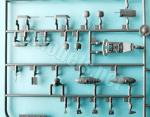
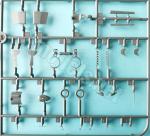
La caja contiene tres bastidores de piezas, un bastidor transparente, dos hojas de calcas y el folleto de instrucciones. Las piezas muestran un moldeado excelente, carecen de rebabas ni marcas visibles y ya ni siquiera traen cilindros de eyector, que sólo están presentes en algunas piezas transparentes. Excepto el bastidor que contiene el fuselaje, el resto lleva marcado “Avia S / CS 199”, que apuntaba a la maqueta de la versión biplaza de entrenamiento que Eduard editó poco después.
El montaje de la maqueta requiere de cierto tiento y experiencia debido sobre todo a la presencia de piezas muy pequeñas y finas, por lo que no parece indicada para el modelista primerizo o muy novato. Entre las alternativas de construcción encontramos el montaje de los cañones subalares y el depósito de combustible, la apertura de la carlinga, la manivela de arranque, así como doble opción para las llantas y la posición de las ruedas. Acertadamente, Eduard nos da la posibilidad de colocar las ruedas más o menos paralelas a las patas según la opción de acabado que se elija. Esta modificación, realizada para intentar mejorar las maniobras al rodar sobre pistas de hormigón, parece que no se hizo en los primeros aviones fabricados.
La maqueta representa un S-199 con la cubierta original Erla Haube alemana. Aunque parece que los aviones checos la llevaron inicialmente, la fueron reemplazando por otra más moderna de burbuja deslizante hacia detrás, también incluida en el bastidor transparente. Los S-199 comprados por Israel en 1948 sólo llevaron la cubierta inicial.
Carlinga
Los lados de la carlinga tienen algún detalle en relieve más evidente en el lado izquierdo del fuselaje porque el derecho tiene dos piezas añadidas con más instrumentos y una calca. El suelo está moldeado en una pieza con el panel blindado tras el asiento y los pedales bien detallados. El asiento se compone de base y respaldo con los cinturones de calca. También hay una palanca de control, una cubierta por delante del asiento y la manivela de control del flap.
El mamparo delantero tiene el panel de instrumentos opcional, con los instrumentos en relieve o bien plano y detallado con una calca. La mira es transparente y se añade, de acuerdo con las instrucciones, en una fase posterior del montaje. Tras cerrar el fuselaje, se introduce el suelo desde debajo y se añade el panel trasero situado tras el piloto, que contiene la tapa del compartimento detallada. Esta operación es bastante delicada porque se puede romper cualquier pieza al realizarla.
La cubierta, que en esta edición es la alemana Erla Haube como ya he dicho, viene separada del parabrisas y puede colocarse abierta. Está detallada con el mástil de la antena y en su interior una pieza con el acolchado del reposacabezas. Las piezas son razonablemente finas para la escala. El parabrisas muestra el blindaje bien definido.
En general, la carlinga muestra un detalle excelente incluso sin piezas de fotograbado que lo resalten aún más.
Fuselaje y motor
El fuselaje está separado en dos mitades cuyas superficies externas poseen un nítido y fino panelado tanto en las líneas de la estructura como en las tapas y accesos. Las piezas incluyen la aleta de cola en dos partes y las raíces de las alas. Tras la carlinga tenemos la habitual antena de bucle con el anillo separado.
La cubierta del motor está separada, así como los abultamientos laterales de las ametralladoras, cuyas salidas hay que pegar en las troneras. Los carenados de las armas tienen dos opciones, según el avión que deseemos representar. Uno de ellos pertenecía originalmente al Fw 190 y el otro era el del Bf 109G, de ahí las pequeñas diferencias a la vista. Las troneras están bien perfiladas, lo mismo que la toma de aire del sobrealimentador, moldeada de una pieza y cambiada al lado opuesto respecto a la original del Bf 109G.
A los lados del morro pueden apreciarse dos pequeñas tomas auxiliares y los escapes separados. Estas piezas están bien perfiladas y limpias de rebabas. La manivela de arranque es opcional. El hueco frontal del morro está tapado por un disco horadado en su centro para pegar el eje de la hélice. La hélice tiene las palas bien perfiladas y sin rebabas. El cono posee tres muescas en su interior para pegar los pequeños vástagos de la placa trasera sobre él. Obviamente, el cono carece de cañón, ya que no se podía instalar en el motor Jumo 211F en V invertida diseñado originalmente para el Heinkel He111.
El panel inferior bajo el motor viene separado y también tiene dos opciones, según la toma de refrigeración de aceite. Uno de los aviones israelíes posee una toma carenada con filtro interno aparte. La segunda alternativa muestra una carena menor en un lado, una tapa de acceso y un pequeño dispositivo que conectaba el intercambiador de calor situado dentro del fuselaje. Este panel es procedente en los aviones checoslovacos y en uno de los israelíes que las instrucciones nos muestran.
Alas y cola
Las alas están formadas por el habitual ensamblaje de tres piezas con las puntas moldeadas en las piezas superiores y la pieza inferior encajada en ellas. El hueco de los pozos, completamente redondeado como en el Bf 109F y que incluye también el de las patas, viene separado y el fondo está bien reproducido en las superficies superiores. El detalle de las superficies es realmente bueno, los paneles y accesos están grabados con mucha finura en ambas caras y también hay algunas líneas simuladas con remaches diminutos. Los paneles abultados en mitad de las alas tienen un relieve aceptable, pero no están tan marcados como las instrucciones los muestran.
Como en otras maquetas de Eduard que comparten este molde, las luces de las puntas vienen en piezas transparentes, aunque el tubo Pitot está moldeado en su lugar. Los slats, alerones y flaps vienen separados y estos últimos se pegan bajados. Los alerones están provistos de contrapesos separados y las superficies tienen el entelado bien reproducido. Los slats son finos y se pegan en posición abierta, como los tendría el avión en tierra.
El interior de las tomas de aire de los radiadores está grabado en las alas sin rejillas internas. Las aletas de salida tienen una muesca que permite doblarlas para situarlas en posición abierta, una operación siempre delicada tratándose de plástico. Un soporte de antena adicional va pegado bajo el ala izquierda.
Las góndolas de los cañones vienen en mitades con el tubo unido a una de ellas y las salidas de los eyectores de los casquillos bien marcadas. Dentro de las góndolas hay que pegar una pieza que tiene los vástagos necesarios para unirlas a las alas.
La maqueta trae un depósito auxiliar con su correspondiente anclaje separado bajo el fuselaje, pero las bombas y los soportes no están incluidos, ya que Eduard los vende en un juego de mejora (referencia 672293). En las fotos de los Avias S-199 israelíes empleados en la guerra de 1948 que he visto no se aprecia el depósito instalado ni tampoco las bombas, aunque sí parece verse el anclaje del armamento en algunos casos.
El empenaje posee un detalle fino y nítido. Tiene el timón vertical separado, con los planos horizontales insertados en su lugar mediante pequeños vástagos. A diferencia de otras maquetas del Bf 109 de Eduard, los timones de profundidad vienen separados y la aleta vertical no.
Tren de aterrizaje
El tren principal tiene una reproducción notable en las patas y el interior de las tapas de las ruedas. Los neumáticos separados tienen doble opción, aunque no se aprecia ninguna diferencia entre ellos, ni siquiera en las bandas de rodadura lisas. Las llantas también son alternativas, pero no se identifican los aviones que pueden llevar cada una. La rueda de cola viene unida a su pata y posee buen detalle en la horquilla y la rueda.
Las ruedas pueden colocarse con más inclinación o menos respecto al suelo, sin que haya que hacer modificaciones en las patas, según las instrucciones.
Calcas
Están repartidas en dos hojas. La mayor contiene escarapelas israelíes y checoslovacas, el panel de instrumentos, los arneses, insignias de unidad, marcas de cola y del fuselaje, matrículas y algunos estarcidos. La segunda hoja lleva poco más de 40 estarcidos impresos. Los motivos tiene un aspecto fino y brillante, buena saturación de color y registro. El soporte no es excesivo en la mayoría de calcas, excepto alrededor de las escarapelas israelíes.
Instrucciones
Vienen en un folleto con formato A4 de 16 páginas impreso en color sobre papel satinado. Contiene una introducción histórica sobre el avión, un plano numerado de piezas, una tabla de colores con equivalencias de pinturas de Gunze Sangyo, 14 pasos de construcción y cinco páginas de perfiles, uno de ellos para colocar los estarcidos. Las vistas explosionadas y las alternativas de montaje son muy claras.
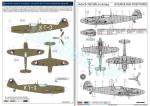
Los acabados muestran dos aviones israelíes de la Escuadrilla 101ª con idénticas escarapelas, salvo en las superficies superiores del segundo y numerados dalet 121 y 115 en diferentes caracteres. Los dos aviones fueron entregados a Israel en el segundo lote enviado por Checoslovaquia entre junio y agosto de 1948, ambos con la cubierta Erla Haube, aunque el dalet 115 tenía la toma del radiador de aceite con carena y toma delantera. Las carenas del retroceso de las ametralladoras también eran algo diferentes. Eduard propone el color RLM02 en todas las superficies, cuyo tono es más gris y no tan marrón como se ve en el folleto.
Los aviones checos van pintados de la misma forma, con escarapelas en la cola en lugar del fuselaje y con bujes y códigos de color distinto. Según las instrucciones, el segundo fue fabricado por Aero y no llevaba cañones bajo las alas.
Valoración
Esta es otra excelente maqueta de la serie que Eduard le viene dedicando al Bf 109. Siendo un avión checoslovaco, era lógico suponer que no pasaría demasiado tiempo sin que viésemos también el S-199, al fin y al cabo un heredero directo del modelo G y K alemán.
Aunque sigue sin convencerme el delicado montaje de la carlinga en el fuselaje, no cabe ponerle más objeciones a esta nueva reedición en formato Weekend, con un detalle excelente que hará pasar buenos ratos al aficionado a la saga del avión más conocido de Messerschmitt.◊





The kit
This is a Weekend format reissue of the first Avia S-199 kit Eduard launched in 2022 in the Dual Combo configuration (two kits in a box with masks and photo-etched parts). In some ways, this new tool kit anticipated the new 1/72 Bf 109G released a year later.
The box contains three sprues of parts, a clear frame, two decal sheets, and the instruction booklet. Parts show excellent molding, are free from flash or visible marks, and ejector pips are only present on some clear parts. Except for the sprue containing the fuselage, the rest are labelled «Avia S / CS 199,» which referred to the two-seat training version Eduard released shortly after.
Assembly of the kit requires some skill and experience, primarily due to the presence of very small and brittle parts, so it does not seem suitable for the novice or beginner modeler. Construction options include the addition of the underwing cannon and fuel tank, posing the cockpit open, the starter handle, as well as a dual option for the rims and wheel positions. Eduard appropriately offers the option of placing the wheels more or less parallel to the legs depending on the finish option chosen. The first S-199s produced seem not to include this modification, made to improve maneuverability when taxiing on concrete runways.
The kit represents an S-199 with the original German Erla Haube canopy. Although it appears that the Czech aircraft initially featured this canopy, it was later replaced with a more modern rear-sliding bubble canopy, also included in the clear frame. The S-199s purchased by Israel in 1948 featured only the original canopy.
Cockpit
The cockpit sides have some raised instruments, more evident on the fuselage left side because the right side has two pieces with more instruments and a decal. The floor is molded in one piece, with the armored panel behind the seat and the pedals nicely detailed. The seat consists of a base and backrest with decal seat belts. There is also a control stick, a cover in front of the seat, and the flap control handle.
The forward bulkhead has an optional instrument panel, one featuring raised instruments or a flat panel detailed with a decal. The sight is a clear piece added, according to the instructions, at a later stage of assembly. After closing the fuselage, the floor is inserted from underneath, and the rear panel behind the pilot is added. This contains a nice cover. Attaching the cockpit to the fuselage is quite delicate and breaking any part is likely.
The canopy, which in this boxing is the German Erla Haube, as mentioned above, comes separate from the windshield and can be showed opened. It is detailed with an antenna mast and a piece of headrest padding inside. Pieces are reasonably thin for the scale and the windshield shows well-defined armor.
Overall, the cockpit shows excellent detail even without photo-etch parts to further enhance it.
Fuselage and engine
The fuselage comes in halves, each with the external surfaces featuring crisp, fine panelling along the structural lines, hatches, and access covers. Parts include a two-part tail fin and wing roots. Behind the cockpit, we find the usual loop antenna with a separated ring.
The engine cowling come apart, as are the lateral bulges for the machine guns, provided with tiny muzzles to be glued into the gun ports. The machine gun fairings come in two versions depending on the aircraft we wish to represent. One of them was the one used in the Fw 190, and the other was from the Bf 109G, hence the slight visual differences. The gun troughs are well-profiled, as is the supercharger air intake, molded in one piece and installed on the opposite side from the original Bf 109G.
The nose sides are detailed with small auxiliary intakes and separate exhausts, which feature a sharp profile and are flash-free. The starter handle is included as an option. The front nose gap is covered by a disc drilled in the middle for gluing the propeller shaft. The propeller’s blades are nicely profiled without any flash either. The spinner is provided with three notches inside to join the small backplate pins. Obviously, the spinner lacks the gun barrel of the Bf 109G, as it could not be installed on the inverted-V Jumo 211F engine, originally designed for the Heinkel He 111.
The lower panel under the engine is also separate and has two alternative pieces, depending on the type oil cooling intake the aircraft carried. One of the Israeli aircraft has a faired intake with a separate internal filter. The second alternative shows a smaller raised fairing on one side, an access cover, and a small device connecting the heat exchanger located inside the fuselage. This last panel is applicable to the Czechoslovakian aircraft and one of the Israeli S-199s shown in the instructions.
Wings and tail
The wings are the usual three-piece assembly, with the tips molded on the upper surfaces and the lower side fitted into them. The wells, completely rounded like those of the Bf 109F, are separate, and the bottom is sharply rendered on the upper surfaces. Surface detail is quite good; the panels and access covers are finely engraved on both sides and there are also some riveted lines. The raised panels in the middle of the wings are acceptable, but are not as sharply outlined as the instructions show.
As with other Eduard Bf 109 kits, the wing tip lights come in clear parts, although the pitot tube is molded in place. The slats, ailerons, and flaps come separately, and the latter are attached folded downwards. The ailerons are provided with separate mass balances, and the surfaces have well-reproduced fabric. The slats are thin and glued in the open position, as the aircraft would have them on the ground.
The radiator air intakes are attached onto the wings without the internal grilles. The rear flaps have a notch to bend them in open position, which seems a bit risky with plastic parts. An additional antenna is glued under the left wing.
The gun pods come in halves with the barrel molded on one of them and the feed chutes clearly visible. A small piece provided with pins is inserted in between the halves to join the cannon to the wings.
The kit includes an auxiliary tank with a separate rack under the fuselage, but the bombs and their racks are not included, as Eduard sell them as upgrades (reference 672293). In the pictures I’ve seen of Israeli Avia S-199s used in the 1948 war, the tank and bombs are not installed, although the bomb racks can be spotted some times.
The tailplanes are finely detailed. There is a separate vertical rudder, with the horizontal planes attached with pins. Unlike other Eduard Bf 109 kits, the elevators are separate, but the vertical fin is not.
Landing gear
The main gear has notable reproduction on the legs and the inner wheel covers. The separate tires have two options, although apparently there is no difference between them, not even in the smooth treads. The rims are also alternative, but the instructions don’t identify which aircraft carried them. The tailwheel is attached to the leg and has good detail on the fork and wheel.
Following the instructions, the wheels can be attached with more or less inclination relative to the ground without needing modifications to the legs.
Decals
They come in two sheets. The larger one contains Israeli and Czechoslovakian roundels, the instrument panel, harnesses, unit badges, tail and fuselage markings, registrations, and some stencils. The second sheet has just over 40 stencils. The items have a fine, glossy appearance, good color saturation and registration. The carrier film is not excessive in most decals, except around the Israeli roundels.
Instructions
They come in a 16-page A4 booklet printed in color on glossy paper. It contains a historical introduction to the aircraft, a numbered parts plan, a color chart with Gunze Sangyo paint equivalents, 14 construction steps, and five pages of profiles, one of which is for stencil placement. The exploded views and assembly alternatives are very clear.
The profiles show two Israeli aircraft from the 101st Squadron with identical roundels, except for the upper surfaces of the second, which were numbered Dalet 121 and 115 in different characters. The two aircraft were delivered to Israel in the second batch sent by Czechoslovakia between June and August 1948, both with the Erla Haube canopy, although Dalet 115 had a faired oil cooler. The machine gun recoil cowlings were also slightly different. Eduard suggest RLM02 on all surfaces, which is more gray and not as brown as the color shown in the booklet.
The Czech aircraft are painted in the same color, with roundels on the tail rather than on the fuselage plus different hubs and color codes. According to the instructions, the second aircraft was manufactured by Aero and did not have underwing cannons.
Conclusion
This is another excellent kit in the series Eduard have dedicated to the Bf 109. Being a Czechoslovakian aircraft, it was logical to assume that it wouldn’t be too long before we also saw the S-199, after all, a direct heir to the German G and K variants.
Although I’m still not convinced by the delicate cockpit assembly, unquestionably the kit has a superb detail that will provide hours of modelling enjoyment to fans of the saga of Messerschmitt’s most famous fighter.◊
Publicado – Published: 7 / 2025
©www.jmodels.net
 jmodels.net
Debe estar conectado para enviar un comentario.