
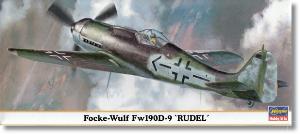
De un vistazo – Quick look
MATERIAL Y PIEZAS
MEDIA & PARTS:
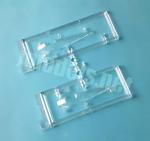
- Plástico inyectado (37 piezas), plástico transparente (5 piezas).
- Injected plastic (37 parts), clear plastic (5 parts).
CALCAS – DECALS:
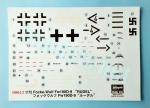
- Cruces balcánicas de distinto tipo, esvásticas, instrumentos del panel y consolas, insignias de escuadrilla y numerosos estarcidos. Apariencia fina y nítidas. Sin exceso de soporte.
- Several types of Balkan crosses, swastikas, panel and consoles gauges, squadron markings and plenty of stencils. Sharp and thin appearance. No excess of carrier film.
OPCIONES – OPTIONS:
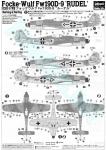
- Focke-Wulf Fw190D-9. Oberst Hans-Ulrich Rudel. Stab./SG2. Grossenhain (Alemania). Abril de 1945.
- Focke-Wulf Fw190D-9. Stab./JG51. 1945.
INSTRUCCIONES – INSTRUCTIONS:
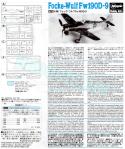
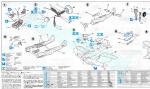
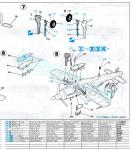
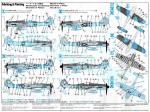
- Folleto doblado formando 8 páginas impresas en blanco y negro. Contiene una breve historia con datos técnicos del avión, 9 secuencias de montaje, una lista de colores con equivalencias en pinturas de Gunze Sangyo, perfiles y un diagrama de piezas numerado. Una hoja separada muestra perfiles de las dos versiones exclusivas de esta caja con su propia lista de colores y pinturas. Claras.
- 8-page folded leaflet printed in black and white. It contains a short history with technical data about the aircraft, 9 assembly steps, a list of colors with matches in Gunze Sangyo paints, profiles and a numbered parts plan. A separate sheet shows profiles of the two aircraft the box is dedicated to with a specific list of colors and paints. Clear.
LO MEJOR – THE BEST:
- Montaje sencillo. Detalle interior decente y exterior bueno. Cubierta de dos piezas.
- Easy build. Decent cockpit and nice exterior detail. Two-piece canopy.
LO PEOR – THE WORST:
- Versiones de pintura muy parejas.
- Paint finishes are almost the same.
VALORACIÓN – CONCLUSION:
- Se trata de una edición específica dedicada al as Rudel en un avión algo impropio para él. Montaje sencillo y pintura algo más exigente para una maqueta con la habitual calidad de Hasegawa. Para todos los públicos.
- This is a special release dedicated to one of Rudel’s aircraft, and one looking uncommon for him. Easy assembly and a bit more demanding painting combine in this kit which shows Hasegawa’s best once again.

La maqueta
Desde inicios de los años 90 Hasegawa ha editado esta maqueta en casi todas las formas posibles, sola o junto a otras en esos apaños comerciales denominados “combos”. Se trata, pues, de una reedición con calcas distintas y las mismas instrucciones. El tema de esta caja, que tiene ya su buen par de décadas, es un tanto raro porque está dedicada a uno de los aviones que el as alemán Hans-Ulrich Rudel pilotó en su largar trayectoria como piloto. Lo infrecuente es que lo hiciera en esta versión D-9, un caza propiamente dicho, cuando Rudel se hizo famoso con el Ju 87 Stuka.
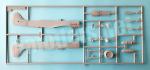
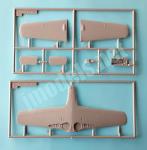
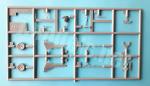
La caja trae cuatro bastidores de piezas, un bastidor transparente, la hoja de calcas y las instrucciones. Las piezas están moldeadas con la calidad que se le supone a la marca y no tienen rebabas ni casi ninguna marca de eyector visible. A cambio hay algunos cilindros del expulsor en algunas piezas, pero son pequeños y se limpiarán con sencillez. El despiece es ya tradicional en este tipo de maquetas de cazas de Hasegawa: el interior está resuelto con una especie de “bañera” en la carlinga además del fuselaje y alas en mitades, lo que hace el montaje bastante sencillo. El panelado es también marca de la casa, con líneas finas, limpias y bien ejecutadas en toda la maqueta.
Carlinga
Se compone de una pieza que contiene el suelo, las consolas laterales y los mamparos delantero y trasero. El asiento, la palanca de control y el tablero de instrumentos están separados. Tanto el panel como las consolas tienen calcas para simular los diversos instrumentos.
Una vez pegado el fuselaje, hay que añadir el panel blindado del reposacabezas y la barra de refuerzo tras él que son opcionales y dependen del tipo de cubierta que empleemos. El parabrisas está separado del resto de la cubierta transparente, lo que permite mostrar el interior, sin embargo no tenemos la mira. La sección trasera de la carlinga tiene dos opciones, una de ellas de perfil más cuadrado y picudo y la otra más abultada y redondeada. En esta maqueta sólo emplearemos la segunda. Aunque las instrucciones señalan las dos opcionales, debemos guiarnos por la hoja de perfiles añadida en esta edición.
Fuselaje y motor
Las mitades del fuselaje, unidas a las superficies verticales de cola, parecen capturar bastante bien el alargamiento y el cambio de formas del modelo D-9. Los escapes son excelentes y están moldeados con muy buena definición in situ, aunque naturalmente las salidas no están abiertas debido a su tamaño. La toma de aire lateral y la cubierta del motor vienen separadas. La primera está dividida en dos piezas y se muestra abierta, mientras que la segunda reproduce bien los abultamientos de las ametralladoras y las troneras. Las bocachas del armamento están apenas sugeridas.
El capó motor es de una pieza con aletas más bien finas y representadas en posición cerrada. El frontal interior no tienen detalle y es liso. La hélice tiene las palas, separadas y bien afinadas, dispuestas sobre un disco base que permite orientarlas adecuadamente. El buje parece tener buenas formas y viene aparte.
La parte ventral del fuselaje está detallada con dos antenas distintas y un depósito de combustible en mitades con las abrazaderas incluidas y provisto de su anclaje separado.
Alas y cola
Las alas están despiezadas en dos mitades superiores y una inferior unida a parte del fuselaje ventral. El panelado es muy bueno y muestra tanto los accesos y registros como la separación de las superficies de control con gran nitidez. Los alerones tienen la estructura interna definida con escaso relieve en ambas mitades y las aletas bien representadas.
Las luces de las puntas alares son diminutas pero tienen nitidez suficiente y están moldeadas en la mitad inferior. Lo contrario sucede con el tubo Pitot y los cañones, que aparecen en las mitades opuestas. Los pozos poseen relativa profundidad y el detalle del fondo me parece suficiente y correctamente marcado.
Los estabilizadores son finos y de una pieza. Los timones están correctamente marcados y poseen aletas bien reproducidos. La apariencia de la estructura interna es similar a la de las alas.
Tren de aterrizaje
Las patas del tren principal muestran la amortiguación y los brazos de torsión con nitidez. Las tapas, finas y aparentemente bien perfiladas, vienen separadas al igual que los brazos de plegado. Las ruedas no están nada mal y destacan tanto las llantas como la banda de rodadura texturizada. Las llantas internas tienen un par de pequeñas marcas de eyector que serán fáciles de disimular con las tapas. El tren posterior está moldeado con una de las mitades del fuselaje.
Calcas
La hoja contiene cruces balcánicas de distinto tipo, esvásticas, los instrumentos del panel y consolas, insignias de unidad y numerosos estarcidos. Los motivos poseen apariencia fina y son nítidos. No muestran exceso de soporte.
Instrucciones
Vienen en un folleto doblado formando ocho páginas impresas en blanco y negro. Contiene una breve historia con datos técnicos del avión, nueve secuencias de montaje, una lista de colores con equivalencias en pinturas de Gunze Sangyo, perfiles y un diagrama de piezas numerado. Una hoja separada muestra perfiles de las dos versiones exclusivas de esta caja (una de ellas el aparato de Rudel), con su propia lista de colores y pinturas.
Ambos aviones aparecen pintados de manera análoga en un camuflaje compuesto de RLM 75 y 83 sobre RLM76 y la cola moteada. Se echa en falta algo más de variedad en los acabados, pero siendo este avión del final de la guerra mundial poco más se puede pedir.
El folleto es idéntico al de la primera edición por ello aún contiene perfiles de varios aviones de ases famosos como Wubke, Barkhorn y otros que no es posible reproducir en esta caja por carecer de calcas.
Valoración
Una vez más Hasegawa nos trajo una versión interesante e inusual de este avión pilotado por Rudel. El montaje es bastante sencillo y la pintura algo más exigente para el muy inexperto, pero la mayoría de los interesados en la Luftwaffe a esta escala la disfrutarán.◊

The kit
Since the early 1990s Hasegawa have released this kit in almost every possible way, alone or together with others in combo boxings. It is, therefore, a reissue with different decals and the same instructions. The topic of this box, which is now a couple of decades old, is somewhat strange because it is dedicated to one of the aircraft that the German ace Hans-Ulrich Rudel flew during his long career as a pilot. The unusual thing is that he did it in this D-9 variant, a fighter, when Rudel became famous with the Ju 87 Stuka.
The box contains four sprues of parts, a clear sprue, the decal sheet and instructions. Parts are molded with the quality that the brand is supposed to and have no flash or almost any visible ejector marks. In exchange there are some ejector pips on some pieces but they are small and will be easily cleaned up. Parts breakup is the standard one hopes to find in Hasegawa fighter kits: the interior is includes a kind of “bathtub” in the cockpit in addition to the fuselage and wings in halves, which makes assembly quite simple. Engraved paneling, also a trademark of the house, is thin, clean and nicely done throughout the kit.
Cockpit
The tub comprises the floor, the side consoles and the front and rear bulkheads. The seat, control column and instrument panel are separate. Both the panel and the consoles have decals to simulate the instruments.
Once the fuselage is attached, we must add the armored panel of the headrest and the supporting bar behind it. Both have options depending on the type of canopy we use. The windshield is separated from the rest of the clear canopy, allowing the interior to be shown, however the sight is not included. The rear canopy section has two options, one of them with a more square and pointed profile and the other more bulky and rounded. In this kit we will only use the second one taking as reference the extra sheet of profiles added in this rebox.
Fuselage and engine
The fuselage halves, molded with the vertical tail surfaces, seem to capture the lengthening and changing shapes of the D-9 quite well. The exhausts are excellent and are molded in place. Obviously the outlets are not open due to their size. The side air intake and engine deck come separately. The first is divided into two pieces and is shown open, while the second has a nice contour with bulges for the machine guns and engraved troughs. The weapons muzzles barely protrude the troughs.
The engine cowling is in one piece with rather thin gilles molded in the closed position. The cowling front has no detail and is rendered flat. The propeller blades are separated and nicely shaped being arranged on a back-plate that helps to pose them correctly. The hub is also molded apart.
The fuselage belly is detailed with two different antennas and a fuel tank in halves with the braces and provided with a separate pylon.
Wings and tail
The wings are divided into two upper halves and a lower one joined to a section of the ventral fuselage. Paneling is very good and shows both accesses and registers as well as the separation of the control surfaces with sharpness. The ailerons have a defined internal structure with little raised detail on both halves and the trim tabs are also rendered.
The wingtip lights are tiny but sharp enough and molded on the lower half. The opposite happens with the Pitot tube and the guns, molded on the upper halves. The wells are relatively deep and detail is quite acceptable and look cleanly reproduced.
Stabilizers are thin and one piece. The rudders are correctly engraved and also include trim tabs. The internal structure is similar to that on the wings.
Undercarriage
The legs have defined shock absorbers and torque arms. The covers, thin and apparently well profiled, come separate as do the folding arms. The wheels are not bad at all and both the hubs and the textured treads are nice. The inner hubs have a couple of small pin marks that will be easy to hide with the covers. The tailwheel is molded on one of the fuselage halves.
Decals
The sheet contains Balkan crosses of different types, swastikas, the instrument panel and consoles, unit markings and plenty stencils. Decals look thin and sharp. They do not show too much carrier film.
Instructions
They come in an 8-page folded leaflet printed in black and white. It contains a short history and technical data of the aircraft, nine assembly sequences, a list of colors with matches in Gunze Sangyo paints, profiles and a numbered parts diagram. A separate sheet shows profiles of the two exclusive versions of this box (one of them Rudel’s mount), with its own list of colors and paints.
Both aircraft are painted almost the same in a scheme comprising RLM 75 and 83 over RLM76 and a speckled tail. Paint finishes lack variety but being a late WWII German fighter little more can be asked for.
Instructions are identical to the first edition, which is the reason they still show profiles of several D-9s belonging to famous aces such as Wubke, Barkhorn and others that had different decals.
Conclusion
Once again Hasegawa brought us an interesting and unusual version of this aircraft flown by Rudel. Assembly is quite simple and painting a little more demanding for newbies, but most of Luftwaffe fans will enjoy it.◊
Publicado – Published: 12 / 2023
©www.jmodels.net
 jmodels.net
Debe estar conectado para enviar un comentario.