

De un vistazo – Quick look
MATERIAL Y PIEZAS
MEDIA & PARTS:
- Plástico inyectado (128 piezas), plástico transparente (24 piezas). Incluye 2 figuras.
- Injected plastic (128 parts), clear plastic (24 parts). Two figures included.
CALCAS – DECALS:
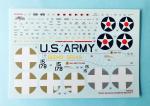
- Impresas por Cartograf. Insignias norteamericanas, insignias de maniobras, panel de instrumentos, decoraciones del morro (noseart), numerales, y numerosos estarcidos. Aspecto fino y brillante. Buena saturación de color y registro. Mínimo soporte.
- Printed by Cartograf. US roundels, maneuvres markings, instrument panel, noseart, registrations and plenty of stencils. Thin and glossy finish. Good saturation and register. Minimal carrier film.
OPCIONES – OPTIONS:
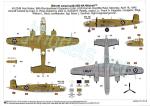
- North American B-25B-NA Mitchell. 40-2249 Hari Karier. 89th Bombardment Squadron (Light). USS Hornet. Doolittle Raid. Saturday, April 18, 1942. Aircraft crewed by Capt. C. R. Greening, pilot; Lt. K. E. Reddy, copilot; Lt. F. A. Kappeler, navigator; SSgt. W. L. Birch, bombardier; Sgt. M. J. Gardner, flight engineer/gunner.
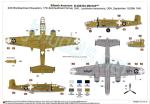
- North American B-25B-NA Mitchell. 17th Bombardment Group. 34th Bombardment Squadron. Louisiana Maneuvers (USA). September 15/28th 1941.
INSTRUCCIONES – INSTRUCTIONS:
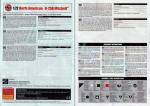
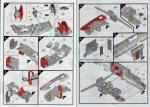
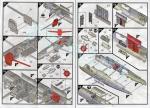
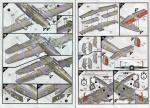
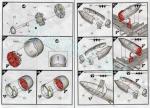
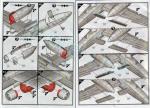
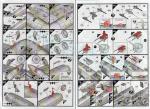
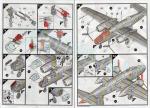
- Folleto A4 de 16 páginas impreso en color. Contiene un sumario histórico sobre el avión con especificaciones técnicas y 82 secuencias de montaje. Dos hojas separadas de formato A3 muestran perfiles a color de las alternativas de acabado con una lista de pinturas esmaltes de Humbrol y una guía para colocar los estarcidos de la maqueta, respectivamente. Hay un error concreto pero importante en el montaje (ver texto).
- 16-page A4 booklet printed in color. It contains a historical summary about the aircraft with technuical specifications and 82 assembly chapters. Two A3 separate sheets show profiles in color of two finishing choices with a list of Humbrol enamel paints and a guide to set the stencils, respectively. There is an important mistake in two assembly chapters (see text).
LO MEJOR – THE BEST:
- Buen detalle general. Múltiples opciones de construcción. Montaje asequible a modelistas menos expertos.
- Nice overall detail. Multiple assembly choices. Suitable assembly for less experienced modelers.
LO PEOR – THE WORST:
- Algunas marcas de la carlinga. Motores mejorables. Ausencia del compartimento de la radio.
- Some pin marks on the cockpit. Improvable engines. Lack of radio operator station.
VALORACIÓN – CONCLUSION:
- Segunda entrega del nuevo molde de Airfix. Tiene buen detalle interno y externo, con algunos aspectos concretos más flojos y mejorables, unido a una gran variedad de alternativas de construcción. Asequible a modelistas con habilidades y experiencia media.
- Second boxing of Airfix new tool. The kit offers good internal and external detail, with a few weaker aspects that could be improved, along with a variety of construction choices. Suitable for modelers with average skills and experience.

La maqueta
Airfix lanzó esta maqueta del B-25B al poco de aparecer la primera con los modelos C y D en la misma caja. Obviamente, las dos comparten el molde actual del fabricante, que es también el más moderno en la escala 1/72 hoy.
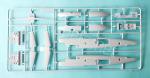
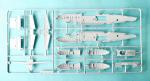
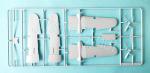
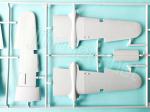
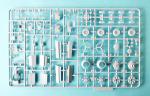
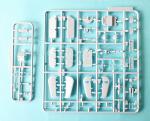
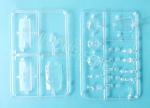
La caja entrega cinco bastidores de piezas grises, dos bastidores transparentes, las calcas y las instrucciones. Todos los bastidores de esta edición son idénticos a los de la maqueta del B-25C/D, salvo uno más pequeño, identificado con la letra E, que reemplaza al H de la primera maqueta, y un bastidor transparente con algunas piezas distintas.
Las piezas están bien moldeadas y carecen de imperfecciones, dejando a un lado las pocas marcas de eyector evidentes en la carlinga y el compartimento del bombardero. Hay algunas más dentro del fuselaje, pero no son perceptibles tras pegar el fuselaje.
El montaje tiene alternativas que permiten mostrar el tren de aterrizaje bajado o plegado, poner las escotillas de acceso bajo el fuselaje y las compuertas de la bodega de bombas abiertas o cerradas, pegar las superficies de control de la cola y los flaps de las alas en posición no neutra, elegir entre dos tipos de miras de bombardeo según la versión de calcas que deseemos construir, y, por último, la punta acristalada del puro de cola también tiene dos opciones.
Este B-25B refleja correctamente las pocas diferencias exteriores con los modelos C y D. En este caso tenemos una ventanilla plana del modelo B en lugar de la cúpula situada sobre el compartimento del navegante del C/D, más la ausencia del parachoques de cola y de una segunda ametralladora fija en el morro.
Airfix ha estudiado muy bien las características específicas del B-25B Hari Kari-er participante en el raid de Doolittle. Como los demás aviones de esta operación, este aparato tenía la torreta ventral suprimida y llevaba ametralladoras simuladas en el puesto de observación de la punta posterior. Para evitar que pudiera caer en manos de los japoneses, la habitual mira Norden fue reemplazada por otra improvisada ideada por el Capitán C. R. Greening, precisamente el piloto de Hari Kari-er. Finalmente, la carga de bombas es igual en la maqueta a la que llevaban los aviones implicados en la operación sobre Japón, que consistía en tres bombas de 500 libras más un haz de bombas incendiarias dispuesto de forma que se desplegase al caer y regase una zona amplia con sus artefactos.
Como esta reedición es en su mayor parte una copia de la primera maqueta sobre la que ya he escrito en estas páginas (North American B-25C/D Mitchell, Airfix A06015), trataré aquí las diferencias con ella.
Revisión
Las secuencias del montaje de la carlinga y la bodega de bombas es igual a la de la primera maqueta de Airfix. El puesto de bombardero también es similar, salvo por la presencia de dos opciones para la mira, una de ellas es la Norden de serie y la otra el dispositivo improvisado que se empleó en la incursión de Doolittle, cuya pieza está en general bien representada. El armamento del morro no está instalado, aunque la ametralladora está incluida en los bastidores. El armamento de la bodega difiere en la sustitución de una de las bombas por el haz de artefactos incendiarios ya descrito.
Una vez cerrado el fuselaje y pegadas las alas sobre los largueros laterales de este, se procede a añadir los dos paneles laterales transparentes situados por detrás de los bordes de salida. Las ventanillas incluidas en las piezas parecen correctas para el B-25B, pero las gemelas del lado izquierdo, me causan dudas porque no las he visto en fotos de esta variante. Las demás ventanillas de ambos lados son las de la primera maqueta, lo mismo que la antena y los mástiles. En lugar de la cúpula del navegante tenemos un panel acristalado plano, que es acertado para esta versión y también está bien reproducido el detalle del puesto de observación del puro de cola, con la opción de colocar a Hari Kari-er dos varillas a modo de ametralladoras simuladas, que eran de hecho dos palos de escoba. Bajo el extremo del fuselaje hay un patín de cola en lugar de parachoques, con la alternativa de taparlo si pretendemos mostrar el avión en vuelo. Las opciones para colocar las escotillas de acceso abiertas también se contemplan en esta edición.
Las secuencias del montaje de las torretas defensivas son las mismas de la maqueta del modelo C/D, salvo que Hari Kari-er tiene la torreta ventral suprimida y cubierta por un carenado.
Las alas con la opción de colocar los flaps bajados, las góndolas, los motores y el tren de aterrizaje tienen un despiece igual a los de la primera caja, al igual que la cola, que también posee el mismo error en la posición invertida de los actuadores de las aletas de los timones de profundidad (piezas D32 y D33), como ya mencioné en la revisión anterior. Los escapes múltiples de los capós motores están suprimidos y en su lugar aparecen dos escapes ahuecados y de distinta longitud a los lados de las góndolas.
Las calcas son de Cartograf. La hoja contiene insignias norteamericanas, insignias de maniobras, el panel de instrumentos, decoraciones del morro (noseart), numerales, y numerosos estarcidos comunes. Los motivos muestran aspecto fino y brillante, con buena saturación de color y registro. La película de soporte no es excesiva.
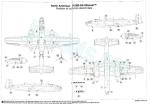
Las instrucciones están impresas en color en un folleto de tamaño A4 y constan de 16 páginas que contiene un sumario histórico sobre el avión con especificaciones técnicas y 82 secuencias de montaje. Dos hojas separadas de formato A3 muestran perfiles a color de las alternativas de acabado con una lista de pinturas esmaltes de Humbrol y una guía para colocar los estarcidos de la maqueta, respectivamente.
Los perfiles en color muestran dos opciones con libreas análogas (Olive Drab sobre gris neutro) con la única diferencia de los bordes azulados de los capós en el avión de la 34ª Escuadrilla de Bombardeo y sus cruces blancas pintadas junto a las insignias nacionales en las alas y el fuselaje.
Valoración
Esta segunda entrega es muy parecida a la primera, pero Airfix ha sabido representar con acierto las características singulares del B-25B en general, y más en concreto las del avión que tomó parte en el raid de Doolittle, que es sin duda uno de los atractivos de este caja. Lamentablemente, Airfix no subsanó el pequeño aunque importante error de las instrucciones en la construcción de la cola.
Uno de las ventajas de este molde son las opciones de montaje, más abundantes que en otros del fabricante. En general el detalle externo está bien conseguido y el interno resulta más que decente, salvo por la ausencia del compartimento de la radio y el detalle en las torretas y motores, que no son del todo malos, pero resultan claramente mejorables.
La maqueta no debería ofrecer dificultades al modelista con experiencia y habilidad media. Las secuencias del montaje parecen muy bien pautadas, así que la prudencia aconseja no desviarse demasiado de ellas para no complicarlo innecesariamente.◊

The kit
Airfix released this boxing shortly after the first one, which included the C and D B-25 variants in the same box. Obviously, both share the manufacturer’s current tooling, which is also the most modern in the 1/72 scale today.
The box contains five sprues of grey parts, two clear sprues, decals, and the instruction booklet. All the sprues in this release are identical to those in the B-25C/D kit, except for one smaller sprue, identified with the letter E, which replaces sprue H from the first kit, and another clear sprue with some different parts.
Parts are well molded and free from blemishes, apart from a few ejector pin marks visible on the cockpit and nose compartment. There are a few more inside the fuselage, but they are not noticeable after the fuselage is closed. The kit offers several options, allowing to display the landing gear lowered or folded, pose the access hatches under the fuselage and the bomb bay doors open or closed, attach the tail control surfaces and wing flaps in non-neutral position, choose between two types of bombsights depending on the decal version you wish to build, and finally, the fuselage glazed tip also has two options.
This kit accurately reflects the few external differences with the C and D models. In this case, we have a flat window instead of an astrodome above the navigator’s compartment found on the C/D, plus the absence of the tail bumper and a second fixed machine gun in the nose.
Airfix have thoroughly studied the specific characteristics of the B-25B Hari Kari-er that participated in the Doolittle Raid. Like the other bombers in this operation, this aircraft had the ventral turret removed and carried simulated machine guns in the rear fuselage glazed tip. To prevent it from falling into Japanese hands, the standard Norden gunsight was replaced with a makeshift device created by Captain C. R. Greening, Hari Kari-er’s pilot. Also, the bomb load in the kit is the same as that carried by the aircraft involved in the operation over Japan, consisting of three 500lb bombs plus a bundle of incendiary bombs arranged to scatter over a wide area after release.
Since this reissue is largely a copy of the first kit I have already written about in these pages (North American B-25C/D Mitchell, Airfix A06015), I will only refer to the differences here.
Review
The assembly sequences for the cockpit and bomb bay are the same as for the first Airfix boxing. The bombardier’s station is also similar, except for the presence of two options for the gunsight: one is the standard Norden sight, and the other is the device used in the Doolittle Raid, which is generally well represented. The nose armament is not installed, although the machine gun is included in the sprues. The bomb bay armament differs in that one of the bombs is replaced by the incendiary bundle described.
Once the fuselage is closed and the wings are attach onto side spars, the two clear side panels behind the trailing edges are added. The windows included in the parts seem correct for the B-25B, but I am doubtful about the twin windows on the left side because I haven’t seen them in pictures of this variant. The other windows on both fuselage sides are from the first kit, as are the teardrop antenna and masts. Instead of the navigator’s dome, there’s a flat glazed panel, which is correct for this version. Detail of the tail-cone clear tip is also well reproduced, with the option of fitting Hari Kari-er with two plastic rods as simulated machine guns, which were actually two broomsticks. Under the fuselage end, there’s a tail skid instead of a bumper, with the option of covering it if you want to show the model in flight. The options for displaying the access hatches open are also included in this boxing.
The assembly sequences for the turrets are the same as in the C/D kit, except that Hari Kari-er has its ventral turret removed and replaced by a fairing.
The wings, with the option of attaching the flaps lowered, the nacelles, the engines, and the landing gear have the same parts breakdown as in the first box, as does the tail, which also has the same mistake in the inverted position of the elevator fin actuators (parts D32 and D33), as I mentioned in my previous review. The multiple exhausts on the engine cowlings are omitted and replaced by two hollow exhausts of different lengths on either side of the nacelles.
The decals are from Cartograf. The sheet contains American markings, white crosses used in maneuvers, the instrument panel, nose art, numbers, and plenty of common stencils. The decals have a fine, glossy appearance, with good color saturation and register. Carrier film is not excessive.
The instructions are printed in color on an 16-page A4 booklet containing a historical summary of the aircraft with technical specifications and 82 assembly sequences. Two separate A3 sheets show color profiles of the alternative finishes, along with a list of Humbrol enamel paints and a guide for applying the common stencils, respectively.
The color profiles show two options with similar liveries (Olive Drab over neutral gray), the only difference being the blue edges around the cowlings on the 34th Bomber Squadron aircraft and its white crosses painted next to the national roundels on the fuselage and wings.
Conclusion
This second installment is very similar to the first, but Airfix has successfully captured the unique characteristics of the B-25B, and more specifically those of the aircraft that took part in the Doolittle Raid, which is undoubtedly one of the assets of this kit. Unfortunately, Airfix didn’t correct the small but significant mistake for building the tail in the instructions.
One of the advantages of this kit is the range of assembly options, clearly more numerous than in other kits from the manufacturer. In general, external detail is nice, and internal detail is more than decent, except for the lack of the radio compartment and the detail on the turrets and engines, which, though not entirely bad, could have been much better.
The kit should not pose difficulties for modelers of average experience and skill. Assembly sequences seem very well laid out, so caution suggests not deviating too much from them to avoid unnecessary complications.◊
Publicado – Published: 3 / 2026
©www.jmodels.net
 jmodels.net
Debe estar conectado para enviar un comentario.