
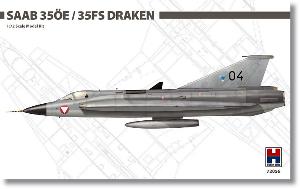
De un vistazo – Quick look
MATERIAL Y PIEZAS
MEDIA & PARTS:
- Plástico inyectado (58 piezas), plástico transparente (4 piezas), máscara adhesiva (12 piezas).
- Injected plastic (58 parts), clear plastic (4 parts), adhesive mask (12 parts).
CALCAS – DECALS:
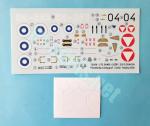
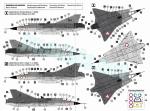
- Impresas por Cartograf. Escarapelas austriacas y finesas, panel de instrumentos y consolas, insignias de unidad, numerales, matrículas y estarcidos. Aspecto fino y mate. Buena saturación y registro. Sin exceso de soporte.
- Printed by Cartograf. Austrian and Finnish roundels, instrument panel and consoles, unit badges, numbers, registers and stencils. Thin and matt finish. Good colour saturation and register. No excess of carrier.
OPCIONES – OPTIONS:
- SAAB 35ÖE n/s 351404. 04 negro. 1 Staffel. Fuerza Aérea Austriaca. Zeltweg (Austria), junio de 1988.
- SAAB 35ÖE n/s 351411. 11 negro. 2 Staffel. Fuerza Aérea Austriaca. Graf-Thalerhof (Austria), junio de 1991.
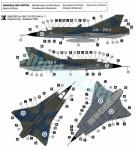
- SAAB 35FS n/s 35412. DK-263. Hävittäjälentolaivue 11. Fuerza Aérea Finlandesa. Rovaniemi (Lapland, Finlandia), 1988.
- SAAB 35ÖE s/n 351404. Black 04. 1 Staffel. Austrian Air Force. Zeltweg (Austria), june 1988.
- SAAB 35ÖE s/n 351411. Black 11. 2 Staffel. Austrian Air Force. Graf-Thalerhof (Austria), june 1991.
- SAAB 35FS n/s 35412. DK-263. Hävittäjälentolaivue 11. Finnish Air Force. Rovaniemi (Lapland, Finland), 1988.
INSTRUCCIONES – INSTRUCTIONS:
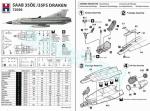
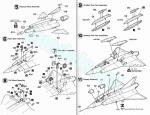
- Folleto doblado de 6 páginas impreso en color en papel satinado. Contiene un plano numerado de piezas, una tabla de colores con equivalencias de pinturas de varias marcas, 11 secuencias de montaje y perfiles. Una hoja separada impresa en color muestra pefiles de la opción finlandesa. Claras.
- 6-page folded leaflet printed in color on satin paper. It shows a numbered parts plan, a color chart with matches in several paint brands, 11 assembly chapters and profiles. A separate sheet printed in color contains profiles for the Finnish aircraft. Clear.
LO MEJOR – THE BEST:
- Fácil de montar. Detalle grabado en fuselaje y alas.
- Easy build. Nice engraved detail on fuselage and wings.
LO PEOR – THE WORST:
- Carlinga con mínimo detalle. Leves marcas de eyector en tapas y neumáticos. Ausencia del tubo Pitot. No incluye armamento.
- Minimal detail inside the cockpit. Pin marks on wheel covers and tires. Lack of Pitot tube and underwing armament.
VALORACIÓN – CONCLUSION:
- Reedición de la original de Hasegawa con una hoja de útiles máscaras añadida. Muy buena calidad de moldeado, sencilla de montar y apta pare recibir todo el detalle que se quiera añadir.
- Reissue of the Hasegawa kit with a handy masks sheet included. Very nice standard of moulding, easy to build and suitable for receiving all kinds of improvements the modeller wishes to add.

La maqueta
Esta es otra copia de la maqueta que Hasegawa viene reeditando desde los años 90. En este caso, Hobby 2000 ha unido, con calcas diferentes, dos versiones que Hasegawa incluyó en distintas cajas, una que contenía aviones austriacos y otra aparatos escandinavos, uno de los cuales era finlandés.
Para montar este Draken tenemos cinco bastidores, uno de ellos transparente, las calcas, una hoja de mascarillas y las instrucciones. Las alteraciones respecto de la maqueta original son las calcas, las máscaras y en parte las instrucciones.
Las piezas tienen un moldeado excelente con un detalle de gran definición en su mayor parte. Las líneas de paneles, el remachado de algunas superficies y la reproducción de ciertas piezas no tiene que envidiar a las de maquetas más actuales y eso que estamos ante un molde con más de 30 años. Como es habitual en muchas ediciones de Hasegawa la zona más floja es la carlinga.
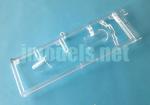
Como en otras ocasiones, Hobby 2000 ha incluido de su cosecha un práctico juego de mascarillas que permiten pintar con más comodidad las tres ruedas más grandes además de la cubierta transparente.
La maqueta permite elegir entre un SAAB J 35ÖE austriaco, que corresponde a un modelo sueco 35D con la carlinga mejorada de un 35F, y un 35FS, correlativo al modelo sueco J 35F1 empleado como caza en Finlandia.
Carlinga
Consta de un suelo unido a las consolas laterales y al mamparo trasero, el panel de instrumentos, la palanca, el asiento y el visor HUD en una pieza transparente. Todos los instrumentos son de calca. Los pedales están representados sobre el suelo. En el asiento destaca el reposacabezas, aunque es básico y pide a gritos mayor detalle.
El panel lleva una pieza transversal en forma de embudo que debe ser una especie de visor del radar Este elemento se ve rara vez en fotos de la carlinga del Draken, así que creo que se puede eliminar esta pieza, que de cualquier forma no vale mucho, y rellenar el hueco que deja en el centro del panel.
La cubierta esta dividida en dos piezas bien moldeadas, de gran transparencia y no demasiado finas, aunque me parecen válidas.
Fuselaje
Al Draken le viene bien el despiece que eligió Hasegawa en el fuselaje, cortado en sentido horizontal y no vertical como es usual. Del estupendo panelado de las superficies ya he adelantado algo antes, ahora solamente cabe añadir la buena reproducción de las tomas triangulares de refrigeración de la parte superior y de los aerofrenos cerrados en ambos lados. Antes de pegar las mitades hay que taladrar varios agujeros para instalar los depósitos auxiliares opcionales, una aleta y el tren de aterrizaje posterior.
El cono frontal viene separado con la sonda aparte. Dentro hay que añadir peso antes de pegarlo. Otras piezas exentas son la espina dorsal situada tras la carlinga, complementada a los lados con el equipo TACAN en dos piezas semejantes, la aleta dorsal y la salida del cañón en el lado izquierdo del fuselaje. La zona ventral lleva una aleta y la turbina de aire de impacto desplegada, con las tapas del compartimento y el ventilador separado.
El buscador de infrarrojos está incluido en la maqueta y aparece pegado bajo el morro en el capítulo 10 de las instrucciones, aunque no se indica su empleo. Una breve comprobación de imágenes en internet nos enseña que no está instalado en el modelo austriaco, mientras que en el finlandés parece que sólo se empleaba ocasionalmente. Al menos la mayoría de imágenes no lo muestran.
La parte frontal de las tomas de aire viene en dos piezas finas de muy buen aspecto, mientras que la parte trasera del fuselaje esta dividida en mitades que contienen en su parte externa el alojamiento del paracaídas de freno y las tomas de refrigeración laterales, que vienen abiertas. La salida del motor está reproducida en una pieza colocada dentro de la tobera y el filo de la salida está también separado.
Alas y cola
Están moldeadas en piezas finas con las típicas lengüetas para insertarlas en sus bases. Las superficies de control están bien marcadas y en el caso de las alas tienen las bisagras definidas por ambas caras.
La cara inferior de las alas lleva el alambrado antivibración bien reproducido, mientras que la aleta de cola tiene la punta separada. La forma de la pieza se asemeja más a la del J 35FS que a la del 35ÖE, que lleva luces de navegación encima y en la parte trasera que la maqueta no trae. Sea como fuere, en ambos casos falta el tubo Pitot.
La única carga son dos depósitos ventrales opcionales con aletas y sus soportes separados. Los depósitos no son intercambiables de posición. Es una lástima que la maqueta no tenga armamento, ni siquiera unos socorridos Sidewinder para darle mayor brío al modelo.
Tren de aterrizaje
El pozo delantero carece de detalle interno. La rueda está moldeada con la pata en una pieza muy bien detallada en el sistema de amortiguación y la guía, con el brazo de plegado aparte. Las tapas son finas y tienen leves marcas de eyector en el lado interno.
Cada elemento del tren principal consta de dos tapas, también con ligeras marcas internas y sin detalle, la pata, que incluye la amortiguación y las luces de aterrizaje sin transparentes, y la rueda. Los neumáticos están marcados y el buje reproducido con limpieza. La cara trasera muestra el sistema de freno sin mucha definición. Desgraciadamente, los neumáticos poseen dos marcas positivas pequeñas en su lado interior.
El tren de cola contiene un carenado situado por delante del pozo, las tapas separadas, el soporte unido al brazo de plegado más dos ruedas muy pequeñas. El detalle está bien conseguido, especialmente la tapa delantera unida al soporte de las ruedas y el brazo actuador.
Calcas
La hoja muestra un buen aspecto y se nota que está impresa con la calidad usual de Cartograf. Contiene escarapelas austriacas y finesas, el panel de instrumentos y las consolas, insignias de unidad, numerales, matrículas y estarcidos. Los motivos tienen un aspecto fino y mate, con buena saturación y registro. La película de soporte apenas es evidente fuera de la calca.
Instrucciones
El folleto doblado de seis páginas impreso en color en papel satinado contiene un plano numerado de piezas, una tabla de colores con equivalencias de pinturas de AK Interactive, Alclad2, AMMO, Hataka, Mr Color y Tamiya, 11 secuencias de montaje y perfiles. Hobby 2000 ha añadido una hoja separada impresa en color con perfiles de la opción finlandesa. Las vistas del montaje son comprensibles y claras.
Los aviones austriacos llevan idéntico patrón de camuflaje gris y pertenecen a las dos escuadrillas de Draken que tuvo el país. El aparato finlandés lleva un discreto camuflaje de verde oliva y azul.
Valoración
Hay que agradecerle a Hobby 2000 que esté reeditando maquetas de Hasegawa como esta, ya que el fabricante no las saca con la asiduidad que merecen.
Nada es perfecto y por eso este molde tiene sus pequeños inconvenientes en forma de marcas indeseables en ciertos sitios (nada del otro jueves, por otra parte), una carlinga minimalista estilo Hasegawa y la falta de armamento bajo las alas que le hubiese dado más empaque.
Sin embargo, sus ventajas destacan muy por encima de todo esto. La maqueta no aparenta dificultad en el montaje y es una base excelente para aumentar su detalle si se le añaden las mejoras necesarias en la carlinga, el armamento y tal vez las ruedas.
Los acabados de pintura son variados, pero imagino que existen suficientes calcas alternativas para no tener que ceñirse a las versiones de esta caja si es que al modelista no le da la suficiente grima por no emplear las magníficas calcas de Cartograf.◊

The kit
This is a rebox of the kit Hasegawa has been reissuing since the 1990s. In this case, Hobby 2000 has combined, with different decals, two versions that Hasegawa included in separate boxes, one box featuring two Austrian aircraft and the other including Scandinavian aircraft, one of which was a Finnish example.
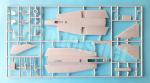
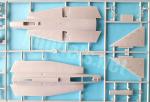
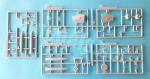
To build this Draken we have five sprues of parts, one of them containing the clear parts, the decals, a sheet of masks and the instructions. The changes with the original kits comprise the decals, the masks and partly the instructions.
Pieces have excellent moulding with a high definition in detail for the most part. Panel lines, riveted lines on some surfaces and most pieces have nothing to envy those of current kits, and this means something in a kit with more than 30 years old. As usual with many Hasegawa 1/72 aircraft kits, the weakest area is the cockpit.
As on other occasions, Hobby 2000 has included a practical set of masks to paint the three largest wheels as well as the clear canopy with ease.
The release allows to choose between an Austrian SAAB J 35ÖE, which corresponds to a Swedish 35D with the improved cockpit of a 35F, and a 35FS, which was the Swedish model J 35F1 used as a fighter in Finland.
Cockpit
It consists of a tub moulded with the side consoles and rear bulkhead, the instrument panel, the control column, the seat and the HUD display in a clear piece. All the instruments are represented in decals and the pedals are moulded on the floor. The seat is nice but it needs some improvements in detail.
The panel has a funnel-shaped crosspiece that must be some kind of radar display. This device is rarely seen in photos of the Draken cockpit, so I think this piece, which is not worth much anyway, can be left out and the hole in the center of the panel filled and covered with the decal.
The canopy is divided into two well-moulded pieces, very transparent and not too thin, but still usable in the model.
Fuselage
The Draken seems well suited to the parts breakdown Hasegawa chose for the fuselage, which is split up horizontally and not vertically as usual. I have already mentioned the excellent surface panels, now it is only necessary to add the good reproduction of the triangular cooling intakes on the top fuselage piece and the closed air brakes on both sides. Before gluing the halves together, you need to drill holes to install the optional auxiliary tanks, a fin and the rear landing gear.
The front cone comes separate with the probe apart. Some weight is necessary inside the cone to avoid the model to be a tail-sitter for ever. Other separate parts are the dorsal spine behind the cockpit, complemented on the sides by the TACAN equipment in two similar pieces, the blade antenna and the cannon port on the left side. The ventral area has a fin and the ram-air turbine deployed, with the compartment covers and the fan separated.
The infrared seeker is included in the kit and is shown attached under the nose in step 10 of assembly but its use is not indicated. A quick check of images on the Internet shows that it was not fitted on the Austrian variant, while it seems to have only been used occasionally in the Finnish Draken. At least most images do not show it installed.
The air intakes lips come in two very nice thin pieces, while the rear fuselage is divided into halves containing the brake parachute housing and the side cooling intakes, which are moulded open. The engine outlet is reproduced on a piece inside the nozzle and the exhaust rim is also provided apart.
Wings and tail
They are moulded in thin pieces with the usual tabs for inserting them into the fuselage. The control surfaces are nicely engraved showing the hinges defined on both sides of the wings.
The wings are detailed with the underwing fences, while the tail fin has a separate tip. The shape of the piece seems to correspond to that of the J 35FS than to the 35ÖE, which has navigation lights on top and at the rear that the kit does not have. Be that as it may, in both cases the Pitot tube is missing.
The only load is two optional ventral tanks with fins and separate pylons. The tanks are not interchangeable. It is a pity the kit does not have any armament, not even some handy Sidewinders to give it more push.
Landing gear
The front well lacks internal detail. The wheel is moulded with the leg and the piece shows nice detail on the shock system and steering mechanism with folding arm separated. The covers are thin and have small pin marks on the inner sides.
The main undercarriage on each side consists of two covers, also showing flat surfaces and shallow marks on the inside, the oleo leg, which includes the landing light without clear lense, and the wheel. The tyres are correctly engraved and the hub detailed. The inner hub shows the brake system without much definition. Unfortunately, the tyres also have two small positive marks on their inner sides.
The tail undercarriage contains a fairing in front of the well, separate covers, the strut attached to the folding arm plus two very small wheels. Detail is well done, especially the front cover attached to the wheel support and the retraction mechanism.
Decals
The sheet is printed with the usual quality Cartograf is famous for. It contains Austrian and Finnish roundels, the instrument panel and consoles, unit badges, aircraft numbers, registrations and stencils. The items have a fine, matte appearance, with good saturation and register. The carrier film is barely noticeable outside the decal.
Instructions
The folded 6-page booklet printed in colour on glossy paper contains a numbered parts diagram, a colour chart with paint equivalents from AK Interactive, Alclad2, AMMO, Hataka, Mr Color and Tamiya, 11 assembly sequences and profiles. Hobby 2000 has added a separate sheet printed in colour with profiles of the Finnish alternative. Assembly steps are comprehensible and clear.
The Austrian aircraft wear identical grey camouflage pattern and belong to the two Draken squadrons that the country fielded. The Finnish aircraft is painted in an unspectacular olive green and blue camouflage.
Conclusion
We have to thank Hobby 2000 for reissuing Hasegawa kits like this one, since the manufacturer does not release them with the frequency they deserve.
Nothing is perfect and this tooling has small drawbacks in the form of undesirable marks (nothing out of the ordinary, on the other hand), a minimalist Hasegawa-style cockpit and the lack of underwing armament that would have given it still a better look.
However, the advantages stand out far above all this. The kit does not seem difficult to build and is an excellent base to improve detail with the suitable aftermarkets inside the cockpit and resin replacements for the armament and, posibly, the wheels.
Paint finishes are varied, but I imagine there are enough alternative decals out there to represent Drakens from other countries if you does not get enough distaste for not using the outstanding Cartograf decals.◊
Publicado – Published: 10 / 2024
©www.jmodels.net
 jmodels.net
Debe estar conectado para enviar un comentario.