

De un vistazo – Quick look
MATERIAL Y PIEZAS
MEDIA & PARTS:
- Plástico inyectado (225 piezas), peana (1 pieza).
- Injected plastic (225 parts), stand (1 part).
CALCAS – DECALS:
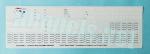
- Banderas, marcas de contenedores, y nombres de 6 buques de la naviera Hapag-Lloyd. Aspecto fino y mate. Impresas con nitidez y sin excesivo soporte.
- Flags, container markings and names for 6 Hapag-Lloyd ships. Thin and matte finish. Sharply printed without too much carrier film.
OPCIONES – OPTIONS:
- CMS Colombo Express. Hapag-Lloyd Container Line.
INSTRUCCIONES – INSTRUCTIONS:
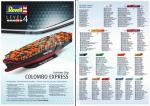
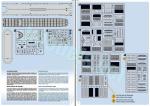
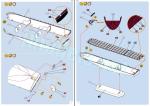
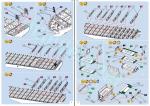
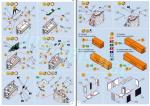
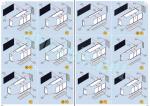
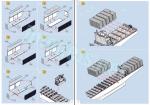
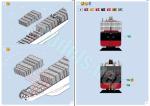
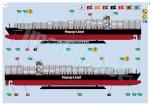
- Folleto de 20 páginas con formato A4 impreso en color. Contiene una lista de colores con equivalencias de pinturas de Revell, un plano numerado de piezas, 44 secuencias de montaje y dos páginas de perfiles.
- 20-page A4 brochure printed in color containing a list of colors with Revell enamel paint matches, a numbered parts plan, 44 assembly steps and two pages of profiles.
LO MEJOR – THE BEST:
- Tema inusual. Molde limpio y bien detallado para la escala. Montaje sencillo.
- Unusual topic. Clean tool and nicely detailed kit for the scale. Easy build.
LO PEOR – THE WORST:
- El montaje y pintura de los contenedores puede ser tedioso.
- Assembling and painting the containers may be tedious.
VALORACIÓN – CONCLUSION:
- Notable maqueta de un tema inusual. Más sencilla de montar de lo que aparenta su tamaño y bien detallada para esta escala. Recomendable a los aficionados con alguna experiencia previa.
- Outstanding kit of an unusual topic. It should be easier to build than it looks due to the size and has a very nice detail for this scale. Recommendable to ship modellers with some experience.

La maqueta
Siempre que veo un carguero hecho maqueta me digo que aún quedan muchos y de tipos interesantes por pasar de la realidad a la escala. Me refiero a buques no militares y sin velas, claro, porque de estos hay para hacer durante una vida y parte de otra.
Cuando Revell acierta, lo hace de pleno. Realmente fue una sorpresa la primera aparición del Colombo Express allá por 2009, pero creo que más sensación causó la factura del molde. La escala no fue sorpresiva, ya que este portacontenedores mide más de 300 m de eslora y, a mayor tamaño, sobrepasaría con creces el ya largo medio metro que tiene esta maqueta. No hay vitrina del común para tanto.
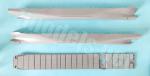
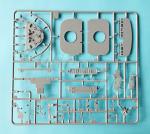
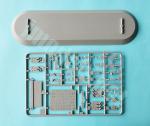
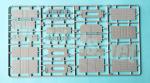
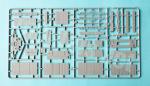
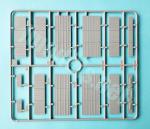
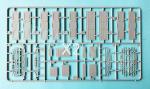
Esta caja es la primera reedición de la maqueta, que Revell lanzó en 2017. Contiene 11 bastidores, las mitades del casco y la cubierta separadas, una hoja de calcas apaisada y el folleto de instrucciones. Las piezas tienen un buen moldeado sin marcas evidentes ni rebabas. Obviamente, gran parte de las piezas de la maqueta pertenecen a los contenedores, cuyo número puede parecer excesivo si no se considera que estos barcos suelen navegar a plena carga, siendo uno de los motivos el rentabilizar costes de transporte.
El despiece no es novedoso. El casco está separado en mitades, la cubierta viene completa, salvo el castillo de proa, y el puente constituye un ensamblaje secundario por sí mismo. El modelista debe contar con que la construcción y pintura de los contenedores se llevará una gran parte del tiempo empleado en terminar el modelo. Con todo, la maqueta no me parece insuperable para los que ya tengan alguna muesca en el cinturón.
Excuso al lector los datos y hechos sobre este buque que puede leer a sus anchas, si lo desea, en el botón de la parte superior de esta revisión.
Casco
Las mitades muestran el bulbo de proa, las tomas de las hélices de maniobra, muy bien definidas a ambos lados del casco, los escobenes y la aleta de popa. Desgraciadamente, las gateras de las amuras vienen marcadas por fuera pero no abiertas por dentro. Las anclas son excelentes y muestran una nitidez notable para la escala.
El lado de popa viene separado, mientras que el interior del casco está reforzado por dos mamparos transversales alineados mediante finos canales moldeados en el interior.
El timón es de una pieza y se puede mover gracias a un brazo separado en mitades que sujeta el eje entre ellas. La hélice destaca por su limpieza en las palas y sus formas bien conseguidas. El razonable grosor de las palas no desentona con el tamaño de la maqueta.
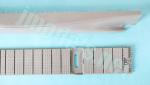
La peana consiste en una base sin soportes. El casco presenta pequeñas muescas para situarlo sobre ella con facilidad. Para rotular la peana, aunque sólo por un lado, hay hasta seis nombres de buques de la compañía Hapag-Lloyd en la hoja de calcas.
Cubierta
La cubierta es de una pieza salvo el castillo de proa separado. Este último cuenta con un bastidor de apilado en la parte trasera, que coincide con el resto de la cubierta. Sobre la pieza del castillo vemos diversos elementos en relieve, como los cabrestantes de las anclas, cuyas cadenas están muy bien definidas, tornos, bitas y bolardos. El mástil de proa es una pieza aparte.
El resto de la cubierta está moldeado con las cubiertas de los compartimentos de carga y ranuras para insertar los bastidores apilables verticales. Estas piezas poseen diferente altura según la posición que ocupan; los más bajos van pegados por detrás del puente y los más altos por delante.
La zona trasera de la cubierta también tiene varias bitas y tornos moldeados in situ así como el bote salvavidas y el sistema de caída libre, compuesto por una estructura separada en dos mitades con una pequeña rampa central para deslizar la embarcación.
Puente
El puente comprende once capítulos del montaje de la maqueta. Revell ha diseñado el montaje para que resulte sencillo y eficaz al mismo tiempo. Las diversas plantas del puente dispone de ranuras para encajar cada uno de sus respectivos lados, detallados con elementos muy pequeños, escaleras, pescantes, barcas de salvamento y todas las diminutas ventanas huecas. Cuando se llega a la cuarta planta de esta especie de edificio, se añade la cara anterior del puente, que también posee todas las ventanas horadadas.
En la parte superior, donde las superficies se hacen algo más pequeñas, hay varias piezas para rematarla y añadir las ventanas del puente de mando propiamente dicho, ya que el resto de la superestructura alberga el alojamiento de los tripulantes y otros servicios. La parte superior contiene las chimeneas y otras salidas en dos piezas, radares, antenas direccionales y una estructura un tanto extraña para lo que debería ser una torre coronada por un foco de señales.
Para esta escala, el detalle es excelente y sólo le faltan las barandillas en las diferentes alas de las plantas y escaleras.
Contenedores
No sería extraño que el modelista dedique más tiempo a montar, pintar y ponerle calcas a los contenedores que al resto de la maqueta, pero creo que este trabajo es el que más va a captar la atención al terminar el modelo y por eso el resultado de lo que se haga con ellos es importante.
La maqueta proporciona cuatro tipos de contenedores: uno de 20 pies, dos de 40 pies de capacidad diferente y otro de 45 pies. El detalle exterior, aunque sencillo, está bien representado en todos. El montaje no supone dificultad, ya que sólo se trata de ir pegando su lados y además las instrucciones ofrecen hasta siete colores distintos para pintarlos, lo que abre posibilidades al gusto “artístico” de cada cual. No faltan tampoco las 130 calcas de la naviera para cada uno de ellos.
Como cabe imaginar, la posición de estos contenedores dentro de un buque de este tipo no es caprichosa y está perfectamente estudiada para evitar accidentes, nivelando el peso y el volumen. Por este motivo creo que lo mejor es seguir las instrucciones al colocar la carga y, si se quieren hacer cambios en el número de contenedores, tomar esta disposición como punto de partida. Obviamente, también se puede presentar el modelo sin carga, pero entonces perderá mucho de su aliciente.
Calcas
La hoja de calcas apaisada contiene banderas, marcas para los contenedores, y los nombres de seis buques de la naviera Hapag-Lloyd. Su aspecto es fino y mate. Están impresas con nitidez y sin excesivo soporte.
Instrucciones
Vienen en un folleto de 20 páginas con formato A4 impreso en color. Contiene una lista de colores con equivalencias de pinturas de Revell, un plano numerado de piezas, 44 secuencias de montaje y dos páginas de perfiles. Tanto las secuencias del montaje como las indicaciones de color son muy claras.
Valoración
El modelista que sienta interés por este Colombo Express no debería dejarse intimidar por el tamaño porque el montaje no tiene la dificultad que aparenta. Ciertamente, también debe considerar que no va a despachar la maqueta en tres tardes aunque sólo sea por el número de contenedores por montar y pintar. Esta tarea puede resultar repetitiva, pero, a fin de cuentas, lo pide este buque y es clave en el acabado que queramos darle al modelo.
Sin duda Revell acertó de pleno al hacer esta notable maqueta de un tema tan inusual en el modelismo. Por eso cabe pedirle al menos que no dejase pasar tanto tiempo entre reediciones.◊


The kit
Whenever I see a freighter kit, I tell myself that there are still many interesting types yet to be portrayed to scale. I mean non-military ships, of course, because there are enough of these to build for a lifetime and a half.
When Revell hit the nail, it knocks your socks off. The first release of the Colombo Express back in 2009 was truly a surprise, but I think the standard of moulding caused more of a stir. The scale wasn’t surprising, as this container ship measures well over 900 ft in length, and at a larger size, it would far exceed the 20 in length of the 1/700 model. There’s no ordinary shelf for that much.
This box is the first reissue of the kit, which Revell launched in 2017. It contains 11 sprues, a separate two-piece hull and one-piece deck, a landscape decal sheet, and the instruction booklet. Parts are well moulded with no evident marks or flash. Obviously, many of the kit’s parts are used to build the containers. One may think there are too many of them included here and forget that these large ships usually sail fully loaded, one of the reasons being to maximize transport costs.
Parts breakup is nothing new. The hull is provided in halves, the deck is complete except for the forecastle, and the bridge is a sub-assembly in itself. The modeller should expect that the containers will take up most of the building and painting job. All in all, the kit doesn’t seem hard for those who already have a few notches under their bellies.
I provide information about the ship data and career on the page you can reach clicking the button at the top of this review.
Hull
The halves show the bulbous bow, the well-defined bow thrusters and the keel. Unfortunately, the mooring pipes are engraved on the outside but not open on the inside. The anchors are excellent and show remarkable sharpness for the scale.
The stern bulkhead is separated, while the hull is strengthen by two transverse bulkheads aligned with thin channels moulded inside the halves.
The rudder is a single piece and can be turned thanks to a base moulded in halves that holds the shaft between them. The propeller have remarkable clean blades with reasonable thickness that fits in with the kit size.
The stand is simple with the hull provided with small notches for easy positioning. To label the stand, but only on one side, there are up to six names of Hapag-Lloyd ships on the decal sheet.
Deck
The deck is a single piece except for the separate forecastle. This has a stacking frame at the rear that matches the rest of the deck. The forecastle is moulded with some raised detail, such as the anchor winches with surprisingly defined chains, winches, bitts, and bollards. The foremast is a separate piece.
The rest of the deck is moulded with the hatch covers and slots for inserting the vertical stacking frames. These pieces have different height depending on their position; the lowest are attached behind the bridge and the highest on the foredeck.
The stern section also has several bitts and winches in place, as well as the lifeboat and the free-fall system, consisting of a structure in halves with a small central ramp for sliding the boat.
Bridge
The bridge comprises eleven chapters of the assembly. Revell designed assembly to be both simple and efficient. The various bridge floors have slots to fit each of the sides. These show details in the form of stairs, davits, lifeboats, and all the tiny hollow windows. When the fourth floor of this kind of building is finished, you add the bridge front, which is also provided with small hollow windows in the piece.
At the top, where the surfaces become smaller, there are several pieces to finish it off and add the bridge windows plus the stacks in two pieces, radars, directional antennas, and a somewhat unusual structure for what should be a signal spotlight.
Considering the scale, detail is excellent and only the railings on the different floors and stairs are missing.
Containers
It wouldn’t be surprising if the modeller spent more time assembling, painting, and decaling the containers than the rest of the kit, but I think this job is what will attract the most attention in the finished model. That’s why the result of what we do with them is so important.
The kit provides four types of containers: 20’ containers, two types of 40’ containers with different capacities, and 45’ containers. External detail, though simple, is well represented in all of them. Assembly is straightforward, as it consists of attaching the sides. Instructions offer up to seven different colours for painting them and that’s a wide choice for the modeller’s «artistic» taste. There are also 130 decals with the Hapag-Lloyd name for each container.
As it can be imagined, the position of these containers within a ship of this type is not arbitrary but perfectly designed to avoid accidents, balancing weight and volume. For this reason, I think it’s best to follow the instructions when attaching the containers, and if you want to make changes to the number of elements in a row or tier, use this layout as a starting point. Obviously, the kit can also be built without cargo, but it will lose much of its appeal.
Decals
The landscape decal sheet contains flags, container markings, and the names of six Hapag-Lloyd container ships. They look thin and matte and are printed sharply without too much carrier.
Instructions
They come in a 20-page A4 booklet printed in color. It contains a color list with matches in Revell enamels, a numbered parts plan, 44 assembly chapters, and two pages of profiles. Both assembly sequences and color directions are very clear.
Conclusion
Those interested in this Colombo Express shouldn’t be intimidated by its size, as assembly shouldn’t be as difficult as it looks. They should also consider that the kit won’t be dispatched in three afternoons, if only because of the number of containers to be assembled and painted. This job can be dull, but, ultimately, it is important to the finish we want to give it.
Revell certainly got a success by releasing this outstanding kit of such an unusual subject in modelling. That’s why we can at least ask them not to let so much time pass between reissues.◊
Publicado – Published: 6 / 2025
©www.jmodels.net
 jmodels.net
Debe estar conectado para enviar un comentario.