
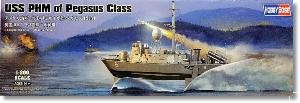
De un vistazo – Quick look
MATERIAL Y PIEZAS
MEDIA & PARTS:
- Plástico inyectado (209 piezas), fotograbado (62 piezas), peana (2 piezas).
- Injected plastic (208 parts), photo-etched (62 parts), stand (2 parts).
CALCAS – DECALS:
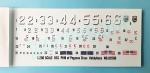
- Números de gallardete, banderas y estarcidos para el casco y superestructura. Buen registro y saturación, finas y sin exceso de soporte.
- Pennant numbers, flags and stencils for the hull and superstructure. In register with apparently good saturation and no excess of carrier film.
OPCIONES – OPTIONS:
- Pegasus Class. Hercules (PHM-2)
- Pegasus Class. Taurus (PHM-3)
- Pegasus Class. Aquila (PHM-4)
- Pegasus Class. Aries (PHM-5)
- Pegasus Class. Gemini (PHM-6)
INSTRUCCIONES – INSTRUCTIONS:
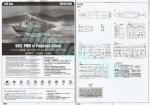
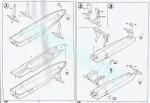
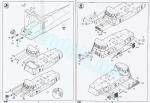
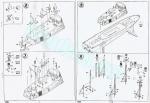
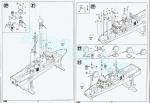
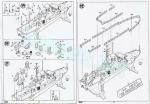
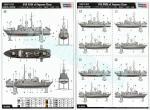
- Folleto A4 de 12 páginas impreso en blanco y negro. Contiene un plano numerado de piezas y 18 capítulos de construcción. Una hoja separada de igual tamaño impresa en color muestra perfiles y una tabla de colores con equivalencias de pinturas de varios fabricantes. Muy claras.
- 12-page A4 booklet printed in black and white. It shows a numbered parts plan and 18 assembly sequences. A separate sheet of the same size printed in color provides profiles and a table of colors with matches in several paint brands. Very clear.
LO MEJOR – THE BEST:
- Bien detallada. Aparente facilidad de montaje.
- Nicely detailed. Apparent ease of assembly.
LO PEOR – THE WORST:
- Ventanas del puente sin transparentes. No contiene base.
- No clear parts for bridge windows. A stand is not included.
VALORACIÓN – CONCLUSION:
- Inusual maqueta de un tipo de embarcación olvidado. Bien detallada y fácil de montar para quienes tengan mano con los fotograbados.
- Unusual kit of a type of ship which has been neglected in the last times. Nicely detailed and easy to build for any modeller used to PE parts.

La maqueta
Las hidroalas (también denominados aliscafos o hidroplanos) no son un tema modelístico nuevo. Ha habido maquetas de estas embarcaciones por lo menos desde los años 50 del siglo pasado y en particular los años 60 fueron especialmente prolíficos en maquetas civiles y militares, sobre todo para el mercado japonés. El interés de las marcas ha ido decreciendo con el tiempo, aunque Pit-Road tuvo la curiosa idea de incluir una hidroala de la Clase Pegasus en la maqueta de la fragata Oliver Hazard Perry a escala 1/700 en los años 90. Este molde ha sido posteriormente copiado por Dragón y Revell. Ya en este siglo, hay solo dos ediciones de resina de la Clase Pegasus de distinto molde a escala 1/350 de White Ensign Models y Orange Hobby respectivamente.
HobbyBoss (HB) sorprendió a muchos hace unos años cuando retomó el tema con dos maquetas de la Clase Pegasus a una escala mayor. La primera maqueta está dedicada a la Pegasus (PHM-1), mientras que la segunda permite montar cualquiera de las otras cinco embarcaciones de la clase. En cierto modo, es lógico que HB lo hiciera así porque la Pegasus era ligeramente distinta al resto debido a problemas de desarrollo y financiación del proyecto original que retrasaron en varios años la botadura del resto de la clase.
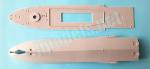
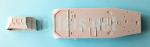
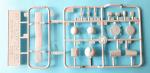
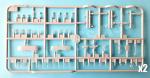
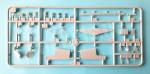
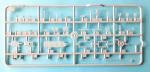
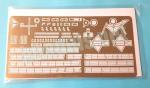
La caja nos ofrece cinco bastidores, el casco, la cubierta y parte de la superestructura separados, una plancha de fotograbados, una pequeña hoja de calcas y las instrucciones. El molde viene limpio de imperfecciones si no contamos los cilindros de eyector en algunas piezas. En general, el detalle es bastante bueno y HB ha intentado no ahorrarse casi nada, por ello hay bastantes piezas de tamaño muy pequeño pese a que la escala es de las mayores en las maquetas de barcos de plástico.
Las instrucciones sugieren tres alternativas de montaje: dos radares distintos en el mástil, disponer las alas extendidas o plegadas y añadir más o menos tubos a los lanzamisiles. Esta última opción puede resultar un poco confusa y a ella me referiré en su lugar.
Casco
Viene en una sola pieza. La parte trasera lleva dos propulsores idénticos detallados con fotograbados y la salida del propulsor principal que se empleaba cuando la embarcación se sostenía sobre las alas. También hay dos pequeños timones fijos bajo el casco.
La proa muestra el hueco del ala anterior y una pieza que puede colocarse una vez hayamos decidido la posición del ala. Esta se compone de dos piezas más un eje colocado dentro del casco que permite sujetarla en el interior del casco. El ala es fina y tiene detalle en el borde de salida. En ambos lados de la zona de proa aparecen las salidas de los propulsores delanteros.
El ala trasera la forman cinco piezas, dos de ellas para los soportes. Puede colocarse plegada hacia popa o alzada mediante dos brazos articulados situados en los dos lados del casco.
Cubierta
La cubierta es una única pieza fina que cuenta con la base del cañón de proa como detalle más significativo. La zona de proa tiene piezas separadas para reproducir diversas escotillas, el ancla, carretes de cable detallados con fotograbados, un mástil, asas y bitas.
La torre del cañón tiene la base aparte y sobre ella hay dos soportes para alzarlo, con una pieza de fotograbado pegada en el interior de la torre que cubre la tronera. El cañón es de una pieza y tiene la boca horadada. La torre va pegada a la base y no puede rotar.
La cubierta de popa está detallada con un mástil, abrazaderas, escotillas, bitas, cajas de estiba, respiraderos y una única bobina de cable. También aparecen las tomas y salidas de los motores en un conjunto formado por siete piezas además de la chimenea, que cuenta con una base separada y está detallada por fuera.
Los lanzamisiles poseen piezas de un solo tubo o dobles más un soporte de fotograbado. Las instrucciones muestran un lanzador de cuatro tubos, dos pares superpuestos, a babor y uno triple con los tubos en una fila a estribor. Las fotos de las diversas hidroalas de esta clase demuestran que la configuración más normal era la de cuatro tubos en ambas bandas, pero también hay fotos donde se aprecian cuatro a un lado y solo uno, dos o tres, con un tubo superpuesto en este último caso, al otro. La única disposición claramente errónea es la de tres tubos paralelos que se ofrece como opción en las instrucciones.
Las barandillas tanto de la cubierta como de la superestructura son de fotograbado y están separadas en ocho tramos.
Superestructura
La superestructura es de una pieza moldeada con las escotillas. Los lados están detallados con equipo diverso además de las barandillas, como chalecos, salvavidas o rejillas de ventilación de la turbina. El lado delantero muestra más chalecos y un megáfono, mientras que en la parte trasera hay una pequeña escalerilla de fotograbado, una escotilla de acceso al compartimento del motor y un tubo de salida.
La cubierta de la superestructura lleva el puente de una pieza en la parte anterior y tras él diversas piezas que representan, focos, un megáfono, dos lanzadores de señuelos multitubo, el acondicionador de aire, una balsa salvavidas, varios compartimentos de estiba así como diversos respiraderos.
La parte central de la cubierta la ocupan una antena HF alargada, el radomo del radar de control de tiro con una pequeña antena IFF sobre él. El radomo está sostenido por un soporte de fotograbado. El mástil principal lleva unas escalerillas, varios soportes, una antena de comunicación por satélite y una antena IFF con dos piezas alternativas.
Desgraciadamente, los cristales del puente no son piezas transparentes, sino que están reproducidos en la misma pieza. Las ventanas llevan los limpiaparabrisas de fotograbado y los motores separados. La cara posterior del puente cuenta con una escalera de fotograbado para acceder a la cubierta superior donde aparece la sirena y una antena VHF.
HB no proporciona una peana como tal, sino solamente una placa identificativa. De este modo se entiende que la maqueta debería posarse sobre las alas o necesariamente sobre una base creada al efecto.
Calcas
La hoja contiene números de gallardete, banderas, además de algunos estarcidos para el casco y superestructura. Los motivos tienen buen registro y saturación, son finos y carecen de exceso de soporte.
Instrucciones
Vienen en un folleto de formato A4 de doce páginas impreso en blanco y negro. Contiene un plano numerado de piezas y 18 secuencias de construcción. Una hoja separada de igual tamaño impresa en color ofrece perfiles y una tabla de colores con equivalencias de pinturas de Mr Hobby, Vallejo, Tamiya, Humbrol y Model Master. Las secuencias de montaje son claras y precisas.
Los acabados de pintura son idénticos y únicamente se diferencian en su número de gallardete.
Valoración
Esta es una maqueta bastante singular, no tanto por ser una patrullera sino porque se trata de una hidroala, un tipo de embarcación bastante inusual en el modelismo naval actual y que HB ha rescatado con gran acierto, en mi opinión.
Quienes deseen salirse de lo trillado, están de enhorabuena. La maqueta está bien detallada y me parece apta para modelistas de cualquier nivel, salvo principiantes.◊

The kit
Hydrofoils are not a brand new modelling topic. There have been kits of these boats since at least the 1950s and in particular the 1960s were especially prolific in civil and military releases, especially for the Japanese market. The interest of the brands in these boats has been decreasing over time, although Pit-Road had the peculiar idea of including a Pegasus Class hydrofoil in their 1/700 Oliver Hazard Perry kit back in the 1990s. This kit has been subsequently reissued by Dragon and Revell. In this century, there are only two different 1/350 resin tools of the Pegasus Class by White Ensign Models and Orange Hobby respectively.
HobbyBoss (HB) surprised many a few years ago when they took up the subject again with two Pegasus Class boxes at a larger scale. The first release is dedicated to the Pegasus (PHM-1), while the second allows you to build any of the other five hydrofoils in the class. In a way, it is logical that HB did this because the Pegasus was slightly different from the rest due to development and financing problems of the project, which meant that the first boat was launched several years before the rest.
The box offers five sprues, two of them identical, a one-piece hull, deck and superstructure, a photo-etched fret, a small decal sheet and the instructions. Parts come free from flaws except for the ejector nodules on some of them. In general, detail is quite good and HB certainly made an effort in this sense as there are quite a few very small parts despite the fact that the scale is one of the largest in plastic ship kits.
The instructions suggest three assembly alternatives: two different radars on the mast, posing the hydrofoils extended or folded and adding more or less tubes to the missile launchers. This last option can be a bit confusing and I will try to clarify that later.
Hull
It comes in one piece. The rear side has two identical hullborne propulsion nozzles detailed with photo-etched parts and the nozzle of the main hydrojet used for foilboard operation. There are also two small fixed rudders under the hull.
The bow shows a gap for the forward foil and a piece that is placed once you have decided the foil position. The foil is made up of two pieces plus a shaft slid into the hull that allows to attached it inside the hull. The forward foil part is thin and has some raised detail on the trailing edge. Both sides of the bow show water pumps nozzles.The aft foil is made up of five pieces, two of them for the supports. It can be attached in the hullboard or foilboard propulsion by means of two folding arms on both hull sides.
Deck
The deck is a single thin piece that has the base of the bow gun. The foredeck has separate parts to reproduce several hatches, the anchor, cable reels, the jack staff, handles and bitts.
The gun turret has a separate base and two parts for the cradle inside it, with a photo-etched piece glued to the inside of the turret covering the gun port. The gun is one piece and has a hollowed nozzle. The turret is glued to the base and cannot rotate.
The aft deck is detailed with a mast, clamps, hatches, bitts, stowage boxes, vents and a single cable reel. Engine intakes and outlets are also shown in a seven-piece set plus the three-piece funnel, which has a separate base and is detailed on the outside.
The Harpoon missile launchers are provided as single or double tube parts plus a photo-etched rack. The instructions show a four-tube launcher, with two pairs superimposed, on the port side and a triple mount with the tubes in a row on the starboard side. Photos of the these hydrofoils show that the most common configuration was four tubes on both sides, but there are also photos showing four on one side and only one, two or three, with one tube superimposed in the latter case, on the other. The only clearly erroneous arrangement is three tubes side by side that is shown in the instructions.
The railings on both the deck and the superstructure are photo-etched and separated into eight pieces.
Superstructure
The superstructure is a single piece moulded with hatches. The sides are detailed with various equipment in addition to the railings, such as life jackets and buoys, rafts or turbine vents. The forward side shows more life jackets and a loudspeaker, while the rear contains a small photo-etched ladder, an access hatch to the engine compartment and an exhaust pipe.
The superstructure deck has a single-piece bridge and several parts representing spotlights, a loudspeaker, two multi-tube decoy launchers, the air conditioner, a life raft, various stowage compartments as well as a few vents.
The middle superstructure contains a long HF antenna and the radome of the fire control radar with a small IFF antenna on it. The radome is supported by a photo-etched rack. The main mast has a length of ladders, struts, a satcom antenna and an IFF antenna with two alternative parts.
Unfortunately, the bridge windows are not clear parts but simply moulded on the bridge. The windows have photo-etched wipers and the motors separated. The rear side of the bridge has a photo-etched ladder to access the top where there is a siren and a VHF antenna.
HB do not provide a display stand but only a nameplate, so the kit is supposed to stand on the foils if you do not wish to make your own stand.
Decals
The sheet contains pennant numbers, flags, plus some stencils for the hull and superstructure. Decals are thin and in register with enough color saturation. They lack excess support.
Instructions
These come in a 12-page A4 booklet printed in black and white. It contains a numbered parts diagram and 18 construction sequences. A separate sheet of the same size printed in colour shows profiles and a colour chart with paint equivalents from Mr Hobby, Vallejo, Tamiya, Humbrol and Model Master. Assembly sequences are clear and precise. Paint finishes are identical with only different pennant numbers.
Conclusion
This is a rather unique kit, not so much because it is a patrol boat but because it is a hydrofoil, a rather unusual type of vessel in current naval modelling and which HB have rescued with great success, in my opinion.
Those who wish to get off the beaten track are in luck. The kit is well detailed and seems suitable for modelers of any level, except beginners.◊
Publicado – Published: 9 / 2024
©www.jmodels.net
 jmodels.net
Debe estar conectado para enviar un comentario.