
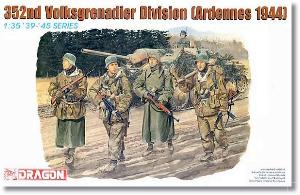
De un vistazo – Quick look
MATERIAL Y PIEZAS
MEDIA & PARTS:
- Plástico inyectado (83 piezas).
- Injected plastic (83 parts).
CONTENIDO – CONTENT:
- Figura 1: Soldado con abrigo y parca sobrepuesta, casco sin camuflaje y fusil (18 piezas).
- Figura 2: Hauptfeldwebel con parca, pantalones camuflados y arma automática (16 piezas).
- Figura 3: Soldado con abrigo, casco camuflado y fusil (16 piezas).
- Figura 4: Soldado con parca, pantalones camuflados, arma automática y Panzerfaust (16 piezas).
- Figure 1: Soldier wearing overcoat, camouflage smock, plain helmet and rifle (18 parts).
- Figure 2: Hauptfeldwebel wearing camuflage smock and trousers with automatic weapon (16 parts).
- Figure 3: Soldier wearing overcoat, camouflage cover on his helmet and rifle (16 parts).
- Figure 4: Soldier wearing camouflage smock and trousers, plain helmet, automatic weapon and Panzerfaust (16 piezas).
INSTRUCCIONES – INSTRUCTIONS:
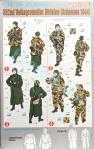
- Impresas en la cara trasera de la caja. Muestra dibujos de las figuras montadas con la numeración de las piezas y códigos de pinturas de Gunze Sangyo y Model Master. Los patrones de las prendas camufladas aparecen con muestras en color a mayor tamaño.
- Printed on the back side of the box. This shows pictures of the assembled figures with parts numbers and codes in Gunze Sangyo and Model Master paints. The camouflage pattern is shown in color chips.
LO MEJOR – THE BEST:
- Buen modelado. Incluye armamento y equipo complementario.
- Good standard of modeling. Extra weapons and equipment included.
LO PEOR – THE WORST:
- Marcas en el lado interno de algunas prendas.
- Pin marks on the interior side of some clothes.
VALORACIÓN – CONCLUSION:
- Un grupo de figuras ideal para formar parte de cualquier escena invernal de finales de la Segunda Guerra Mundial. Están bien modeladas, son fáciles de montar, aunque la pintura requiere cierta habilidad. El armamento y equipo extra permite darles aún más variedad de la que tienen de caja.
- A group of figures ideal for any winter scene from the end of World War II. They’re well modeled and easy to assemble, although painting requires some skill. The extra weapons and equipment allow for even more variety than what’s included in the box.

Contenido de la caja
Para enmarcar históricamente estas figuras, conviene repasar con brevedad algunos datos sobre la unidad que representan.
La 352ª División de Infantería del Ejército alemán estuvo desplegada durante la Guerra Mundial en el Frente Occidental, donde defendió Omaha Beach el Día D. Las grandes perdidas sufridas obligó a reorganizarla, esta vez con el nombre de 352ª División Volksgrenadier, para tomar parte en la ofensiva de las Ardenas integrada en el 85º Cuerpo de Infantería del 7º Ejército alemán. Tras la derrota alemana, intervino posteriormente en combates en Tréveris y el río Mosela. Muy debilitada ya en Marzo de 1945, combatió en Worms. Al final de la contienda, la unidad, reorganizada como Kampfgruppe, se rindió en Darmstadt.
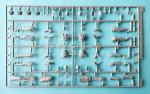
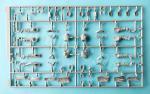
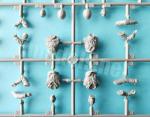
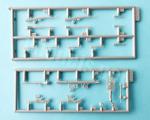
Esta caja de soldados alemanes de Dragón se viene reeditando sin cambios desde finales de los años 90. Contiene un bastidor con las piezas para montar cuatro figuras y su equipo, más dos bastidores pequeños con diferente armamento que Dragón ha incluido en otras cajas de figuras alemanas.
El bastidor principal, que contiene las figuras, incluye también equipo personal como granadas de mano, contenedores de comida, bolsas, cartucheras, contenedores de máscaras de gas, etc. Uno de los bastidores de armamento integra bayonetas, un Faustpatrone 30, un Panzerfaust 60, dos fusiles que muy probablemente sean el Gewehr 43 (G43), dos granadas de mano Stielhandgranate 43 y una Stielhandgranate 24. El segundo bastidor muestra un Panzerfaust 60 en posición de disparo con la mira levantada, dos rifles de asalto Sturmgewehr 44 (también conocidos como StG 44 o MP 44) y un Raketenpanzerbüchse 54 (más conocido por su apodo de Panzerschreck) en cinco piezas y un proyectil de 88 mm RPzB. Gr. 4312.
Las piezas están bien moldeadas, como es esperable en el fabricante. Pocas de ellas tienen cilindros de salida del eyector y muy leves líneas de molde en los lugares habituales, tales como las piernas y botas, los brazos y los costados del torso. Creo que serán sencillas de limpiar porque son poco perceptibles. Los brazos y manos están bien modelados, aunque algunas de las mangas deben ser ahuecadas para darles más realismo. El armamento complementario presenta una definición tan buena que se pueden identificar con bastante facilidad.
Obviamente, las figuras están diseñadas para aparecer en grupo y a juzgar por sus poses parece tratarse de una patrulla de reconocimiento, ya que algunas de ellas dirigen las miradas hacia los lados en actitud de observación atenta y sus pasos parecen cautelosos.
Describiré las figuras en el orden en que las numera la parte posterior de la caja, cuya imagen he incluido en la galería fotográfica.
Figuras
Todas ellas están despiezadas de manera similar en piernas, brazos, tronco, cabeza y cascos por separado. Los cascos presentan textura diferente en las superficies dependiendo de si lucen la cubierta con camuflaje o no. Los torsos que así lo requieren están moldeados con el hueco para colocar las granadas de mano sujetas por el cinturón, aunque sin duda habrá que trabajar la pieza para lograr ajustarlas con realismo.
La figura 1 consta de 18 piezas en total. Lleva un abrigo largo y una parca reversible con capucha camuflada sobrepuesta. El casco no tiene cubierta camuflada. La parte inferior del abrigo está separada en cuatro piezas que muestran marcas de eyector positivas en los lados internos. Será necesario eliminarlas para que la prenda ajuste bien con las piernas. El detalle en las arrugas de las prendas, botas y equipo es bastante bueno y nítido. El equipo personal comprende un cinturón con cartuchera, cantimplora, contenedor de la máscara antigás y bolsa para el pan. Los rasgos de la cara, que muestra una expresión seria, están correctamente perfilados. La pose es natural y el soldado sujeta un fusil G43 terciado hacia arriba.
La figura 2 comprende 16 piezas en total y se trata de un Hauptfeldwebel (equivalente a Sargento Primero en algunos ejércitos) a juzgar por la insignia bordada en su brazo derecho, que no es nada reconocible en la pieza de plástico que la simula. Luce una parca reversible con capucha, camuflada igual que los pantalones. El casco no lleva cubierta camuflada, sin embargo. La cara tiene los rasgos bien marcados y mira hacia un lado. El detalle del uniforme destaca especialmente en las costuras, correajes y cuello de la parca. El equipo está formado por un rifle de asalto StG 44 con sus cartucheras, una granada de mano al cinto y prismáticos colgados al cuello, cantimplora, bolsa para el pan y pala.
El soldado 3 luce un abrigo con tres piezas separadas en los faldones de la parte inferior y marcas positivas en los lados internos por limpiar para mejorar el encaje. Además lleva un casco con cubierta camuflada y fusil terciado hacia abajo con un total de 16 piezas. La cara presenta los rasgos bien moldeados. El equipo personal incluye el cinturón con cartucheras y granada de mano, cantimplora, bolsa de pan y contenedor de la máscara antigás.
Finalmente, la figura 4 tiene 16 piezas y se trata de un soldado con parca y pantalones camuflados y casco sin cubierta. Está armado con un StG 44 y un Panzerfaust 60 sobre el hombro izquierdo. La cara muestra, igual que las demás, rasgos bien definidos pero sin expresividad, además de un pasamontañas en el cuello. El equipo lo integran cartucheras para el rifle StG 44, granadas de mano, bolsa, pala y cantimplora.
Instrucciones
La guía de pintura impresa en la parte posterior de la caja lleva muestras a mayor tamaño del patrón de camuflaje de las parcas. Las pinturas se identifican mediante códigos y pertenecen a las gamas de Gunze Sangyo y Model Master.
Cada figura está representada en dos imágenes en escorzo, frontal y posterior, lo que facilita el montaje y la pintura.
Valoración
La caja permite montar y pintar con relativa facilidad, según la habilidad de cada cual, cuatro buenas figuras, modeladas con gran detalle y susceptibles en realidad de ser integradas en cualquier escena invernal del finales de la Guerra Mundial. El equipo y armamento adicional es un extra que no le va a venir nada mal a la caja de restos, especialmente si el modelista tiene preferencia por frecuentar este tipo de figuras.
Tanto las poses como la distribución del equipo y el tipo de prendas empleadas en cada figura nos da idea de que Dragón ha intentado darle variedad a su apariencia, dentro de una correcta historicidad.◊

Box content
In order to give these figures a historical perspective, it is worth briefly saying something about the unit they represent.
The German Army 352nd Infantry Division was deployed during World War II on the Western Front, where it defended Omaha Beach on D-Day. The heavy losses suffered forced it to be reorganized, this time under the name of 352nd Volksgrenadier Division, to fight in the Ardennes offensive as part of the 85th Infantry Corps of the German Seventh Army. After the German defeat, it subsequently fought in Trier and the Mosela River. Already greatly weakened by March 1945, it fought in Worms. At the end of the war, the unit, reorganized as a Kampfgruppe, finally surrendered in Darmstadt.
This box of German soldiers from Dragon have been reissued unchanged since the late 1990s. It contains a sprue with the pieces to assemble four figures and their field gear, plus two smaller sprues with different weapons that Dragon have included in other German figure boxings.
The main frame with the figure parts also includes personal equipment such as hand grenades, mess kits, pouches, gas mask canisters, etc. One of the weapon sprues comprises bayonets, a Faustpatrone 30, a Panzerfaust 60, two rifles that are most likely the Gewehr 43 (G43), two Stielhandgranate 43 hand grenades, and a Stielhandgranate 24. The second sprue shows a Panzerfaust 60 in firing position with the sight raised, two Sturmgewehr 44 assault rifles (also known as StG 44 or MP 44), a Raketenpanzerbüchse 54 (better known by its nickname Panzerschreck) in five pieces, and an 88 mm RPzB Gr. 4312 shell.
Parts are well molded, as expected from the manufacturer. Few of them have ejector pins and very faint seam lines in the usual places, such as the legs and boots, the arms, and the torso sides. I think cleanup will be easy because they are barely noticeable. The arms and hands are well modeled, although some of the cuffs need to be hollowed out for more realism. The additional weapons are so well defined that they can be identified fairly easily.
Obviously, the figures are designed to be used as a group, and judging by their poses, it appears to be a reconnaissance patrol, as some of them look sideways in a posture of attentive observation and their steps look cautious.
I will describe the figures in the order they are numbered on the back of the box. I have included a picture of it in the photo gallery as reference.
Figures
All of them are similarly provided in separate legs, arms, torso, head, and helmets. The helmets have different surface textures depending on whether they have a camouflage cover. Some torsos are molded with a recess for the hand grenades held with the belts, although the pieces will surely require some modifications to achieve a realistic fit.
Figure 1 consists of 18 pieces. He wears a long coat and a reversible camouflage smock with hood. The helmet has no camouflage cover. The lower part of the coat is separated into four pieces that show positive ejector marks on the inner sides. These will need to be removed to ensure a correct fit over the legs. Detail in the creases on the garments, boots, and equipment is quite good and sharp. Personal equipment includes a belt with ammo pouches, a water bottle, a gas mask canister, and a bread bag. The facial features, which have a serious expression, are correctly outlined. The pose is natural and the soldier holds a G43 rifle.
Figure 2 comprises 16 pieces in total and is a Hauptfeldwebel (equivalent to a First Sergeant in some armies), judging by the insignia embroidered on his right arm, which is not at all recognizable on the plastic piece. He wears camouflage smock and trousers. The helmet, however, has no camouflage cover. The face has well-defined features and looks to one side. Detail on the uniform is quite nice, especially in the seams, straps, and the smock collar. The equipment consists of a StG 44 assault rifle with its poaches, a hand grenade on his belt, binoculars hanging from his neck, a water bottle, a bread bag, and a shovel.
Soldier 3 wears an overcoat with three separate pieces in the lower flaps and positive marks on the inner sides that need to be cleaned to improve the fit. He also wears a helmet with a camouflage cover and a rifle, for a total of 16 pieces. The face shows well-defined features. The personal gear includes a belt with ammo pouches and a hand grenade, a water bottle, a bread bag, and a gas mask canister.
Finally, figure 4 has 16 pieces and is a soldier wearing a camouflage smock and trousers plus a plain helmet. He is armed with a StG 44 and a Panzerfaust 60 resting on his left shoulder. Like the others, the face shows well-defined but inexpressive features, and a balaclava around his neck. The field gear includes pouches for the StG 44 rifle, hand grenades, a bag, a shovel, and a water bottle.
Instructions
The painting guide printed on the back of the box includes samples of the camouflage pattern. Paints are identified by codes and belong to the Gunze Sangyo and Model Master ranges.
Each figure is represented in two foreshortened images, front and back, which facilitates assembly and painting.
Conclusion
The box allows for relatively easy assembly and painting, depending on individual skill, of four good figures, modeled with great detail. They can be integrated into any winter scene from the end of World War II. The extra gear and armament will be a welcome addition to the box of spares, especially if the modeler frequently makes use of WWII German figures with vehicles or in dioramas.
The poses, the assortment of field gear, and the type of clothing used on each figure clearly suggest that Dragon have attempted to vary their appearance, within a correct historical context.◊
Publicado – Published: 8 / 2025
©www.jmodels.net
 jmodels.net
Debe estar conectado para enviar un comentario.