
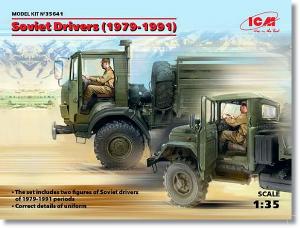
De un vistazo – Quick look
MATERIAL Y PIEZAS
MEDIA & PARTS:
- Plástico inyectado (13 piezas).
- Injected plastic (13 parts).
CONTENIDO – CONTENT:
- Soldado conductor con gorro de cuartel (6 piezas).
- Soldado conductor con gorra de orejeras y visera (7 piezas).
- Driver soldier with side cap (6 parts).
- Driver soldier with patrol cap (7 parts).
INSTRUCCIONES – INSTRUCTIONS:
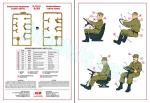
- Una hoja A4 de papel satinado impresa en color. Muestra los bastidores con las piezas numeradas, una tabla de colores con equivalencias de Revell y Tamiya y vistas de las figuras montadas.
- A4 sheet printed in color on satin paper. It shows a view of the sprues with parts numbers, a color chart with matches in Revell and Tamiya paints and pictures of the assembled figures.
LO MEJOR – THE BEST:
- Montaje y pintura sencillos. Detalle correcto en general.
- Easy assembly and painting. Overall correct detail.
LO PEOR – THE WORST:
- Líneas de molde muy evidentes en algunas piezas.
- Very evident seam lines on some pieces.
VALORACIÓN – CONCLUSION:
- De fácil montaje y pintura, son un buen complemento para dar vida a cualquier vehículo ligero ruso de los años 80.
- Easy to build and paint, these figures will be a nice addition to any Russian softskin vehicle of the 1980s.

Contenido de la caja
Esta caja de conductores del final de la era soviética apareció en 2018. También están incluidos en la maqueta ZiL-131 KshM with Soviet Drivers (referencia 35524) de ICM y no sería raro que la marca las haga reaparecer como extras en otras futuras maquetas de la compañía.
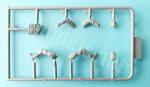
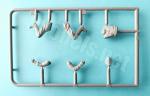
En la caja encontramos dos pequeños bastidores, uno por figura, bien envueltos en una bolsa con cierre sellado y la hoja de instrucciones.
El nivel del moldeado es bueno, las piezas carecen de rebabas o deformaciones, pero tienen las usuales líneas de molde, más evidentes en las piernas, cabezas y uno de los torsos. Las figuras están despiezadas con los brazos, piernas y cabezas separadas. La única diferencia es que una de ellas tiene la gorra separada de la cabeza.
Figuras
El conductor con gorra de cuartel, muy similar a la pilotka de la Segunda Guerra Mundial, tiene los rasgos faciales bien definidos y un par de líneas de molde a los lados del cuello y cara que llegan hasta la gorra.
Lleva un uniforme de verano, pero los bolsillos desaparecidos en el torso y piernas no permiten distinguir si se trata del modelo Obr.69, de sólo cuatro bolsillos, o bien del conocido popularmente como Afghanka que fue empleado desde los inicios de los años 80, pero cuya designación correcta es Obr.88. Este uniforme se distingue por sus seis bolsillos, cuatro en la guerrera, dos en las perneras de los pantalones y en ocasiones otros dos en los brazos. En cualquier caso, ambos uniformes se emplearon a la vez, singularmente en la Guerra de Afganistán.
El torso tiene un detalle simple pero nítido. El cuello y el pecho muestran insignias de la infantería motorizada. Las hombreras están bien marcadas y en las instrucciones se nos indica que deben pintarse de rojo con los caracteres cirílicos dorados CA (Sovietskaya Armiya, Ejército Soviético), lo que nos indica que pertenece a las Fuerzas de Tierra. Sin embargo, los bolsillos son desiguales, ya que uno de ellos ni se ve y el otro está poco definido. El cinturón es poco visible, pero pasable.
Los brazos muestran un detalle nítido en los puños y manos, mientras que en las piernas las botas están correctamente definidas. Las arrugas del tejido no están mal, aunque no me convencen del todo, tal vez sea por la línea de molde sobre los muslos y la parte delantera de la pierna.
La segunda figura está tocada con una gorra con orejeras, típica de la Guerra de Afganistán y generalmente empleada con el uniforme Afghanka de verano. La cabeza tiene buen detalle en la cara y líneas de molde mucho menos evidentes por su tamaño.
El detalle del uniforme es bastante mejor y tanto el cuello como los bolsillos de pecho, brazos y piernas se aprecian con más claridad. Debajo del cuello parece asomar la típica camiseta interior con rayas blancas y azules que se puede ver en muchas fotos del conflicto afgano. Las botas son de un modelo diferente al anterior, más cortas y con cordones. Las piernas muestran un detalle correcto, pero de nuevo la reproducción de las arrugas del tejido y las mismas piernas no son del todo apropiadas, ya que la parte frontal de los muslos de ve algo plana.
Instrucciones
Una hoja A4 de papel satinado impresa en color. Muestra los bastidores con las piezas numeradas, una tabla de colores con equivalencias de Revell y Tamiya y vistas de las figuras montadas. Las figuras son sencillas de pintar, ya que no tienen prendas con tejido de camuflaje y los colores son básicos.
Valoración
Este par de figuras son sencillas y en gran parte tienen un detalle simple pero acertado. También son fáciles de montar y pintar, sin exigencias para el modelista bisoño, y darán vida a cualquier camión o vehículo ligero ruso de los años 80.◊


Box content
This late Soviet-era box of drivers appeared in 2018. We have also seen them in ICM’s ZiL-131 KshM with Soviet Drivers kit (reference 35524), and it wouldn’t be surprising if the brand included them again as extras in other future kits.
Inside the box are two small sprues, one per figure, neatly wrapped in a self-sealing bag plus the instruction sheet.
The standard of molding is good, with the pieces having no flash or blemishes, but the usual seam lines, most evident on the legs, heads, and one of the torsos. The figures are broken up with the arms, legs, and heads separated. The only difference is that one of them has the cap apart.
Figures
The driver wearing a side cap, very similar to the World War II pilotka, has well-defined facial features and a pair of seam lines on the neck sides that extend to the cap.
He wears a summer uniform, but the missing pockets on the tunic and legs make it difficult to distinguish whether it is the Obr.69 model, with only four pockets, or the one popularly known as Afghanka, which was used from the early 1980s with the correct designation of Obr.88. This uniform is distinguished by its six pockets: four on the tunic, two on the thighs, and sometimes another two on the arms. In any case, both uniforms were used simultaneously, notably in the Afghanistan War.
The torso has a simple but sharp detail. The collar and chest show Motorized Rifle insignia. The shoulder straps are well marked, and the instructions point out that they should be painted red with the gold Cyrillic characters CA (Soviet Army), which proves that he belongs to the Soviet Land Forces. However, the pockets are uneven, with one invisible and the other poorly defined. The belt is barely evident, but passable.
The arms show sharp detail on the cuffs and hands, and the boots are also well defined. The creases on the legs are not bad, although I’m not wholly convinced; perhaps because of the seam lines on the thighs and front of the legs.
The second figure wears a cap with ear flaps, typical of the Afghanistan War and widely used with the summer uniform. The head has good facial detail and seam lines that are much less obvious due to the piece size.
Detail on the uniform is considerably better, and the collar, breast, arm, and leg pockets are more clearly defined. Below the collar, the figure seems to wear the typical blue and white striped undershirt seen in many photos of the Afghan conflict. The boots are a different model, shorter and with laces. The legs show correct detail, but again, the reproduction of the fabric and the legs themselves are not entirely convincing, as the front of the thighs looks somewhat flat.
Instructions
They are provided in an A4 sheet printed in color on satin paper showing a view of the sprues with parts numbers, a color chart with matches in Revell and Tamiya paints and pictures of the assembled figures. The figures are easy to paint, as they don’t have camouflage garments and the colors are basic.
Conclusion
This pair of figures largely feature simple but overall nice detail. They’re also easy to assemble and paint, offering no demands for the novice modeler, and will enliven any 1980s Russian truck or light vehicle.◊
Publicado – Published: 8 / 2025
©www.jmodels.net
 jmodels.net
Debe estar conectado para enviar un comentario.