
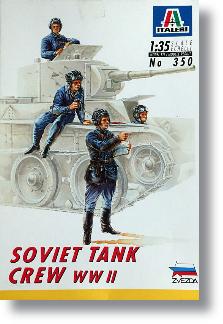
De un vistazo – Quick look
MATERIAL Y PIEZAS
MEDIA & PARTS:
- Plástico inyectado (31 piezas).
- Injected plastic (31 parts).
CONTENIDO – CONTENT:
- Un oficial (9 piezas).
- Un jefe de carro (7 piezas).
- Un conductor (7 piezas).
- Un artillero (8 piezas).
- One officer (9 parts).
- One tank commander (7 parts).
- One driver (7 parts).
- One gunner (8 parts).
INSTRUCCIONES – INSTRUCTIONS:
- Impresas en blanco y negro sobre la cara posterior de la caja. Las referencias de pintura pertenecen a la gama de Model Master / Italeri.
- Printed in black and white on the back side of the box. Paint references belong to Model Master / Italeri range.
LO MEJOR – THE BEST:
- Moldeado limpio. Fácil montaje. Detalles bien definidos en general.
- Clean tool. Easy assembly. Overall nicely defined detail.
LO PEOR – THE WORST:
- Equipo complementario escaso.
- Scarce complementary equipment.
VALORACIÓN – CONCLUSION:
- Un grupo de figuras eficaz, de montaje sencillo, acierto en el detalle y poco costosos para realzar cualquier carro soviético de inicios de la Guerra Mundial o el periodo inmediato anterior.
- A handy set of figures, easy to assemble, well-detailed, and inexpensive to enhance any Soviet tank from the pre- or early WWII period.

Contenido de la caja
Estas figuras de carristas soviéticos de Italeri ya han aparecido anteriormente con el sello de Zvezda. Calculo que la primera caja debió ser lanzada en los primeros años 90 y desde entonces lleva ya varias reediciones por parte de las dos marcas.
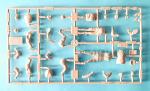
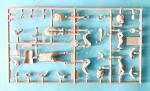
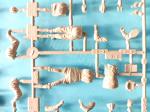
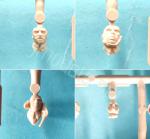
La caja contiene un único bastidor con las piezas numeradas y bien separadas para cada figura. Complementos hay muy pocos; solamente un par de pistolas de oficial en sus fundas, unos prismáticos, un zurrón, que parece de una máscara antigás, y lo que parece una carpeta que contiene mapas o instrucciones.
El plástico está correctamente moldeado y las piezas no presentan marcas ni rebabas. Las líneas de molde son muy finas y apenas evidentes, por ello la preparación de las piezas para montarlas necesitará escaso tiempo. El moldeado de las figuras es bastante bueno, apreciándose con claridad los pequeños detalles de los uniformes. Las arrugas de las prendas también muestran realismo y naturalidad.
Las figuras representadas comprenden un oficial y tres tripulantes, que pueden colocarse en cualquier carro con una dotación de tres hombres, como el T-26, BT-2, BT-5 o BT-7, por ejemplo. Los rasgos faciales están representados con precisión, en algunos casos tapados parcialmente por las orejeras y el barboquejo del casco.
Los atuendos son idénticos, salvo en el caso del oficial que viste una chaqueta y pantalones de montar. Los uniformes corresponden a un periodo justo anterior a la Guerra Mundial o primeros años de ella. De acuerdo con la caja, el mono de los tripulantes va pintado de azul, pero también se podría pintar de gris o negro, atendiendo a escasa homogeneidad que ocasionalmente tenían algunas prendas de manufactura soviética.
Figuras
El oficial superior está separado en nueve piezas. La cabeza, el casco y los brazos están separados, mientras que el tronco y las piernas son de una pieza, pero extrañamente la mitad delantera del tronco viene aparte. La pose es natural y aparece dando instrucciones con un mapa o documento abierto en una mano. Como he dicho, viste una chaqueta negra de cuero o cuero sintético, pantalones de montar y botas altas. El casco de carrista es el típico soviético y similar al de las demás figuras, con tres resaltes acolchados longitudinales y orejeras. El detalle del uniforme (correajes, cinturón, cuello e insignias, botones) es nítido, lo mismo que en las arrugas de los brazos, piernas y botas. El equipo está compuesto por una bolsa o zurrón con bolsillos laterales que parece el estándar para la máscara antigás y una pistola en su funda.
El aparente artillero está sentado sobre el vehículo recibiendo instrucciones y consta de siete piezas: cabeza, casco, tronco, brazos y piernas. Aparece sosteniendo unos prismáticos y dos banderas de señales, lo que puede indicar que su carro es el de mando de su unidad y carece de radio. El casco es similar a los demás, pero muestra el barboquejo suelto y las orejeras están moldeadas con la cara. Salvo el correaje cruzado y el cuello, el tronco no tiene gran detalle. Las piernas dejan ver los bolsillos del mono y las botas con claridad.
La figura del conductor tiene un despiece igual al anterior. Las manos están, supuestamente, colocadas sobre las palancas de conducción del vehículo y el detalle de la cara, el casco abrochado y los bolsillos de las perneras están bien resueltos.
Finalmente, el que parece el jefe de carro por la pistola enfundada que luce, tiene siete piezas. En este caso las cadera y piernas vienen juntas y el tronco, cabeza, casco y brazos aparte. La pose lo retrata sujetando la escotilla del vehículo. La posición erguida da más juego para que los detalles del mono se vean algo más claramente.
Instrucciones
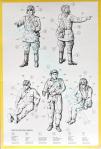
Están impresas en blanco y negro sobre la cara posterior de la caja. Para diferenciar el montaje de la pintura, las piezas de cada figura están identificadas con letras y números, o bien sólo con números cuando se trata del equipo adicional, mientras que las pinturas llevan su código en letras y pertenecen a la gama de Model Master / Italeri. Las ilustraciones de los carristas no plantean ningún problema en el montaje o la decoración.
Valoración
Este grupo de figuras puede ser un complemento eficaz y poco costoso para cualquier carro soviético del periodo inicial de la Segunda Guerra Mundial o precedente. El moldeado está bien realizado en el material y la ausencia de defectos ayudará a que el montaje sea muy breve.
Los atuendos están bien ajustados al periodo histórico y muestran suficiente nitidez. Las expresiones faciales tienen cierta diferencia y no me parece esencial reemplazar las cabezas.
En el lado menos bueno hay que señalar los escasos complementos incluidos en el bastidor, a los que podrían haberse sumado gafas de conducción o fundas de prismáticos o mapas, por ejemplo.◊

Box content
These Soviet tankers from Italeri were previously launched under the Zvezda label. I think the first box must have been released in the early 1990s, and since then there have been several reboxes by both companies.
The box contains a single sprue with the parts numbered and clearly separated for each figure. There are very few complements; just a pair of officer’s pistols in their holsters, binoculars, a backpack that looks like the one used in the Soviet army for a gas mask, and a kind of folder containing maps or instructions.
Plastic is correctly molded, and parts show no marks or flash. Seam lines are very thin and barely noticeable, so preparing the parts for assembly will take little time. The molding of the figures is quite good, with the small details of the uniforms clearly visible. The wrinkles in the garments are also convincing.
The figures comprise an officer and three tank crew members, who can be added to any tank with a three-man crew, such as the T-26, BT-2, BT-5, or BT-7, for example. The facial features are accurately depicted, in some cases partially hidden by the helmet’s flaps and chin strap. The outfits are identical, except for the officer, who wears a jacket and breeches. The uniforms correspond to a period just before World War II or in the early years of the conflict. According to the box, the crew members’ overalls are painted blue, but they could also be painted gray or black, given the lack of uniformity Soviet-made garments occasionally had.
Figures
The senior officer is separated into nine pieces. The head, helmet, and arms are separate, while the torso and legs are one piece, but oddly enough, the front half of the torso is separate. The pose is natural, and he appears to be giving instructions with a map or document open in one hand. As mentioned, he wears a black leather or synthetic leather jacket, breeches, and high boots. The tank driver’s helmet is typically Soviet and similar to that of the other figures, with three longitudinal padded ridges and earmuffs. The uniform detail (straps, belt, collar and insignia, buttons) is sharp, as are the creases on the arms, legs, and boots. The equipment consists of a bag or backpack with side pockets and a holstered pistol.
The apparent gunner is seated on the vehicle receiving instructions and consists of seven pieces: head, helmet, torso, arms, and legs. He is shown holding binoculars and two signal flags, which may indicate that his tank is the command vehicle of his unit and has no radio. The helmet is similar to the others, but shows the chinstrap loose, and the earmuffs are molded on the face. Except for the cross-body straps and the collar, the torso lacks much detail. The legs clearly reveal the pockets of the overalls and boots.
The driver’s figure is broken down in the same way as the previous one. The hands are supposedly placed on the vehicle’s driving levers, and facial detail, the fastened helmet, and the leg pockets are well-defined.
Finally, the figure which seems the tank commander, given the holstered pistol he sports, has seven pieces. In this case, the hips and legs are one piece, while the torso, head, helmet, and arms are separate. The pose depicts him holding the vehicle’s hatch. The upright position allows the details of the overalls to be seen more clearly.
Instructions
They are printed in black and white on the back of the box. To differentiate assembly from painting, the parts of each figure are identified with letters and numbers, or just numbers for additional equipment, while the paints are coded in letters and belong to the Model Master/Italeri range. The illustrations pose no problems for assembly or painting.
Conclusion
This group of figures can be an effective and inexpensive addition to any Soviet tank from the early World War II period or earlier. Molding is well done and the lack of blemishes or defects points to a straightforward assembly.
The outfits are well-matched to the historical period and are quite clear. The faces vary somewhat and I don’t think replacing the heads is essential.
On the downside, the frame has a limited number of accessories and these could have been supplemented with driving goggles or binoculars and maps cases, for example.◊
Publicado – Published: 9 / 2025
©www.jmodels.net
 jmodels.net
Debe estar conectado para enviar un comentario.