
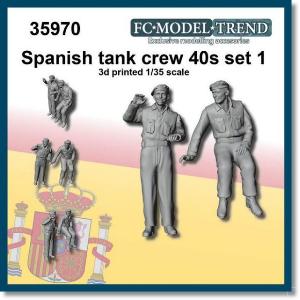
De un vistazo – Quick look
MATERIAL Y PIEZAS
MEDIA & PARTS:
- Resina impresa en 3D (2 piezas).
- 3D printed resin (2 parts).
CONTENIDO – CONTENT:
- Dos figuras completas.
- Two complete figures.
INSTRUCCIONES – INSTRUCTIONS:
- No tiene.
- Not included.
LO MEJOR – THE BEST:
- Listas para pintar sin montaje. Adaptables a múltiples carros de combate. Diferencia en las expresiones faciales y poses.
- Ready to paint without assembly. Can be fitted to several tanks. Different facial gestures and poses.
LO PEOR – THE WORST:
- Carecen de referencia de pintura. Prendas un tanto neutras, sin mucha caracterización.
- No paint reference included. A bit ‘neutral’ uniforms, without specific details.
VALORACIÓN – CONCLUSION:
- Adición interesante a la no muy larga lista de figuras de carristas de la Guerra Civil Española. Ambas piezas están bien modeladas en general, están casi listas para pintar y pueden encajar con facilidad en distintos carros y escenas de dicho periodo o la posguerra.
- Interesting addition to the not so long list of Spanish tankers from the Spanish Civil War. Both figures are overall well modelled, almost ready to be painted and can fit in different AFVs and scenes of the conflict or the postwar period.

Contenido de la caja
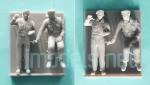
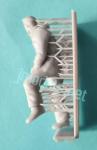
El contenido se presenta dentro de un estuche de plástico transparente con una etiqueta identificativa. Las figuras están esculpidas en resina mediante impresora de tres dimensiones y unidas por múltiples vástagos finos a una base. La delgadez de los soportes permite cortarlos y limpiarlos con facilidad.
Figuras
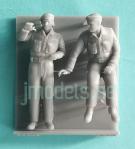
La primera figura es un carrista en pie sosteniendo la tapa de la escotilla de un carro con la mano diestra y la siniestra apoyada en el borde de la abertura. Las facciones están bien definidas y muestra un gesto sonriente. Desgraciadamente, dos de los vástagos de soporte están unidos justo por detrás de las orejas, lo que hace la operación de limpieza un tanto delicada para no dañarlas. Las manos están finamente detalladas.
Su atuendo parece un mono de carrista típico de la Guerra Civil Española complementado por una boina, botas y cinturón. La boina y el cinturón están reproducidos con gran nitidez en las arrugas y las hebillas. La boina carece de insignias. Las botas no muestran cordones y tan solo las suelas están algo mejor marcadas. La parte superior del mono está mejor reproducida que la inferior. En ella se aprecian las hombreras, el cuello y los bolsillos. Las arrugas de las mangas me parecen bastante naturales. Sin embargo, el pantalón se ve muy plano, tieso y sin los amplios bolsillos delanteros que se pueden ver en algunas fotos del conflicto. El atuendo carece de marcas de rango o botones.
La segunda figura muestra una pose diferente y relajada. Aparece sentada y con el brazo derecho apoyado lateralmente abarcando una superficie más amplia que la de su compañero, con lo que es más difícil de adaptar en la torre de un carro de la época, tal vez sólo en un T-26, pero se puede situar en otra parte de cualquier blindado. El gesto del rostro es serio y su cuello está girado levemente hacia el lado de apoyo. El detalle de rostro y manos es bueno.
Su atuendo es el mismo y de similares características que he descrito para su compañero de caja, pero las arrugas tanto de las mangas como del pantalón son más realistas.
Ambas figuras pueden adaptarse a diferentes blindados empleados por el ejército nacionalista durante la Guerra Civil, tanto propios como capturados, como el Panzer I, T-26, BT-5, FAI o BA-6, o incluso al Panzer IV y StuG III adquiridos en 1943. Se me ocurre que la figura del carrista en pie se adaptaría mal al Panzer I de mando (Kleiner Panzerbefehlswagen) porque su escotilla superior se abría lateralmente.
Valoración
Junto con las maquetas de carros y la amplia bibliografía publicada sobre los medios blindados empleados en la Guerra Civil Española, afortunadamente también son cada vez más las figuras específicas de carristas que se pueden encontrar en la escala 1/35. Concretamente, FC Model Trend tiene varias parejas de ellas de los dos bandos, pero también las hay de El Viejo Dragón y Warriors, por ejemplo.
La ventaja de estas dos figuras es que vienen listas para pintar, tras una pertinente limpieza, y no requieren montaje, lo que puede ser un estímulo para los modelistas más reacios a emplear figuras en las maquetas por su inexperiencia o aptitudes. Además, se pueden adaptar a varios tipos de blindados de la época. Con las expresiones faciales y poses que se les ha dado son fácilmente integrables en cualquier escena.
Sin embargo, aunque en general el modelado y la definición del atuendo no es mala, flaquean un tanto en la carencia de algunos detalles más definitorios, como bolsillos en los pantalones e insignias de unidad o rango. También se echa de menos que el fabricante hubiese añadido algún tipo de referencia de colores, siquiera genérica, para pintarlas.◊
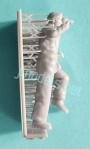

Box content
The figures come inside a self-sealing plastic blister with an identifying label. The figures are made of resin using a 3D printer and attached to a base by multiple thin gates, which are quite thin and easy to cut and clean up.
Figures
The first figure is a standing tanker holding the hatch cover of a tank with his right hand and his left hand resting on the edge of the hatch. His features are well-defined, and he shows a smiling face. Unfortunately, two of the gates are joined just behind the ears, making cleaning a bit delicate to avoid damaging them. The hands are finely detailed.
He seems to wear a typical Spanish Civil War tanker overall, complemented by a beret, boots, and belt. The beret and belt are reproduced with great sharpness in the creases and buckle. The beret lacks badges. The boots have no laces, and only the soles are somewhat better engraved. The upper overall is better reproduced than the lower half. The shoulder pads, collar, and pockets are clearly visible. The creases on the sleeves seem quite natural. However, the trousers look very flat, stiff, and lack the wide front pockets seen in some photos of the conflict. The outfit lacks rank patches or buttons.
The second figure shows a different, relaxed pose. He is seated and leaning laterally to the right, covering a larger area than his companion, making it more difficult to fit in the turret of a tank of the period — perhaps only in a T-26, but it could be placed elsewhere on any armored vehicle. His facial expression is serious, and his neck is turned slightly to the right. Detail on his face and hands is good.
His outfit is the same as the one described for his box companion, but the wrinkles on both the sleeves and trousers are more realistic.
Both figures can be adapted to different armored vehicles used by the Nationalist Army during the Civil War, both their own and captured, such as the Panzer I, T-26, BT-5, FAI or BA-6, or even the Panzer IV and StuG III acquired by Spain in 1943. The figure of the standing tanker would not fit well to the Panzer I command tank (Kleiner Panzerbefehlswagen) because its upper hatch opened to the sides.
Conclusion
Along with AFV kits and the extensive published literature on the armored vehicles fielded in the Spanish Civil War, we are seeing more specific tank crew figures available in the 1/35 scale. Specifically, FC Model Trend has several pairs of them from both contenders, but there are also kits from El Viejo Dragón (a Spanish figure manufacturer) and Warriors, for example.
The advantage of these two figures is that they come ready to paint, after a necessary cleanup, and need no assembly, which can be an incentive for modelers who are more reluctant to use figures in their kits due to inexperience or lack of skills. In addition, they can be adapted to various types of armored vehicles from the period. With the facial expressions and poses they have, they can be easily set in any scene.
However, while the overall modeling and definition of the outfit is nice, they are somewhat lacking in more defining details, such as trouser pockets and unit or rank patches. It’s also a pity that the manufacturer hadn’t added some kind of color reference, even a generic one, to paint them.◊
Publicado – Published: 7 / 2025
©www.jmodels.net
 jmodels.net
Debe estar conectado para enviar un comentario.