

De un vistazo – Quick look
MATERIAL Y PIEZAS
MEDIA & PARTS:
- Plástico inyectado (35 piezas), plástico transparente (5 piezas), goma (4 piezas), rodamientos de plástico (4 piezas).
- Injected plastic (35 parts), clear plastic (5 parts), rubber (4 parts), plastic polycaps (4 parts).
CALCAS – DECALS:
- Dos juegos de matrículas e instrumentos del salpicadero. Apariencia fina y brillante. Nítidas, con adecuada saturación de color y sin demasiado soporte.
- Two sets of plates and dashboard gauges. Thin and glossy finish. Sharp with good saturation and not too much carrier film.
OPCIONES – OPTIONS:
- Suzuki Wagon R “California”.
INSTRUCCIONES – INSTRUCTIONS:
- Folleto de 4 páginas impreso en blanco y negro. Contiene un plano numerado de piezas, una tabla de colores con equivalencias de pinturas acrílicas de Gunze Sangyo más 11 secuencias de montaje.
- 4-page brochure printed in black and white. It shows a numbered parts plan, a color chart with matches in Gunze Sangyo acrylic paints and 11 assembly stages.
LO MEJOR – THE BEST:
- Sencillez de montaje. Detalle general. Ruedas con giro.
- Easy build. Overall detail. Steerable wheels.
LO PEOR – THE WORST:
- Las puertas no se pueden colocar abiertas.
- No option to pose the doors open.
VALORACIÓN – CONCLUSION:
- Pocas piezas, montaje fácil y detalle mejor de lo esperable la hacen apta para iniciarse en el modelismo de vehículos civiles.
- Low parts count, easy assembly, and better-than-expected detail make it suitable for beginners in civilian vehicle modelling.

La maqueta
Coincidiendo con el año del lanzamiento del popular automóvil japonés Suzuki Wagon R en 1993, Fujimi lanzó su primera maqueta a escala 1/24 y desde entonces lleva más de quince reediciones de diferentes modelos (R RG-4, R RR, R “Sunroof”, etc.).
La maqueta representa el primer modelo fabricado entre 1993 y 1998 con un perfil en el capó algo más largo e inclinado que en otros modelos posteriores, por señalar un detalle evidente a primera vista. El Wagon R es un automóvil clasificado en Japón como kei car, la categoría inferior de automóviles con especificaciones y dimensiones muy restringidas. La primera generación de este modelo, tenía un motor Suzuki F6A de 660 cc. Inicialmente tenía dos puertas a la izquierda y solo una a la derecha (la del conductor), como aparece en la maqueta. El modelo tuvo un éxito espectacular en Japón, donde se llegaron a vender unas 900.000 unidades.
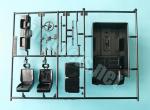
La caja trae dos bastidores de piezas de color negro, un bastidor transparente, la carrocería moldeada de color rojo, cuatro rodamientos de plástico, las ruedas con los neumáticos ya montados, las calcas y las instrucciones. El molde es muy limpio, sin rebabas en las piezas, que en su gran mayoría no tienen marcas visibles. La única excepción son la parte trasera de los respaldos de los asientos delanteros. Tan sólo algunas piezas muestran cilindros de salida del eyector.
Con poco más de 40 piezas, la maqueta es fácil de ensamblar para cualquier modelista y la pintura se hace más llevadera al estar la carrocería moldeada en plástico rojo. Supongo que si se elige otro color, deberá imprimarse previamente.
Chasis y suspensión
El chasis y el fondo de la carrocería vienen moldeados en una pieza junto con la parte interna de los guardabarros. Con un detalle limpio y bien definido, en el que se aprecia con claridad la parte inferior del motor, el depósito de combustible, molduras estampadas y el tubo de escape completo bien reproducido.
Las ruedas del tren delantero pueden girar gracias a un sistema simple que Fujimi ha diseñado para la maqueta. Los amortiguadores están unidos a los tambores de freno de cada rueda e incluyen también los pivotes de la barra de dirección. La barra de dirección va pegada al extremo delantero del chasis como punto de apoyo. La pieza contiene dos ojales en los extremos para introducir sin pegarlos los pivotes de los tambores. Los amortiguadores van unidos sin pegamento sobre el interior de los guardabarros y giran a la vez que las ruedas. Nada real, pero eficaz a fin de cuentas. Las ruedas se unen a su tambor mediante una clavija insertada a presión sin pegamento.
El tren trasero consiste en dos soportes pegados en paralelo a los pasos de rueda con ojales en las puntas para introducir el eje sin pegarlo. Las ruedas en este caso sí van pegadas a los extremos del eje. También hay una barra de soporte del depósito de combustible, situado en la parte trasera del chasis.
Ruedas
Las instrucciones indican que los neumáticos vienen separados y se colocan a presión en las llantas, pero en realidad están ya puestos en ellas. La banda de rodadura es excelente y carece de rebabas. Las llantas se proporcionan de color metálico, con seis radios, pequeñas molduras y cuatro tuercas. Están perfectamente ahuecadas con realismo. No he podido encontrar unas llantas idénticas en vehículos reales en Internet, así que ignoro si Fujimi se las habrá inventado. En cualquier caso, lucirán muy bien en la maqueta empleándolas tal cual vienen.
Interior
El habitáculo está contenido en una especie de bañera abierta solamente por la parte trasera para representar el maletero. La pieza se pega sobre el chasis una vez terminado su interior. El suelo está moldeado con el freno de mano, las bases de los asientos delanteros y los asientos traseros menos sus respaldos separados y moldeados con clavijas que permiten abatirlos.
El detalle en piezas separadas comprende la palanca de marchas, los asientos delanteros, el salpicadero, el volante y la cubierta del engranaje de la columna de la dirección. Los asientos delanteros contienen reposacabezas ahuecados en lugar de acolchados. El lado trasero del respaldo está hueco y posee un par de marcas de eyector. Cubrir el vacío con una lámina de plástico parece lo más sencillo, ya que se verán desde el exterior. El salpicadero es bastante parecido al real de un Wagon R de los años 90 y los indicadores son de calca.
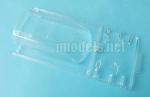
Todos los cristales del vehículo está moldeados en una pieza no excesivamente gruesa pegada en el interior de la carrocería y detallada posteriormente con el retrovisor. El techo posee dos huecos para instalar los techos solares en los modelos que lo llevan.
Carrocería y detalles externos
La carrocería, excepto los paragolpes, también es una sola pieza con las las barras de techo incorporadas. Las puertas, unidas a la carrocería, y tiradores están bien marcados por el exterior, pero en el interior no están representados. El paragolpes delantero está detallado con la rejilla del radiador, la del motor, la placa de matrícula, y los huecos de las luces antiniebla, que carecen de cristales. Las luces de los faros solamente están sugeridas en esta pieza y cubiertos por cristales transparentes. Además, en la parte delantera tenemos los retrovisores y los limpiaparabrisas, que tienen buena definición.
El paragolpes trasero es bastante parecido al real. Tiene las lentes de los faros en piezas transparentes con las luces sugeridas como en el delantero y la placa de matrícula incorporada en la pieza. El limpiaparabrisas de la luneta trasera también viene aparte.
Terminada la carrocería, se une a la base del chasis, cuya parte anterior dispone de dos pequeñas lengüetas que ayudan a pegarla correctamente.
Calcas
La hoja, pequeña y alargada, contiene básicamente dos juegos de matrículas e instrumentos del salpicadero. Las calcas son finas y brillantes y también muestran adecuada saturación de color sin demasiado soporte.
Instrucciones
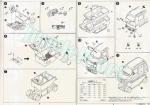
Se presentan en un folleto de cuatro páginas impreso en blanco y negro que contiene un plano numerado de piezas, una tabla de colores con equivalencias de pinturas acrílicas de Gunze Sangyo más 11 secuencias de montaje. En su mayor parte está escrito en japonés con mínimas aclaraciones en inglés, pero las secuencias del montaje pueden seguirse fácilmente.
Valoración
Este Wagon R debe venderse bien, al menos en el mercado japonés, por eso no es de extrañar la cantidad de cajas y modelos que Fujimi ha lanzado durante años.
Si no le pedimos tres pies al gato, esta es una maqueta ideal para iniciarse en el sugerente mundo del modelismo de vehículos civiles, porque tiene pocas piezas, es sencilla de montar y el detalle me parece bastante bueno para lo simplificado que está.◊





The kit
Coinciding with the launch of the popular Japanese car Suzuki Wagon R in 1993, Fujimi released their first 1/24 scale kit and has since produced more than fifteen boxings of different models (R RG-4, R RR, R «Sunroof,» etc.).
The kit represents the first generation model produced between 1993 and 1998 that featured a slightly longer and more sloping hood profile than later Wagons, just to highlight a detail that is immediately apparent. The Wagon R is classified in Japan as a kei car, the lowest category of cars with very restricted specifications and dimensions. The first generation car had a 660 cc Suzuki F6A engine. Initially, it had two doors on the left and only one on the right (the driver’s door), as shown in the kit. The Wagon R was a spectacular success in Japan, where some 900,000 units were sold.
The box comes with two sprues of black parts, a clear frame, the red moulded body, four plastic bearings, the wheels with the tires, the decals, and the instructions. The tool is very clean, with no flash on the parts, most of which have no visible marks, the only exception being the rear part of the front seat backrests. Only a few parts show ejector pips.
With just over 40 parts, the kit is easy to build for any modeller, and painting is made easier by the body being molded in red plastic. I assume that if you choose another color, the body will need to be primed beforehand.
Chassis and suspension
The chassis and the bottom of the body are moulded in one piece, along with the wheel arches. Detail is clean and well-defined, clearly showing the lower part of the engine, the fuel tank, some stamped mouldings, and the exhaust pipe, which is well reproduced.
The front wheels can turn thanks to a simple system that Fujimi designed for the kit. The shock absorbers are attached to the brake drums of each wheel and also include the steering rod pivots. The sway bar is glued to the front end of the chassis as a support point. The piece contains two eyelets at the ends for inserting the drum pivots without gluing them. The shock absorbers are attached without glue to the inside of the wheel arches and rotate simultaneously with the wheels. Not realistic, but effective nonetheless. The wheels are attached to their drums by means of a pin pressed in without glue.
The rear axle consists of two supports glued parallel to the wheel arches with eyelets at the ends for inserting the axle without gluing it. The wheels in this case are glued to the ends of the axle. There is also a fuel tank support bar at the chassis rear.
Wheels
According to the instructions the tires come separately and are pressed onto the rims, but they are actually provided with them. The tread is excellent and free from flash. The rims are supplied in a metallic color, with six spokes, small mouldings, and four lug nuts. The rims are realistically hollowed. I haven’t been able to find identical rims on real vehicles on the Internet, so I don’t know if Fujimi made a mistake here. Anyway, they will look great on the model using them as they come.
Cab and interior
The cabin is contained in a kind of bathtub open only at the rear to represent the trunk. The piece is glued onto the chassis once the interior is finished. The floor is moulded with the handbrake, the front seat bases, and the rear seats without the backrests, which are separated and provided with pins to pose them folded if desired.
There are separate pieces for the gear lever, front seats, dashboard, steering wheel, and the steering column gear cover. The front seats have hollowed-out headrests instead of padding. The rear sides of the backrest are hollow and show a couple of pin marks each. Covering the gap with a plastic sheet seems the simplest choice, as the marks will be visible from the outside. The dashboard is quite similar to the real one from a 1990s Wagon R and the gauges are decals.
All of the vehicle’s glass is moulded in a single, not too thick piece glued to the inside of the body and then detailed with the rearview mirror. The roof has two openings for installing sunroofs on models equipped with them.
Body and external detail
The body, except for the bumpers, is also a single piece with raised rails moulded on. The doors, which are moulded closed, and the handles are clearly visible on the outside, but are not represented on the inside. The front bumper is detailed with the radiator and engine grilles, the license plate, and the fog lights, but these are not provided as clear pieces. The headlights are only suggested in the piece and covered by clear pieces. Additionally, the front is detailed with the mirrors and windshield wipers, which look sharply defined.
The rear bumper is quite similar to the real thing. It has clear headlight lenses with suggested lights as on the front, and the license plate is included in the piece. The rear window wiper is also provided separately.
The finished body is joined to the chassis, which has two small front tabs that help to attach it correctly.
Decals
The small long sheet basically contains two sets of license plates and the dashboard instruments. Decals are thin and glossy, with good color saturation and minimal carrier.
Instructions
They are presented in a 4-page brochure printed in black and white containing a numbered parts plan, a color chart with Gunze Sangyo acrylic paint matches and 11 assembly chapters. It is mostly written in Japanese with minimal directions in English, but the assembly sequences are easy to follow.
Conclusion
This Wagon R kit must sell well, at least in the Japanese market, so it’s no surprise the number of kits and variants Fujimi has released over the years.
This is a basic kit, simply designed and with an easy assembly that still has an overall nice detail. It really looks ideal for getting started in the exciting world of civilian vehicle modelling.◊
Publicado – Published: 6 / 2025
©www.jmodels.net
 jmodels.net
Debe estar conectado para enviar un comentario.