
De un vistazo – Quick look
MATERIAL Y PIEZAS
MEDIA & PARTS:
- Plástico inyectado (158 piezas).
- Injected plastic (158 parts).
CALCAS – DECALS:
- Matrículas y marcas tácticas. Apariencia fina y brillante. Buen registro. Sin exceso de soporte.
- Number plates and tactical markings. Thin and glossy finish. Good register. No excess of carrier film.
OPCIONES – OPTIONS:
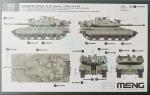
- Merkava Mk.4M. Ejército israelí. 401ª Brigada Acorazada. 1er Batallón “Shelaqh” (Espada). Carro 11 Gimel. Altos del Golán, octubre de 2014.
- Merkava Mk.4M. IDF. 401st Armored Brigade. 1st “Shelaqh” (Sword) Battalion. Tank 11 Gimel. Golan Heights, October 2014.
INSTRUCCIONES – INSTRUCTIONS:
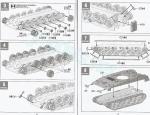
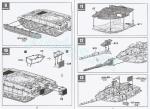
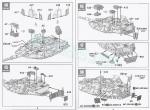
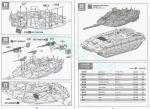
- Folleto de formato A5 de 12 páginas impreso en blanco y negro. Contiene un plano de piezas sin numerar, 22 secuencias de montaje y una tabla de colores con equivalencias de pinturas de Meng / AK y Acrysion de Mr Hobby. La cara trasera de la caja contiene perfiles y códigos de pinturas de Meng / AK.
- 12-page A5 booklet printed in black and white. Contains a parts plan without numbers, 22 assembly steps and a color chart with Meng / AK and Mr Hobby Acrysion paints. The back side of the box shows profiles and Meng / AK paint codes.
LO MEJOR – THE BEST:
- Notable y nítido detalle general. Sencilla de montar.
- Nice and sharp detail overall. Easy to assemble.
LO PEOR – THE WORST:
- Cañón fijo. Escotillas cerradas. Herramientas y retén del cañón no separados.
- Non-movable gun. Hatches molded closed. Tools and gun travel lock molded in place.
VALORACIÓN – CONCLUSION:
- Es sencilla de montar y no tiene concesiones en el detalle, salvo lo apuntado arriba. Asequible a modelistas de cualquier nivel de experiencia.
- It’s easy to build and has no concessions in detail, except for the downsides noted above. Suitable for modelers of any level of experience.

La maqueta
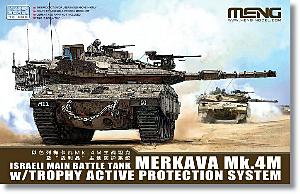
Meng Model sigue empeñada en sus lanzamientos de carros de combate actuales con este nuevo Merkava Mk.4M, empleado por Israel en conflictos recientes, como el de la Franja de Gaza. La maqueta retrata este vehículo con el sistema de protección activa Trophy, lo cual es en realidad redundante, puesto que todos los Merkava Mk.4M llevan hoy día este sistema integrado. Este modelo recibe del sistema Trophy la denominación de Windbreaker.
El Trophy es un sistema de protección activa de vehículos, empleado por Israel desde 2010 y por algunos países posteriormente, compuesto por un radar de control de tiro y cuatro antenas de paneles planos que vigilan todo el contorno y la parte superior del carro formando una especie de cúpula de protección. Es eficaz en detectar y anular multitud de misiles y cohetes pudiendo seguir varios blancos a la vez, tanto en posición estática como en movimiento. Dos lanzadores se encargan de crear una nutrida y compacta nube de proyectiles penetrantes formados por explosión (EFP, Explosive Formed Penetrators) con un alcance eficaz a 10 m del vehículo capaz de eliminar la amenaza sin riesgo elevado para la infantería propia circundante. El sistema es adaptable a vehículos pesados (como el transporte de tropas Namer) y ligeros con peso variable según el caso.
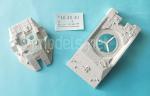
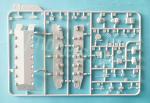
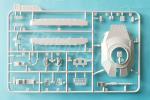
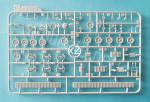
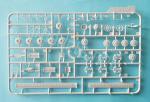
Esta maqueta de nuevo cuño comprende cuatro bastidores de piezas, dos de ellos son idénticos y contienen la suspensión, el tren de rodaje y las cadenas, la parte superior del casco y la torre por separado, una pequeña hoja de calcas y las instrucciones.
Las piezas de plástico tienen un moldeado limpio y nítido, sin defectos, rebabas o marcas, como viene siendo habitual en las maquetas del fabricante en esta escala escala. El detalle general es muy bueno y el despiece contiene un promedio de piezas que ni simplifica el modelo ni aburre por su cantidad. También hay algunos elementos pequeños moldeados in situ, característica nada extraordinaria en esta escala.
La ausencia de fotograbados y las pocas piezas delicadas que encontramos en los bastidores hacen del montaje un proceso muy asequible incluso para el modelista con poca experiencia. El único acabado de pintura nos ofrece un carro monocolor, por tanto también en este apartado la ausencia de dificultades es evidente.
Revisión
La parte inferior del casco viene separada en tres elementos, ya que la pieza del fondo incluye las planchas delantera y trasera. De esta manera, el montaje de las planchas laterales es mucho más sencillo. La plancha delantera tiene otra plancha de blindaje adicional separada más dos ganchos de remolque. La trasera tiene otra pieza añadida en su parte central y también ganchos de remolque a los lados. Los lados del casco se unen haciendo coincidir las salidas de las barras de torsión moldeadas en ellos con las cubiertas incorporadas al suelo del casco.
El montaje continúa con la adición de la cubierta del diferencial de la rueda tractora y la suspensión. Esta consta de seis piezas por lado con muelles helicoidales muy bien reproducidos en cada una. Las ruedas tractoras, tensoras y de carretera se componen de dos piezas. Las tractoras tienen notable definición y limpieza tanto en los dientes como en el detalle central. Las tensoras muestran los radios precisos y el perfil ondulado correcto en los bordes de las ruedas. Las ruedas de carretera llevan las llantas correctamente representadas y las bandas de rodadura limpias de líneas de molde.
Los rodillos de retorno contienen en cada lado dos ruedas dobles y tres sencillas. Pese al tamaño muy pequeño de las sencillas, Meng no ha hecho concesiones y el detalle en las llantas está al par con el resto del tren de rodaje.
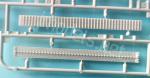
Las cadenas se proporcionan en tramos de diferente número de eslabones. Cada lado consta de seis tramos con el delantero y trasero curvados y adaptado a las ruedas. El detalle por ambas caras es limpio y los dientes muestran gran nitidez. Un detalle interesante que no se le ha escapado a Meng es que los tramos coincidentes con las tractoras tienen los extremos de los eslabones ahuecados para introducir los dientes, mientras que en el resto de tramos los eslabones están bien reproducido pero no ahuecados. A simple vista los dientes de las tractoras parecen lo bastante finos para ajustar en las cadenas, pero no puedo asegurarlo.
La parte superior del casco es una pieza con un detalle muy bueno moldeado sobre ella. La parte delantera y la cubierta tiene las placas de blindaje correctamente grabadas y gran definición en las rejillas de ventilación del motor. El retén de transporte del cañón es nítido, pero podría haberse moldeado como pieza separada, lo mismo que las herramientas situadas tras la torre. La escotilla del conductor viene cerrada y provista de visores. En la parte delantera se aprecian los faros y en la trasera diversas cajas de respeto y las tomas de combustible. En ambos lados hay varias asas moldeadas in situ.
En la parte delantera de la pieza sólo hay que instalar la cara frontal de los guardabarros. El blindaje lateral está representado en una pieza a los dos lados. El detalle en las superficies externas es de nuevo muy notable y tiene nitidez en las placas, pernos y los faldones inferiores de caucho, que se han representado ondulados para imitar la textura. La parte posterior cuenta con dos bastidores que sujetan planchas de protección de los depósitos de combustible.
La mitad de los capítulos de montaje están dedicados en exclusiva a la torre, que está dividida en dos mitades superpuestas con la plancha trasera separada. La pieza superior tiene un detalle sobresaliente en las placas de blindaje, los visores laterales, asas, rejillas en la parte posterior y la tronera de la ametralladora coaxial bien perfilada, pero el detalle esencial viene aparte. Tampoco en esta ocasión Meng se ha dejado nada detrás y la pieza inferior viene igualmente detallada con placas de blindaje, rejillas y algunos accesos adicionales, pese a que no se apreciarán con claridad cuando se instale la torre sobre el casco.
La plancha posterior incorpora tres bases de antenas en la pieza más otras dos separadas así como un tramo de cadenas de repuesto. La cesta de estiba posterior está separada en tres piezas de gran finura y detalle, entre el que está el sistema protector contra proyectiles RPG de bolas y cadenas moldeado en el borde inferior. Otros tramos de este sistema también aparecen separados a los lados de la parte posterior de la torre.
El cañón se monta con facilidad porque sólo consta de dos piezas. La mitad inferior del mantelete está unida al cañón y este posee buen detalle en la cubierta térmica y el extractor de humos. La boca está horadada. La parte superior del mantelete incluye la base de la ametralladora de calibre 50. El arma viene sobre el afuste en una pieza bien perfilada con el sistema de alimentación y puntería aparte. Unidas las dos partes, el cañón va simplemente pegado sobre las dos mitades de la torre, lo que impide deprimirlo o alzarlo. Esta es la mayor desventaja de esta maqueta.
La parte superior de la torre contiene varias bases de antenas adicionales en su contorno, los tubos de granadas de humo separados en dos filas, dos planchas de blindaje a los lados y la ametralladora de 7,62 mm bien reproducida con su base, afuste y caja de munición separados. La escotilla del comandante cuenta con una pieza que simula los periscopios perimetrales. Tanto su escotilla como la del artillero sólo se pueden colocar cerradas, desafortunadamente.
Las placas del radar del sistema Trophy vienen separadas. Las dos delanteras van integradas en carenados laterales de la torre pegadas desde afuera, mientras que las traseras ocupan las esquinas y son independientes. Los lanzadores de proyectiles EFP poseen los brazos del soporte giratorio aparte.
La hoja de calcas es pequeña y apenas contiene matrículas y marcas para el carro identificado como 11 guimel que muestran una apariencia fina y brillante. Poseen buen registro sin exceso de soporte.
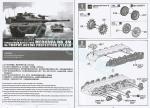
El folleto de instrucciones tiene un formato A5 y consta de doce páginas impresas en blanco y negro. Contiene un plano de piezas sin numerar, 22 secuencias de montaje y una tabla de colores con equivalencias de pinturas de Meng / AK y Acrysion de Mr Hobby. La cara trasera de la caja contiene perfiles y códigos de pinturas de Meng / AK. Los perfiles de la caja muestran un carro pintado en un verde grisáceo que en realidad no corresponde con el tono marrón actual de los Merkava Mk.4M y que los fabricantes de pintura suelen denominar, por ejemplo, gris IDF 1 (Moderno) (Mr Hobby) o Arena Gris 73 Real IDF (Ammo Mig).
Valoración
Incluso con las carencias que he apuntado antes, que pueden no serlo tanto para algunos, este nuevo lanzamiento de Meng Model aúna un detalle muy notable en general con un montaje sencillo y apto para modelistas con diferentes habilidades y experiencia.◊

The kit
Meng Model continues to release 1/72 modern tanks with this brand new Merkava Mk.4M, used by Israel in recent conflicts, such as the one in the Gaza Strip. The kit depicts this vehicle with the Trophy active protection system, which is actually redundant, since all Merkava Mk.4Ms now have this system integrated. This Merkava variant is known as Windbreaker, which comes from the name of the system itself.
The Trophy is an active vehicle protection system, used by Israel since 2010 and by some other countries since then. It consists of a fire-control radar and four flat-panel antennas that monitor the entire perimeter and top of the tank, shaping a kind of protective dome. It is effective in detecting and destroying a multitude of missiles and rockets, and can track several targets simultaneously with the vehicle either stationary or moving. Two launchers are responsible for creating a dense and compact cloud of explosive formed penetrators (EFPs) with an effective range of 10 m from the vehicle, capable of eliminating the threat without significant risk to the surrounding infantry. The system is adaptable to heavy vehicles (such as the Namer APC) and light vehicles, varying in weight in each case.
This new-tool kit comprises four sprues of parts, two of which are identical and contain the suspension, running gear and tracks, the upper hull and turret pieces molded separately, a small decal sheet, and the instructions.
Plastic parts are cleanly molded without blemishes, flash or marks, as is typical of the manufacturer’s kits in this scale. Overall detail is quite good, and the sprues contain an average number of parts that neither simplifies the kit nor overwhelms the modeler. There are also some small elements molded in place, a feature that won’t surprise anyone familiar with this scale.
The lack of photo-etched parts and the few delicate pieces found on the frames will make assembly a very easy process, even for the inexperienced modeler. The single paint finish is for a single-color tank, so the lack of difficulties is evident in painting as well.
Review
The lower hull part is divided into three elements, as the bottom piece includes the front and rear plates. This makes attaching the side plates much simpler. The front plate has a further separate armor plate plus two tow hooks. The rear plate has another piece added in the middle and tow hooks on the sides. The hull sides are joined by matching the torsion bar outlets with the covers molded on the hull floor.
Assembly continues with the addition of the final drive cover and suspension. This consists of six pieces per side with very well-reproduced coil springs on each. The road wheels are doubled while the sprockets and idlers are provided in halves. The drive wheels have remarkable definition and cleanliness in both the teeth and the hubs. The idlers show neat spokes and the correct wavy shape on the wheel rims. The road wheels have correctly rendered rims with the treads free of seam lines.
The return rollers contain two double wheels and three single wheels on each side. Despite the very small size of the single wheels, Meng have made no compromises, and detail on the rims is similar to the rest of the running gear.
The tracks are provided in lengths with varying numbers of links. Each side contains six of them, with the front and rear pieces adapted to the wheel contour. Detail on both sides is clean, and the teeth are sharp. An interesting detail that Meng have not overlooked is that the lengths matching the sprockets have the link gaps hollowed out to fit the teeth, while on the other lengths the links are nicely reproduced but solid. At first glance, the sprocket teeth look thin enough to fit the tracks, but I have not checked this.
The upper hull is a single piece with very good detail molded on. The front hull and engine deck have well-engraved armor plates and excellent definition on the vents. The gun travel lock is well defined, but could have been molded as a separate piece, just as the tools behind the turret. The driver’s hatch comes closed and fitted with sights. The headlights are visible at the front, and several spare boxes and fuel filler caps are visible at the rear. Several handles are molded in place on both hull sides.
The hull has the front fenders in separate pieces. The side armor is represented as a single piece on both sides. Detail on the external surfaces is again very nice on the plates, bolts, and the lower rubber skirts, which have been rendered with a wavy pattern to simulate texture. The rear hull has two frames that hold the fuel tank protection plates.
Half of the assembly chapters are devoted exclusively to the turret, which is divided into two matching halves with a separate rear side. The upper piece features outstanding detail on the armor plates, sights, handles, rear grilles, and the well-profiled coaxial machine gun port, but the essential details are provided separately. Meng have not left anything behind and the lower piece is equally detailed with armor plates, grilles, and some additional access covers even if these will not be clearly visible when the turret is installed on the hull.
The rear side includes three antenna bases in the piece plus two separate ones, as well as a section of spare track. The rear stowage basket is separated into three highly refined and detailed pieces, including the ball-and-chain RPG protective system molded on the lower edge. Other sections of this system also come separately on the turret’s rear sides.
The gun is easy to assemble as it consists of only two parts. The lower mantlet half is attached to the barrel, and this shows a very good definition on the thermal cover and smoke extractor. The muzzle is hollowed out. The upper mantlet part includes the base of the .50 caliber machine gun. The weapon is provided with the mount in a well-profiled piece with separate feed and sighting systems. Once the two parts are attached, the barrel is simply glued onto the turret halves, making it impossible to depress or raise the weapon. This is the biggest drawback of this kit.
The upper turret side contains several additional antenna bases along its perimeter, the smoke grenade launchers separated in two rows, two armor plates on the sides, and a nice 7.62 mm machine gun with the base, mount, and ammo box apart. The commander’s hatch has a piece simulating the periscopes. Both this hatch and the gunner’s one can only be fitted closed, unfortunately.
The Trophy system’s radar plates are provided separately. The two front pieces are integrated into the turret’s side fairings and attached from the outside, while the rear ones on the turret corners are separate. The EFP rotating launchers have separate arms.
The decal sheet is small and contains only license plates and markings for a tank identified as 11 Gimel, which show a fine, glossy appearance. They have good registration without excessive carrier.
The A5 instruction booklet consists of twelve pages printed in black and white. It contains a parts plan, 22 assembly steps and a color chart with Meng/AK and Mr. Hobby Acrysion paint equivalents. The back of the box contains profiles with Meng/AK paint codes showing a tank painted in overall grayish green, which doesn’t really match the current brown shade of the Merkava Mk.4M, a color which paint manufacturers refer to as IDF Gray 1 (Modern) (Mr. Hobby) or Real IDF Gray Sand 73 (Ammo Mig), for example.
Conclusion
Even with the shortcomings I mentioned above, which may not be so important to some, this new release from Meng Model combines very nice overall detail with simple assembly and looks quite suitable for modelers of varying skill and experience.◊
Publicado – Published: 10 / 2025
©www.jmodels.net
 jmodels.net
Debe estar conectado para enviar un comentario.