
De un vistazo – Quick look
MATERIAL Y PIEZAS
MEDIA & PARTS:
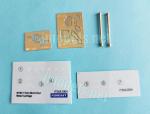
- Plástico inyectado (260 piezas), fotograbado (7 piezas), aluminio torneado (2 piezas).
- Injected plastic (260 parts), photo-etched (7 parts), turned aluminium (2 pieces).
CALCAS – DECALS:
- Dos hojas que incluyen insignias norteamericanas, matrículas y numerales. Aspecto fino y brillante. Sin exceso de soporte.
- Two sheets including US markings, registers and vehicle numbers. Thin and glossy appearance. No excess of carrier film.
OPCIONES – OPTIONS:
- 19 GMC. 15º Batallón de Artillería AA. Yumok Chong (Corea del Sur) proximidades del paralelo 38º, fines de mayo de 1951.
- M19 GMC Flak Wagon. 82º Compañía AA, 37º Batallón de Artillería de Campaña, 2ª División de Infantería. Invierno de 1950-51.
- M19 GMC. 15th AA Artillery Battalion. Yumok Chong near the 38th Parallel, late May 1950.
- M19 GMC Flak Wagon. 82nd AA Company, 37th Field Artillery Regiment, 2nd Infantry Division. Winter 1950-51.
INSTRUCCIONES – INSTRUCTIONS:
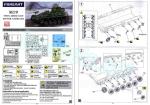
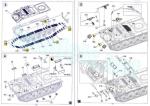
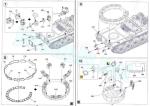
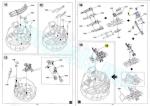
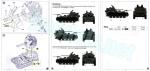
- Folleto de 12 páginas impreso en blanco y negro. Contiene un plano numerado de piezas, 17 capítulos de montaje y dos páginas de perfiles con indicaciones de color y sus equivalentes en pinturas de varias marcas.
- 12-page booklet printed in black and white. It shows a numbered parts plan, 17 construction chapters and two pages of profiles in color with matches in several paint ranges for the overall Olive Drab of the vehicles.
LO MEJOR – THE BEST:
- Detalle excelente para esta escala. Incluye una selección sensata de mejoras.
- Excellent detail for this scale. Includes a sensible selection of etched and metal parts.
LO PEOR – THE WORST:
- Terminaciones de pintura sin variedad. Ausencia de referencias de color en piezas específicas.
- Lack of variety in paint finishes. Lack of paint reference on specific parts.
VALORACIÓN – CONCLUSION:
- Excelente reproducción de un vehículo casi olvidado por el modelismo. Proporcionalmente a su escala, la maqueta nada tiene que envidiar en detalle a otras de mayor tamaño. Recomendable a modelistas con cierta experiencia.
- Excellent rendition of a vehicle almost neglected by modelling. Comparatively in terms of scale, this kit has nothing to envy to other larger ones. Recommended to modellers with some experience.

La maqueta
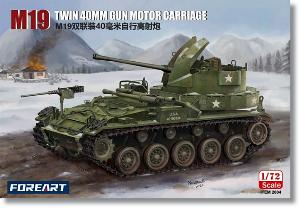
Hasta hace no mucho tiempo el M19 GMC era un vehículo prácticamente olvidado por el modelismo. No le ha salvado del abandono ni siquiera el hecho de ser pariente cercano del conocido carro de combate M24 Chaffee. Hace unos años Bronco Models produjo la primera maqueta a escala 1/35, un M19A1 de elevada calidad, detalle y precio. Ahora, la china FOREART nos trae otro M19 de nuevo cuño y menor tamaño.
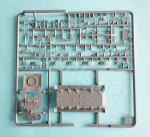
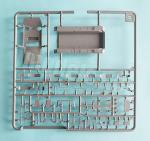
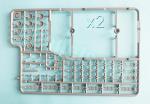
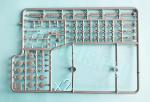
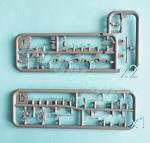
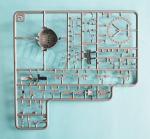
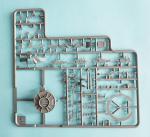
La caja contiene siete bastidores de distinto tamaño, dos de ellos idénticos, dos pequeñas láminas de fotograbado, dos cañones de metal torneado, las calcas y las instrucciones. Al abrir la caja encontramos un despiece relativamente análogo al de una maqueta de mayor escala y se aprecia que FOREART no ha hecho concesiones en el detalle. Las piezas están bien moldeadas y carecen de rebabas. No hay tampoco marcas de eyector visibles.
La construcción del modelo no es tan sencilla ni continua como en otras maquetas de este tamaño debido al mayor número de piezas que forman tanto la superestructura como el interior de la torre. Por ello, no parece la más indicada para principiantes.
Aunque su fabricante lo publicita como M19, la maqueta representa en realidad un M19A1, con diferencias con el M19 muy visibles en el escape único emplazado hacia la izquierda del casco (uno a cada lado de la torre en el M19), el generador auxiliar sobre un guardabarros y los salientes en los laterales de la torre con el equipo de radio situado en el derecho que el M19 no tiene.
Parte inferior del casco y suspensión
La mitad inferior del casco está moldeada en una pieza sin la plancha trasera. La pieza incluye los guardabarros, de finura y detalle aceptable para el tamaño. El lado externo del fondo muestra con mucha precisión varias cubiertas de diferentes sistemas de drenaje y de la parte central del suelo así como los anclajes de las barras de torsión.
La plancha frontal lleva dos asas y dos ganchos de remolque, mientras que la trasera la forma un marco para pegar sobre él las puertas del compartimento de estiba separadas. Hay también un gancho de pivote, ganchos de remolque, dos soportes para colocar los ojales de izado encima y en la cara frontal dos piezas que incluyen las luces traseras y los estribos posteriores. El detalle de las piezas es bastante acertado si se compara con imágenes del vehículo real.
Las anclajes de las barras de torsión están bien definidos sobre cada lado del casco, que también muestran los topes de los brazos de la suspensión. Los amortiguadores vienen separados insertados en agujeros de forma cuadrada que ayudan a darles la orientación correcta. Al pegar los brazos de la suspensión sobre ellos, el conjunto, y también las ruedas, queda nivelado sobre el suelo. Además, las instrucciones muestran una vista de planta de la disposición correcta de la suspensión antes de colocar las ruedas.
La cubierta de los diferenciales de las ruedas tractoras vienen separados con el detalle de las nervaduras de refuerzo bien simulado. Las cubiertas de las tensoras están unidas al brazo de la suspensión más próximo mediante un conector de compensación.
Tren de rodaje y cadenas
FOREART tampoco ha hecho rebajas en el detalle del tren de rodaje. Todas las ruedas resisten muy bien la comparación con las originales de este carro. Los bujes y las tuercas alrededor del centro muestran gran definición, lo mismo que los dientes de las tractoras, que, junto con las tensoras, son las únicas que vienen de una pieza. Las tensoras muestran, además, los pequeños huecos de la banda de rodadura como las reales. Las ruedas de apoyo y los rodillos de retorno son todos dobles. Las instrucciones señalan la colocación de las ruedas externa de los rodillos tras pegar las cadenas para facilitar el montaje, ya que los guardabarros impiden colocar los tramos de cadenas con estas ruedas puestas.
Las cadenas están separadas en tramos y eslabones y tienen un excelente detalle, especialmente en el lado exterior. Los dientes son nítidos y las piezas carecen de marcas o rebabas. Dado que las cadenas del M19 no tienen caída entre los rodillos, el único problema que se vislumbra al montar las de la maqueta es el encaje de los dientes de las tractoras en los eslabones porque los huecos para introducirlos son muy pequeños.
Superestructura
La plancha superior es de una pieza. El detalle moldeado en ella incluye el cable de arrastre en la parte delantera, la rejilla de ventilación del radiador más las tapas de las bocas de llenado del radiador y del depósito de combustible. La zona trasera es lisa a excepción del anillo de la torre moldeado en relieve.
La parte delantera contiene dos tramos de cadenas de repuesto sobre cada guardabarros, los faros y la sirena detallados con guardas de fotograbado, las herramientas separadas y fijadas sobre un bastidor, el botiquín, la base de la antena y las tapas de las escotillas delanteras provistas de periscopios y del brazo giratorio. La ametralladora tiene el afuste, la empuñadura y la caja de munición aparte. El arma es fina y me parece decentemente reproducida.
La zona central está ocupada por una excelente rejilla de ventilación del motor moldeada incluso con las bisagras y los tubos de repuesto de los cañones moldeados con los anclajes. Extrañamente, el extremo de uno de los tubos está separado del resto. También hay que instalar la batería, compuesta de cuatro piezas con la tapa bien definida, el generador de la torre, formado por ocho piezas sin las guardas de protección además de la salida del tubo de escape detallada con un protector de fotograbado.
Torre
Antes de montar la torre hay que construir el anillo de cajas de munición que la rodea. Este anillo consta de una base sobre la que van pegadas las caras externas de las cajas. Posteriormente se añaden las cajas, que se han moldeado de dos en dos en su mayoría. Las tapas y cierres están representados con nitidez.
Una vez situada la munición sobre el vehículo, se procede al montaje de la torre. El suelo y los lados son de una pieza y sobre ellos hay que colocar un buen número de piezas, no sólo para el cañón y el sistema de puntería, sino también los asientos de los artilleros, asas, los escudos frontales y las radios situadas en el saliente derecho de la torre. El suelo muestra zonas moldeadas con suelo antideslizante de gran realismo.
Antes de colocar los cañones hay que instalar los conductos deflectores de los casquillos situados debajo del arma. La pieza viene separada en cuatro partes con los recuperadores y la cuna añadidos por debajo. Los cargadores automáticos y la munición colocada sobre las piezas está moldeada aparte, aunque esta última carece de las guardas posteriores del sistema. El escudo delantero y la mira también están exentos. La mira está reproducida con precisión en sus tres piezas y tiene dos retículas de fotograbado. FOREART tampoco ha olvidado colocar el sistema de elevación a la izquierda del cañón con su diminuta manivela. La maqueta ofrece la opción de emplear los tubos de los cañones de plástico o metal.
Calcas
Vienen separadas en dos hojas que contienen insignias norteamericanas, matrículas y numerales. Los motivos muestran aspecto fino y brillante sin exceso de soporte.
Instrucciones
Están impresas en blanco y negro en un folleto de doce páginas que muestra un plano numerado de piezas, 17 capítulos de montaje y dos páginas de perfiles con indicaciones de color y sus equivalentes en pinturas de varias marcas.
Los dos vehículos propuestos en los perfiles son similares salvo en las calcas y están pintados en Olive Drab. No se han incluido referencias para pintar detalles en colores diferentes, como las radios, los asientos o el cable de remolque.
Valoración
Realmente esta maqueta es una sobresaliente reproducción de un vehículo que ha sido casi olvidado por el modelismo. Desde luego en cuestión de detalle y salvando la proporción de escala no le falta nada que no pudiésemos esperar en una maqueta mayor. Otro aspecto muy positivo es la sabia elección en las piezas de mejora de esta edición, que cuenta con los fotograbados imprescindibles y la opción de usar los cañones de metal. El despiece es un poco elevado para un carro de tamaño real más bien pequeño, pero está pensado para mejorar estrictamente el detalle y no para inflar bolsas con piezas redundantes.
Verdaderamente corren tiempos favorables para los modelistas interesados en los vehículos militares de esta escala, ya que las maquetas están alcanzando un nivel de precisión nunca visto antes, y este M19 es otra prueba más.◊

The kit
Until not long ago, the M19 GMC was a vehicle that had been almost neglected by modelling. Not even the fact that it is a derivative of the well-known M24 Chaffee tank has saved it from oblivion. A few years back, Bronco Models released the first 1/35 scale kit, a high-quality, detailed and pricy M19A1. Now, the Chinese company FOREART brings us another new, smaller M19.
The box contains seven sprues of different sizes, two of them identical, two small sheets of etched parts, two turned metal barrels, the decals and the instructions. On opening the box, we find a relatively similar breakdown to that of a larger scale kit and it becomes clear that FOREART has made no concessions in terms of detail. Parts are well moulded and free from flash. There are no visible ejector marks either. Assembly is not as simple or straightforward as in other kits of this size due to the greater number of pieces fot the superstructure and the turret interior. For this reason, it does not seem to be the most suitable choice for beginners.
Although its manufacturer advertises it as an M19, the kit actually represents an M19A1, with differences from the M19 that are very visible in the single exhaust located to the left of the hull (one on each turret side in the M19), the auxiliary generator placed on a fender and the bulges on the turret sides that are missing in the M19.
Lower hull and suspension
The lower hull is moulded in one piece without the rear plate. The piece includes the fenders, which are acceptably thin and detailed for the size. The outer side of the hull lower plate shows a nice rendition of the drains, centre hull floor covers and the torsion bar anchor covers.
The front plate is detailed with two handles and two tow hooks, while the rear plate includes a frame to attach the separate stowage compartment hatches. There is also a pintle hook, tow hooks, two brackets to place the lifting eyes on and two pieces that include the rear lights and the foot holds. Detail on the parts is quite accurate when compared to pictures of the real vehicle.
The torsion bar anchors and the cushion stop brackets are well defined on each hull side. The shock absorbers come separately inserted in square-shaped holes that help give them the correct position. The suspension arms are then attached, holding the assembly level on the ground. In addition, the instructions show a plan view of the correct suspension arrangement before the wheels are fitted.
Running gear and tracks
FOREART has not cut corners on the detail of the running gear either. All the wheels show outstanding detail when compared with the real gear on this tank. The hubs and nuts around the centre hubs show great definition, as do the teeth on the sprockets, which, with the idlers, are moulded in one piece. The idlers also show the small gaps on the tread like the real thing. The roadwheels and return rollers are all two-piece. The instructions call for the outer wheels to be attached on the rollers after gluing the tracks to make assembly easier, as the mudguards prevent the track lengths from being fitted with these wheels in place.
The tracks are separated into lengths and links and have excellent detail, especially on the outer side. The teeth are sharp and parts are clean from flash or pin marks. Since the M19 tracks have no sag between the rollers, the only problem when assembling the tracks is the fitting of the sprocket teeth into the links because the gaps to insert them are way too small.
Superestructure
The upper hull deck is one piece. Moulded detail includes the towing cable at the front, the radiator air inlet and fillers and fuel filler covers. The rear hull is empty except for the raised turret base ring.
The upper front contains a spare track length on each fender, the headlights and siren detailed with etched guards, separate tools attached on a rack, the first aid kit, the antenna base and front hatch covers fitted with periscopes and swivel arms. The machine gun has separate pintle mount, grip and ammo box. The gun looks quite fine for the scale.
The deck shows an excellent engine vent in a separate piece and the spare barrels moulded with the clamps. Oddly, the end of one of the barrels is provided separately. You also have the battery box, made up of four pieces with a well-defined cover, and the turret auxiliary engine comprising eight pieces but without the protective guards. The exhaust pipe is the revised type of the M19A1 and is provided with an etched muffler guard.
Turret
Before starting the turret assembly you need to build the ring of ammo boxes around it. This ring consists of a base on which the back sides of the boxes are glued. The boxes are then added, most of which have been moulded in pairs. The lids and latches are sharply represented.
The turret floor and sides come in one piece with lots of parts to detail the interior, not only for the gun and the sight, but they also include the gunners’ seats, handles, the front shields and the radios located on the right bulge. The floor shows a very realistic non-slip floor.
The gun assembly starts attaching the shell case deflectors on the floor. The guns comes in four parts with the recoil cylinders and cradle added underneath. The automatic loader and ammunition on these parts are separate, although the ammo lacks the rear sides of the containers. The front shield and the sight are also moulded apart. The sight is accurately reproduced in three parts and has two photo-etched spider sights. FOREART has also added the elevation system on the left of the gun with its tiny crank. The kit offers the option of using plastic or metal barrels for the guns.
Decals
They come in two sheets containing US markings and serial numbers. The items have a thin, glossy appearance without too much carrier.
Instructions
The booklet has 12 pages and is printed in black and white. It shows a numbered parts plan, 17 assembly chapters and two pages of profiles with colour equivalents in several paint ranges.
The two vehicles in the profiles are similar except for the decals and painted overall Olive Drab. References have not been included for painting details in different colours, such as the radios, seats or tow cable.
Conclusion
This kit is an outstanding rendition of a vehicle that has been almost forgotten by modelling. In terms of detail and scale proportions, it certainly doesn’t lack anything that we could expect in a larger kit. Another very positive aspect is the wise choice of upgrade parts in this release, which has the essential etched parts and the metal barrels provided as an option. The parts list is a bit high for a rather small tank, but it seems designed strictly to improve detail and not to fill bags with redundant parts.
These are truly good times for modellers interested in military vehicles in this scale, as kits are reaching a level of detail never seen before, and this M19 is yet another proof.◊
Publicado – Published: 10 / 2024
©www.jmodels.net
 jmodels.net
Debe estar conectado para enviar un comentario.