
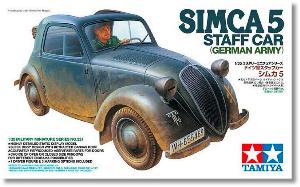
De un vistazo – Quick look
MATERIAL Y PIEZAS
MEDIA & PARTS:
- Plástico inyectado (50 piezas), plástico transparente (7 piezas). Incluye una figura (5 piezas).
- Injected plastic (50 parts), clear plastic (7 parts). One figure included (5 parts).
CALCAS – DECALS:
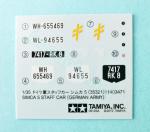
- Matrículas, instrumentos del salpicadero y marcas tácticas. Impresión fina y muy brillante, saturadas de color denso, mínimo exceso de soporte.
- Number plates, dashboard gauges and tactical markings. Thin and very glossy appearance, with good register end color density. Minimal surplus carrier film.
OPCIONES – OPTIONS:
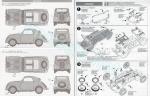
- SIMCA 5. Wehrmacht. 3ª División de Infantería. Frente Oriental.
- SIMCA 5. Luftwaffe. Fecha y lugar desconocidos.
- SIMCA 5. Vehículo civil durante la Segunda Guerra Mundial. Francia.
- SIMCA 5. Wehrmacht. 3rd Infantry Division. Eastern Front.
- SIMCA 5. Luftwaffe. Date and location unknown.
- SIMCA 5. Civilian vehicle in WWII. France.
INSTRUCCIONES – INSTRUCTIONS:
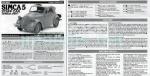
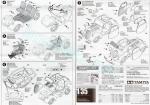
- Folleto vertical impreso en blanco y negro. Muestra 7 secuencias de montaje y perfiles. Un segundo folleto impreso en blanco y negro contiene un sumario histórico en varios idiomas con especificaciones técnicas y vistas del vehículo.
- Vertical leaflet printed in black and white. It shows 7 assembly steps and profiles. A second leaflet printed in black and white contains a historical summary in several languages with technical specifications and views of the vehicle.
LO MEJOR – THE BEST:
- Buen detalle general. Facilidad de montaje.
- Nice overall detail. Ease of assembly.
LO PEOR – THE WORST:
- Marcas de eyector. Pequeños detalles en las puertas y rueda de repuesto.
- Pin marks. Small details on the doors and spare wheel.
VALORACIÓN – CONCLUSION:
- La maqueta junta gran calidad en el molde con sencillez de montaje, aunque en ocasiones Tamiya simplifique en demasía. Pese al reducido tamaño de este automóvil, la maqueta tiene grandes posibilidades de presentación en cualquier escena. Apta para una mayoría de modelistas.
- The kit combines high-quality molding with ease of assembly, although Tamiya sometimes oversimplifies things. Despite its small size, the kit offers great display potential in any scene. Suitable for most modelers.

La maqueta
Con la excepción de varias motocicletas, seguramente Tamiya jamás ha lanzado un vehículo militar en la escala 1/35 tan pequeño como este. Hasta hoy sigue siendo la única maqueta de plástico del SIMCA 5 en dicha escala. Tal vez Tamiya le dio a Bronco Models la idea para su Fiat Topolino, cuyas primeras maquetas también retratan coches militares alemanes e italianos. No es de extrañar, porque el automóvil francés es pariente directo del original italiano Fiat 500 Topolino.
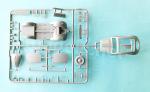
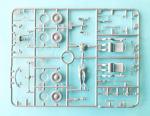
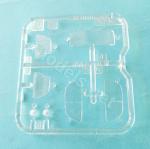
La caja contiene dos bastidores de piezas grises con un total de 50 piezas, un bastidor transparente, la hoja de calcas y las instrucciones. Como es habitual, el moldeado de las piezas es excelente y únicamente hay marcas de eyector visibles en los asientos, el interior de las puertas y los faldones de los guardabarros delanteros. Afortunadamente, no van a dar mucha guerra porque son débiles y pequeñas. También encontramos un par de rechupes muy leves en los asientos sin demasiada importancia, ya que se puede cubrir con facilidad.
El montaje es muy sencillo y no sólo por el menguado número de piezas, sino también porque Tamiya suele sacrificar parte del despiece para facilitar la construcción del modelo. Como ejemplo en esta maqueta valga el suelo de la carrocería, una pieza que incluye una parte del chasis, los guardabarros y el suelo del habitáculo.
La posibilidades de pintura que ofrece esta caja no son ni originales ni atractivas porque consisten en dos vehículos alemanes pintados de gris y otro civil francés de color negro.
Revisión
La maqueta de esta especie de huevo con ruedas se inicia con la suspensión y dirección. Como he mencionado, el suelo de la carrocería es de una pieza y contiene el suelo del habitáculo, los guardabarros y el compartimento del motor, aunque este sólo está reproducido parcialmente por debajo. La cara inferior muestra algunas molduras y parte de los largueros del bastidor. En la parte delantera de los guardabarros hay que taladrar varios agujeros para instalar posteriormente la placa de matrícula y los paragolpes.
En el tren delantero tenemos el eje y una fina barra estabilizadora por separado. Estas piezas van pegadas por encima de la parte inferior del motor. Tras pegar el árbol de la transmisión, a este eje se le añade la parte delantera del bastidor, moldeada con un travesaño, la caja de cambios, que tampoco está completa, y los brazos de la suspensión inferiores. Los superiores no están reproducidos. En la parte trasera el eje con su diferencial viene moldeado con un travesaño que muestra dos soportes de la carrocería en los extremos y las ballestas, complementadas por dos brazos articulados aparte.
Con tantos elementos unidos en pocas piezas, la construcción de la base del vehículo se termina con rapidez, quedando solamente por añadir el fino tubo de escape, los faldones de los guardabarros delanteros y las ruedas. Estas últimas están divididas en dos piezas, con la llanta interna separada y un rodamiento de plástico en su interior para facilitar el acoplamiento al eje. El detalle en la llanta exterior y el neumático es limpio y excelente, aunque hay líneas de molde casi imperceptibles sobre la banda de rodadura. La rueda de repuesto está reproducida en su mitad externa, con una pestaña en el contorno para pegarla por dentro a la parte trasera de la carrocería. Esta simplificación puede afectar a la apariencia del modelo, ya que el hueco que deja la rueda puede llegar a verse a través del techo abierto.
El interior no es menos sencillo de montar. Los pedales están moldeados en su lugar. El embrague y freno aparecen erguidos, mientras que el acelerador está simplemente pegado al suelo. El salpicadero va montado en la parte superior de la carrocería, a la que también se une el retrovisor, y muestra los indicadores en limpio relieve con tres pequeñas calcas para detallarlos. Los asientos son de una pieza y muestran buena factura, pese a que las superficies apenas están texturizadas y la cara trasera del respaldo tiene un par de leves marcas que tapar. El montaje se completa con la adición de las palancas de marcha y freno, la columna de la dirección y el volante. La columna carece del mando de los intermitentes. Si se desea añadir la figura es mejor hacerlo antes de pegar la parte superior de la carrocería. Hacerlo posteriormente no parece imposible si no pegamos el volante, aunque debe ser más complicado.
La parte superior de la carrocería está moldeada sin el capó del motor, las puertas, la rueda de repuesto y la lona del techo abierta y recogida en una pieza moldeada con textura realista. Las varillas del bastidor del toldo y los cierres no se incluyen en la maqueta. La carrocería está moldeada con finura y gran definición en las aletas de ventilación, los paneles laterales de acceso al motor, los indicadores sobre los guardabarros así como en las molduras de las puertas y la parte trasera del habitáculo.
El capó exento muestra una nitidez excelente en la parrilla y su moldura circundante, pero le faltan los cierres laterales. Los faros poseen la lente separada con opción para emplear las piezas transparentes ranuradas propias de un vehículo civil o bien las cubiertas de conducción nocturna. Las luces traseras no son transparentes y una de ellas está unida a la matrícula. Los paragolpes y las placa de matrícula vienen también aparte, estas últimas presenta pequeñas marcas de eyector que conviene eliminar.
Las puertas está bien representadas en los dos lados, pero no eran tan delgadas como las de la maqueta. Incluyen las bisagras y las cerraduras, que no están muy bien definidas y además les falta el detalle sobre el borde de las puertas, visible si se dejan abiertas. La parte interna tiene algunas marcas de eyector débiles y visibles.
Las ventanillas laterales son bastante finas y tienen piezas dobladas para colocarlas abiertas o cerradas. El parabrisas es algo más grueso y está detallado con limpiaparabrisas separados.
La figura del conductor comprende cinco elementos: cabeza, brazos y torso, más la cadera y las piernas unidas en una pieza. En general, el moldeado es bastante bueno y el atuendo convincente, apreciándose bien casi todos los detalles del uniforme. Las arrugas de las prendas parecen realistas y bien conseguidas. Las facciones están bien marcadas. Menos positivas, aunque usuales, son las finas líneas de molde a los lados de las piernas, botas y torso. Lo peor a mi juicio son los grandes huecos que hay en gran parte de la espalda y posaderas, que Tamiya ha dejado a propósito para que la figura asiente correctamente en su lugar. Por muy razonable que sea el propósito, parece que a uno le han dado gato menguado por liebre completa.
Como de costumbre, la hoja de calcas está bien impresa. Contiene matrículas, instrumentos del salpicadero y marcas tácticas con un aspecto fino y muy brillante, buena densidad de color y mínimo exceso de soporte.
Las instrucciones están impresas en blanco y negro en un folleto vertical que muestra siete secuencias de montaje y perfiles. Un segundo folleto impreso en blanco y negro contiene un sumario histórico en varios idiomas con especificaciones técnicas y vistas del vehículo. Además de estos dos folletos, Tamiya ha incluido su tradicional hoja de consejos técnicos para montar y pintar el modelo.
Los perfiles de pintura nos ofrecen un automóvil con matrícula de la Wehrmacht y otro de la Luftwaffe, ambos de gris, además de una tercera opción civil francesa pintada de negro. Esta última no parece inadecuada, por mucho que la versión civil se salga del tema que reza en la caja. Muy probablemente habrá modelistas que le encuentren acomodo en sus proyectos. Para quienes deseen algo diferente, Internet ofrece imágenes de vehículos militares con diferentes camuflajes y usos (sanitario, por ejemplo), más otros civiles pintados en dos colores.
Valoración
Fue un acierto de Tamiya lanzar este vehículo por sus grandes posibilidades de presentación pese a su reducido tamaño. Como casi siempre la buena ejecución del molde está al par de la sencillez de montaje.
Quienes pretendan construir y pintar este SIMCA 5 de caja y sin complicaciones no parece que vayan a encontrarle inconvenientes a la maqueta, que, sin embargo, necesita afinar y completar ciertos pequeños detalles, algo que, al menos parcialmente, se puede remediar con fotograbados.◊
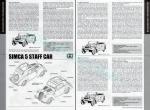

The kit
With the exception of several motorcycles, Tamiya have never released a military vehicle in the 1/35 scale as small as this one. To this day, it remains the only plastic kit of the SIMCA 5 in this scale. Perhaps Tamiya gave Bronco Models the idea for their Topolino, whose first kits also depicted German and Italian staff cars. This isn’t surprising, as the French car is a direct relative of the original Italian Fiat 500 Topolino.
The box contains two sprues of gray parts with a total of 50 pieces, a clear sprue, a decal sheet, and the instructions. As usual, the molding of parts is excellent, and there are only visible ejector pin marks on the seats, the inside of the doors, and the front mudflaps. Fortunately, these won’t cause much trouble because they are small and shallow. There is also a couple of slight sink marks on the seats, but can be easily filled.
Assembly is very simple, not only because of the small number of parts, but also because Tamiya often joins different components in one piece to facilitate this. For example, the body floor is a single piece including part of the chassis, fenders, and cab floor.
Paint choices are neither original nor appealing, consisting of two German vehicles painted gray and one French civilian vehicle painted black.
Review
Construction of this egg-like wheeled vehicle begins with the suspension and steering. As mentioned, the body floor is a single piece including the cab floor, fenders, and engine compartment, although the engine is only partially reproduced underneath. The underside shows some moldings and part of the frame side members. Several holes need to be drilled in the front of the fenders to later install the license plate and bumpers.
At the front, we have the axle and a thin sway bar as separate parts. These are glued above the lower part of the engine. After gluing the driveshaft, the front part of the frame molded with a crossmember, the gearbox (which is also incomplete), and the lower suspension arms are attached to this axle. The upper arms are not reproduced. At the rear, the axle with its differential is molded with a crossmember that shows two brackets at the ends and the leaf springs, complemented by two separate arms.
With so many elements combined into just a few pieces, the vehicle’s base is quickly assembled, leaving only the thin exhaust pipe, the front mudflaps, and the wheels to be added. The wheels are divided into two pieces, with the inner rim separate and a plastic ring inside for attachment to the axle. The detail on the outer rim and tire is clean and excellent, although there are very thin seam lines on the tread. The spare wheel is reproduced in the outer half, with a tab around the edge for gluing it from the inside to the rear of the body. This simplification can affect the model’s appearance, as the internal gap left by the wheel may be visible through the open roof.
The interior is no less simple to build. The pedals are molded in place. The clutch and brake levers are upright, while the accelerator is simply flush with the floor. The dashboard as well as the rearview mirror are attached on the upper body piece. The dashboard shows clean raised gauges with three small decals for detail. The seats are one-piece and well-made, although the surfaces are barely textured and the back of the seatback has a couple of very shallow marks that need cleaning-up. Assembly is completed with the addition of the gear and brake levers, the steering column, and the steering wheel. The column lacks the indicator lever. If you wish to add the figure, it’s best to do so before attaching the upper body. Adding it afterward doesn’t seem impossible if the steering wheel is not in place, but it won’t be easy.
The upper body is molded without the hood, doors, spare tire, and roof canvas. This is provided folded-up with a realistic texture. The canvas wire frame and latches are not provided in the kit. The body is finely molded with great definition in the vents, engine access panels, fender indicators and door moldings.
The detachable hood shows excellent sharpness in the grille and the raised molding around it, but lacks the side latches. The headlights have separate lenses with the option of using the slotted clear lenses typical of a civilian vehicle or black-out covers. The taillights are not transparent pieces, and one of them is molded with the license plate. The bumpers and license plate are also separate; the latter has small ejector marks that should be removed.
The doors are well represented on both sides, but they weren’t as thin as those on the kit. They include hinges and latches which aren’t very well defined, and they also lack the detail on the door edge, visible when the doors were open. As said, the inside has some small pin marks to clean up.
The side windows are quite thin and have alternative pieces to pose them open or closed. The windshield is somewhat thicker and is detailed with separate wipers.
The driver figure comprises five parts: head, arms, and torso, plus the hips and legs joined as one piece. Overall, the molding is quite good, and the clothes are convincing, with almost all the details of the uniform clearly visible. The wrinkles in the clothing look realistic and well done. Facial features are well defined. Less positive, though common, are the fine seam lines along the sides of the legs, boots, and torso. The worst part, in my opinion, is the large gaps across much of the back and buttocks, which Tamiya deliberately left so the figure would fit properly. However reasonable the purpose, one feels to have been taken for a ride.
As usual, the decal sheet is well printed. It includes license plates, dashboard instruments, and tactical markings with a fine, glossy finish, good color density, and minimal excess carrier.
The instructions are printed in black and white in a vertical leaflet showing seven assembly sequences and profiles. A second black and white booklet contains a multilingual historical summary with technical specifications and views of the vehicle. In addition to these two leaflets, Tamiya have included their traditional sheet with tips for assembling and painting the model.
The paint profiles show a Wehrmacht and a Luftwaffe vehicle, both in gray, as well as a third, civilian French option painted black. This last one doesn’t seem unsuitable, even though the civilian version deviates from the topic stated on the box. Some modelers are likely to find a place for it in their projects. For those who want something different, the Internet offers images of military vehicles with different camouflage schemes and uses (medical transport, for example), as well as other civilian vehicles painted in two colors.
Conclusion
It was a smart move by Tamiya to release this vehicle, given its great display potential despite its small size. As is almost always the case, the excellent molding is matched by the ease of assembly.
Those who intend to build and paint this SIMCA 5 straight from the box will likely find it nice and uncomplicated. However, it needs some refinement and completion in a few small details, something that can be at least partially fixed up with photo-etched parts.◊
Publicado – Published: 12 / 2025
©www.jmodels.net
 jmodels.net
Debe estar conectado para enviar un comentario.