
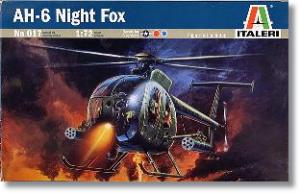
De un vistazo – Quick look
MATERIAL Y PIEZAS
MEDIA & PARTS:
- Plástico inyectado (52 piezas), plástico transparente (7 piezas).
- Injected plastic (52 parts), clear plastic (7 parts).
CALCAS – DECALS:
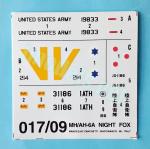
- Impresas por Zanchetti. La hoja contiene insignias israelíes y japonesas, rótulos identificativos, matriculas y algunos estarcidos. Aspecto brillante, buena saturación de color, sin exceso de película. Bien impresas.
- Printed by Zanchetti. The sheet contains Israeli and Japanese markings, registers and some stencils. Glossy appearance, good color saturation without too much carrier. Well printed.
OPCIONES – OPTIONS:
- MH/AH-6A. Fuerzas Especiales de EE. UU. Golfo Pérsico, 1986.
- MD-530. Fuerza Aérea Israelí. Sur del Líbano, 1982.
- OH-6D. Ejército Japonés. Hokkaido, 1990.
- MH/AH-6A. U.S. Special Forces. Arabian Gulf, 1986.
- MD-530. Israeli Air Force. South Lebanon, 1982.
- OH-6D. Japanese Army. Hokkaido, 1990.
INSTRUCCIONES – INSTRUCTIONS:
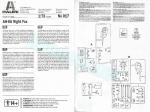
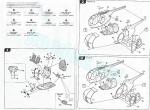
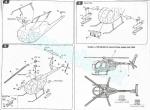
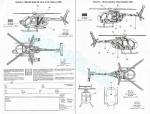
- Folleto doblado de 8 páginas impreso en blanco y negro. Contiene breve historia del helicóptero, un plano numerado de piezas, 6 capítulos de construcción y perfiles. Las referencias de color aparecen en códigos Federal Standard y pinturas acrílicas de Italeri. Claras.
- 8-page folded leaflet printed in black and white. It contains a short history of the helicopter, a numbered parts plan, 6 assembly chapters and profiles. Color references are given in Federal Standard codes and Italeri acrylic paints. Clear.
LO MEJOR – THE BEST:
- Montaje sencillo. Interior detallado. Puede mostrarse el interior.
- Easy build. Nice cockpit detail. Cockpit can be showed.
LO PEOR – THE WORST:
- Algunas (pocas) marcas de eyector en el interior de la carlinga.
- A few pin marks on the cockpit walls.
VALORACIÓN – CONCLUSION:
- Pese a sus años, aún es una buena opción a esta escala tanto por el detalle como por la sencillez de montaje.
- Despite its age, ease of assembly and overall detail still make the kit a a good choice to build this chopper.

La maqueta
Esta maqueta lleva bastante tiempo en el mercado en dos cajas diferentes que básicamente han cambiado poco desde su lanzamiento inicial. El molde de Italeri también lo han empleado Tamiya y Bilek en varias ocasiones.
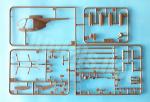
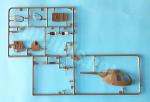
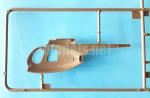
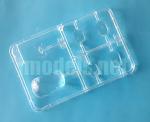
La maqueta se presenta en dos finos bastidores con 52 piezas de plástico verde oscuro, un bastidor transparente con siete piezas, una pequeña hoja de calcas y las instrucciones. Las piezas son finas y están bien moldeadas. No presentan rebabas ni casi tampoco marcas de eyector, sólo hay unas cuantas muy leves y sencillas de disimular en la parte interna del fuselaje. Hay algunas piezas finas y frágiles, como los patines y la hélice de cola, con las que hay que tener un poco más de cuidado al manipularlas. A simple vista la maqueta muestra un despiece bastante sencillo y limpio, lo que nos augura en principio un montaje sin muchas complicaciones.
Las tres versiones de acabado ya han aparecido en ediciones anteriores de esta maqueta y nos ofrecen una versión de transporte y otras dos de ataque dotadas de armamento y dispositivos ópticos diferentes como opciones de montaje.
La maqueta representa distintas versiones del helicóptero Boeing AH-6 “Little Bird” que Italeri ha conjugado en la misma caja por su apariencia externa. La primera es una versión de ataque de las fuerzas de operaciones especiales de los EE. UU., la segunda es un MD-500D apodado TOW Defender dotado con armamento anticarro y la tercera es un OH-6D fabricado en Japón con licencia por Kawasaki.
Cabina
El interior está bien detallado y bastante completo. Sobre un suelo texturizado tenemos dos paneles verticales también detallados, uno de ellos es el mamparo de la cabina que contiene las bases de los asientos y el otro es el mamparo trasero que limita la zona trasera de transporte. Este mamparo está texturizado en relieve con el tejido insonorizante.
La cabina de pilotaje dispone de dos juegos de pedales, dos asientos con sus respectivas palancas de cabezada colectiva, las palancas de control con una base común aparte y un buen panel de instrumentos que tiene los indicadores en relieve sin calca. El habitáculo trasero sólo tiene un dispositivo plano sobre el suelo con dos brazos laterales que, atravesando las puertas del compartimento, sirven de soporte a los lanzacohetes. Las instrucciones aplican esta pieza tanto a la versión norteamericana como al OH-6D japonés, aunque en los perfiles de pintura ambos aparatos no los llevan.
Fuselaje
Las superficies externas están finamente detalladas con paneles representados mediante finas líneas grabadas y remachadas. El fuselaje se compone de dos mitades que incluyen el brazo de cola. La parte frontal acristalada en una pieza transparente. Las puertas del lado derecho aparecen cerradas en la pieza, pero las de babor vienen separadas. La compuerta de la zona trasera no podrá ponerse abierta si decidimos emplear los lanzacohetes, ya que el soporte de ese lado la atraviesa, pero al menos la de la carlinga sí tiene esa opción.
Las piezas transparentes me parecen adecuadas en finura y perfil. El bastidor incluye dos pequeños paneles acristalados a ambos lados del techo, los cristales de las puertas y el acristalamiento frontal. Este es una pieza grabada con finas líneas de panel. Los cristales de las puertas están detallados con pequeñas respiraderos circulares.
El techo tiene una antena de aleta y a los lados de la parte posterior del fuselaje hay escapes para la versión israelí, que cuenta también con un filtro cónico para la tobera posterior. La tobera de las otras versiones es una simple pieza cilíndrica insertada entre las mitades del fuselaje. Los patines son muy finos y vienen de una pieza a cada lado. La alineación con el fuselaje debe ser cuidadosa.
La versión norteamericana dispone de una mira infrarroja bajo la cabina y lanzacohetes ligeros M260 de siete tubos en soportes externos, mientras que la israelí tiene una mira estabilizada a un lado del parabrisas frontal y como armas externas cuenta con lanzadores de misiles anticarro TOW que están representados con los estabilizadores, el soporte y el lanzador en dos mitades.
Rotores y cola
El rotor principal aparenta un montaje bastante sencillo tras haber cerrado el fuselaje. La cabeza cuenta con un eje, una pieza que representa las varillas de control, el carenado de la cabeza y las palas. Estas son finas, tienen cierta flexibilidad y las conexiones con la cabeza están decentemente definidas.
El rotor de cola está formado por un eje situado al extremo del brazo y la hélice, que es bastante fina y delicada de manipular. Por delante del rotor hay una pieza que parece representar algún tipo de antena. La aleta y los estabilizadores son de una pieza, finos y están bien grabados. Los estabilizadores tienen aletas verticales separadas.
Calcas
La hoja, bien impresa por Zanchetti, contiene insignias israelíes y japonesas, rótulos identificativos, matriculas y algunos estarcidos. Las calcas muestran aspecto brillante, buena saturación de color y no tienen exceso de película.
Instrucciones
Se presentan en un folleto doblado de ocho páginas impreso en blanco y negro. Contiene una breve historia del helicóptero, un plano numerado de piezas, seis capítulos de construcción y perfiles. Las referencias de color aparecen en códigos Federal Standard y pinturas acrílicas de Italeri. Las vistas explosionadas son sencillas y dan cuenta con claridad de las opciones de montaje. La cara trasera de la caja está impresa con perfiles de sólo dos de los posibles acabados.
Las opciones de pintura ofrecen suficiente variedad para una maqueta tan pequeña y así tenemos un aparato norteamericano con librea verde, otro israelí también con librea de un color arena y un tercero japonés camuflado.
Valoración
Parece que no pasa el tiempo por esta veterana maqueta y aún es una opción muy atinada para representar este helicóptero en la escala pequeña. El detalle es en general bastante bueno y el montaje no debe presentar especiales dificultades incluso al modelista de nivel más básico.◊

The kit
This kit has been on the market for quite some time in two different boxes that have basically changed little since their initial release. The Italeri tool has also been used by Tamiya and Bilek on several occasions.
The kit arrives in two thin frames with 52 dark green plastic parts, a clear frame with seven pieces, a small decal sheet and the instructions brochure. Pieces are thin and well molded. There is no flash and almost no ejector pin marks. There are only a few of these on the cockpit walls but are small, shallow and will be easy to clean up. There are some thin and fiddly parts, such as the landing skids and the tail propeller, that will need a little more care when handling. At first glance, the kit shows a fairly simple and clean breakup, which predicts an assembly without many complications.
The three paint finishes included in this release have already appeared in previous boxes and depict a transport version and two other attack versions equipped with different weapons and optical devices as assembly options.
The kit represents different versions of the Boeing AH-6 “Little Bird” helicopter that Italeri have combined in the same box due to their common basic origin. The first is an US attack version used by the special forces, the second is an MD-500D often called TOW Defender equipped with anti-tank missiles and the third is an OH-6D manufactured under license in Japan by Kawasaki.
Cockpit
The interior is well detailed and quite complete. The textured floor is provided with two bulkheads, the first one for the pilots cockpit detailed with the seat bases and a rear bulkhead closing the cargo compartment. This bulkhead is textured with raised soundproofing fabric.
The cockpit has two sets of pedals, two seats with their collective pitch control levers, the cyclic control levers with a separate common base and a nice instrument panel with raised gadgets and no decal to depict them. The rear cockpit only has a flat device on the floor with two side arms that, going through the compartment doors, are used as pylons for the rocket launchers. Instructions apply this part to both the US version and the Japanese OH-6D, although both machines do not have them in the paint profiles.
Fuselage
The external surfaces are finely detailed with panels rendered with thin engraved and riveted lines. The fuselage is made up of two halves that include the tail boom. The front glazed panels are a clear piece. The doors on the right side are closed in the piece, but those on the port side are separate. The rear port door cannot be lshowed opened if we decide to use the rocket launchers, since the pylon on that side goes through it, but at least the cockpit door does have that option.
The clear pieces look thin and correctly profiled. The clear frame includes two small glazed panels on both sides of the roof, the door windows and the front glazing. This is a piece with thin engraved panel lines. The door windows are detailed with small round vents.
The roof has a fin antenna and on the rear fuselage sides there are exhausts for the Israeli version, which also has a conical filter for the rear nozzle. The nozzle in the other versions is a simple cylindrical piece inserted between the fuselage halves. The landing skids are very thin and come in one piece on each side. Alignment with the fuselage must be careful.
The US version has an infrared sight under the cockpit and seven-tube M260 light rocket launchers on external pylons, while the Israeli has a stabilized sight on one side of the front windshield and TOW anti-tank missile launchers as external loads. The launchers are represented with the pylon, the mounting and the launcher in two halves.
Rotors and tail
The main rotor looks a fairly simple assembly after the fuselage is closed. The head has a shaft, a piece for the control links, the head fairing and the blades. These are thin, have some flexibility and the grips are decently defined.
The tail rotor is made up of a shaft located at the end of the tail boom and the propeller, which is quite thin and brittle. In front of the rotor is a part that looks like some type of antenna. The fin and stabilizers are one piece, thin and nicely engraved. The stabilizers have separate vertical fins.
Decals
The sheet is printed by Zanchetti. It contains Israeli and Japanese markings, registers and some stencils. Decals have a glossy appearance, good color saturation not too much carrier.
Instructions
They come in an 8-page folded leaflet printed in black and white. It contains a short history of the helicopter, a numbered parts plan, six assembly chapters and profiles. Color references are given in Federal Standard codes and Italeri acrylic paints. Exploded views are easy to follow and show the assembly choices clearly. The back side of the box shows profiles of only two out of the three paint finishes.
Paint options offer enough variety for a small kit such as this and so we have an US overall green chopper, an Israeli overall tan helicopter and a Japanese camouflaged OH-6D.
Conclusion
It seems that time respects this old kit and it is still a very good option to render this helicopter on the small scale. Detail is quite good and assembly should not pose any special difficulties even to the modeller with basic skills.◊
Publicado – Published: 11 / 2023
©www.jmodels.net
 jmodels.net
Debe estar conectado para enviar un comentario.