
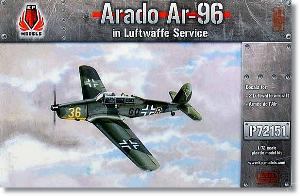
De un vistazo – Quick look
MATERIAL Y PIEZAS
MEDIA & PARTS:
- Plástico inyectado (40 piezas), plástico transparente (4 piezas).
- Injected plastic (40 parts), clear plastic (4 parts).
CALCAS – DECALS:
- Escarapelas alemanas y francesas, matrículas, numerales y algunos estarcidos. Aspecto fino y brillante. Nítidas con buena saturación de color y sin película sobrante.
- German and French markings, registers, numbers and some stencils. Thin and glossy finish. Sharp with good color saturation and no surplus carrier.
OPCIONES – OPTIONS:
- Arado Ar 96B-7. Luftwaffe. Schlachtgeschwader 102. Havlíčkův Brod (Czech Republic). October 1944-March 1945.
- Arado Ar 96B. Luftwaffe. Prague Airport. July 17 1944.
- Arado Ar 96B-1. Armée de l’Air. 1945.
INSTRUCCIONES – INSTRUCTIONS:
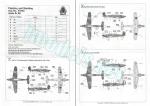
- Folleto de formato A5 de 4 páginas impreso en blanco y negro. Contiene 8 pasos de montaje y un plano numerado de piezas. Una hoja A4 separada impresa en blanco y negro muestra perfiles y una tabla de colores con pinturas equivalentes de Humbrol y Agama.
- 4-page A5 leaflet printed in black and white. It contains 8 assembly steps and a numbered parts plan. A separate A4 sheet printed in black and white shows profiles and a color chart with Humbrol and Agama paints.
LO MEJOR – THE BEST:
- Sencillez de montaje.
- Ease of assembly.
LO PEOR – THE WORST:
- Detalle en relieve. Cubierta de una pieza. Instrucciones.
- Raised detail. One-piece canopy. Instructions.
VALORACIÓN – CONCLUSION:
- No es una maqueta para gustos actuales, pero la pueden aprovechar bien los novatos y a quienes no les importe todo el detalle que KP le puso al revés.
- It’s not a kit for today’s taste, but it can be fit for beginners or those who don’t mind all the raised detail KP molded on it.

La maqueta
El Arado Ar 96 siempre ha tenido cierto predicamento en el modelismo, al menos en esta escala. Durante décadas los dos moldes de referencia y más asequibles eran el de Heller y el de KP, ambos reeditados por otras marcas. Al cabo del tiempo, otros fabricantes se han sumado con moldes nuevos de serie limitada, como Kovozávody Prostějov y Special Hobby.
La antigua maqueta de KP, ahora en manos de KP Models, ha tenido dos versiones básicas: la de la Luftwaffe y el modelo checoslovaco Avia C-2. En este caso, la caja de KP Models reza “in Luftwaffe Service”, pero tiene una tercera versión francesa. Así que “Luftwaffe”, pero menos.
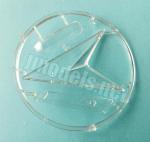
La caja trae tres bastidores de piezas grises, un bastidor transparente, que incluye la peana original de dos piezas, las calcas y las instrucciones. El molde se mantiene en buena forma aún, porque las piezas no tienen defectos de moldeado y sólo se encuentran rebabas, marcas positivas, cilindros del eyector y líneas de molde esparcidas con parquedad en algunas piezas. Nada muy importante a la hora de retirar la morralla superflua.
Que KP le puso ganas al detalle se aprecia en todo lo que hay en el exterior del avión: líneas de paneles y remaches, accesos y registros. Todo muy bien perfilado y definido, pero en relieve. Para quienes esto no sea importante hay que decir que esta maqueta aún puede dar de sí tras 40 años y es una opción que considerar por su sencillez de montaje. Los que quieran algo mejor y no deseen grabar todo eso ni por pensamiento, pueden ir descartando esta maqueta.
Además del montaje bastante asequible a cualquier modelista, en el que KP Models ha mezclado elementos propios del modelo C.2 checoslovaco sin advertirlo, la pintura ofrece tres versiones con camuflaje, pero los códigos de pintura presentes en los perfiles de las instrucciones son completamente erróneos e inservibles. Sobre esto me extenderé un poco luego.
La edición retrata tres versiones del avión: el aparato francés es un Ar 96B-1, un modelo desarmado, y los alemanes son un B, el modelo de mayor producción, y un B-7, una versión de entrenamiento de tripulantes de aviones de ataque y bombarderos en picado que llevaba bombas, como las que hay en la maqueta y que las instrucciones se saltan a la torera. Después de todo, saber esto es irrelevante porque la maqueta es una y la misma, salvo que decidamos ponerle las bombas y decir que es un B-7. Bueno.
Revisión
La carlinga está compuesta por un suelo, los asientos, las palancas, el tablero de instrumentos del piloto y el del tripulante trasero situado sobre un bastidor entre los dos puestos. Lo mejor son los instrumentos, muy bien definidos en los dos paneles. El trasero va pegado a dos soportes a los lados del fuselaje. Los asientos son demasiado anchos y bajos, más propios para contener a un consumidor habitual de alimentos ultraprocesados, además de tener sendas marcas positivas en su fondo. Los lados de la carlinga vienen lisos, sin detalle pero también sin marcas. La cubierta es de una pieza más bien fina, bastante transparente pero distorsionada y con el bastidor en fino relieve. Tiene mejor aspecto que factura.
Los lados del fuselaje incluyen las superficies verticales de cola. El detalle de los paneles está moldeado todo él en relieve y el lado izquierdo incluye el mástil de la antena. A los lados del capó tenemos un par de escapes separados, más bien malos, y a un lado de la cabina un carenado abultado aparte. El capó dispone también de una tronera carenada con un cañón del arma simplón y descartable. Estos dos carenados parecen pertenecer en realidad al C.2 checoslovaco y no al Ar 96 alemán, que también los llevaba, pero no en todas las versiones y no siempre a juzgar por las fotos que he visto.
El frontal del motor viene separado con la toma inferior cegada. La hélice está moldeada parcialmente con un buje cuadrado en lugar de redondo que puede rectificarse con cuidado. La pieza es usable una vez que se le hayan limpiado las líneas de molde en los bordes de fuga. El característico buje con aletas me parece bien representado y viene aparte.
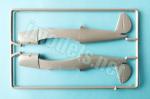
Las alas se presentan en tres piezas, una de ellas reproduce todas las superficies inferiores. Para pegarlas hay diminutos vástagos de unión en medio de las superficies, no en las puntas como es lo acostumbrado. Los alerones y flaps tienen acaso demasiada holgura en las líneas grabadas, pero llevan las bisagras visibles, aunque simples, en la parte inferior. Las piezas muestran ligeras rebabas en las puntas fácilmente eliminables. Todo el esfuerzo que KP quiso ponerle a las alas para reproducir el detalle es digno de mejor causa al estar en relieve muy fino. Hay líneas que plasman la estructura de las alas, pero también líneas de remaches diminutos, accesos remachados y hasta los pozos, que están cerrados, tienen este tipo de detalle en su interior.
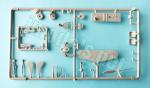
Bajo las alas tenemos el tubo Pitot más un faro transparente situado bajo el ala de babor que me resulta muy extraño y que no corresponde a la luz de aterrizaje plana situada justo en ese lugar en la versión alemana. Uno de los bastidores incluye otro pequeño bastidor en su interior. Contiene una rueda de cola carenada, un par de bombas y sus soportes. Las instrucciones omiten estas piezas. Las bombas, naturalmente, podría ir en la versión B-7 y tanto los artefactos como los soportes son bastante decentes.
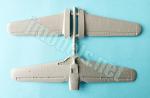
Los estabilizadores están moldeados de una pieza que se monta en una ranura practicada en el puro de cola. Todas las superficies de cola llevan los timones bien grabados y el detalle superficial es similar al de las alas, pero aún más delgado si cabe.
El tren de aterrizaje principal comprende las patas, las ruedas y las tapas. De estos elementos, se puede rescatar la extrema finura de las tapas, bien detalladas por fuera. Lo demás es simplemente pasable, pero se puede emplear en la maqueta. La rueda posterior aparece sin carena, aunque también sirve la carenada que omiten las instrucciones.
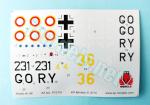
La hoja de calcas parece bien impresa. Lleva escarapelas alemanas y francesas, esvásticas en mitades, matrículas, numerales y algunos estarcidos de aspecto fino y brillante. Todas muestran nitidez con buena saturación de color y sin película sobrante. Desgraciadamente, no se han incluido calcas para los colores de la bandera francesa presentes en el timón del aparato galo, por tanto hay que pintarlos.
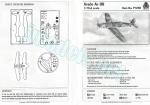
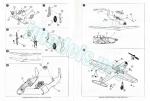
Las instrucciones se presentan en un folleto de formato A5 de cuatro páginas impreso en blanco y negro que contiene ocho pasos de montaje y un plano numerado de piezas al que le faltan elementos. Una hoja A4 separada impresa en blanco y negro muestra perfiles y una tabla de colores con pinturas equivalentes de Humbrol y Agama. Las referencias de pintura que muestran los perfiles son casi todos erróneos, y por tanto inservibles. A juzgar por los patrones de camuflaje de los tres aviones, el francés incluido, los colores más acertados deberían ser RLM 70 y 71 sobre RLM65. Al menos esa es una de las libreas que empleaba el Ar 96. Otra llevaba el soseras RLM02 por todas partes.
Valoración
Lo mejor que se puede decir de este Ar 96 es que es sencillo de montar y que su detalle interno no es más escaso que el de otras maquetas de su calaña. Habrá a quienes cause dentera ver todo ese detalle en las alas y el fuselaje puesto del revés, pero supongo que a otros menos puntillosos no les importará tanto mientras al menos está ahí donde debe. Para el modelista aprendiz o para el todoterreno puede ser todavía una maqueta bien aprovechable, pese a que las instrucciones le van a ayudar lo justo y aún menos.◊

The kit
The Arado Ar 96 has never been overlooked by brands at least in the 1/72 scale. For decades, the two most widely available kits were those from Heller and KP, both of which were reboxed by other manufacturers. Over time, other companies have joined in with new, short-run kits, such as Kovozávody Prostějov and Special Hobby.
The old KP kit, now a product of KP Models, has had two boxings: the Luftwaffe version and the Czechoslovakian Avia C-2. In this case, the KP Models box reads «in Luftwaffe Service,» but it includes a third, French version. So, it’s «Luftwaffe,» but less so.
The box contains three sprues of grey parts, a clear sprue (which still has the original two-piece stand), the decals, and the instructions. The tool is still in good shape, as parts have no molding blemishes and only minor flash, raised pin marks, ejector cylinders, and scattered seam lines are found on some pieces. Nothing too significant when removing the excess material.
KP’s attention to detail is evident throughout the external surfaces: panel lines and rivets, access points, and hatches. Everything is very well-defined and outlined, but embossed. For those who don’t consider this important, it’s worth noting that this kit still has potential after 40 years and is an option to consider due to its ease of assembly. Those who want something better and don’t want to bother with all that raised detail can simply dismiss this kit.
In addition to the fairly straightforward assembly for any modeler, in which KP Models has inadvertently mixed elements from the Czechoslovakian C.2, paint finishes offer three camouflage versions, but the paint codes in the instructions are incorrect and unusable. More on this below.
The kit depicts three versions of the aircraft: the French trainer is an unarmed Ar 96B-1, and the German variants are a B, the most widely produced version, and a B-7, a training version for attack and dive-bomber crews that could carry bombs, like the ones included in the kit, which are completely overlooked in the instructions. Ultimately, this is irrelevant because the kit is just one and the same, unless we decide to add the bombs and call it a B-7. OK.
Review
The cockpit consists of a floor, seats, levers, the pilot’s instrument panel, the rear instrument panel plus a frame between the two seats. The best feature are the panels, showing very well defined instruments. The rear is attached to two brackets on the fuselage sides. The seats are too wide and low and they also have positive mark inside. The cockpit sides have no detail, but they are also clean from marks. The canopy is a single, rather thin piece, quite transparent but distorted, with the frame molded subtly raised. It looks better than it actually is.
The fuselage halves include the vertical tail surfaces. All the panels are molded raised and the left side includes the antenna mast. On either side of the cowling, there are a pair of separate, rather poor exhausts, and on one side of the cockpit, a separate, bulky fairing. The cowling also features a faired trough with a simple, disposable gun barrel. These two fairings seem to actually belong to the Czechoslovakian C.2 and not to the German Ar 96, which also had them, but not in all versions, judging from the pictures I’ve checked.
The engine front comes separate with the lower air intake closed. The propeller is partially molded with a square hub instead of a round one, which can be corrected with some care. The propeller is usable once the seam lines on the trailing edges have been cleaned up. The characteristic finned hub seems well represented and is a separate piece.
The wings come in three pieces, one of which reproduces all the underside surfaces. For alignment, there are tiny pins in the middle of the surfaces, not on the tips as is customary. The ailerons and flaps may have too wide engraved lines, but they have visible, albeit simple, hinges on the underside. The pieces show slight flash on the tips, but it’s easily removable. All the effort KP put into reproducing the detail on the wings is worthy of a better cause, seeing the very thin raised lines. There are lines depicting the wing structure, lines of tiny rivets, riveted registers, and even the wheel wells show rivets inside. Under the wings, we have the Pitot tube plus a clear spotlight under the port wing, which I find very strange and does not correspond to the flat landing light located in that exact spot on the German version. One of the sprues includes another small frame with a faired tailwheel, a pair of bombs, and the racks. The instructions omit these parts. The bombs, naturally, could be used with the B-7 variant, and both the bombs and racks are quite decent.
The stabilizers are molded in a single piece that fits into a slot in the tail boom. All the tail surfaces have well-engraved rudders, and surface detail is similar to that on the wings, but even finer.
The main landing gear comprises the legs, wheels, and covers. Of these, the fine covers, which are well-detailed on the outside, are the best. The rest is merely passable, but can be used in the kit. The tailwheel appears without a fairing, although the faired one omitted in the instructions is also appropriate.
The decal sheet looks well printed. It includes German and French markings, swastikas in halves, registers, aircraft numbers and stencils. All of them have a thin and glossy appearance, are sharp with good color saturation and no surplus carrier film. Unfortunately, decals for the French flag colors on the rudder are not included, so these must be painted.
The instructions come in a 4-page A5 leaflet printed in black-and-white containing eight assembly steps and a numbered parts diagram with some parts missing, as said. A separate black-and-white A4 sheet shows profiles and a color chart with equivalents in Humbrol and Agama paints. Paint codes shown on the profiles are mostly incorrect and therefore unusable. Judging from the camouflage patterns of the three aircraft, including the French one, the most accurate colors would be RLM 70 and 71 over RLM 65. At least that’s one of the liveries used by the Ar 96. Another one was the dull RLM02.
Conclusion
The best thing that can be said about this Ar 96 is that it’s easy to build and the cockpit detail is no more scarce than in other kits of its kind. Some might find it jarring to see all that detail on the wings and fuselage upside down, but I suppose less demanding modelers won’t mind as long as it’s all there. For the novice modeler or the tough cookies, it can still be a very useful kit, even though the instructions will be of minimal help, if any.◊
Publicado – Published: 11 / 2025
©www.jmodels.net
 jmodels.net
Debe estar conectado para enviar un comentario.