
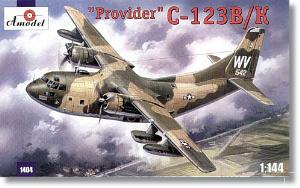
De un vistazo – Quick look
MATERIAL Y PIEZAS
MEDIA & PARTS:
- Plástico inyectado (73 piezas), plástico transparente (21 piezas).
- Injected plastic (73 parts), clear plastic (21 parts).
CALCAS – DECALS:
- Insignias norteamericanas, matrículas y registros, marcas de fuselaje y alas, líneas de no pisado más algunos estarcidos. Aspecto satinado y fino. Colores saturados. Un poco de exceso de soporte.
- US markings, registrations and numbers, fuselage and wing lines, wing walk lines plus some stencils. Thin and satin appearance. Saturated colors. A bit excess of carrier.
OPCIONES – OPTIONS:
- C-123B Provider 40569. USAF. Elmendorf AFB (Alaska), 1969.
- C-123K Provider. 55-4542.USAF. 834th Air Division. Tan Son Nhut AB (South Vietnam). May 1968. Aircraft flown by Lt. Col. Joe Jackson (Medal of Honor).
INSTRUCCIONES – INSTRUCTIONS:
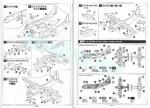
- Folleto de formato A4 de 4 páginas impreso en blanco y negro. Contiene un sumario histórico sobre el avión, un plano numerado de piezas, 13 pasos de construcción y perfiles. Las referencias de color pertenecen a la gama de pinturas esmaltes de Humbrol.
- 4-page A4 brochure printed in black and white. It shows a historical summary about the aircraft, a numbered parts plan, 13 construction chapters and profiles. Color references belong to Humbrol enamel range.
LO MEJOR – THE BEST:
- Carlinga detallada. Montaje relativamente sencillo. Opciones de pintura diferentes.
- Detailed cockpit. Relative ease of assembly. Varied paint choices.
LO PEOR – THE WORST:
- Montaje de los paneles bajo el fuselaje. Tren de aterrizaje frágil.
- Assembly of panels under the fuselage. Brittle undercarriage assembly.
VALORACIÓN – CONCLUSION:
- Con la salvedad de tratarse de una maqueta con edición limitada, tiene un detalle decente en general y no debe ser muy complicada de construir para quienes tengan experiencia. La edición y sus continuaciones son las únicas de un Provider en esta escala por ahora.
- With the caveat that it’s a short-run kit, it has decent detail overall and shouldn’t be too difficult to build for those with experience. This boxing and its sequels are the only ones of a Provider in this scale so far.

La maqueta
Se trata de la primera caja del molde lanzado por Amodel en 2005, al que la marca añadió otras cajas con distintas versiones de este avión, como el HC-123B (versión Guardacostas); C-123J con esquíes para operaciones árticas; UC-123B/K, adaptado a misiones de defoliación sobre Vietnam; y NC/AC-123K, variante configurada para la vigilancia nocturna con sensores especiales.
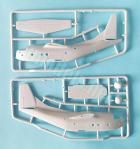
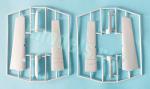
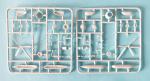
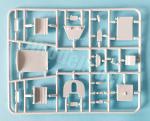
La maqueta comprende ocho bastidores más otro transparente, la hoja de calcas y las instrucciones. Para el estándar de serie limitada que suele emplear Amodel, las piezas están bien moldeadas, no presentan marcas de eyector y las rebabas son reducidas. Algunas en el fuselaje y los pozos necesitan un poco de limpieza. Las líneas de paneles y otros detalles del fuselaje y las alas están bien grabadas y son muy delgadas. Seguramente algún modelista se planteará repasar muchas de ellas para no perderlas tras aplicar pintura.
Sin ser una maqueta para bisoños, el montaje no parece difícil para quien tenga experiencia. Lo que veo peor son las tres piezas planas que simulan la panza y compuerta del avión, pegadas una tras otra. Me da que ajustarlas sin que se noten las uniones no va a ser fácil.
Las dos variantes propuestas en esta caja tenían una apariencia muy parecida, pero el modelo K llevaba además dos turborreactores General Electric J85 debajo de las alas para conseguir mayor potencia al despegue, lo que le permitía operar con más carga en pistas de menor longitud. Esta es la única alternativa de montaje en la maqueta.
Las opciones para pintar la maqueta presentan claras diferencias, con un C-123B en color aluminio y un C-123K empleado en Vietnam con el camuflaje común del Provider y otros aviones de la USAF en ese teatro de operaciones.
Revisión
La carlinga está bien provista para lo que los fabricantes suelen ofrecer en esta escala. Contiene un suelo detallado con dos asientos con reposacabezas, los controles y la consola central El panel tiene los instrumentos bien definidos en negativo y va pegado a una de las mitades del fuselaje. En la parte posterior hay un mamparo sin detalle con la puerta de acceso a la carlinga separada. Los lados del fuselaje están limpios de marcas.
El parabrisas es relativamente fino y los paneles están bien grabados. La cara interna contiene una consola de instrumentos adicional, pero muy estrecha y elevada. Todas las ventanillas y paneles acristalados del fuselaje son bastante delgados y van colocados desde afuera. Hay rebabas que limpiar en algunos huecos, como he dicho antes.
No hay propiamente suelo en la bodega, sino tres piezas que forman la zona ventral del fuselaje dispuestas de forma consecutiva. Las dos primeras están grabadas por fuera y una de ellas presenta una pequeña toma adicional. La rampa de carga no está grabada y la maqueta no admite, en principio, la opción de colocarla abierta. La sección del techo de la bodega situada bajo las alas viene separada. Parece que la pieza no tiene otro objeto que simular las lengüetas que fijan las alas al fuselaje. Estas ranuras están cegadas por el plástico y hay que abrirlas.
Antes de cerrar el fuselaje hay que colocar los pozos de las ruedas. El delantero va pegado bajo la carlinga. La pieza trae un poco del detalle interior, tiene las tapas aparte, una pata muy simple y las ruedas, con los neumáticos y las llantas definidos. Creo que se pueden dar por buenas. Los pozos del tren principal se añaden sobre huecos abiertos en el fuselaje. Ambas piezas tienen líneas en relieve por dentro para adecentarlos un poco. Las patas son también muy simples y van sencillamente pegadas sobre el lado interno del fuselaje, lo que no parece que le vaya a dar mucha firmeza. Por contra, las ruedas son más que decentes y el detalle de las llantas me parece bien conseguido y limpio. Las tapas de los pozos no son demasiado gruesas.
Las mitades del fuselaje incluyen el filete dorsal, que por cierto tiene una de sus mitades sin grabar, y las superficies verticales de la cola. El morro también está separado porque en los bastidores encontramos una pieza alternativa para el radomo empleado en otras versiones de la maqueta. La única pieza aparte es una pequeña toma colocada por detrás de la carlinga.
Tanto las alas como las góndolas de los motores están separadas en mitades. Las mitades inferiores de las alas se pegan engastadas en las superiores. Esto deja una línea demasiado evidente en las superficies de control por debajo. Las puntas muestran las luces de navegación definidas y también tenemos los faros de aterrizaje en piezas transparentes.
Las góndolas tienen grabados los paneles muy finos, como en las alas y el fuselaje. Los capós, de una pieza, llevan los motores pegados en el interior y en estos los cilindros están mal definidos pero vienen en general limpios. Las hélices son más que aceptables y muestran las palas delgadas y las puntas con la forma correcta. El eje viene por separado. Para alinear bien las góndolas hay un par de líneas en relieve sobre cada ala.
Bajo las alas hay dos depósitos auxiliares, comunes para las dos versiones de la caja, con el soporte separado. Para el C-123K tenemos además las góndolas de los reactores J85 con las salidas de la tobera y los soportes aparte. La toma frontal tiene la puerta en posición cerrada.
Los estabilizadores y sus timones están moldeados en una pieza insertada en la cola. El grabado de los paneles es fino y la separación de los timones está bien lograda. El timón vertical está moldeado en una de las mitades del fuselaje.
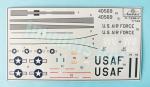
La hoja de calcas muestra insignias norteamericanas, matrículas y registros, marcas del fuselaje y las alas, líneas de no pisado más algunos estarcidos, todos ellos con un aspecto satinado y fino. Los colores parecen bien saturados y no hay exceso de soporte.
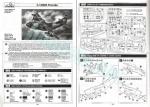
El folleto de instrucciones tiene un formato A4 y consta de cuatro páginas impresas en blanco y negro. Contiene un sumario histórico sobre el avión, un plano numerado de piezas, trece pasos de construcción y perfiles. Las referencias de color pertenecen a la gama de pinturas esmaltes de Humbrol.
La identificación de las dos versiones es muy escueta, pero he encontrado algo más sobre el C-123K con número de serie 55-4542 en la revista norteamericana Air & Space Forces Magazine. Este aparato fue el que empleó el Teniente Coronel Joe Jackson en mayo de 1968 durante la batalla en la base de Kham Duc. Durante la misma logró rescatar, bajo un intenso fuego enemigo, a los últimos militares norteamericanos cercados. Esta acción le valió la Medalla de Honor del Congreso. Un perfil de este avión aparece en el antiguo libro de Squadron Signal C-123 Provider in Action y es también una de las opciones de pintura de la maqueta de Roden de escala 1/72 Fairchild C-123K / UC-123K (ref. 057).
Valoración
Para quienes sientan inclinación por los aviones empleados en la Guerra de Vietnam y no tengan mucho espacio en la vitrina, esta es una edición recomendable siempre que se tengan, nunca mejor dicho, horas de vuelo a las espaldas. Considerando su molde de serie limitada, la maqueta tiene un detalle bastante decente, no parece muy ardua de construir y posee distintas opciones de pintura.◊

The kit
This is the first box from the new tool produced by Amodel in 2005. Later on, the company added other kits with different versions of this aircraft, such as the HC-123B (Coast Guard version); the C-123J with skis for Arctic operations; the UC-123B/K, adapted for defoliation missions over Vietnam; and the NC/AC-123K, a variant configured for night surveillance with special sensors.
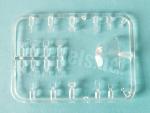
The kit comprises eight sprues plus one clear sprue, a decal sheet, and the instructions. For the short-run standard that Amodel usually employ, parts are well molded, show no ejector pin marks, and have minimal flash. Some cleanup is necessary on the fuselage and wheel wells. Panel lines and other details on the fuselage and wings are well-engraved and very thin. Some modelers will likely consider refining some of these to avoid losing them after painting.
While not a kit for beginners, assembly doesn’t seem difficult for those with experience. What I find most problematic are the three flat pieces that simulate the belly and cargo door of the aircraft, glued one after the other. I suspect that fitting them together without the seams being noticeable won’t be easy.
The two variants offered in this kit had a very similar appearance, but the K model also featured two General Electric J85 turbojet engines under the wings for greater takeoff power, allowing it to operate with a heavier load on shorter runways. This is the only assembly alternative in the kit.
Paint choices are clearly different, with a C-123B in aluminum and a C-123K used in Vietnam in the usual camouflage of the Provider and other USAF aircraft in that theater of operations.
Review
The cockpit is well-stuffed for what manufacturers typically offer in this scale. It features a detailed floor with two seats with headrests, the controls, and the center console. The instrument panel has clearly defined negative gauges and is attached to one of the fuselage halves. There’s also a rear bulkhead without detail, with the cockpit door separate. The fuselage sides are clean from markings.
The windshield is relatively thin, and the windows are cleanly engraved. The inner side contains an additional instrument console, but it’s very narrow and high. All the fuselage windows and glazed panels are quite thin and fitted from the outside. There’s some flash that needs cleaning in a few window gaps, as I mentioned before.
There isn’t a proper floor in the cargo hold, but rather three pieces that form the ventral section of the fuselage, arranged consecutively. The first two are engraved on the outside, and one of them has a small additional intake. The loading ramp isn’t engraved, and the kit doesn’t, in principle, allow for the option of displaying it open. The section of the cargo hold roof under the wings comes separately. It appears that this piece is there only to hide the tabs that attach the wings to the fuselage. These slots are closed by plastic and need to be opened.
Before closing the fuselage, the wheel wells need to be attached. The front one is glued under the cockpit. The part includes some interior detail, separate covers, a very simple landing gear leg, and the wheels with defined tires and rims. I think these are acceptable. The main landing gear bays are added on the fuselage interior. Both parts have raised lines inside to make them look a bit neater. The landing gear legs are also very simple and are just glued on the inner fuselage sides and look too brittle. On the other hand, the wheels are more than decent, and the rim detail looks well done and clean. The wheel well covers aren’t too thick.
The fuselage halves include the fin root fillet faring, which, by the way, shows one side without engraved panels, and the vertical tailplanes. The nose is also separate because there is an alternative part for the radome used in other versions of the kit. The only separate part is a small intake behind the cockpit.
Both the wings and engine nacelles are separated into halves. The lower wing halves are fitted in place on the upper ones. This leaves a rather obvious line on the control surfaces underneath. The wingtips show clearly defined navigation lights, and the landing lights are also included as clear pieces.
The engine nacelles show thin panels as those on the wings and fuselage. The one-piece cowlings have the engines glued inside; the cylinders are poorly defined but generally clean. The propellers are more than acceptable, showing thin blades and correctly shaped tips. The shaft is separate. There is a couple of raised lines on each wing to align the nacelles.
Under the wings are two auxiliary fuel tanks, common to both versions, with separate pylons. For the C-123K, we also have the J85 engine nacelles with separate nozzle outlets and pylons. The engine front intake has the door in the closed position.
The stabilizers and elevators are molded as a single piece inserted into the tail. Panel lines are finely etched, and the rudder spacing is well done. The vertical stabilizer is molded with one of the fuselage halves.
The decal sheet shows USAF markings, serial numbers and registrations, fuselage and wing markings, wing walk lines, and some stencils. All of them have a fine, satin finish. Colors appear well-saturated, and there is no excess carrier film.
The A4 instruction brochure has four pages printed in black and white. It contains a historical summary of the aircraft, a numbered parts diagram, thirteen assembly steps, and profiles. Color references are from the Humbrol enamel paint range.
The identification of the two versions is very short, but I found some more information about the C-123K with serial number 55-4542 in the American Air & Space Forces Magazine. This aircraft was flown by LtCol Joe Jackson in May 1968 during the battle at Khan Duc Air Base, when he managed to rescue, under intense enemy fire, the last of the surrounded American servicemen. This action earned him the Congressional Medal of Honor. A profile of this aircraft appears in the old Squadron Signal book C-123 Provider in Action and is also one of the paint options for the Roden 1/72 Fairchild C-123K / UC-123K kit (ref. 057).
Conclusion
For those with a penchant for aircraft used in the Vietnam War but limited space on the shelf, this is a recommended box, provided you have, quite literally, plenty of flying experience. Considering its short-run tooling, the kit has a fairly decent level of detail, doesn’t look too difficult to build, and offers varied paint options.◊
Publicado – Published: 12 / 2025
©www.jmodels.net
 jmodels.net
Debe estar conectado para enviar un comentario.