
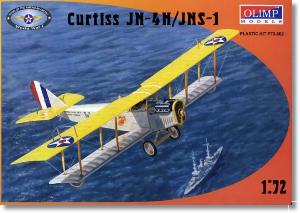
De un vistazo – Quick look
MATERIAL Y PIEZAS
MEDIA & PARTS:
- Plástico inyectado (107 piezas).
- Injected plastic (107 parts).
CALCAS – DECALS:
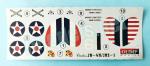
- Escarapelas norteamericanas y marcas de cola, números e insignias de unidad. Acabado fino y brillante, saturadas de color y con buen registro. Aparentemente bien impresas.
- US roundels and tail markings, numbers and unit badges. Thin and glossy finish, color-saturated and in register. Apparently well printed.
OPCIONES – OPTIONS:
- Curtiss JN-4H Jenny. U.S. Navy. Miami, 1922.
- Curtiss JNS-1 Jenny. U.S.A.A.C. 1927.
INSTRUCCIONES – INSTRUCTIONS:
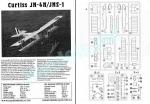
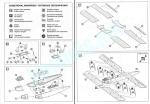
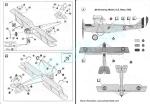
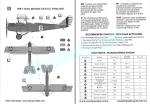
- Folleto A5 de 8 páginas impreso en blanco y negro. Muestra un sumario histórico sobre el avión, un plano numerado de piezas, 7 capítulos de montaje, dos páginas de perfiles y una tabla de colores con equivalencias de pinturas de Humbrol, Model Master y Revell.
- 8-page A5 booklet printed in black and white. It contains a historical summary about the aircraft, a numbered parts diagram, 7 assembly chapters, two pages of profils and a color chart with matches from Humbrol, Model Master and Revell ranges.
LO MEJOR – THE BEST:
- Tema inusual. Detalle suficiente para la escala. Acabados atractivos.
- Unusual topic. Enough detail for the scale. Attractive paint finishes.
LO PEOR – THE WORST:
- Falta de parabrisas transparentes. Montaje de los soportes alares (ver texto).
- Lack of clear windshields. Wing struts assembly (see text).
VALORACIÓN – CONCLUSION:
- Tras la desaparición del fabricante, es difícil de encontrar salvo de segunda mano. Excepto en las alas, al modelista experto no se le atragantará el montaje de esta relativamente asequible maqueta que cuenta con acabados atractivos.
- After the manufacturer disappeared this kit can only be found in the second-hand market. It won’t be a hard build for the expert modeller except (maybe) for the wing assembly. Nice paint finishes are always an extra appeal in US interwar aircraft.

La maqueta
Hace ya tantos años que no sabemos nada de Olimp Models como para no pensar que esta marca ucraniana ha desaparecido como humo en el viento. El magro catálogo de la casa incluía hasta seis versiones del Curtiss JN-4 Jenny, tres de ellas del modelo JN-4 y una del hidro N-9H. La maqueta objeto de esta revisión contiene un modelo naval y otro del USAAC y obviamente comparte molde con las demás ediciones.
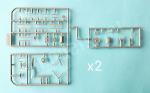
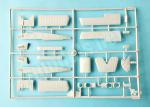
La caja contiene tres bastidores, dos de ellos idénticos, las calcas y las instrucciones. Las piezas están correctamente moldeadas y no muestran marcas de eyector en lugares visibles. Sin embargo, algunas piezas tienen ligeras rebabas que limpiar en la hélice, pedales y soportes de las alas. La reproducción del entelado sobre la estructura interna parece mejor conseguida en las alas que en el empenaje, donde resulta un tanto exagerado y menos convincente.
Otro aspecto que destacar es la ausencia de piezas transparentes para los parabrisas. Ciertamente las fotos de este avión demuestran que algunos Jenny civiles no los llevaban, pero no parece ser el caso en los aviones militares.
La maqueta ofrece la posibilidad de construir tanto el modelo naval JN-4H, variante que incorporaba novedades respecto al JN-4D anterior en su motor más potente, mayor capacidad de combustible, fuselaje reforzado y radiador más grande, como la variante JNS-1 (Standarized) del USAAC. Este modelo resultó de la normalización de equipamiento realizado a unos 200-300 aparatos a finales de los años 20.
Carlinga
Los lados internos de las carlingas están libres de marcas y muestran escaso detalle en relieve simulando la estructura interior. Los suelos de ambos puestos van unidos por debajo de un bastidor común sobre el que se pegan los asientos, que son sencillos, de buenas hechuras y carecen de marcas. Cada suelo está detallado con la palanca de mando y los pedales. Los paneles son gruesos y poseen calcas muy nítidas para los instrumentos.
El panel del fuselaje que contiene los huecos de acceso a las carlingas viene separado en una pieza algo gruesa que muestra el acolchado protector bien definido. Como he mencionado, faltan los parabrisas, piezas que deberá fabricar el modelista.
En general, el detalle interno me parece básico pero suficiente para un avión entrenador como este.
Fuselaje y motor
Las mitades del fuselaje carecen de paneles grabados salvo en el cubremotor y los estribos de acceso. Como mencionaba antes, el panel situado por encima de los puestos de la carlinga viene separado y cuenta con una pieza alternativa dotada de un anillo trasero correspondiente al modelo de entrenamiento artillero JN-4HG. La zona inferior de ambas mitades llevan un hueco para insertar los planos inferiores de las alas.
La maqueta nos proporciona dos mitades para el capó motor. En apariencia, las saldas de ventilación del motor son idénticas a las que trae el fuselaje y que deberemos cortar. La diferencia está en el perfil frontal inferior, que en este modelo tiene forma redondeada en lugar de cuadrada para adaptar la pieza del radiador. Esta pieza muestra cierto detalle en la malla y el tapón de llenado.
El hueco superior del capó lo cubre el motor, representado por dos hileras de cilindros de escaso detalle y una base pegada a los lados del motor. Los escapes vienen separados en dos piezas con tubos de salida alargados para el modelo JNS-1. Si hacemos el modelo naval JN-4H usaremos los mismos escapes con los tubos recortados y doblados hacia afuera como se indica en las instrucciones y se aprecia en los perfiles.
La hélice está moldeada en una pieza con las palas finas y correctamente torsionadas, aunque posee ligeras rebabas que limpiar en los bordes. El eje está unido al radiador y es demasiado corto y grueso, por ello hay que rehacerlo.
Alas y cola
Ambos planos de las alas poseen las superficies centrales separadas de los extremos, por lo que constan de tres piezas cada uno. En los planos superiores también los alerones están separados sin detalle en las bisagras. El entelado de las dos alas es sutil, consistente por ambas caras y tiene un aspecto bastante realista. Los bordes de ataque y salida son delgados y el perfil convexo de las superficies me parece bien conseguido. El plano superior está detallado con los soportes de los actuadores de los alerones mientras que el inferior lleva dos patines en finas piezas semicirculares próximos a las puntas.
Hay cuatro soportes centrales más otros cuatro por ala. A primera vista los primeros no parecen tener la misma longitud y lo cierto es que las instrucciones no ayudan a discernir cuáles son los delanteros o traseros. Aparentemente, los más cortos van situados atrás. Todos los soportes están provistos de clavijas para insertarlos en los agujeros de las alas, sin embargo no será muy sencillo darles la inclinación adecuada que se aprecia en los perfiles de las instrucciones.
Los planos de cola están reproducidos en dos piezas. El timón está mejor marcado en el plano vertical que en el horizontal y la textura del relieve estructural no parece tan buena como en las alas. Las superficies están detalladas con los soportes de los cables de control de los timones y los estabilizadores cuentan además con soportes separados.
Tren de aterrizaje
Consta de dos soportes en V, un eje intermedio carenado, las ruedas y el patín de cola. Los soportes, aunque finos, muestran robustez y no deben ser difíciles de pegar. Los neumáticos están correctamente marcados en las ruedas y las llantas exteriores llevan grabado el hueco de la válvula de llenado.
Calcas
La hoja tiene impresas escarapelas norteamericanas, marcas de cola, números e insignias de unidad con un acabado fino y brillante. Los motivos poseen buena saturación de color y registro adecuado.
Instrucciones
El folleto tiene un formato A5 y consta de ocho páginas impresas en blanco y negro. Muestra un sumario histórico sobre el avión, un plano numerado de piezas, siete capítulos de montaje sencillos de seguir, dos páginas de perfiles y una tabla de colores con equivalencias de pinturas de Humbrol, Model Master y Revell.
Los perfiles, aunque no del todo claros, son relativamente útiles para arriostrar el modelo. Los acabados muestran suficiente variedad. El aparato del USAAC lleva el fuselaje pintado de verde y las superficies de las alas y la cola de amarillo. El JN-4H lleva el fuselaje en gris de la Marina con las alas amarillas.
Valoración
Tras la desaparición de Olimp Models está claro que esta maqueta y sus hermanas han quedado ya para el mercado de segunda mano, donde aún debería ser posible encontrarlas. Es realmente una pena que este avión no tenga hoy maquetas alternativas más recientes que el molde de escala 1/48 en resina de la casa polaca Lukgraph.
Lo que más se echa en falta en la maqueta es la falta de piezas transparentes para los parabrisas, pero por lo demás esta edición cuenta con detalle suficiente para la escala y los acabados siempre resultan atractivos en los aviones norteamericanos de entreguerras.
La edición está destinada a modelistas expertos en series limitadas y en especial a los que gusten de estos biplanos no tan comunes y con cierta elegancia de líneas como las de este Jenny.◊

The kit
It’s been so many years since we last heard from Olimp Models that it’s easy to imagine this Ukrainian brand has vanished like smoke in the wind. The company’s meager catalog included up to six versions of the Curtiss JN-4 Jenny, three of them catered for the JN-4 model and one for the N-9H flying boat. The kit I review here contains a naval variant and a USAAC version, and obviously shares the same tooling with the other boxings.
The box contains three sprues of parts, two of them identical, the decals, and the instructions. Parts are correctly moulded and show no visible ejector marks. However, some pieces have slight flash on the propeller, pedals, and wing struts. The rendition of the fabric texture over the internal structure seems better achieved on the wings than on the tail, where it is a bit too raised and less convincing.
Another aspect worth noting is the lack of clear parts for the windshields. Certainly, the photos of this aircraft prove that some civilian Jennys did not have them, but this does not seem to be the case of military aircraft. The kit offers the possibility of building both a US Navy JN-4H, a variant that incorporated new features compared to the previous JN-4D, such as a more powerful engine, increased fuel capacity, reinforced fuselage, and larger radiator, and the JNS-1 (Standardized) variant of the USAAC. This model resulted from the standardization of equipment for approximately 200–300 aircraft in the late 1920s.
Cockpit
The inner cockpit sides are free from marks and show little raised detail simulating the interior structure. The floors of both seats are joined beneath a common frame onto which the seats are glued. These seats are simple, well-made, and clean. Each floor is detailed with the column and pedals. The panels are thick and have very neat decals for the instruments.
The fuselage panel containing the cockpit access openings is separated into a bit thick piece that shows well-defined protective padding. As mentioned, the windscreens are missing and the modeller will have to provide them.
Overall, internal detail looks basic but enough for a trainer aircraft such as this one.
Fuselage and engine
The fuselage halves lack engraved panels except for the engine cover and footsteps. As mentioned before, the panel above the cockpit stations is separate and includes an alternative part with a rear gun mount corresponding to the JN-4HG gunnery training model. The lower part of both fuselage halves has a recess for inserting the lower wings.
The kit provides two extra halves for the engine cowling. The engine vents are apparently identical to those moulded with the fuselage pieces. Following the instructions, the separate cowling pieces are the ones to be used in this kit, so the fuselage has to be trimmed. The difference between both cowlings is in the lower front shape, which in this model is rounded, rather than square as in the fuselage, to accommodate the radiator part. This shows some detail in the mesh and the filler cap.
The upper cowling gap is covered by the engine, represented by two rows of poorly detailed cylinders and a base attached to the cowling inner sides. The exhausts are separated into two pieces with elongated outlet pipes for the JNS-1. If we build the Navy JN-4H, we’ll use the same exhausts with shorter pipes bent outward as indicated in the instructions and shown in the profiles.
The propeller is moulded in one piece with thin, correctly twisted blades, although it has slight flash to be cleaned around the edges. The shaft comes attached to the radiator and is too short and thick, so it must be replaced.
Wings and tail
Both wing planes have their center surfaces separated from the sides, so they consist of three pieces each. The ailerons on the upper planes are also separated without detail in the hinges. The fabric on both wings is subtle, consistent on both sides, and has a fairly realistic appearance. The leading and trailing edges are thin, and the convex profile of the surfaces looks fine. The upper plane is detailed with the aileron horns, while the lower plane has two skids in thin semicircular pieces near the tips.
There are four cabane struts plus four more interplane struts per wing. At first glance, the first ones do not appear to be the same length, and the instructions do not help distinguish which ones are front or rear. Apparently, the shorter ones are located aft. All the struts are provided with pins to insert them into holes moulded on the wings; however, it will not be very easy to give them the correct dihedral, as shown in the instructions.
The tailplanes come in two pieces. The vertical rudder is better engraved than the elevator, and the structural raised texture isn’t as good as on the wings. Surfaces are detailed with the rudder cable horns, and the stabilizers also have separate bracing struts.
Landing gear
It consists of two V-shaped struts, a faired intermediate shaft, the wheels, and the tailskid. The struts, though thin, look strong and should not be difficult to glue. The tires are correctly marked on the wheels, and the outer rims have the filler valve engraved.
Decals
The sheet includes American roundels, tail markings, numbers, and unit badges with a fine, glossy finish. Decals have good color saturation and adequate register.
Instructions
The booklet is A5 in size and consists of eight pages printed in black and white. It includes a historical summary of the aircraft, a numbered parts drawing, seven easy-to-follow assembly chapters, two pages of profiles, and a color chart with paint equivalents from Humbrol, Model Master, and Revell.
The profiles, although not very clear, are relatively useful for rigging the kit. The finishes show enough variety. The USAAC aircraft has a green fuselage with yellow wing and tail surfaces. The JN-4H sports a Navy grey fuselage with yellow wings.
Conclusion
After the closing of Olimp Models, it’s clear that this kit and its sisters are relegated to the secondhand market, where they should still be available. It’s truly a shame that this aircraft doesn’t currently have more alternatives other than the 1/48 scale resin boxings from the Polish manufacturer Lukgraph.
What’ I miss most in this kit is the lack of clear parts for the windshields, but otherwise, this release has enough detail for the scale. Paint finishes on interwar American aircraft are always attractive, so that is clearly another asset for the modeller.
This release is intended for modelers with experience in short runs, especially for those who appreciate these less common biplanes with elegant lines like the Jenny.◊
Publicado – Published: 4 / 2025
©www.jmodels.net
 jmodels.net
Debe estar conectado para enviar un comentario.