

De un vistazo – Quick look
MATERIAL Y PIEZAS
MEDIA & PARTS:
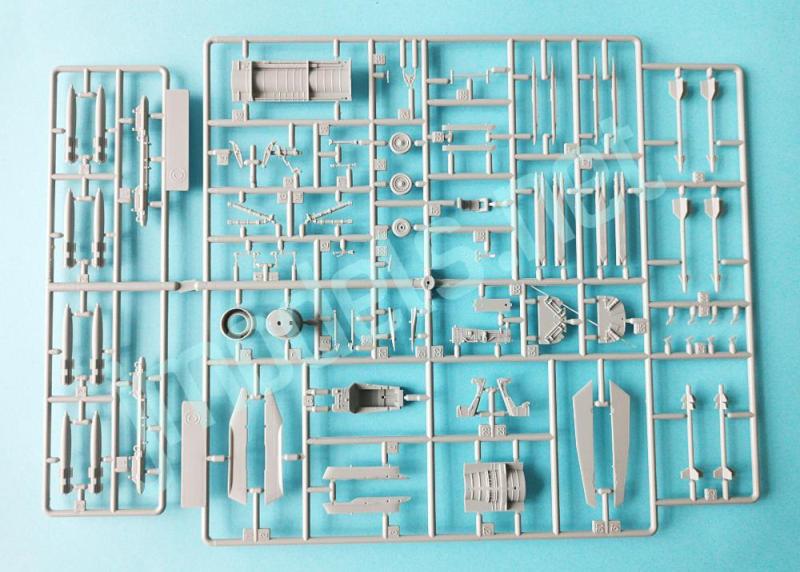
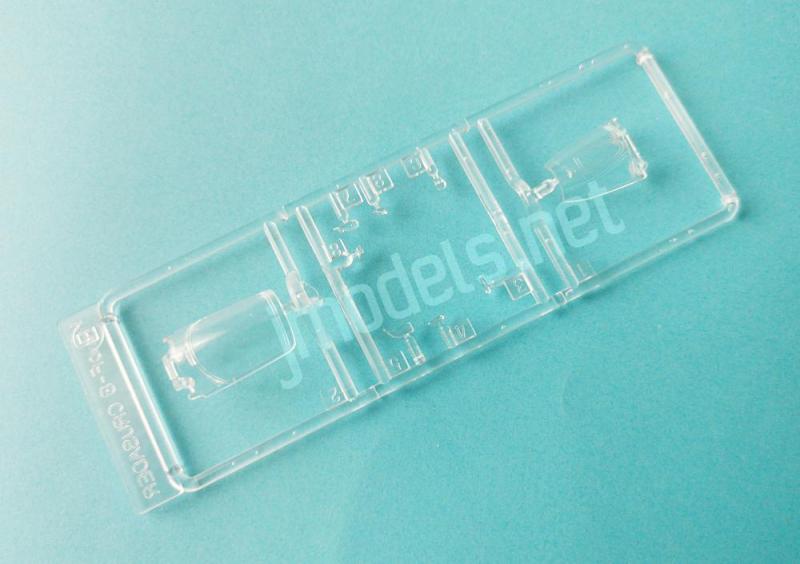
- Plástico inyectado (101 piezas), plástico transparente (9 piezas), máscara adhesiva (15 piezas)
- Injected plastic (101 parts), clear parts (9 parts), paint mask (15 parts).
CALCAS – DECALS:
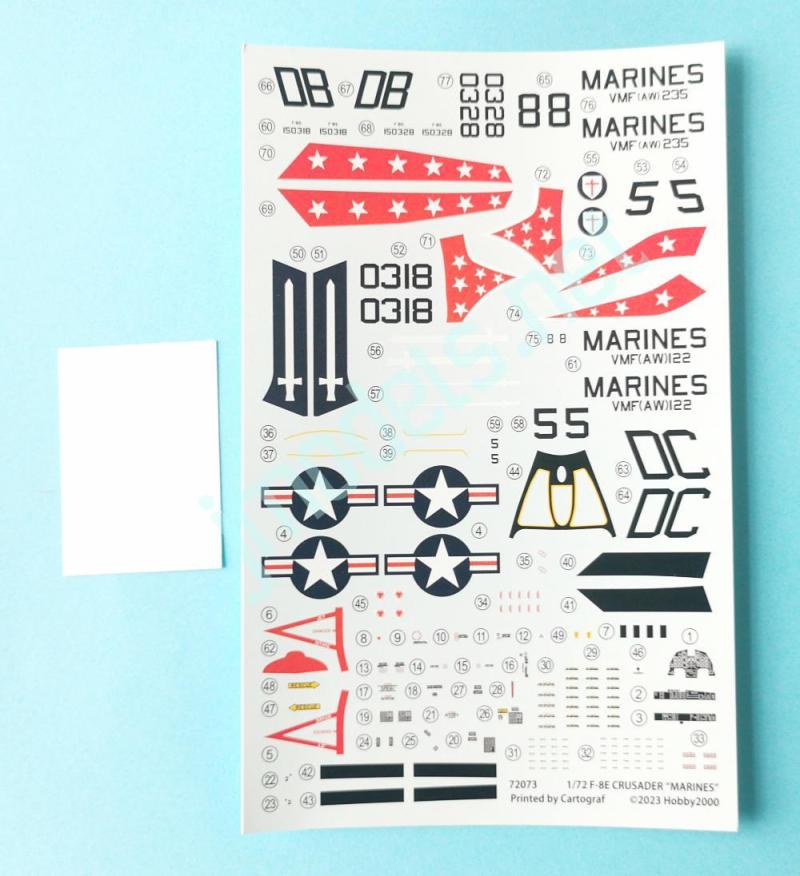
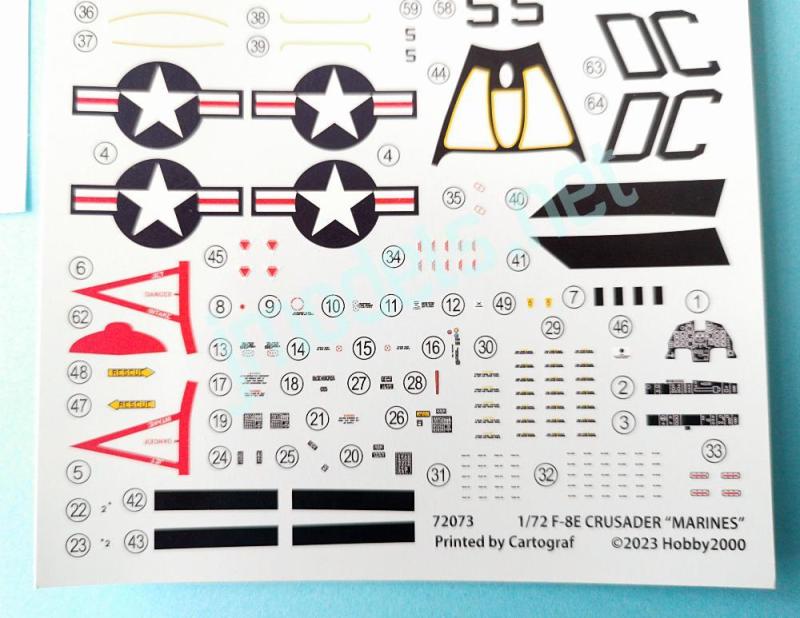
- Impresas por Cartograf. Insignias norteamericanas, panel de instrumentos y consolas, marcas de unidad, numerales y matrículas, decoraciones diversas y estarcidos. Aspecto fino y acabado brillante. Buena saturación de color, registro correcto. Sin exceso de soporte.
- Printed by Cartograf. US insignia, instrument panel and consoles, registrations and aircraft numbers and stencils. Thin and glossy finish. Good color saturation, correct register. No surplus carrier.
OPCIONES – OPTIONS:
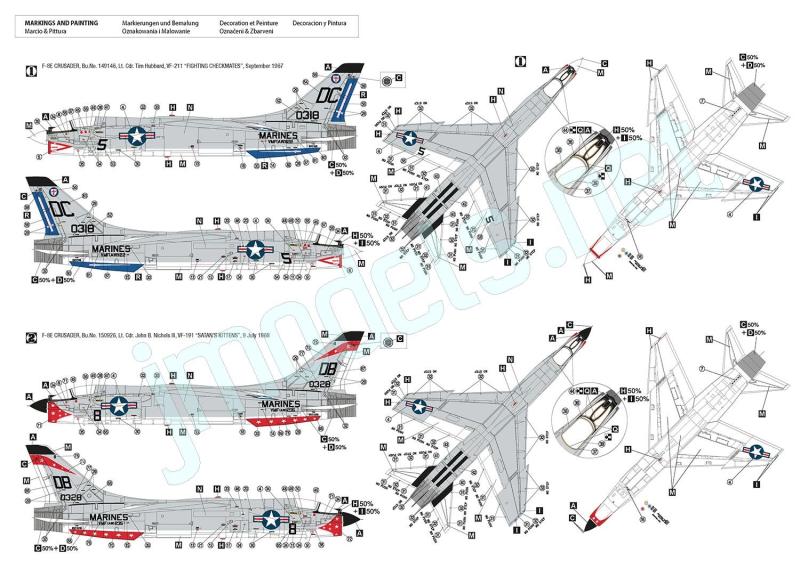
- F-8E Crusader. Bu.No. 149146. USMC. VF-211 “Fighting Checkmates”. Lt. Cdr. Tim Hobbard. September 1967.
- F-8E Crusader. Bu.No. 150926. USMC. VF-191 “Satan’s Kittens”. Lt. Cdr. John B. Nichols III. 9 July 1968.
INSTRUCCIONES – INSTRUCTIONS:
- Folleto A4 doblado de 6 páginas impreso en color en papel satinado. Contiene un plano numerado de piezas, una tabla de colores con equivalencias de varios fabricantes, 13 capítulos de montaje y 2 páginas de perfiles.
- 6-page A4 folded leaflet printed in color on satin paper. It contains a numbered parts plan, a color chart with matches in several paint ranges, 13 assembly steps and 2 pages of profiles.
LO MEJOR – THE BEST:
- Molde limpio. Buen detalle general. Alternativas de construcción. Máscaras para pintar. Calcas de Cartograf.
- Clean tooling. Nicely detailed overall. Assembly choices. Paint masks. Cartograf decals.
LO PEOR – THE WORST:
- No tiene opción para colocar las alas plegadas.
- No alternative to build the wings folded.
VALORACIÓN – CONCLUSION:
- Reedición del buen molde de Academy con mejores instrucciones y las útiles máscaras de pintura. Muy recomendable a los aficionados a los reactores.
- Reissue of the good Academy tool with better instructions plus useful paint masks. Highly recommendable to jet fans.

La maqueta
Algunas de las principales marcas de modelismo siempre han tenido un Crusader en la escala 1/72 en sus catálogos, valgan Hasegawa, Revell, Academy o ESCI/Italeri como ejemplos. En años recientes Sword se ha añadido a la lista con un nuevo molde de serie limitada de la versión de reconocimiento RF-8 que no teníamos anteriormente. En este tiempo también han aparecido un par de maquetas de Hobby 2000 que emplean el prolífico molde de Academy. La alternativa a esta caja dedicada a aviones de los Marines se denomina F-8E Crusader «MiG Killers» (referencia 72073) e incluye versiones de la Marina norteamericana.
La maqueta comprende cinco bastidores de piezas, uno de ellos transparente, una hoja de máscaras adhesivas, las calcas y las instrucciones. Las máscaras, seña característica de Hobby 2000, nos ayudan a pintar tanto la cubierta transparente como las ruedas.
El nivel del moldeado es notable, destacando por su limpieza y definición incluso en detalles muy pequeños. Las piezas no tienen rebabas, defectos o líneas de molde visibles. Hay marcas de eyector negativas muy pequeñas sobre algunas superficies internas, en general sencillas de disimular, pero las situadas sobre el neumático delantero serán enojosas de cubrir.
La construcción del modelo por el número de piezas y el ensamblaje de las alas al fuselaje no hacen a esta maqueta la mejor precisamente para alguien que desee hacer su primer reactor, aunque no debe tener inconvenientes de nota para cualquier otro modelista.
Como es de esperar, la librea naval compuesta de Light Gull Gray (FS3621) sobre Insignia White (FS17875) es idéntica en los dos aparatos que ofrecen los perfiles de las instrucciones.
Reseña
El interior de la carlinga está reproducido a partir de una pieza única que incluye el suelo, consolas y mamparo tras el asiento. Los lados internos del fuselaje también tienen moldeados varios instrumentos en relieve. El asiento es una réplica bastante aceptable del Martin-Baker original y consta de cuatro piezas, la superior lleva moldeados los tiradores del sistema de eyección. También están representados el panel de instrumentos sin detalle pero con calca, la mira en una pieza transparente, la palanca de control y un mamparo trasero con algunos dispositivos en relieve. Las consolas tienen los instrumentos representados a tamaño minísculo también en relieve. Como alternativa, podemos eliminarlos y emplear calcas en su lugar, según las instrucciones.
La cubierta de la carlinga está separada en dos secciones, ambas finas y bien moldeadas. La frontal tiene el parabrisas blindado bien reproducido y el buscador de infrarrojos separado por delante. La trasera lleva el panel de presurización interno bien definido. Las instrucciones no lo indican, pero es posible colocar esta parte transparente abierta.
Dentro del fuselaje hay que añadir una larga toma de aire del motor unida con clavijas a sus lados internos. La toma está acertadamente separada en dos mitades longitudinales. La pieza inferior contiene también el pozo delantero, decentemente detallado por dentro y sin marcas. Tras la toma está el pozo interno del freno neumático ventral, plasmado con el relieve estructural y un brazo de apertura en su interior. El freno tiene tres elementos y puede colocarse abierto o cerrado. La pieza principal también está definida por dentro. Aún más retrasado aparece el pozo de las ruedas, compuesto de un fondo, dos mamparos en los extremos, más otro pegado a lo largo de la mitad del pozo. Estas piezas están definidas con conductos y dispositivos que le dan un detalle convincente en esta escala. Finalmente, la parte trasera del fuselaje lleva el pozo del gancho de apontaje, este último detallado con calcas. El fondo tiene un par de marcas leves que no inciden sobre el detalle. Si colocamos el gancho plegado, no se aprecian.
Las mitades del fuselaje incluyen la aleta vertical más el timón y un hueco en la zona dorsal para adaptar las alas.. Las líneas de panel están grabadas con mucha finura y consistencia en todas las superficies. La parte delantera muestra los carenados abiertos de los cañones. Sobre los lados hay que abrir los agujeros para instalar los soportes de los misiles, las aletas ventrales y las tomas de aire de la postcombustión a cola. El extremo de la tobera es un tanto simplón, se compone de un cilindro interno detallado en su fondo y una pieza externa con los bordes de la salida.
El hueco dorsal del fuselaje contiene la superficie situada bajo el encastre de las alas. Entre su detalle interno está el gato separado y un soporte bastante fino en la parte trasera. Con estos elementos es posible colocar las alas con mayor incidencia respecto del fuselaje, única opción que reflejan las instrucciones, aunque nada impide colocarlas bajadas.
Las alas están separadas en mitades desiguales. La pieza inferior encaja en la mitad de la superior dejando completas las puntas a partir de las bisagras de plegado. El grabado de las líneas de los paneles es muy fino y nítido. Las superficies móviles son convincentes. Los flaps de los bordes de ataque viene separados de las alas, al igual que la carena del encastre, sobre la que se aprecia la luz anticolisión superior. Este elemento lleva un panel frontal al colocar las alas elevadas con más incidencia. El único inconveniente que le encuentro a las alas es que Academy no contempló la opción de colocar las puntas plegadas.
El armamento comprende bombas Mk 82 Snake Eye moldeadas con las aletas de retardo en la caída y la espoleta bien definida así como lanzadores a los lados del fuselaje donde se pueden colocar cohetes Zuni, o bien uno o dos misiles AIM-9 Sidewinder.
Los estabilizadores se unen al fuselaje mediante vástagos que simulan los pivotes estabilizadores del avión real. La aleta vertical está grabada con gran nitidez en las líneas e hileras de remaches, así como en la separación del timón. Las luces de navegación y el radar de alerta de cola están definidos con corrección.
El tren de aterrizaje delantero está compuesto de una pata con la mitad de la horquilla separada para instalar la rueda. Esta pieza muestra un par de marcas a un lado del neumático, como ya he mencionado. Las puertas del pozo tienen un detalle fino sobre el lado interno.
La reproducción de los elementos del tren principal es realmente buena e incluso tiene calcas para realzar el interior de las tapas superiores. Las tapas inferiores están moldeadas con una sección del fuselaje ventral, por lo que hay que instalar las patas en el pozo antes de pegar esta pieza. Las ruedas tienen un detalle muy destacable en las llantas.
La hoja de calcas es de Cartograf. Contiene insignias norteamericanas, el panel de instrumentos y las consolas, marcas de unidad, numerales y matrículas, decoraciones diversas y bastantes estarcidos. Las calcas muestran un aspecto fino, acabado brillante, buena saturación de color y registro correcto. Carecen de exceso de soporte.
Las instrucciones están impresas en color en un folleto doblado de formato A4. Contiene un plano numerado de piezas; una tabla de colores con pinturas equivalentes de AK Interactive, Alclad2, AMMO Mig, Hataka, Mr Color, Revell y Tamiya; trece capítulos de montaje y dos páginas de perfiles. Las secuencias de montaje están bien complementadas con algunas vistas de detalle e información con los colores internos y externos pertinentes.
Con esta caja podemos terminar un Crusader de la escuadrilla de los Marines VF-211 “Fighting Checkmates” que pilotó el Teniente Tim Hobbard. Este oficial obtuvo una victoria confirmada sobre un MiG-17 en Vietnam. El segundo avión, de la escuadrilla VF-191, perteneció al Teniente John B. Nichols III, condecorado en Vietnam y protagonista del último derribo de un enemigo con armas de fuego en la historia de la Marina norteamericana.
Valoración
Las reediciones de Hobby 2000 suelen acertar en el molde que copian, y este es un buen ejemplo, ya que el Crusader de Academy parece el más potable en esta escala. Además, la marca coreana lleva bastantes años sin reeditarlo, lo que hace aún más oportuna esta maqueta. Muy recomendable a los aficionados a los reactores y en especial a los de la Navy, que hay unos cuantos.◊





The kit
Some of the mainstream manufacturers, such as Hasegawa, Revell, Academy, or ESCI/Italeri, have always had a 1/72 scale Crusader in their catalogs. In recent years, Sword have joined the list with a new short-run RF-8 reconnaissance version, which had not been kitted before in this scale. During this time, a Hobby 2000 have released couple of kits using Academy’s prolific mold. The alternative boxing to this USMC Crusader is called F-8E Crusader «MiG Killers» (reference 72073) and includes US Navy aircraft.
The kit comprises five sprues, one of them clear, a paint mask sheet, decals, and instructions. The die-cut, self-adhesive masks, a feature of Hobby 2000 kits, help with painting both the canopy and the wheels.
The level of molding is remarkable, especially for the clean recessed lines and definition even in very small details. Parts have no flash, blemishes, or evident seam lines. There are very small negative ejector marks on some internal surfaces, generally easy to conceal, but those on the front wheel tire will be difficult to clean up.
Due to the number of parts and the wing-fuselage assembly, construction doesn’t seem the best choice for those building their first jet, although it shouldn’t pose any significant problems for any other modeler.
As expected, the naval livery of Light Gull Gray (FS3621) over Insignia White (FS17875) is identical on the two aircraft shown in the instruction profiles.
Review
The cockpit interior is reproduced from a single piece that includes the floor, consoles and bulkhead behind the seat. The fuselage side walls also show raised instruments. The seat is a fairly acceptable replica of the real Martin-Baker and consists of four pieces, the upper one having the ejection handles molded on. Also represented are the flat instrument panel with a decal, the sight in a clear piece, the control stick and a rear bulkhead with some raised devices. The consoles have raised instruments represented in tiny size. Alternatively, we can remove them and use decals instead, according to the instructions.
The canopy is provided in two pieces, both thin and well molded. The front piece has a defined armored windshield and a separate infrared seeker in front. The rear has a well-defined internal pressurization panel. The instructions do not show it, but it is possible to place this clear part open.
Inside the fuselage there is a long engine air intake, attached with pins to the fuselage sides. The intake is wisely divided into two longitudinal halves. The lower section also contains the forward wheel well, decently detailed internally and without marks. Behind the intake is the well of the ventral airbrake, molded with structural raised detail and a jack inside. The brake has three pieces and can be positioned open or closed. The brake is also quite well-defined internally. Further aft is the wheel well, consisting of a floor, two bulkheads at the ends, and a third one attached along the well. These parts are molded with ducts and devices that provide convincing detail at this scale. Finally, the rear of the fuselage houses the arresting hook well. The hook is detailed with decals. The floor has a couple of light marks that do not affect detail. They are not visible when the hook is folded.
The fuselage halves include the vertical fin, the rudder, and a recess in the dorsal area for attaching the wings. Panel lines are engraved with great precision and consistency on all surfaces. The front section shows the open cannon fairings. Holes are drilled on the sides for the missile launchers, ventral fins, and tail afterburner cooling air ducts. The nozzle is rather simplistic, consisting of a detailed inner cylinder and an outer piece with the outlet edges.
The dorsal fuselage recess contains the surface located under the wing attachment. Internal details include a separate jack and a rather thin support at the rear. These elements allow for mounting the wings at a higher incidence, the only option shown in the instructions, but you can also install then lowered.
The wings are separated into halves with the lower piece fitting into the upper half. The wingtips are molded on the upper surface from the wingfold hinges. Panel lines are very fine and crisp. Control surfaces are convincing. The leading-edge flaps are separate from the wings, as is the dorsal fairing, on which the upper anti-collision light is visible. The fairing has a front panel when the wings are raised at a higher angle of incidence. The only drawback I find with the wings is that Academy did not consider the option of folding the wingtips.
The armament includes Mk 82 Snake Eye bombs with clearly defined blades and fuzes, as well as fuselage-side launchers for Zuni rockets or one or two AIM-9 Sidewinder missiles.
The stabilizers are attached to the fuselage by struts that copy the stabilizing pivots of the real aircraft. The vertical stabilizer is engraved with precision, also showing tiny riveted lines, as well as the rudder separation. The navigation lights and the tail warning radar are accurately defined.
The nose landing gear consists of a leg with half of the fork apart for attaching the wheel. This part shows a couple of marks on one side of the tire, as mentioned. The wheel well doors have fine detail on the inside.
The reproduction of the main landing gear components is excellent and there are decals to enhance the interior of the upper covers. The lower doors are molded on a section of the ventral fuselage, so the landing gear needs to be installed before gluing this piece. The wheels have very sharp detail on the rims.
The decal sheet is printed by Cartograf. It contains American insignia, the instrument panel and consoles, unit markings, numbers, registrations and stencils. The decals have a fine appearance, a glossy finish, good color saturation, and correct register. They do not have excess carrier.
The instructions are printed in color on a folded A4 booklet. It contains a numbered parts diagram; a color chart with equivalent paints from AK Interactive, Alclad2, AMMO Mig, Hataka, Mr Color, Revell, and Tamiya; thirteen assembly chapters; and two pages of profiles. The assembly sequences are well complemented by detailed views and information with the relevant internal and external colors.
With this kit, you can complete a Crusader from the Marines’ VF-211 «Fighting Checkmates» squadron, flown by Lieutenant Tim Hobbard. This officer achieved a confirmed victory over a MiG-17 in Vietnam. The second aircraft, from VF-191, belonged to Lieutenant John B. Nichols III, decorated in Vietnam and responsible for the last enemy aircraft shot down by gunfire in the history of the U.S. Navy.
Conclusion
Hobby 2000 usually have a good taste to choose the molds they reissue, and this is a good example, as the Academy Crusader seems the best choice in this scale. The Korean brand hasn’t released it for quite a few years, making this kit even more timely. Highly recommended to jet enthusiasts and especially to US Navy fans, which are quite a few.◊
Publicado – Published: 7 / 2026
©www.jmodels.net


Debe estar conectado para enviar un comentario.