
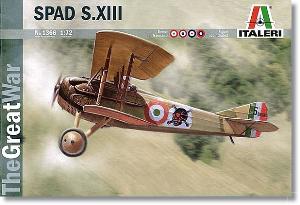
De un vistazo – Quick look
MATERIAL Y PIEZAS
MEDIA & PARTS:
- Plástico inyectado (29 piezas).
- Injected plastic (29 parts).
CALCAS – DECALS:
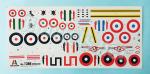
- Impresas por Zanchetti. Escarapelas italianas, francesas, británicas y norteamericanas, insignias de unidad, marcas del fuselaje y cola, códigos y algunos estarcidos. Aspecto muy brillante y no demasiado fino. Buena saturación de color y registro. Nítidas y sin exceso de soporte.
- Printed by Zanchetti. Italian, French, British and US roundels, unit insignia, fuselage and tail markings, codes and some stencils. Very glossy and not too thin appearance. Good color saturation and register. Sharp with no excess carrier.
OPCIONES – OPTIONS:
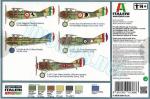
- SPAD S.XIII. Corpo Aeronautico Militare. 91a Squadriglia. Volpago (Treviso, Italy). 11/5/1918. Aircraft flown by Sgt. Fulco Benlamino Ruffo di Calabria
- SPAD S.XIII. Corpo Aeronautico Militare. 91a Squadriglia. 15/6/1918. Aircraft flown by Maggiore Francesco Baracca.
- SPAD S.XIII. Armée de l’Air. SPA 88. 1918. Aircraft flown by Lt. Marcel Coadou.
- SPAD S.XIII. Royal Flying Corps. No. 23 Squadron. 26/2/1918. Aircraft flown by Second Lt. David Colquhoun Doyle.
- SPAD S.XIII. American Expeditionary Force. 103rd Aero Squadron. 3rd Pursuit Group. Toul-Croix de Metz (France), 1918. Aircraft flown by Capt. Robert Soubiran.
INSTRUCCIONES – INSTRUCTIONS:
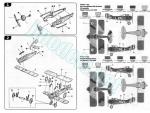
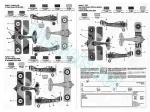
- Folleto doblado de formato A5 y 6 páginas impreso en blanco y negro. Contiene un sumario histórico sobre el avión, un plano numerado de piezas, 2 pasos de montaje y 3 páginas de perfiles. La cara trasera de la caja muestra perfiles en color y una relación de pinturas acrílicas de Italeri.
- 6-page A5 folded leaflet printed in black and white. Contains a historical summary about the aircraft, a numbered parts diagram, 2 assembly steps and 3 pages of profiles. The back side of the box shows profiles in color and a list of Italeri acrylic paints.
LO MEJOR – THE BEST:
- Sencillez de montaje. Calcas.
- Ease of assembly. Decals.
LO PEOR – THE WORST:
- Nulo interior. Entelado de alas y fuselaje.
- No interior. Raised detail on fuselage and wings.
VALORACIÓN – CONCLUSION:
- Es un molde antiguo con presentación limpia y calcas amplias y aprovechables, pero la maqueta es demasiado básica. Hoy sólo parece apta para el principiante.
- It’s an old tooling with a neat presentation plus a nice useful decal sheet, but the kit is too basic. Today it only seems suitable for the beginner.

La maqueta
Se trata de una reedición de una maqueta de ESCI que a su vez copia un molde original de la japonesa Marusan de 1968. Eso dicen en Scalemates. Vaya usted a saber, porque también aseguran que la maqueta de Academy de este avión es propia y en realidad es otra secuela de ESCI-Marusan. La de Revell, casi igual de mala, es de cuño de la antigua Revell británica y no está emparentada con las anteriores.
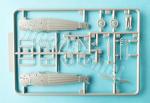
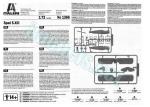
Esta caja es la única que Italeri ha lanzado hasta ahora. Dentro hay dos bastidores de piezas, una gran hoja de calcas y las instrucciones. Las piezas muestran un modelado limpio y bien ejecutado. Sólo encontramos unas marcas a los lados de la cabina que no afectarían al detalle interno si lo hubiera y otras negativas bajo los estabilizadores que merman el detalle moldeado en ellos.
Con tan escaso número de piezas, el montaje no parece que pueda ser más sencillo. Conociendo el percal y sabiendo que esta maqueta no puede competir con la de Eduard, que por ahora es lo mejorcito que tenemos del SPAD XIII en la escala 1/72, Italeri ha metido en esta edición una amplia hoja de calcas para representar una variedad de aviones empleados por pilotos famosos. Más abajo los menciono.
Salvo mejor opinión del lector, he encontrado que las instrucciones de las maquetas de Eduard son una guía mejor para pintar este avión que las de Italeri, idénticas unas a otras y sospechosas.
Revisión
De la carlinga no hay nada que decir porque el interior está vacío y ni siquiera tenemos un mal parabrisas o una figura que disimule la falta.
Las mitades del fuselaje muestran el detalle en relieve. La parte delantera contiene los capotajes del motor a los lados del morro y las rejillas laterales de ventilación, estas últimas con forma incorrecta y nada convincentes en su aspecto. El entelado de la estructura tras la carlinga es totalmente irreal y muy exagerado. El panel superior de la cubierta del fuselaje está separado y donde se supone que deberíamos ver dos ametralladoras Vickers, aparecen dos sustitutos que recuerdan amortiguadores o algo similar. Vaya tino. Sin embargo, los largos escapes están bastante bien porque son finos y tienen las salidas abiertas con nitidez en el fuselaje. El patín de cola, muy grueso, está unido a una de las mitades del fuselaje.
Del motor apenas tenemos lo que se aprecia en la pieza que cubre el fuselaje por delante, que es el radiador simulado con líneas delgadas en relieve. La hélice es acaso demasiado fina y puntiaguda, pero está limpia y bien moldeada con la torsión de las palas decentemente reproducida.
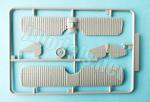
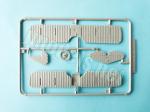
Las alas vienen en dos piezas. Los planos inferiores están unidos por una sección ventral del fuselaje. El detalle estructural posee un relieve desproporcionado y resulta mucho más irreal incluso que el del fuselaje al ser tan profuso. Sin embargo, los alerones están grabados con limpieza. A los soportes de las alas se les ha intentado dar la forma correcta, diferente en los externos e internos, pero las piezas son un poco anchas y no están sueltas, sino moldeadas en un bastidor para pegarlas en las ranuras de las alas, lo que no será muy acertado, pero facilita y mucho el montaje. Los soportes centrales también son sencillos de colocar al estar unidos en su parte superior, así que se pegan a las alas igual que el resto.
Las superficies de cola están separadas en dos piezas. Ambas tienen la estructura reproducida mediante líneas delgadas en relieve, nada que ver con las alas, y los timones bien grabados. Dos soportes laterales aparte refuerzan los estabilizadores.
Si sencillo parece el montaje de las alas, el del tren de aterrizaje no lo es menos. Tenemos dos soportes, el capotaje del eje y las ruedas, de una pieza con los neumáticos bien marcados y las llantas detalladas con líneas delgadas en relieve.
La hoja de calcas me parece un aliciente de esta maqueta. La hoja es de Zanchetti y en ella aparecen escarapelas italianas, francesas, británicas y norteamericanas, insignias de unidad, marcas del fuselaje y cola, códigos más algunos estarcidos. Los motivos poseen aspecto muy brillante pero extrañamente no demasiado fino. La saturación de color, nitidez y registro me parecen correctas, El soporte no sobresale de las calcas.
Las instrucciones las ha reformado Italeri para la ocasión en un folleto doblado de formato A5 y seis páginas impresas en blanco y negro. Contiene un sumario histórico sobre el avión, un plano numerado de piezas, dos pasos de montaje y tres páginas de perfiles. En la cara trasera de la caja aparecen perfiles en color y una relación de pinturas acrílicas de Italeri.
Italeri ha hecho una buena selección de aviones de pilotos famosos que volaron con este caza. El as italiano Baracca es de los más conocidos por su caballito, emblema hasta hoy de la marca Ferrari, pero la lista continúa con Ruffo di Calabria, otro as italiano con alrededor de veinte victorias; Marcel Coadou, as francés que llegó tarde a la guerra pero la remató con una decena de victorias; el británico Colquhoun Doyle, sin historial relevante, pero su avión es muy conocido al ser derribado y fotografiado por los alemanes; y finalmente, Robert Soubiran, piloto norteamericano que, al contrario que Coadou, se tragó la guerra desde el inicio como voluntario y cuyo mayor legado es su impagable archivo fotográfico del conflicto y en especial de la Escuadrilla Lafayette.
Valoración
Este molde, aunque limpio y bien presentado, tiene muchas desventajas para el modelista medio y avanzado por su excesiva simplicidad y falta de detalles importantes por dentro y fuera, siendo el más significativo la carlinga. Sin embargo, puede ser una maqueta muy adecuada para los novatos que afronten por vez primera un avión biplano. La hoja de calcas y los aviones de pilotos famosos pueden darles alicientes para montar esta maqueta.◊

The kit
This is a rebox of an ESCI kit, which in turn copies an original tool from the Japanese company Marusan from 1968. That’s what Scalemates says. Who knows, because they also claim that the Academy kit of this aircraft is their own, but in fact it is actually another sequel to ESCI-Marusan. The Revell kit, almost as bad, is from the old British Revell factory and is not related to the others.
This box is the only one Italeri have released so far. Inside there are two sprues of parts, a large decal sheet, and the instructions. Parts show clean and well-executed molding. We only find some marks on the cockpit sides that wouldn’t affect the internal detail, if there were any, and other negative marks under the stabilizers piece that damage the thin raised lines of the structure.
With such a small number of parts, assembly couldn’t be any simpler. Knowing its limitations and that this kit can’t compete with Eduard’s, which is currently the best we have of the SPAD XIII in the 1/72 scale, Italeri included a large decal sheet in this release to represent a variety of aircraft used by famous pilots. I’ll mention them below.
I’ve found the instructions for Eduard’s kits to be a better guide for painting this kit than Italeri’s, which show identical camouflage patterns and look questionable.
Review
There’s nothing to say about the cockpit because the interior is empty, and we don’t even have a decent windshield or a figure to fill the gap.
Detail is molded raised on the fuselage halves. The fuselage front contains the small engine cowlings on either side of the nose and the side grilles, the latter incorrectly shaped and unconvincing. The fabric covering of the structure behind the cockpit is completely unrealistic and highly exaggerated. The upper deck panel is separated, and instead of two Vickers machine guns, detail looks like shock absorbers or something similar. However, the long exhaust pipes are quite well done as they are thin and have clean defined outlets on the fuselage. The too thick tail skid is molded on one of the fuselage halves. We barely see anything of the engine except what’s visible on the piece covering the fuselage front,, which is a simulated radiator with thin raised lines. The propeller is perhaps a bit too thin and pointed, but it is clean and well molded with the blade twist decently reproduced.
The wings come in two pieces. The lower surfaces are joined by a panel of the fuselage belly. Structural detail is too big and raised, even more unrealistic than that of the fuselage due to its profusion. However, the ailerons are cleanly engraved. An attempt has been made to give the wing struts the correct shape, different on the inboard and outboard pieces, but the they are a bit wide and are not loose, but molded in a frame to be glued into the wing slots. This isn’t ideal, but it greatly simplifies assembly. The cabane struts are also easy to attach as they are joined at the top, so they are glued to the wings just as the rest.
The tailplanes are separate into two pieces. Both have the structure reproduced in thin, raised lines, unlike the wings, and the rudders are well engraved. Two separate side struts strengthen the stabilizers.
If wing assembly looks simple, the landing gear construction is no less so. We have two V-struts, the axle fairing and the wheels, molded in one piece with the tires well engraved and the hub fairings detailed with thin raised lines.
The decal sheet is a real asset in the kit. It is printed by Zanchetti and shows Italian, French, British, and American roundels, unit insignia, fuselage and tail markings, codes, and some stencils. The decals have a very glossy appearance, but strangely, they don’t seem particularly fine. Color saturation, sharpness, and registration are all good. There is no excess carrier film.
The instructions have been updated by Italeri for this kit and are provided in a folded A5 leaflet with six black and white pages. It includes a historical summary of the aircraft, a numbered parts diagram, two assembly steps, and three pages of profiles. The back of the box features color profiles and a list of Italeri acrylic paints.
Italeri has included a good selection of aircraft flown by famous pilots who flew this fighter. The Italian ace Baracca is one of the best known for his personal marking of a horse, an emblem of the Ferrari brand to this day, but the list continues with Ruffo di Calabria, another Italian ace with around twenty victories; Marcel Coadou, a French ace who arrived late to the war but finished it off with a dozen victories; the British Colquhoun Doyle, without a relevant history, but his plane is very well known for being shot down and photographed by the Germans; and finally, Robert Soubiran, an American pilot who, unlike Coadou, went into the war from the beginning as a volunteer and whose greatest legacy is his priceless photographic archive of the conflict and especially of the Lafayette Escadrille.
Conclusion
This kit, although clean and well-presented, is quite basic for the average and advanced modeler due to its lack of important details inside and out, the most significant being the cockpit. However, it can be a very suitable kit for novices tackling a biplane for the first time. The decal sheet and the aircraft flown by famous pilots can provide them with incentives to build this kit.◊
Publicado – Published: 12 / 2025
©www.jmodels.net
 jmodels.net
Debe estar conectado para enviar un comentario.