
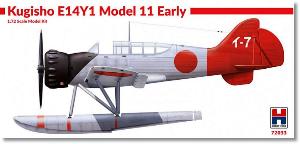
De un vistazo – Quick look
MATERIAL Y PIEZAS
MEDIA & PARTS:
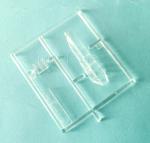
- Plástico inyectado (41 piezas), plástico transparente (2 piezas). Incluye catapulta (7 piezas).
- Injected plastic (41 parts), clear plastic (2 parts). Catapult included (7 parts).
CALCAS – DECALS:
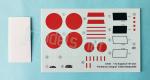
- Impresas por Cartograf. Hinomarus, líneas de pisado en las alas, marcas de cola y de los flotadores. Finas y brillantes, con buena saturación de color y registro correcto. Sin exceso de soporte.
- Printed by Cartograf. Hinomarus, non-step lines, registers and markings for the floats. Thin and glossy appearance, with good color saturation and correct register. No surplus carrier film.
OPCIONES – OPTIONS:
- Yokosuka E14Y1 Model 11. Yokosuka Naval Air Technical Arsenal. September 1942.
- Yokosuka E14Y1 Model 11. I-7 submarine.
INSTRUCCIONES – INSTRUCTIONS:
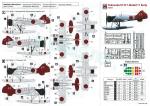
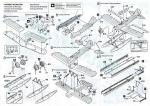
- Folleto doblado impreso en color. Contiene un plano numerado de piezas, una tabla de colores con equivalencias de varias marcas de pintura, 9 pasos de construcción y perfiles.
- Folded leaflet printed in color. It shows a numbered parts plan, a chart of colors with matches in several paint ranges, 9 construction steps and profiles.
LO MEJOR – THE BEST:
- Sencilla de armar y pintar. Notable detalle externo. Motor. Incluye máscaras.
- Easy to build and paint. Nice surface detail on the fuselage and wings. Masks included.
LO PEOR – THE WORST:
- Marcas de eyector, aunque leves. Cubierta transparente de una pieza. Mástil mal situado.
- Pin marks, though shallow. One-piece canopy. Antenna mast wrongly placed.
VALORACIÓN – CONCLUSION:
- Reedición de esta escasa maqueta de Fujimi que ya no es tan corriente ver hoy. Se mantiene en forma gracias a su gran detalle exterior, más la sencillez de montaje y pintura. El interior ofrece oportunidades de mejora por su insuficiencia. Las máscaras propias de Hobby 2000 son siempre un plus.
- Reissue of a rare Fujimi kit, which is uncommon to see today. Ii is still in shape thanks to its excellent exterior detail, combined with the ease of assembly and painting. The cockpit offers room for improvement as it is quite sparse. Hobby 2000’s own masks are always a plus.

La maqueta
No abundan las maquetas de este avión en ninguna escala y no es raro, ya que es de los menos populares de la aviación japonesa. Tal vez le perjudique su aparente fragilidad, así como el hecho de que no se fabricase en gran cantidad por estar destinado a operar en submarinos. Lo cierto es que es más conocido por tratarse del único avión que bombardeó el suelo continental de los EE. UU. durante la Segunda Guerra Mundial.
Además de Fujimi, la checa MPM lanzó su propia maqueta a finales de los años 90, pero no se ha vuelto a ver desde entonces. Las dos maquetas que Hobby 2000 tiene en su catálogo son copias del molde de Fujimi con nuevas instrucciones y la habitual hoja de máscaras adhesivas.
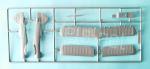
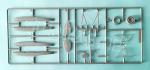
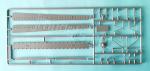
La caja lleva cuatro bastidores de piezas, incluido uno transparente, la hoja de máscaras y la de calcas, además de las instrucciones. El plástico está moldeado con la acostumbrada finura y nitidez de las marcas japonesas, quedando por limpiar algunas marcas de eyector leves y pequeñas en el interior de la carlinga y la catapulta.
Las dimensiones de las alas, fuselaje y flotadores coinciden perfectamente con los planos de escala 1/72 del libro Japanese Submarine Aircraft de T. Januszewski publicado por Mushroom Models. Solamente el timón vertical de la maqueta se queda corto en torno a 1 mm.
El detalle externo es mejor que el de la carlinga, que se ve bastante vacía. En principio el montaje de este hidroavión parece sencillo y la pintura no lo es menos, ya que ofrece dos alternativas similares con diferencias en los códigos de cola y algunas marcas en las alas y flotadores.
Una de las alternativas refleja el aparato del submarino I-7, que fue el encargado de lanzar su aparato en misión de reconocimiento sobre Pearl Harbour unos días después del ataque japonés para observar los daños. Aunque generalmente se acepta que este submarino empleaba un E14Y, como también se afirma en el libro recién mencionado, en la web Nihon Kaigun se argumenta que el I-7 (Tipo J3, botado en 1935) tenía un anticuado hangar dividido en dos tubos de almacenamiento que le impedía llevar este hidroavión. Esta duda puede ser razonable, ya que el I-25, cuyo E14Y fue sin duda el que bombardeó Oregón, era del Tipo B1, más moderno y con un hangar más amplio.
Revisión
Como decía antes, la carlinga no tiene lujos y está pelada de detalle. Los lados del fuselaje están vacíos, dejando aparte las marcas negativas leves por limpiar. El suelo es de una pieza que comprende desde el panel frontal a la parte posterior de la carlinga y tan solo lleva los pedales. Las demás piezas separadas incluyen dos asientos y paneles diferenciados con calcas para representar los instrumentos y la palanca de control. La ametralladora posterior no está incluida, aunque se vea en algunas cajas de Fujimi y Hobby 2000.
El suelo del observador posee un hueco cuadrado que coincide con el acristalamiento inferior situado en la parte posterior de las alas. La pieza transparente es un poco gruesa, lo mismo que la cubierta de la carlinga, que es de una pieza con la estructura bien representada. Fujimi erró en la posición del mástil de la antena, que no iba emplazado sobre la cubierta, sino en el lado derecho del fuselaje, justo por delante del puesto del observador.
El fuselaje muestra paneles grabados en la parte delantera y la estructura entelada bastante bien reproducida en la trasera, detalle que se extiende a las superficies verticales de cola moldeadas en las mitades. El motor está limpio de restos de plástico y tiene nitidez en los cilindros y alzaválvulas. El capó está dividido en dos anillos, aunque la unión separa por la mitad los carenados de las cabezas de los cilindros, replicados con definición y finura. Los escapes poseen la forma estrecha apropiada. La hélice es fina y la pieza incluye el eje.
Las alas comprenden tres piezas con los flaps separados y las bisagras muy prominentes en los bordes de salida. La pieza inferior va encajada en el fuselaje. La textura de la superficie entelada está muy bien conseguida, así como los bordes de ataque lisos de madera. Las puntas llevan las luces perfiladas y el tubo Pitot. Hay dos bombas de buena factura con sus soportes como armamento subalar.
La cola y los estabilizadores tienen los timones y aletas bien marcados. Los estabilizadores están detallados con los soportes laterales y una fina línea que nos indica por dónde se plegaban para almacenar el avión en el hangar, aunque esta línea no la muestran ni la punta de la aleta vertical ni tampoco la aleta inferior. El detalle de las superficies es realista.
Los flotadores vienen en mitades. Su detalle externo es bueno, salvo en los timones, desiguales y faltos de definición y por ello deben reemplazarse. Los soportes no deben dar problemas para montarlos. Los soportes anteriores se unen previamente a los flotadores y los posteriores, más los laterales, a las alas.
Fujimi incluyó la catapulta de lanzamiento como base para ambientar el modelo. El artefacto pretender ser la de un submarino, aunque ignoro qué grado de realismo puede tener. La cuna viene separada en tres piezas con ranuras de desagüe (eso parecen) grabadas en la base y algunas marcas leves sobre los lados. El carro de lanzamiento comprende un suelo, dos soportes laterales y un bastidor de refuerzo entre ellos. Los soportes tienen cuatro puntos de anclaje para el avión, aunque las instrucciones no indican cómo colocarlo sobre ellos.
Las calcas corren a cargo de Cartograf, que es una marca fiable por su buen hacer. La hoja lleva Hinomarus, líneas de pisado en las alas, marcas de cola y líneas de los flotadores. Su aspecto es fino y brillante, poseen buena saturación de color y un registro correcto. El soporte está perfectamente recortado alrededor de cada calca.
Las instrucciones están impresas en color en un folleto doblado que muestra un plano numerado de piezas, una tabla de colores con equivalencias de pinturas de AK Interactive, AMMO MiG, Hataka, Mr Color y Tamiya, nueve pasos de construcción y perfiles.
Ni las vistas explosionadas del montaje ni los perfiles para pintar y colocar las calcas ofrecen problema por su sencillez y claridad. Las libreas de las dos alternativas que se proponen son casi idénticas y reflejan el esquema oficial de muchos aviones de la Marina japonesa de principios de los años 40.
Valoración
Para quienes no tuvieron ocasión de conseguir las maquetas de Fujimi en su momento, cuando tenían mejor distribución fuera de Japón, las reediciones de Hobby 2000 resultan muy propicias y, en el caso de este avión, oportunas porque no hay otra maqueta mejor por ahora.
Aunque flaquea mucho en la carlinga, la cubierta es de una pieza y el mástil está mal situado, la maqueta se salva con cierta holgura todavía por su bien copiado detalle externo. Fujimi debió estudiar el avión con cierto interés y se nota en las dimensiones correctas que tienen sus elementos principales.
El montaje y la pintura no es difícil incluso para el modelista de nivel básico y por eso recomiendo esta maqueta a cualquier seguidor de la aviación japonesa.◊

The kit
Kits of this aircraft are rare in any scale, and this is not surprising, as it is one of the least popular in Japanese aviation. Perhaps a disadvantage is its apparent fragility, as well as the fact that it was not produced in large numbers because it was intended to operate on submarines. In fact, it is best known for being the only aircraft to bomb the continental United States during World War II.
In addition to Fujimi, the Czech MPM released its own kit back in the late 1990s, but it has not been seen since. The two boxings that Hobby 2000 have in their catalog are copies of the Fujimi tool with new instructions and the usual sheet of adhesive masks.
The box includes four sprues, including a clear one, a mask sheet, the decals and the instructions. Plastic is molded with the usual fineness and sharpness found in Japanese kits, with some light ejector marks inside the cockpit and on the catapult.
The dimensions of the wings, fuselage, and floats match spot on the 1/72 scale drawings in T. Januszewski’s book Japanese Submarine Aircraft, published by Mushroom Models. Only the kit’s rudder falls short by about 1 mm.
External detail is better than that inside the cockpit, which looks rather bare. Apparently, assembly and painting look simple. Paint choices offer two similar aircraft with differences in the tail codes and some markings on the wings and floats.
One alternative is for the E14Y on board submarine I-7, which was tasked with launching its aircraft on a reconnaissance mission over Pearl Harbor a few days after the Japanese attack to observe the damage. Although it is generally accepted that this submarine was provided with an E14Y, as also stated in the said book, the Nihon Kaigun website argues that the I-7 (Type J3, launched in 1935) had an old hangar divided into two storage tubes that prevented it from carrying this seaplane. This doubt may be reasonable, since the I-25, whose E14Y was undoubtedly the one that bombed Oregon, was a Type B1, more modern and with a larger hangar.
Review
As mentioned, the cockpit is quite empty. The fuselage sides are bare, aside from very shallow negative marks to clean up. The floor is a single piece that runs from the front panel to the rear of the cockpit and only contains the pedals. The other separate parts include two seats and separate panels with decals to represent the instruments plus the control stick. The rear machine gun is not included, although it can be seen in some Fujimi and Hobby 2000 artboxes.
The observer’s floor has a square gap that matches the lower glazing located aft of the wings. The clear piece is a bit thick, as is the cockpit canopy, which is a single piece with a well-represented structure. Fujimi made a mistake in the position of the antenna mast, which was not placed on the canopy, but on the right side of the fuselage, just forward of the observer’s cockpit.
The fuselage features engraved panels at the front and a fairly well-reproduced fabric structure at the rear, a detail that extends to the vertical tail surfaces molded with the fuselage halves. The engine is clean from flash and has sharp cylinders and tappers. The cowling is divided into two rings, although the seam separates the cylinder head fairings. These are reproduced with definition and finesse. The exhausts have the appropriately narrow shape. The propeller is thin and the part includes the shaft.
The wings comprise three pieces with separate flaps and prominent hinges on the trailing edges. The lower piece is fitted into the fuselage belly. The texture of the fabric surface is nicelyl rendered, as are the smooth wooden leading edges. The tips feature the small navigation lights and the Pitot tube. There are two well-molded bombs with the racks as underwing armament.
The tail and stabilizers have defined rudders and fins. The stabilizers are detailed with the side struts and a thin line showing the spot where they folded for storage in the hangar, although this line is not shown on either the tip of the vertical fin or the lower fin. Surface detail is again quite nice.
The floats come in halves. Detail is good, except for the rudders, which, being uneven and poorly molded, they clearly need to be improved. Attachment of the struts should not cause any headaches. The one-piece front struts are glued to the floats first, and the rear and side struts are added to the wings.
Fujimi included the catapult as a base for the model. I suppose the device is intended to be that of a submarine, but I don’t know how realistic it is. The cradle comes in three pieces with drainage slots (or so they look) engraved on the base and some shallow marks on the sides. The trolley comprises a floor, two side struts, and a frame between them. The struts have four anchor points for the aircraft, although the instructions don’t indicate how to attach it to the trolley.
The decals are printed by Cartograf, a trusted brand for their products. The sheet features Hinomarus, wing non-step lines, tail markings, and float lines. They are fine and glossy, with good color saturation and correct registration. The carrier is perfectly cut around each decal.
The instructions are printed in color on a folded leaflet showing a numbered parts drawing, a color chart with paint equivalents from AK Interactive, AMMO MiG, Hataka, Mr. Color, and Tamiya, nine construction steps, and profiles.
Neither the exploded views nor the profiles for painting and decaling show any problems as they are simple and clear. The liveries are almost identical and depict the standard scheme of many Japanese Navy aircraft from the early 1940s.
Conclusion
For those who didn’t have the opportunity to get Fujimi kits at the time when they were more easily available outside Japan, Hobby 2000 reboxes are very helpful and, in the case of this aircraft, fortunate because there is currently no better kit of this aircraft.
Although the kit has its lows in the sparse cockpit, the one-piece canopy and the wrongly positioned antenna mast, it still has some credit thanks to the nice surface detail on the wings and fuselage. Fujimi must have studied the aircraft with some care, and this is evident in the correct dimensions of the main elements.
Assembly and painting are not difficult, even for the basic modeler, so I can recommend this kit to any fan of Japanese aviation.◊
Publicado – Published: 7 / 2025
©www.jmodels.net
 jmodels.net
Debe estar conectado para enviar un comentario.