
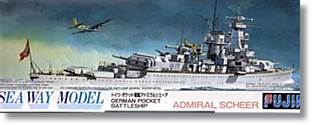

Aprovechando el molde del Graf Spee a la misma escala, Fujimi lanzó a finales de los 90 la serie completa de los acorazados de bolsillo alemanes: Admiral Graf Spee, Deutschland y Admiral Scheer. Pensados en principio para aunar velocidad y potencia de fuego con un escaso desplazamiento, lo cierto es que, salvo el primero, históricamente estos buques no jugaron el papel que se esperaba de ellos y ya empezada la guerra fueron clasificados como cruceros pesados.
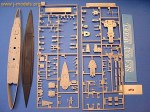
La maqueta de Fujimi representa bastante bien al Scheer a esta escala. Se compone de dos bandejas de piezas, el casco con su línea de flotación, el contrapeso metálico y las instrucciones. Hay además una pequeña pegatina para la bandera, que hay que recortar. El despiece e incluso el color del plástico, recuerda a otras maquetas de Pit Road. El acabado de las piezas es en general muy bueno, con pocas rebabas o marcas de eyector. La cubierta, sin embargo, está mejor detallada a proa, y no se han grabado las planchas de madera que la componían. También se podría haber mejorado la artillería secundaria, que viene moldeada en una sola pieza. El detalle del puente de mando es excelente, pero el modelista que desee construir el Scheer anterior a la Guerra Mundial, como es mi caso, deberá tener en cuenta algunos cambios como el telémetro y la disposición de los reflectores. Tampoco el hidroavión que trae la maqueta (un Arado 196) corresponde al que tuvo antes de la guerra (Heinkel He-60 biplano).
Las instrucciones muestran ocho pasos de construcción, comenzando por el montaje de la artillería, posteriormente el puente y chimenea, las superestructuras y mástiles, y finalmente el casco. Las referencias de pintura se dan, como ya es tradicional, en las gamas de Gunze Sangyo y Mr Color. El barco aparece con el casco en gris oscuro y la cubierta en color madera. No se dan referencias del camuflaje que llevó en la Segunda Guerra Mundial ni del periodo anterior, cuando iba pintado en un gris claro y bandas con los colores de la bandera alemana (rojo, blanco y negro) sobre las torres principales. Aunque se muestran los colores del hidroavión, no se proporcionan calcas y sus insignias deben pintarse, tarea difícil a menos que se tenga pulso de atleta.
La maqueta es apta para cualquier modelista, incluso para los menos expertos, sobre todo porque su montaje es aparentemente sencillo.◊


Using the same tooling of the Graf Spee, Fujimi released the complete series of the German pocket battleships in the late 1990s: Admiral Graf Spee, Deutschland and Admiral Scheer. These three were initially launched to get speed and firepower with a minimum displacement. But the truth is that, except for the first ship, they did not play the role they were supposed to. So much so, that later in the war they were reclassified as heavy cruisers.
The kit represents quite well the Scheer at this scale. Inside the box you find two sprues with more than 70 parts, the usual ballast, the hull with a plastic waterline and the instructions. There is also a small sticker with the flag to be cut out. The sprues, and indeed the colour, resembles other kits by Pit Road. Parts are quite correctly moulded, with few ejector pins and flash. The deck is perhaps better detailed at the bows and unfortunately the wooden boards are not engraved. The AA guns could have been improved because the guns and the turrets have been moulded together. Detail in the conning tower is excellent, but if you want to build the pre-war battleship, you will have to change some elements here, such as the seachlights and the rangefinder. In that period, the German pocket battleships also carried a Heinkel He-60 biplane on board, and not the Arado which replaced it later (this is included in the kit).
The instructions show the assembly in 8 steps. You begin with the turrets, later you build the bridge and funnel, then continue with the superstructures and masts, and finally you glue everything onto the hull. Colour reference, as usual, is given in Gunze Sangyo and Mr Color charts. The profile shows overall dark grey with wooden decks and black masts and funnel top. There is no reference to the camo scheme the ship had in the war, or to the late 1930s scheme, when she bore a lighter grey and the colours of the German flag (red, white and black) painted on the main turrets. Although the leaflet shows how the seaplane was painted, you are also supposed to paint the Balkan crosses. There are not any decals provided for it.
The kit is recommendable for any modeller with a taste for the German Kriegsmarine, regardless his experience, above all because assembly looks quite easy.◊
Revisado – Revised: 9 / 2023
Actualizado – Updated: 4 / 2022
Actualizado – Updated: 5 / 2017
Publicado – Published: 8 / 2006
©www.jmodels.net
 jmodels.net
Debe estar conectado para enviar un comentario.