

De un vistazo – Quick look
MATERIAL Y PIEZAS
MEDIA & PARTS:
- Plástico inyectado (31 piezas), plástico transparente (8 piezas). Incluye 2 figuras (4+4 piezas).
- Injected plastic (31 parts), clear plastic (8 parts). Two figures included (4+4 parts).
CALCAS – DECALS:
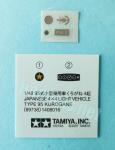
- Dos hojas muy pequeñas. Una contiene los instrumentos del salpicadero y una estrella del Ejército Imperial y la segunda calcas plateadas para el espejo retrovisor, la matrícula e insignias de la Marina. Bien impresas.
- Two very small sheets. One contains the dashboard instruments and an Imperial Army star, while the second silver decals for the rearview mirror, number plate and markings of the Imperial Navy. Correctly printed.
OPCIONES – OPTIONS:
- Vehículo ligero tipo 95 Kurogane. Ejército Imperial japonés.
- Light vehicle Type 95 Kurogane. Imperial Japanese Army.
INSTRUCCIONES – INSTRUCTIONS:
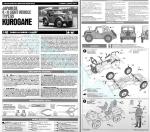
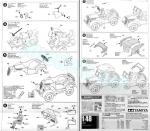
- Folleto vertical de 6 páginas impreso en blanco y negro. Contiene una breve historia del vehículo, una lista de pinturas de Tamiya, 9 pasos de montaje y perfiles.
- 6-page leaflet printed vertically in black and white. It shows a short history of the vehicle, a list of Tamiya paints, 9 assembly stages and profiles.
LO MEJOR – THE BEST:
- Montaje sencillo. Buen detalle en general. Opciones en el toldo. Figures.
- Easy build. Nicely detailed overall. Assembly choices for the canvas top. Figures.
LO PEOR – THE WORST:
- Detalle demasiado simplificado para un vehículo tan pequeño (puertas cerradas, ganchos de remolque).
- Too simplified detail for such a small car (doors molded closed, towing hooks).
VALORACIÓN – CONCLUSION:
- Muy sencilla de montar incluso para los menos expertos, posee un buen detalle, aunque demasiado simplificado en ciertas piezas considerando el tamaño del vehículo.
- Very easy to assemble even for the less experienced, it has a nice detail, though sometimes too simplified for such a small vehicle.

La maqueta
Este pequeño vehículo debe ser de las primeras maquetas que Tamiya sacó en esta serie a escala 1/48. Tras su aparición en solitario el fabricante la ha incluido en ocasiones como complemento en varias cajas de aviones japoneses de la misma escala, como el Ki-61, el A6M2 y 5, el Raiden, etc. Curiosamente, Tamiya nunca lo ha editado en solitario a escala 1/35 como hizo, por ejemplo, con la furgoneta británica de 10 caballos o el conocido Citröen Traction 11 CV.
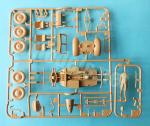
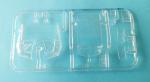
Dentro de la caja encontramos la carrocería separada, dos bastidores de piezas, un bastidor transparente dos pequeñas hojas de calcas y las instrucciones. El escaso número de piezas, alrededor de una treintena, nos indica que la maqueta es bastante sencilla de montar. El moldeado es bastante bueno y las piezas no tienen marcas ni rebabas.
Además de emplear las dos figuras que trae la maqueta, la única opción de montaje es la posibilidad de colocar el toldo cerrado o abierto.
Chasis, suspensión y ruedas
Pese a que se trata de un vehículo bastante pequeño sin el motor y que los detalles del habitáculo no son profusos, Tamiya ha seguido simplificando muchos elementos de la parte inferior del chasis que no serán evidentes. El bastidor está unido al suelo de la cabina e incluye los paragolpes en la misma pieza con los enganches delanteros muy mal replicados, como se puede apreciar en la misma ilustración de la caja. En esta pieza también se aprecia la suspensión delantera, el eje de la transmisión y una parte del tubo de escape con el silenciador. Del motor apenas tenemos una mínima sección en la zona delantera.
Las piezas separadas incluyen dos tramos del escape, uno de ellos el de salida, los brazos de suspensión delanteros unidos en una sola pieza, la suspensión trasera moldeada junto con el depósito de combustible y los dos ejes idénticos que van introducidos a través de la suspensión y que, obviamente, deben pegarse de modo que posean la misma longitud en cada extremo.
Las ruedas vienen separadas y poseen buen detalle en la banda de rodadura de los neumáticos y en el tapacubos, reproducido con el pequeño hueco de la válvula de aire y la corona central diferente para las ruedas delanteras y traseras, que por tanto no son intercambiables. Las piezas carecen de detalle en el lado interno y van tan solo introducidas en los ejes.
Interior
El habitáculo está detallado con tres asientos moldeados en una pieza cada uno, dos delante sin texturizar, y otro detrás provisto de brazos y respaldo acolchado. Los soportes de los delanteros están moldeados sobre el suelo.
La parte delantera posee la cubierta de la caja de cambios con la palanca de marchas y de freno separadas, la columna de la dirección y el volante igualmente aparte. El panel delantero del motor está moldeado con el suelo interior.
El parabrisas está fabricado de una pieza que incluye los dos retrovisores laterales. Los cristales, moldeados con los limpiaparabrisas, vienen separados y se insertan en rebajes del marco. El retrovisor tienen el espejo separado reproducido con una pieza transferible plateada. El lado trasero del parabrisas está unido al salpicadero, que muestra los instrumentos en fino relieve detallados con calcas.
Carrocería
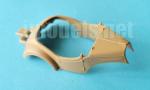
Viene en una sola pieza con las puertas cerradas, los guardabarros traseros, el maletero y el capó, pero carece de la parrilla delantera. La bisagra central de apertura del capó es tan solo una fina línea en relieve que más parece un perfil, sin embargo los lados del capó llevan dos finas rejillas de ventilación en relieve. Las puertas muestran las bisagras y los tiradores sin definición pero están bien marcadas por fuera. Desgraciadamente, por dentro los contornos no están ni siquiera señalados y carecen de detalle. La parte trasera contiene un soporte para pegar la rueda de repuesto encima y la pequeña luz trasera es una pieza transparente insertada en la carrocería desde el interior.
Los guardabarros traseros son algo más delgados que los delanteros, pero todos ellos llevan una moldura fina por el exterior. El par delantero está moldeado en una pieza y va pegado al chasis antes de colocar la carcasa de la carrocería. Los faros están exentos y sus lentes son piezas transparentes.
La parrilla delantera está separada en una pieza que posee buen detalle en la rejilla y la moldura que la rodea. La placa de la insignia se reproduce con un transferible plateado y la estrella del Ejército Imperial es de calca.
Como señalaba antes, el toldo abierto o no es la única opción de montaje de esta maqueta. El toldo doblado consta de tres piezas, dos de ellas a los lados simulando los soportes plegados. La parte superior muestra un cierto detalle en la textura del tejido, aunque el lado trasero no me parece tan bien conseguido.
Para formar el toldo abierto también tenemos tres piezas, pero transparentes, que incluyen las ventanillas de material traslúcido, aunque aquí son transparentes, en la parte trasera y en los lados que habrá que tapar con máscaras al pintar. La pieza central es fina y muestra las arrugas de la tensión del tejido con muy buena definición. Los lados incluyen el soporte de varillas.
Figuras
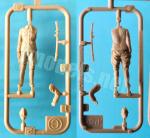
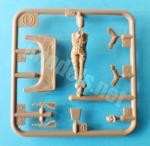
La maqueta incluye la figura del conductor sentado al volante y la de un oficial en pie. El conductor tiene la cabeza con gorra y los brazos separados. Según las instrucciones, la figura debe pegarse sin los brazos antes de colocar el volante, para posteriormente poder añadírselos en la posición correcta. Los detalles faciales no son malos pese al tamaño y el uniforme está correctamente reproducido, apreciándose los bolsillos, botones, polainas y botas. Sólo hay finas líneas de molde a los lados de las caderas y piernas. Lo que me parece algo peor es la pose demasiado rígida.
El oficial tiene un brazo y la cabeza tocada con gorra separados además de una espada sobre la que apoya la mano. El brazo derecho está unido al cuerpo. Tanto los rasgos de la cara y el uniforme son bastante aceptables y no poseen lineas de molde. La pose, aunque carece de dinamismo, parece al menos más natural que la del conductor.
Las figuras no desmerecen de la maqueta y resultan un complemento muy bueno tanto para el vehículo como para la supuesta escena donde deseemos colocarlas.
Calcas
La caja trae dos hojas muy pequeñas. Una contiene calcas para los instrumentos del salpicadero y una estrella del Ejército Imperial y la segunda transferibles plateados para el espejo retrovisor, la matrícula e insignias de la Marina. Estas dos últimas no las usaremos. Ambas hojas están bien impresas.
Instrucciones
Vienen en un folleto doblado impreso verticalmente en blanco y negro con seis páginas diferenciadas. El formato lo hace un tanto molesto de consultar. Contiene una breve historia del vehículo, una lista de pinturas de Tamiya, nueve pasos de montaje muy comprensibles y perfiles. Como de costumbre, los lados de la tapa muestran perfiles del vehículo a color como orientación para pintar la maqueta.
Valoración
Al igual que en otras ocasiones, Tamiya ha diseñado esta maqueta para que sea muy sencilla de armar al precio de simplificar ciertos detalles. Considerando que está destinada, supuestamente, a figurar como complemento de una escena junto a un avión a la misma escala, el objetivo de la edición me parece más que cumplido y en este sentido es irreprochable. La inclusión de dos figuras y las piezas transparentes para el toldo desplegado me parecen un acierto también.
Sin embargo, dado el tamaño de este Kurogane, el fabricante se podría haber esmerado más en ciertos detalles del vehículo que me parecen demasiado sintetizados o claramente mal reproducidos, como el interior de las puertas y los ganchos frontales, ambos muy evidentes y en el caso de las puertas todavía más si deseamos colocar el toldo plegado.
Con todo, hay que reconocer que Tamiya ha puesto este pequeño vehículo también al alcance de las habilidades del modelista no experto y resulta extraño que no se haya decidido hasta ahora a editarla en solitario a una escala mayor.◊

The kit
This small vehicle must be one of the first kits Tamiya released in this 1/48 series. After this boxing, the manufacturer has occasionally included it as a complement in various boxes of Japanese aircraft of the same scale, such as the Ki-61, the A6M2 and 5, the Raiden, etc. Curiously, Tamiya has never released it alone in 1/35 scale as the company did, for example, with the British 10-hp utility car or the well-known Citroën Traction 11 CV.
Inside the box we find the separate body, two sprues of parts, a clear sprue, two small decal sheets and the instructions. The small number of parts, around thirty, indicates that the kit is quite easy to assemble. The standard of molding is quite good and parts have no marks or flash.
Apart from using the two figures included, the only assembly choice is the possibility of showing the canvas folded or not.
Chassis, suspension and wheels
Although this is a fairly small vehicle without an engine and details inside the cab are not extensive, Tamiya has simplified many elements of the lower chassis that will not be evident. The frame is attached to the cab floor and includes the bumpers in the same piece with the front tow hooks very poorly replicated, as can be seen in the artbox. The part is also detailed with the front suspension, the transmission shaft and a length of the exhaust pipe attached to the muffler. We only have a minimal part of the engine.
The separate pieces include two sections of the exhaust, one of them the tailpipe, the front suspension arms joined in a single piece, the rear suspension molded with the fuel tank and two identical axles inserted through the suspension and that, obviously, should be glued so that they have the same length at each end.
The wheels come separately and have good detail on the tire treads and hubcaps. These show the small air valve and different centre caps for the front and rear wheels, which are not interchangeable. The pieces lack detail on the inner hub sides and are simply inserted into the axles.
Cab
The cab is detailed with three seats, two at the front with no texture on the surfaces, and one at the back provided with arms and a padded backrest. The front seats supports are moulded on the floor.
The front cab has separate pieces for the gearbox cover, the gearshift and brake levers, the steering column and the steering wheel. The engine panel is molded with the cab floor.
The windscreen is one piece including two side mirrors. The glass, molded with the wipers, are separate and inserted into recesses in the frame. The rear view mirror is detailed with a silver transfer piece. The rear side of the windscreen is molded with the dashboard, which has thin raised instruments detailed with decals.
Body
It comes in one piece with the doors molded closed, rear fenders, trunk and hood, but lacks the front grille. The center hinge for opening the hood is just a thin raised line that looks more like a moulding, but the hood sides have two thin raised air vents. The doors show poor hinges and handles but are well engraved on the outside. Unfortunately, the inside contours are not even marked and the surface is flat. The trunk contains a support to attach the spare wheel and the small rear light is a clear piece inserted into the body from the inside.
The rear fenders are somewhat thinner than the front ones, but all of them have a thin moulding on the outside rims. The front pair is molded in one piece and glued to the chassis before the body shell is attached. The headlights are provided with clear pieces for the lenses.
The front grille is separated in one piece showing nice detail on the louvres and the molding around them. The front plate is reproduced with a silver transfer and the Imperial Army star is a decal.
As mentioned, the canvas roof is the only assembly option in the kit. The folded roof consists of three pieces, two of them on the sides simulating the folded frames. The centre piece shows some detail on the fabric texture, but the back side does not look so well done.
The open roof top also has three pieces, but they are clear and include the rear and rear quarter windows that need to be masked to paint the canvas. The central piece is thin and shows the wrinkles of the fabric with very good definition. The sides are molded with raised scissor frames.
Figures
The kit includes a driver sitting at the wheel and a standing officer. The driver has a separate capped head and arms. According to the instructions, the figure is glued without the arms before the steering wheel is in place, so that they can be added later in the correct position. Facial detail is not bad despite the size and the uniform is correctly reproduced, with visible pockets, buttons, leggings and boots. There are only thin seam lines on the sides of the hips and legs. I find the pose too stiff and this does not round it off, in my opinion.
The officer has one arm and his capped head separated, as well as a sword on which he rests his hand. The right arm is attached to the body. Both the facial features and the uniform are quite acceptable and do not show seam lines. The pose, although lacking in dynamism, seems at least more natural than that of the driver.
The figures do not detract from the kit and are a very nice complement both to the vehicle and to the supposed scene where we want to place them.
Decals
The box contains two very small sheets. One of them has decals for the dashboard and an Imperial Army star and the second include silver transfers for the rearview mirror, license plate and a Navy badge. We will not use these last two in the kit. Both sheets are well printed.
Instructions
They come in a folded leaflet printed vertically in black and white with six distinctive pages. The format makes the instructions somewhat annoying to consult. The leaflet contains a brief history of the vehicle, a list of Tamiya paints, nine very comprehensible assembly steps and profiles. As usual, the sides of the box top show colored profiles as a guide for painting the model.
Conclusion
As in other 1/48 kits Tamiya has designed this one to be very easy to build at the cost of simplifying some detail. Considering that it is supposedly intended to be used as a complement to a scene with an aircraft of the same scale, the kit will clearly fulfill the role expected. The inclusion of two figures and the clear pieces for the closed roof top are also a nice touch.
However, given the size of this Kurogane, the manufacturer could have increase parts count a bit to improve detail, which sometimes is too synthesized or even poorly reproduced, such as on the inside of the doors and the front hooks, both very obvious and in the case of the doors even more so if we choose to build the roof folded.
All in all, Tamiya made this small vehicle suitable for the skills of the less experienced modeler and it is strange that they have not released it alone on a larger scale.◊
Publicado – Published: 12 / 2024
©www.jmodels.net
 jmodels.net
Debe estar conectado para enviar un comentario.