
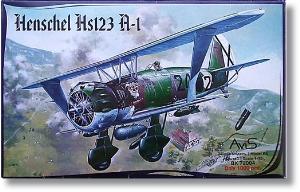
De un vistazo – Quick look
MATERIAL Y PIEZAS
MEDIA & PARTS:
- Plástico inyectado (62 piezas), acetato (1 pieza).
- Injected plastic (62 parts), acetate (1 part).
CALCAS – DECALS:
- Impresas por Decograph. Insignias alemanas y nacionalistas españolas, insignias de unidad, esvásticas recortables, numerales y algunos estarcidos. Acabado fino y brillante. Buen registro y saturación. Sin exceso de película soporte.
- Printed by Decograph. German and Spanish Nationalist markings, unit badges, cut-out swastikas, aircraft numbers and some stencils. Thin and glossy finish. Good register and apparently well-color saturated. No surplus carrier film.
OPCIONES – OPTIONS:
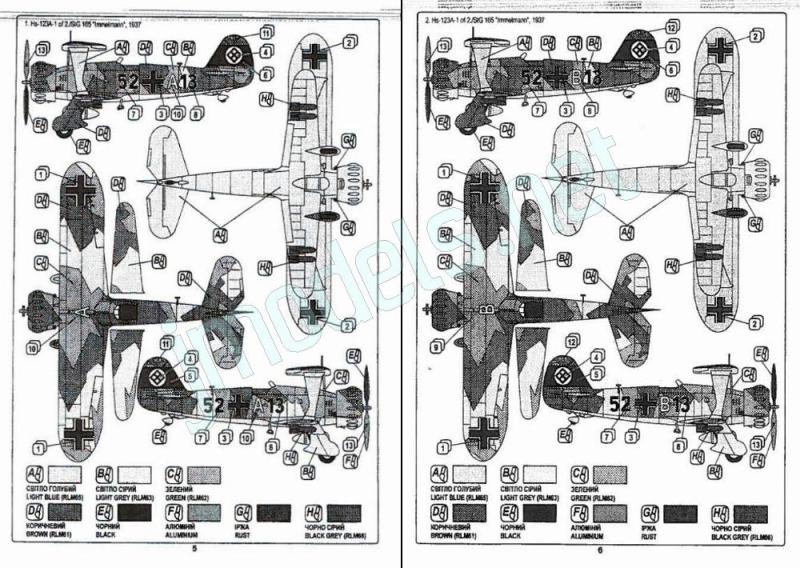
- Henschel Hs123A-1. 52+A13. 2/StG 165 “Himmelmann”, 1937.
- Henschel Hs123A-1. 52+B13. 2/StG 165 “Himmelmann”, 1937.
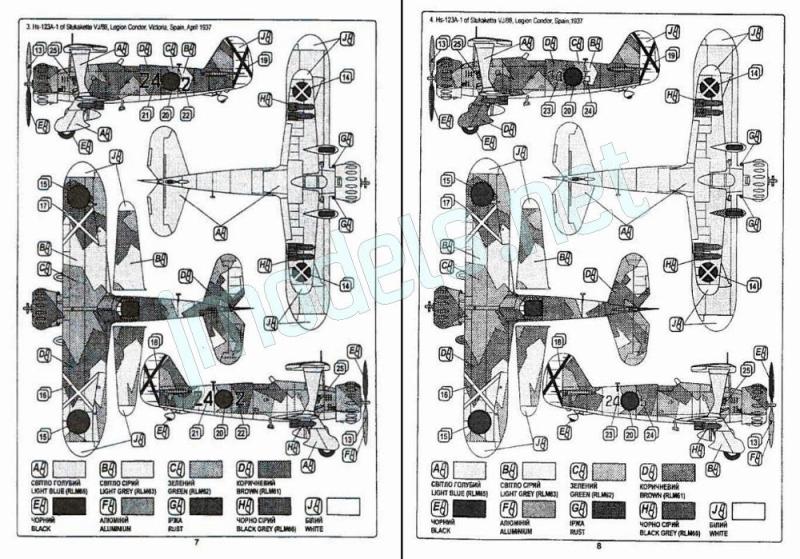
- Henschel Hs123A-1. 24-2. Legión Cóndor. Stukakette VJ/88. Vitoria (España). Abril de 1937.
- Henschel Hs123A-1. 24-5. Legión Cóndor. Stukakette VJ/88. España, 1937.
INSTRUCCIONES – INSTRUCTIONS:
- Folleto de formato A5 de 8 páginas impreso en blanco y negro. Contiene un sumario histórico, un diagrama de piezas numerado, 6 capítulos de montaje y 4 páginas de perfiles con listas de colores genéricos o en código RLM.
- 8-page A5 booklet printed in black and white. It shows a historical summary, a numbered parts diagram, 6 assembly steps and 4 pages of profiles with lists of colors. These have generic names and matches in the RLM code in some cases.
LO MEJOR – THE BEST:
- Buen detalle en la carlinga.
- Nice detail inside the cockpit.
LO PEOR – THE WORST:
- Moldeado en ciertas zonas. Encastre de la cola. Acabados de pintura sin diversidad.
- Rough areas on the wings and struts. Tail assembly. Lack of variety in the paint finishes.
VALORACIÓN – CONCLUSION:
- No es mala maqueta, pero requiere experiencia y trabajo para sacarle el partido que puede dar. Para modelistas curtidos.
- Not a bad kit, but it needs experience and work to yield all the potential it has. Recommended to seasoned modelers.

La maqueta
El Henschel Hs 123 no puede quejarse del trato recibido por el modelismo en todas las escalas desde hace medio siglo. En la escala 1/72 el molde más veterano es el de Airfix, pero ya en este siglo han aparecido otras maquetas, como las de AviS en 2007, con copias de Amodel, y Fly en 2011, también reditada por LF Models. De todas, la maqueta más completa es la de Fly, pero no parece la más fácil de construir. La de AviS, sin embargo, parece situarse en detalle y dificultad entre la anterior y la muy básica de Airfix.
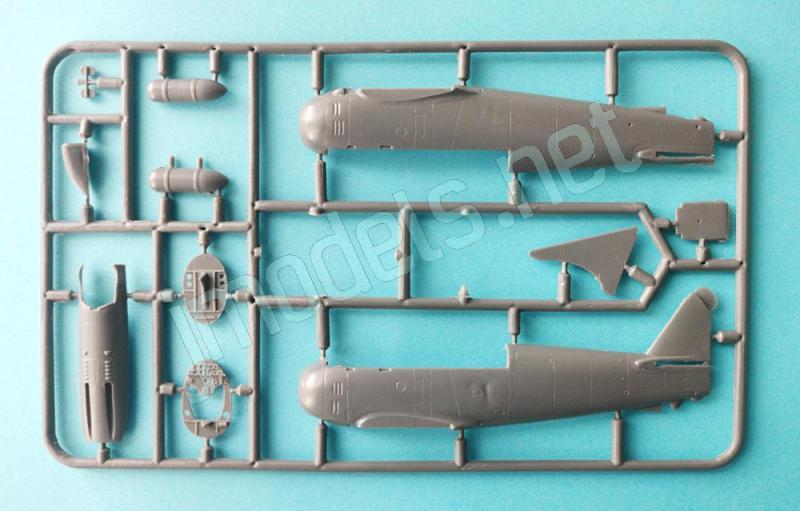
La caja trae cuatro bastidores de piezas, el parabrisas de acetato, la hoja de calcas y las instrucciones. Al abrir la caja, se echa de ver con prontitud que este es un molde de inyección lenta que recuerda a otros producidos por Amodel. El moldeado muestra, con ciertas excepciones, un detalle algo “blando” sin mucha nitidez y zonas levemente rugosas en las alas y sus puntales. No hay marcas que mencionar, pero el modelista no escapará de tener que limpiar algunas rebabas en torno al motor y líneas de molde. La reproducción del panelado en el fuselaje y las alas no es convincente porque las líneas son demasiado finas y poco profundas, así que desaparecerán tras la primera pintura.
La construcción del modelo no tiene piezas alternativas y en los acabados de pintura el fabricante no se ha estrujado la mollera, ya que todos ellos son iguales con casi las mismas calcas también.
Reseña
Aunque se va a apreciar bastante poco de ella, la carlinga tiene un detalle bueno en general. Los lados internos del fuselaje contienen menos definición en el relieve estructural y algo mejor en los instrumentos a una banda y las botellas de oxígeno a la otra. El espacio de la carlinga lo rellenan un mamparo trasero bien detallado sobre el cual va pegado el asiento, un mamparo delantero que contiene un notable panel de instrumentos sin calca con la palanca pegada sobre una pequeña base, más un suelo por delante de este mamparo que contiene los pedales. El fino parabrisas de acetato tiene impreso el marco de los cristales.
La cubierta delantera del fuselaje está separada. La pieza incluye el hueco de la carlinga y las troneras de las ametralladoras definidas. El detalle de las mitades no es nada profuso, consistiendo en dos estribos bajo los lados de la carlinga con dos asideros en el lado izquierdo, algunos accesos redondos, varias salidas de ventilación tras el motor y las líneas de paneles ya mencionadas. Una pieza redonda cierra el hueco del fuselaje en el morro.
El motor tiene el capó seccionado en dos mitades transversales donde se aprecian las carenas de los cilindros bien reproducidas y las salidas del armamento sin ahuecar. A los lados hay dos pequeños escapes dobles independientes y una toma de aire bajo el anillo. El motor es pasable de forma y bastante peor en detalle. Los cilindros son lisos y la caja de engranajes delantera parece algo pequeña. La hélice es de una pieza con el eje separado. Las palas son finas y sus filos hay que repasarlos suavemente con lija.
La construcción de las alas comienza pegando el plano inferior de una pieza bajo el fuselaje. Las superficies muestran líneas grabadas demasiado finas junto con un suave relieve estructural. Sin embargo, los flaps están reproducidos con mucha más nitidez y profusión en este relieve. Estas mismas características parecen algo mejores en el plano superior. La pieza tiene los alerones bien grabados y las diminutas luces de navegación en las puntas. Los soportes son finos y tienen buen perfil. Los situados sobre el fuselaje son de una pieza en forma de N. Para conseguir el ángulo inclinado necesario en los de las alas, AviS ha incluido una pieza que nos sirve de plantilla. Es de agradecer.
La carga subalar consiste en un depósito ventral más cuatro bombas SC50 de 50 kg con dos aletas separadas pegadas sobre los soportes moldeados en las alas.
El timón de cola y los estabilizadores son independientes. Estos últimos son de una pieza y se pegan encastrados en el puro de cola, pero el grosor de la pieza a simple vista nos indica que no va a ser sencillo insertarlos. Los timones de profundidad y las aletas están bien grabados. En la cara inferior se aprecian dos actuadores finos. El timón vertical está moldeado con la estructura en suave relieve. El grabado de la aleta es muy tenue, apreciándose también la luz de navegación poco definida y un actuador de la aleta bastante más nítido.
Las carenas de las patas están separadas en mitades para colocar las ruedas, nada extraordinarias, entre ellas. El refuerzo posterior de las carenas hay que hacerlo siguiendo la longitud y grosor indicadas en las instrucciones. La rueda de cola y su carena forman una pieza a la que hay que añadir una pequeña varilla horizontal fabricada por uno mismo.
La hoja de calcas está impresa por Decograph. Contiene insignias alemanas y nacionalistas españolas, marcas de unidad, esvásticas recortables, numerales y algunos estarcidos. Las calcas poseen un acabado fino y brillante con buen registro y saturación. No hay exceso de soporte.
El folleto de instrucciones tiene un formato A5 y consta de ocho páginas impresas en blanco y negro. Contiene un sumario histórico, un diagrama de piezas numerado, seis capítulos de montaje y cuatro páginas de perfiles con listas de colores genéricos o en código RLM en algunos casos.
En la pintura no hay mucho donde elegir. Las libreas de camuflaje astillado compuesto de RLM 61, 62 y 63 sobre RLM 65 son iguales en los cuatro perfiles. Incluso los dos aviones de la Luftwaffe y la pareja de la Legión Cóndor llevan casi las mismas marcas con distinciones sólo en los numerales.
Valoración
La maqueta de AviS tiene potencial para sacar de ella un modelo apañado del Hs 123, pero, como ejemplar de serie limitada, necesita práctica y trabajo en refinar ciertos detalles para sacarle todo este partido. A mi juicio, lo mejor es la carlinga, bien provista y sin la necesidad de mucho más detalle en esta escala. El montaje no parece sencillo en ciertos momentos, sigularmente en el encastre de los estabilizadores. Las calcas tienen buen aspecto, pero los acabados de pintura son un tanto decepcionantes por su escasa diferencia, siendo esta una de las desventajas menores de la maqueta.◊


The kit
The Henschel Hs 123 can’t complain about the attention it has received from modeling in all the scales for the last half-century. In the 1/72 scale, the reference kit was the Airfix offer, dating back from the 1970s, but in this century new kits have appeared, such as those from AviS in 2007, with reboxes from Amodel, and Fly in 2011, also reissued by LF Models. The Fly boxings seem to be the most accurate, but they don’t look the easiest to build either. The AviS releases seem to fall between the former and the very basic Airfix kit in terms of detail and difficulty.
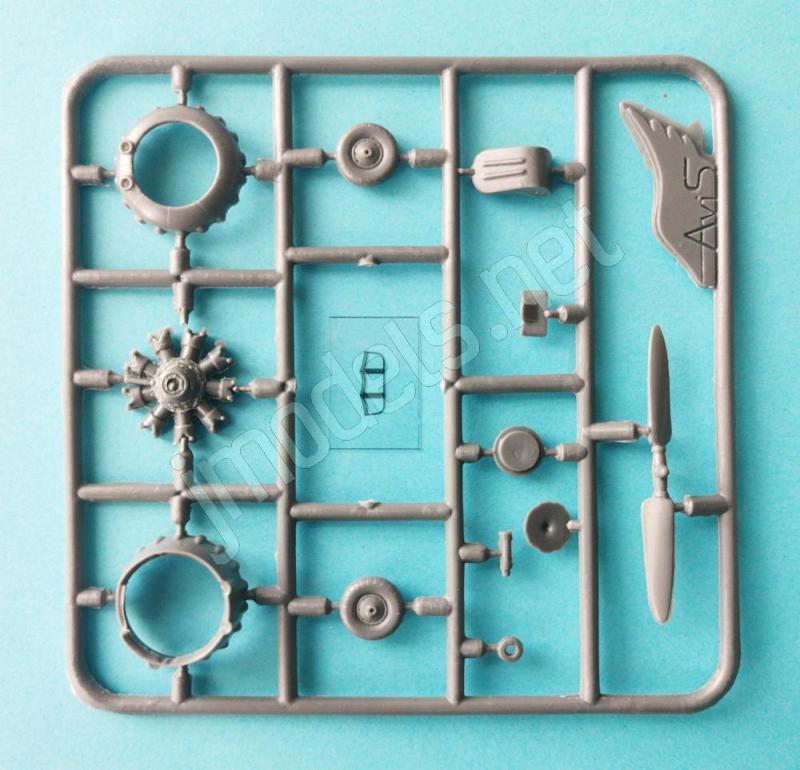
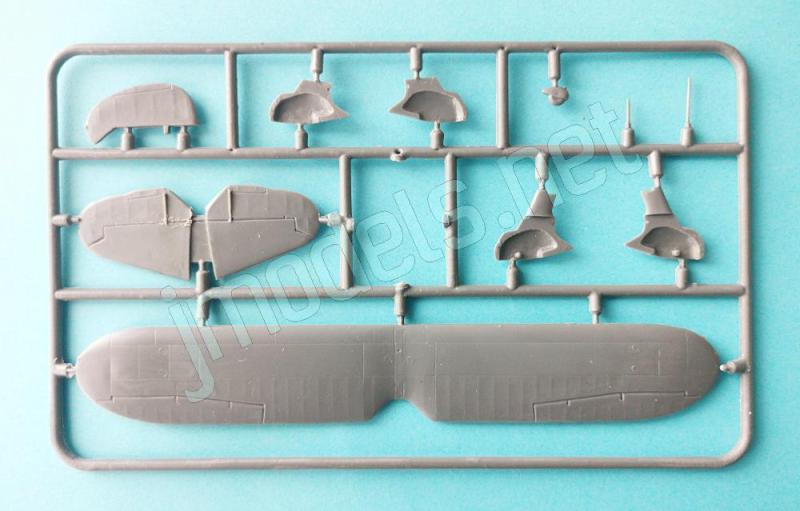
The box contains four sprues of parts, an acetate windscreen, the decal sheet, and the instructions. Upon opening the box, it’s immediately apparent that this is a short-run tool reminiscent of others produced by Amodel. The molding shows, with some exceptions, a somewhat «soft» detail with slightly rough areas on the wings and the struts. There are no pin marks to mention, but the modeler will inevitably have to clean up seam lines and some flash around the engine piece. Engraved panel lines on the fuselage and wings are not convincing, being too thin and shallow, so they will disappear after the first coat of paint.
The kit has no alternatives during construction, and the manufacturer hasn’t put much thought into the paint finishes, as they are all identical, with almost the same decals as well.
Review
Although you will see little of it, the cockpit has good detail in general. The fuselage sidewalls have less definition in the raised structural ribbing than on the the instruments on one side and two oxygen cylinders on the other. The cockpit space is filled by a well-detailed rear bulkhead with the seat attached on it, a forward bulkhead containing a nice instrument panel without decals plus the control stick attached to a small base. There is also a floor in front of this bulkhead with separate pedals. The thin acetate windshield has a printed glass frame.
The forward fuselage deck is separated. The piece includes the cockpit opening and defined machine gun troughs. External fuselage detail is not profuse, consisting of two mounting steps, two footholds on the left side, some round accesses, several cooling louvers behind the engine and the panel lines already mentioned. A round piece closes the gap in the fuselage front to install the engine.
The engine has a cowling divided into two transverse halves with nice raised cylinder fairings and the gun ports. These are not hollowed out. On the sides there are two small double exhausts and an air intake under the ring. The engine is passable in shape and much worse in detail. The cylinders are smooth and the front gearbox seems a bit small. The propeller is one piece with the shaft separated. The blades are thin and the edges need some soft sanding.
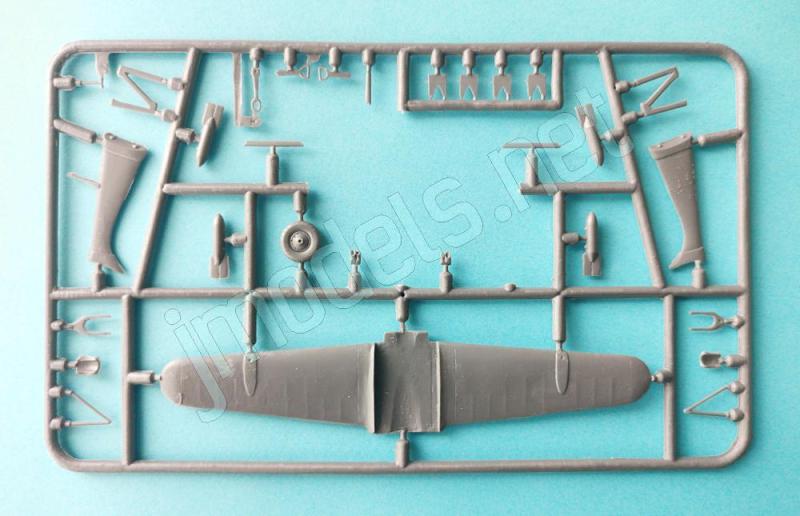
Construction of the wings begins by gluing the one-piece lower wings under the fuselage. The surfaces show too fine engraved lines along with soft raised structural detail. However, the flaps are reproduced much more sharply. These same features seem somewhat better on the upper wings. The piece has well-engraved ailerons and tiny navigation lights at the tips. The struts are thin and have a correct profile. Cabane struts are rendered in two N-shaped pieces. To achieve the necessary angle in the wing struts, AviS included a piece to be used as a template. It should be appreciated.
The underwing load consists of a ventral fuel tank plus four 50kg SC50 bombs attached on racks molded under the wings.
The tail rudder and stabilizers are separate from the fuselage. The latter come in a single piece embedded into the tail boom, but the thickness of the piece shows that attachment will not be easy. The elevators and fins are well engraved. Two thin actuators are visible on the underside. The vertical stabilizer is molded with soft raised structural detail. The tailfin engraving is very faint, and the navigation light is also poorly defined, while the fin tab actuator is quite sharp.
The spats come in halves to install the wheels, which are unremarkable, in between. The rear spat bracing strut is provided by the modeler following to the length and thickness indicated in the instructions. The tail wheel and its fairing are a single piece. This has a small horizontal rod that needs to be made.
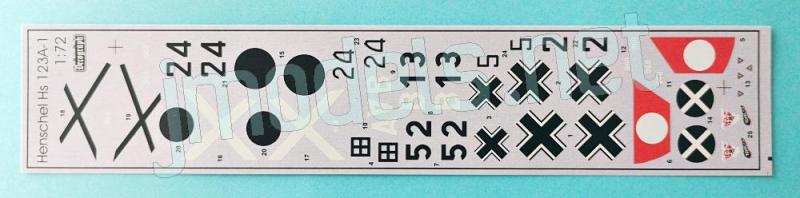
The decal sheet is printed by Decograph. It contains German and Spanish nationalist insignia, unit badges, cut-out swastikas, aircraft numbers, and some stencils. The decals have a fine, glossy finish with good register and saturation. There is no surplus carrier film.
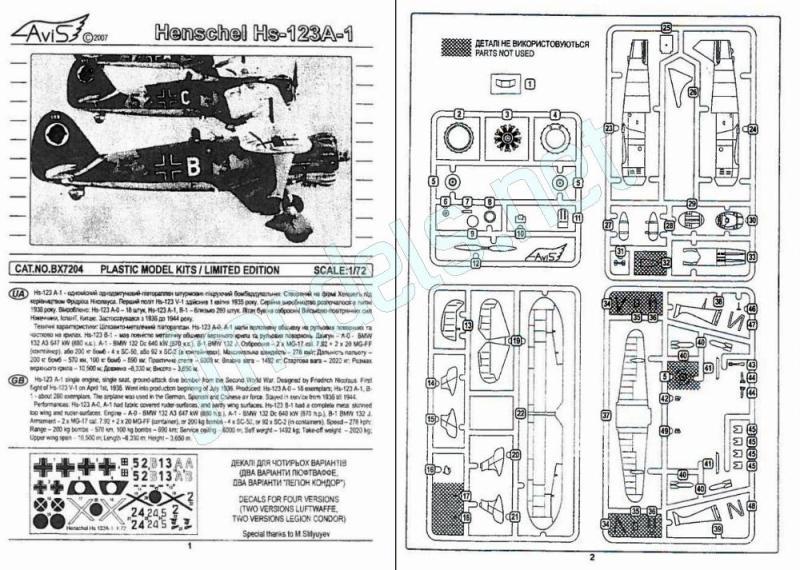
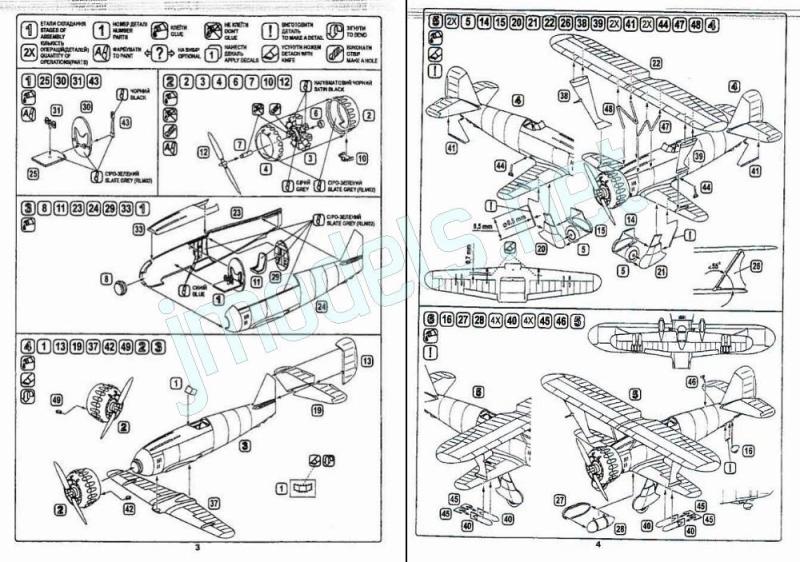
The instruction booklet is A5 format and consists of eight pages printed in black and white. It contains a historical summary, a numbered parts diagram, six assembly chapters, and four pages of profiles with generic color reference and RLM codes in some cases.
There isn’t much choice when it comes to painting. The splinter camouflage liveries of RLM 61, 62, and 63 over RLM 65 are identical in all four profiles. Even the two Luftwaffe aircraft and the pair from the Condor Legion have almost the same markings, with differences only in the numbers.
Conclusion
Building a nice kit from the AviS Hs 123 is feasible, but as a short run, it needs practice, patience and some work to refine some details to reach its full potential. In my opinion, the best part is the cockpit, which is well-stuffed and doesn’t need much more detail at this scale. Assembly doesn’t seem straightforward at times, particularly when fitting the stabilizers. The decals look good, but the paint finishes are somewhat disappointing due to their lack of variation, which is one of the kit’s minor drawbacks.◊
Publicado – Published: 6 / 2026
©www.jmodels.net


Debe estar conectado para enviar un comentario.