
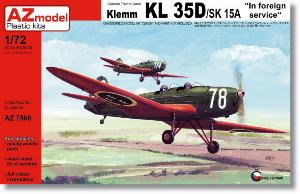
De un vistazo – Quick look
MATERIAL Y PIEZAS
MEDIA & PARTS:
- Plástico inyectado (34 piezas), acetato (2 piezas).
- Injected plastic (34 parts), acetate (2 parts).
CALCAS – DECALS:
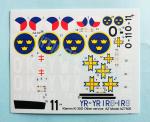
- Insignias nacionales, arneses, matrículas y códigos. Apariencia fina y brillante. Aparente buena densidad de color y nitidez. Muy escaso exceso de soporte.
- National roundels, seat belts, registers and codes. Thin and glossy finish. Apparent good color density and sharpness. Very little surplus carrier film.
OPCIONES – OPTIONS:
- Klemm KL-35D (C.1-11). O-11. Czechoslovak Air Force. Nitra airfield. 1945.
- Klemm KL-35D. OK-YWX. Slovak Air Force. 1943.
- SK 15A (Klemm KL-35D). White 78. Swedish Air Force. 1941.
- Klemm KL-35D. YR+IR. Royal Romanian Air Force. 1941.
INSTRUCCIONES – INSTRUCTIONS:
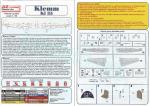
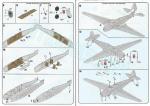
- Folleto A5 de 4 páginas impreso en color. Contiene un sumario histórico sobre el avión, un plano numerado de piezas, una tabla de colores con referencias de pinturas de Humbrol y 14 secuencias de montaje. La cara trasera de la caja muestra perfiles en color con una lista de pinturas de Humbrol.
- 4-page A5 brochure printed in color. It shows a hostorical summary about the aircraft, a numbered parts plan, a color chart with Humbrol paint matches and 14 assembly chapters. The back side of the box shows profiles with a list of Humbrol paints.
LO MEJOR – THE BEST:
- Aparente montaje sencillo. Calcas. Variedad de opciones de pintura.
- Apparent easy build. Decals. Varied paint choices.
LO PEOR – THE WORST:
- Zonas con superficies irregulares en las alas.
- Areas with irregular surfaces on the wings.
VALORACIÓN – CONCLUSION:
- AZ Model rescató este avión para la escala tras la desaparición de Huma. Es un molde de serie limitada, pero con un montaje sencillo y una amplia variedad de acabados en esta caja.
- AZ Model revived this aircraft after Huma’s demise. Limited run kit, but it seems easy to assemble and has a wide variety of paint finishes in this boxing.

La maqueta
Desde que Huma Modell sacó el Klemm Kl 35 por vez primera en los años 90 no había otra maqueta en la escala 1/72 para hacer este minoritario avión hasta la llegada del nuevo molde de AZ Model. A diferencia de la maqueta de Huma, cuya revisión escribí hace tiempo (Klemm Kl 35. Huma Modell Referencia 2501), el molde de AZ Model se ha lanzado en tres cajas: un Kl 35B, un D y la tercera con versiones de fuerzas aéreas de varios países y ninguna alemana, como en las otras dos. Sabre Kits tiene una edición más reciente del Kl 35D, que es copia del molde de AZ Model.
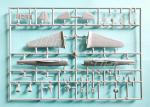
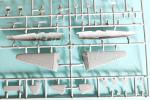
La maqueta está despiezada en un sólo bastidor con poco más de 30 piezas complementado por una hoja de acetato que contiene los parabrisas, la hoja de calcas y las instrucciones. El moldeo es el habitual en ediciones limitadas, por ello encontramos leves líneas de molde en la mayoría de piezas. No hay marcas de eyector, ni siquiera en el interior del fuselaje, pero las superficies superiores de las alas muestran zonas irregulares que necesitan ser repasadas con lija fina. Afortunadamente, el detalle estructural no está muy afectado. En la parte inferior también hay un leve hundimiento similar a una marca en el ala izquierda. Nada de esto es extraordinario tratándose de una maqueta de este tipo.
Los paneles grabados son finos pero realizados con cierta blandura que les resta definición. Las alas combinan los detalles grabados con la reproducción de la estructura de las alas y superficies de control, que están grabadas con mejor definición y más anchura. Esto mismo vale para las superficies de cola.
El montaje tiene como opciones las ruedas y patas con o sin carenas además de la hélice con buje o sin él. Sobre esto último me extenderé luego.
Los acabado de pintura son realmente variados, con libreas simples de reproducir, como suelen ser en general las de los entrenadores de esta clase y época, y colores muy diferentes, lo que probablemente nos hará dudar en la elección.
Revisión
La carlinga va montada sobre un suelo moldeado con algunos paneles en relieve y unos pequeños pedales. Los lados simulan las estructura tubular interna con los cierres de las puertas de acceso en el lado izquierdo. Cada puesto de pilotaje contiene el panel, la palanca, dos asientos idénticos y otros dos mamparos tras cada asiento. Los paneles son distintos y tienen los instrumentos grabados con nitidez. Las piezas poseen la misma numeración, pero no son intercambiables como se podría entender de las instrucciones. El panel con el detalle más profuso es el del puesto del profesor en la parte trasera, mientras el más sencillo es el delantero del alumno.
El fuselaje está moldeado completo con el capó, sin las superficies de cola, ni tampoco la cubierta delantera del motor. Las raíces alares están moldeadas a cada lado. El detalle a simple vista es algo mejor que el de las alas y no trae las irregularidades superficiales de estas. Los paneles de los acceso a la carlinga vienen cerrados. La estructura del fuselaje está simulada con mucha sutilidad. Los parabrisas son dos piezas de acetato con el marco impreso en líneas negras. No serán sencillos de colocar sin habilidad.
Antes de cerrar el fuelaje, se introduce un panel transversal en el morro que tiene moldeado una especie de cilindro vertical a modo de motor. Sobre él se agrega la cubierta, que muestra los huecos de las tomas de refrigeración. A un lado del capó aparece un corto y ancho escape un poco ahuecado en una pieza separada. El hueco para pegar la hélice queda por encima de estas tomas. Las instrucciones muestran las dos hélices opcionales con el eje, pero en la realidad este hay que fabricarlo. Ambas hélices son finas, con formas en las palas algo diferentes y poca definición en los filos, que necesitan un repaso de lija. Las instrucciones indican que la pieza correcta es la que se aprecia en los perfiles de la caja, en donde se comprueba que ninguno de los aviones lleva el cono. Sin embargo, las imágenes de los SK 15A (equivalentes al Kl 35D) suecos los muestran siempre con el cono y también se aprecia en la foto conservada del aparato rumano YR+IR, pero parece que el C.1-11 checoslovaco no lo llevaba. Las fotos de Kl 35D alemanes o de otras nacionalidades no son concluyentes y se ven aviones con y sin el dichoso cono.
Las alas está fabricadas de una pieza con lengüetas para fijarlas al fuselaje. AZ ha conseguido que no se vean dentro al quedar por debajo del suelo de la carlinga. El perfil de ala de gaviota invertida característico de este avión me parece bien conseguido. Además de lo comentado antes sobre las alas, hay que añadir el decente detalle de la estructura interna de los timones y las tiras de refuerzo entre las secciones. El pequeño tubo Pitot viene separado.
Las superficies de cola van pegadas directamente sobre el puro del fuselaje. Como ya he dicho, los timones en los tres casos están bien grabados, al igual que las aletas. La estructura está reproducida con una suavidad que le da realismo.
Los aviones que podemos montar con esta caja carecen de carenas en el tren principal y en su lugar tenemos a cada lado un soporte en V y una pata con la amortiguación. Las ruedas son de una pieza, sin detalle en la banda de rodadura, pero con un detalle limpio y bien realizado en la llanta. La rueda de cola está unida a su pata.
Las calcas están bien impresas. Los motivos presentan aspecto fino y brillante, aparente buena densidad de color y nitidez. A su alrededor hay muy escaso exceso de soporte. La hoja contiene insignias nacionales, los arneses, matrículas y códigos.
Como es habitual en AZ Model, las instrucciones no son específicas de esta caja, sino compartidas con las otras dos ediciones. Están impresas en color en un folleto de formato A5 de cuatro páginas que contiene un sumario histórico sobre el avión, un plano numerado de piezas, una tabla de colores con referencias de pinturas de Humbrol y catorce secuencias de montaje. La cara trasera de la caja muestra perfiles en color junto a las mismas pinturas del folleto. Las opciones de acabado tienen mucha variedad, con libreas metálica, gris, azul intenso o el contrastado verde oscuro sobre naranja del SK 15 sueco. Hay para elegir.
Valoración
Este avión tan olvidado es realmente para minorías y ha sido una suerte que AZ Model se haya acordado de él, ya que desde la desaparición de Huma no había otra maqueta más actual en esta escala.
Ciertamente, la maqueta no debe ser difícil de montar y podría ser una pieza ideal para iniciarse en este tipo de ediciones, a lo que también contribuye la variedad y relativa sencillez de alternativas de pintura.◊

The kit
Since Huma Modell first released the Klemm Kl 35 in the 1990s, there had been no other 1/72 scale kit of this rare aircraft until the arrival of the new AZ Model tool. Unlike the Huma kit, which I reviewed some time ago (Klemm Kl 35, Huma Modell Reference 2501), the AZ Model offer has had three different boxings: a Kl 35B, a Kl 35D, and this kit containing aircraft from several countries, but no German Kl 35 as in the other two releases. Sabre Kits has a more recent edition of the Kl 35D, which is a copy of the AZ Model tool.
The kit comes in a single sprue with just over 30 parts, supplemented by an acetate sheet containing the windscreens, decal sheet, and instructions. The molding is typical of limited runs, so slight seam lines can be expected on most parts. There are no ejection marks, not even inside the fuselage, but the upper wing surfaces show uneven areas that need to be smoothed with fine sandpaper. Fortunately, the structural detail is not significantly affected. There is also a shallow round sink on the left wing underside. None of this is unusual for a kit of this type.
The engraved panels are thin but somewhat soft, which reduces their definition. The wings combine engraved details with a reproduction of the wing structure and control surfaces, which are engraved with better definition and greater width. The same applies to the tail surfaces. The kit includes alternatives for wheels and landing gear with spats or just a bare undercarriage, as well as a propeller with or without a spinner.
Paint finishes are really varied, with liveries that are easy to reproduce, as is generally the case with trainers of this size and era, and very different colors, which will surely make choosing difficult.
Review
The cockpit is built on a floor molded with some raised panels and small pedals. The sides simulate the internal tubular structure with the access panel molded closed with the latches on the left side. Each cockpit contains an instrument panel, a control stick, two identical seats, and two bulkheads behind each seat. The instrument panels are different and have clearly engraved instruments. Both parts have the same number, but they are not interchangeable, contrary to what the instructions might suggest. The most detailed panel is the instructor’s at the rear, while less gadgets are evident on the student’s at the front.
The fuselage is molded with the cowling, but without the tail surfaces and the engine front. The wing roots are also included on each side. Detail is somewhat better than that on the wings and lacks their surface irregularities. The fuselage raised structural detail is subtle. The windshields are acetate pieces with the frame printed in black lines. They won’t be easy to glue without skill, by the way.
Before closing the fuselage, a cross-section panel is inserted inside the nose. This has a molded-in vertical cylinder resembling an engine. The cowling front is then added. The piece shows the openings for the cooling intakes. A short slightly hollowed exhaust is attached on one side of the cowling. The instructions show two optional propellers with the shaft, but in fact, the shaft is provided by the modeler. Both propellers are thin, with slightly different blade shapes that need some sanding. The instructions indicate that the correct part is the one shown in the box profiles, where none of the aircraft had a spinner. However, images of the Swedish SK 15A (equivalent to the Kl 35D) always show them with the spinner, and it is also visible in the surviving photograph of the Romanian YR+IR aircraft. However, it seems that the Czechoslovakian C.1-11s did not have it installed. Photos of German and other Kl 35Ds are inconclusive, showing aircraft both with and without the spinner.
The wings are provided as a single piece with tabs for attachment. AZ has managed to conceal the tabs inside the fuselage by inserting them below the cockpit floor. The characteristic inverted gull-wing profile of this aircraft looks fine. In addition to the said wing details, the internal structure of the rudders and the covers of the wing sections are nice. The small Pitot tube is separate.
The tailplanes are glued directly onto the fuselage. As mentioned, the rudders and elevators are well engraved, as are the trim tabs. Structural detail is smooth and realistic.
The wheel spats are not used with the aircraft in this box; instead, we have a V-strut and an oleo strut on each side. The wheels are one-piece with no tread pattern, but show define detail on the rim. The tail wheel is molded with the strut.
The decals are nicely printed. They have a fine and glossy appearance, with apparent good color density and sharpness. There is very little excess carrier around them. The sheet contains national roundels, seat belts, registration numbers, and codes.
As usual with AZ Model, the instructions are not specific to this box but are shared with the other two kits. They are printed in color in a 4-page A5 brochure containing a historical summary of the aircraft, a numbered parts diagram, a color chart with Humbrol paints, and 14 assembly sequences. The back of the box shows profiles in color with the same paints. There is a wide variety of finish options, including metallic, gray, deep blue, or the contrasting dark green over orange of the Swedish SK 15. There’s plenty to choose from.
Conclusion
This long-forgotten aircraft is truly for a niche market, and it’s fortunate that AZ Model rescued it, as there hadn’t been another kit in this scale since Huma disappeared.
Certainly, the kit shouldn’t be difficult to build and could be an ideal piece for those starting to build short runs. This is also aided by the variety and relative simplicity of the paint options.◊
Publicado – Published: 3 / 2026
©www.jmodels.net
 jmodels.net
Debe estar conectado para enviar un comentario.