
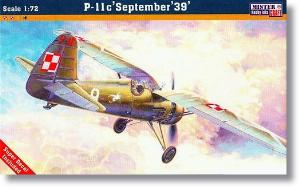
De un vistazo – Quick look
MATERIAL Y PIEZAS
MEDIA & PARTS:
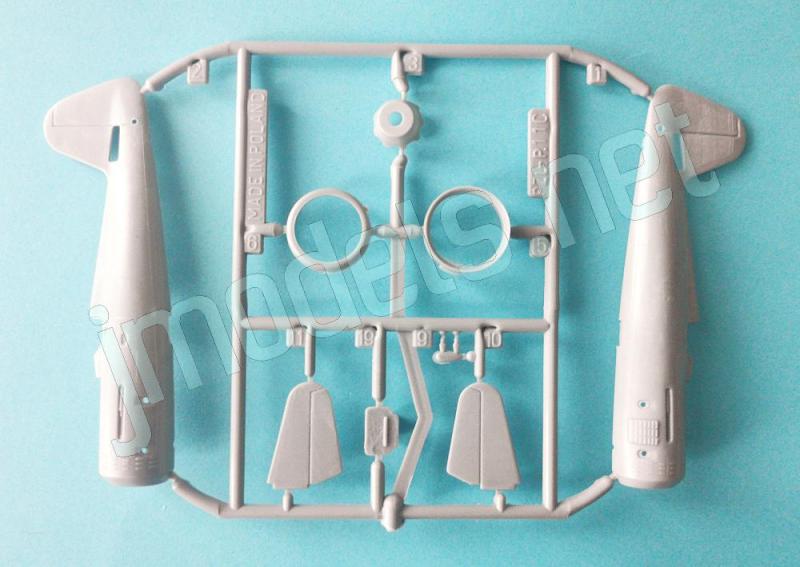
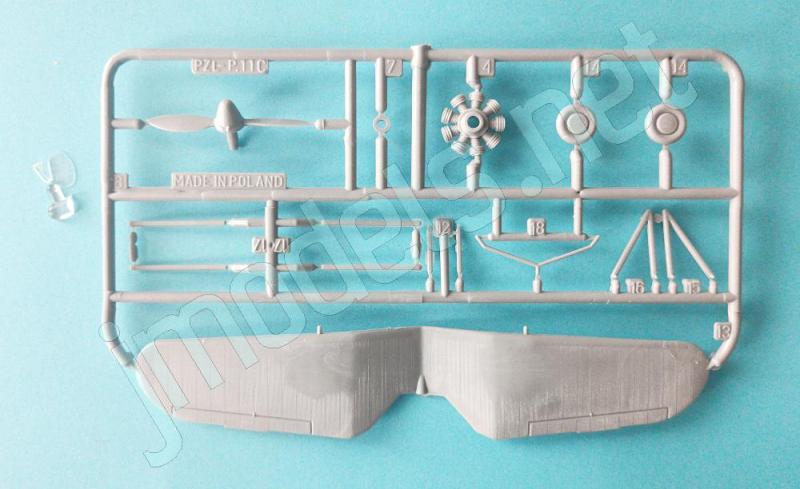
- Plástico inyectado (24 piezas), plástico transparente (1 pieza).
- Injected plastic (24 parts), clear plastic (1 part).
CALCAS – DECALS:
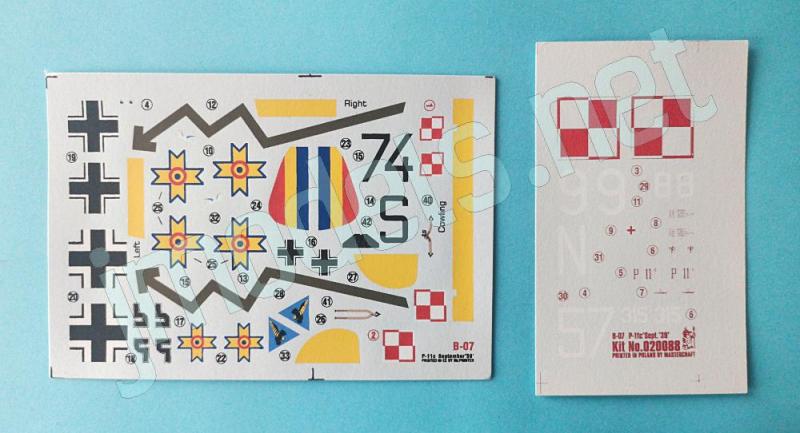
- Dos hojas. Una contiene escarapelas nacionales, arneses del piloto, numerales, esvásticas, bandas identificativas, panel de instrumentos e insignias de unidad. La segunda lleva impresas insignias polacas, numerales y varios estarcidos. Acabado brillante y fino. Buen registro y saturación de color. Sin exceso de soporte.
- Two sheets. The first sheet contains national markings, pilot’s belts, aircraft numbers identification stripes, swastikas, instrument panel and unit badges. The second one includes Polish markings, aircraft numbers and some stencils. Thin and glossy finish. Good register and color saturation. No surplus carrier film.
OPCIONES – OPTIONS:
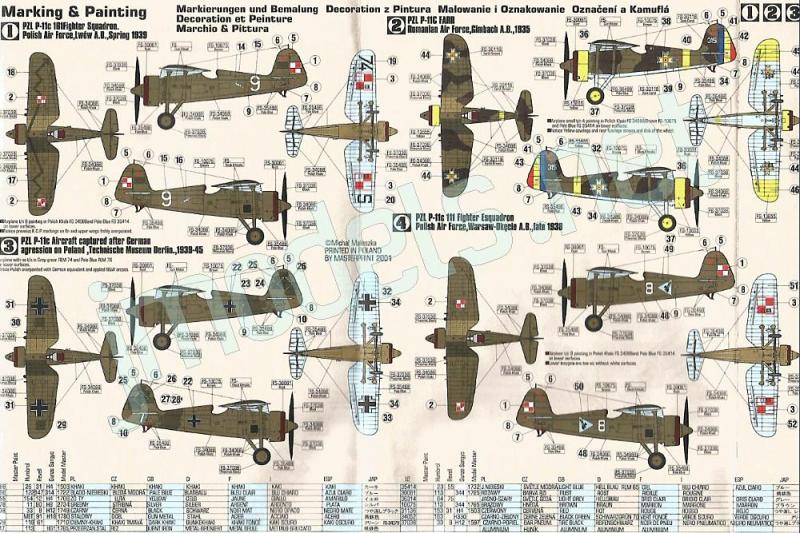
- PZL P.11c. Polish Air Force. 161 Fighter Squadron. Lwów Air Base (Poland). 1939.
- PZL P.11c. FARR. Romanian Air Force. Ghimbav Air Base (Romania). 1935.
- PZL P.11c. Luftwaffe. Captured aircraft. Technische Museum. Berlin. 1939-45.
- PZL P.11c. Polish Air Force. 111 Fighter Squadron. Warsaw-Okęcie Air Base (Poland). 1939.
INSTRUCCIONES – INSTRUCTIONS:
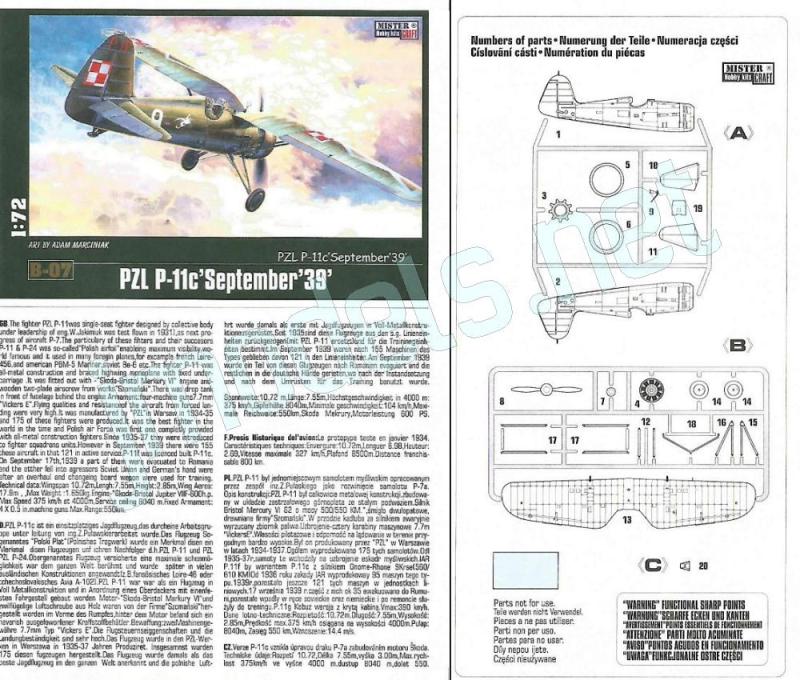
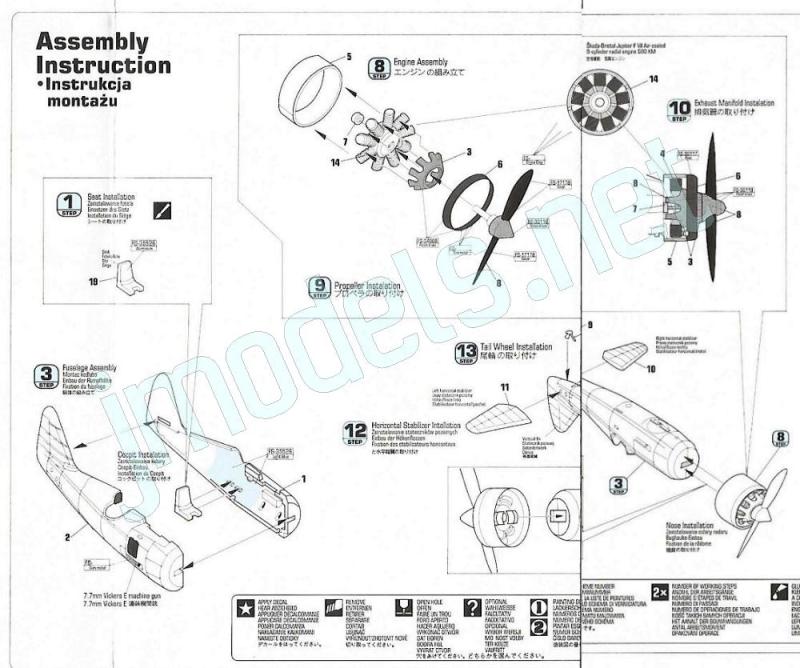
- Folleto A5 doblado formando 8 páginas impreso en color. Contiene una introducción histórica sobre el avión, un plano de piezas numerado, 19 secuencias de montaje, una tabla de colores con equivalencias de varias marcas de pintura y perfiles.
- 8-page A5 folded leaflet printed in color. It shows a historical introduction about the fighter, a numbered parts diagram, 19 assembly steps, a color chart with matches in several paint ranges and profiles.
LO MEJOR – THE BEST:
- Montaje sencillo en apariencia.
- Apparently it’s an easy build.
LO PEOR – THE WORST:
- Panelado. Carlinga. Ausencia de pequeños detalles externos.
- Panelling. Cockpit. Lack of some minor external details.
VALORACIÓN – CONCLUSION:
- Es un molde antiguo superado ampliamente por otras marcas hoy. Sólo es válida para quienes deseen practicar habilidades sustituyendo lo erróneo y poniéndole lo que le falta.
- It’s an old tool, far surpassed by other brands today. It’s only suitable for those who want to test their skills by replacing what’s wrong and adding what’s missing.

La maqueta
Se trata de una reedición de 2010 del viejo molde de los años 80 de la marca polaca PZW, ya desaparecida. Esta misma maqueta se lanzó también en 2007, cuando el fabricante se denominaba aún Mastercraft.
En el interior de la caja hay dos bastidores de piezas, el parabrisas transparente, dos hojas de calcas y las instrucciones. El molde está bien producido y no trae defectos ni rebabas. Sólo hay una marca de eyector a cada lado de la carlinga por detrás del asiento que no es visible desde el exterior y otra sobre la base del asiento. Líneas de molde sí hay que limpiar, especialmente en el motor y el contorno de las alas.
La maqueta posee un aspecto muy sencillo, pero nada despreciable si pretendemos emplearla para aportar lo que le falta en la carlinga y algunos detalles externos mínimos. Tanto la construcción del modelo como los acabados de pintura no aparentan dificultad. Entre estos últimos destaca el avión rumano, bastante vistoso y no solamente por su librea camuflada.
Reseña
De la carlinga sólo tenemos el asiento y además es inservible por infumable, sin embargo la hoja de calcas incluye los arneses del piloto y el panel, bastante malo por cierto porque no se aprecian los instrumentos. Las instrucciones no muestran los cinturones ni el panel, en este último caso es comprensible porque ni siquiera hay una pieza que lo simule. El modelista con cierto amor propio se entretendrá en rellenar lo que falta, siquiera parcialmente, que no es poco ni evidente en su mayoría. El parabrisas es al menos decente y tiene un grosor razonable. Las instrucciones muestran la mira (pieza 32), pero no está incluida en la maqueta.
Las superficies externas de las mitades del fuselaje tienen aspecto liso, pero tras una observación más atenta se comprueba que realmente están bastante bien paneladas, aunque de manera tan sutil que será imposible no taparlas al pintar. Los detalles obvios en las piezas son los reposapiés de acceso del piloto, las troneras y cañones de las ametralladoras laterales, el radiador del aceite demasiado grueso y con detalle básico, y las salidas de ventilación del motor tras el capó, representadas en relieve en lugar de grabadas. En la parte inferior tampoco está grabado el depósito principal de combustible, por mucho que las instrucciones sí lo muestran y también falta el tubo Venturi. La zona ventral del fuselaje tiene una ranura para insertar una peana que no está incluida en la maqueta.
El motor no está tan mal como cabría esperar y para lo poco que se va a ver. Los cilindros están detallados y únicamente hay que limpiarles ligeras líneas de molde en su contorno. La caja de engranajes viene aparte y está bien ahuecada. El capó es de una pieza con el anillo externo por separado y naturalmente sin rastro de los escapes. La hélice está unida al cono, que parece algo romo y carece de las pequeñas tomas en forma de cuña, y las palas son finas, pero acaso cortas y un tanto anchas.
Las alas son de una pieza y su moldeado no es malo, pero por algún motivo los finos paneles paralelos grabados sobre ellas no aparecen en un par de zonas situadas en la cara superior. De cualquier forma, el panelado superior es incorrecto y el inferior apenas se nota. Eso sí, los alerones están grabados con nitidez y las aletas aparecen definidas. De las luces de las puntas sólo tenemos una y los cañones de las ametralladoras integrados en los bordes de ataque deben sustituirse. Los soportes de las alas parecen algo finos y carecen de las carenas en los encastres.
Los estabilizadores van insertados en la cola. Los paneles son idénticos a los de las alas, es decir demasiado profusos, pero los elevadores están bien grabados. Las superficies verticales tienen el mismo aspecto.
Los soportes de las ruedas parecen también demasiado delgados. Entre ambos aparecen otros dos soportes de amortiguación en una pieza fina (número 18 en las instrucciones) que el P.11 no llevaba. Las ruedas tienen los neumáticos y llantas bien grabados con la cubierta externa completamente lisa. El patín de cola viene aparte, pero no se parece nada al real.
Las calcas vienen impresas en dos hojas. Una contiene escarapelas nacionales, los arneses del piloto, numerales, esvásticas, bandas identificativas, el panel de instrumentos e insignias de unidad. La segunda muestra insignias polacas, numerales y varios estarcidos. Ambas poseen un acabado brillante y fino, buen registro y saturación de color. Carecen de exceso de soporte.
El folleto doblado de instrucciones está impreso en color con un formato A5 y consta de ocho páginas. Contiene una introducción histórica sobre el avión en varios idiomas, un plano de piezas numerado, 19 pasos de montaje, perfiles y una tabla de colores con pinturas equivalentes de Humbrol, Revell, Gunze Sangyo y Model Master.
Las terminaciones ofrecen prácticamente las mismas libreas polacas, incluido el avión capturado, salvo en el caso del aparato rumano, que luce camuflaje y llamativas bandas amarillas que nos proporciona una de las hojas de calcas.
Valoración
Este antiguo molde necesita muchas y variadas mejoras y no tiene punto de comparación ni siquera con la maqueta de Azur, que tampoco es ya puntera. Habiendo hoy mejores maquetas del caza P.11 en la escala 1/72 donde elegir (Arma Hobby, IBG Models), dudo que haya quien se meta en jardines para mejorar esta, aunque casi nunca faltan los que van por libre y se atreven con todo, afortunadamente.◊

The kit
This is a 2010 reissue of the old 1980s mold from the now-defunct Polish brand PZW. This same kit was also released in 2007, when the manufacturer was still called Mastercraft.
Inside the box are two sprues of parts, a clear windscreen, two decal sheets, and the instructions. The standard of molding is that of a short-run kit and has no blemishes or flash. There is only one ejector mark on each side of the cockpit sidewalls behind the seat, which is not visible from the outside, and another on the seat base. Seam lines are especially present on the engine and the wing edges.
The kit has a very simple appearance, but it’s perfectly adequate if you intend to use it to fill in missing parts in the cockpit and some minor external details. Both the model’s construction and the paintwork look straightforward. The Romanian aircraft stands out among the finishing choices due to its garish stripes on the camouflage livery.
Review
All we have of the cockpit is the seat, and this clearly needs a replacement, as it has nothing to do with the real thing. However, one of the decal sheets includes the pilot’s harness and the instrument panel, which is quite bad, as the instruments are barely visible. The instructions don’t show the seatbelts or the instrument panel; in the latter case, this is understandable since there isn’t even a part for the panel. Modelers with a taste for challenges will build many missing parts themselves, even though most of them won’t be evident after closing the fuselage. The windshield is at least decent and has a reasonable thickness. The instructions show the gunsight (part 32), but it’s not included in the kit.
The external surfaces of the fuselage halves appear smooth, but upon closer inspection, it’s clear that they are actually quite well engraved, although so subtly that it will be impossible not to make them disappear after painting. The parts are molded with some features, such as the pilot’s footrests, the side machine gun troughs and barrels, the overly thick and poorly detailed oil cooler, and the cooling louvres behind the cowling, which are embossed rather than engraved. The main fuel tank engraved in the instructions is also missing from the underside, as is the Venturi tube. The fuselage belly has a small slot to fit a stand that is not included in the release.
The engine isn’t as bad as one might expect, considering how little of it will be visible. The cylinders are sharp and only need cleaning very thin seam lines around their contour. The engine’s reduction gear is separate and well-hollowed. The cowling is a single piece with a separate outer ring and, naturally, no exhaust pipes. Both parts are quite thin. The propeller is attached to the spinner, which looks somewhat blunt and lacks the small wedge-shaped inlets. The blades are thin, but perhaps short and a bit wide.
The wings are a single piece and are well-molded, but for some reason, the thin, parallel panels engraved on them are missing in a couple of areas on the upper surface, at least in my kit. In any case, the upper panel lines are incorrect, and the lower ones are barely noticeable. However, the ailerons are neatly engraved, and the tabs are well-defined. We only have one of the wingtip lights, and the machine gun barrels molded on the leading edges need to be replaced. The wing struts are somewhat thin and lack the attachment fairings.
The stabilizers are inserted into the tail. The panels are identical to those of the wings, meaning they are profuse, but the elevators are well-engraved. The vertical surfaces show this same appearance.
The wheel V-struts also seem too thin. Between them is an additional strut (number 18 in the instructions) that the P.11 did not have. The wheels have engraved tires and rims with completely smooth outer hubs. The tail skid is separate, but it bears no resemblance to the real one.
The decals are printed on two sheets. One contains national markings, the pilot’s harnesses, aircraft numbers, swastikas, identification stripes, the instrument panel, and unit badges. The second shows Polish markings, numbers, and some stencils. Both have a glossy, fine finish, good register, and color saturation. They have no surplus carrier.
The folded instruction leaflet is printed in color on A5 paper and consists of eight pages. It contains a historical introduction to the aircraft in several languages, a numbered parts diagram, 19 assembly steps, profiles, and a color chart with equivalent paints from Humbrol, Revell, Gunze Sangyo, and Model Master.
Paint finishes offer virtually the same Polish liveries, including the captured P.11, except for the Romanian aircraft, which sports camouflage and striking yellow stripes provided by one of the decal sheets.
Conclusion
This old kit needs many and varied improvements and is not even comparable to its counterpart from Azur, which is no longer a cutting-edge piece either. With better 1/72 scale P.11 kits available today (Arma Hobby, IBG Models), I doubt anyone will bother trying to improve this one, although fortunately, there are always those who go it alone and are able to build anything.◊
Publicado – Published: 9 / 2026
©www.jmodels.net


Debe estar conectado para enviar un comentario.