
De un vistazo – Quick look
MATERIAL Y PIEZAS
MEDIA & PARTS:
- Plástico inyectado (38 piezas), plástico transparente (2 piezas).
- Injected plastic (38 parts), clear plastic (2 parts).
CALCAS – DECALS:
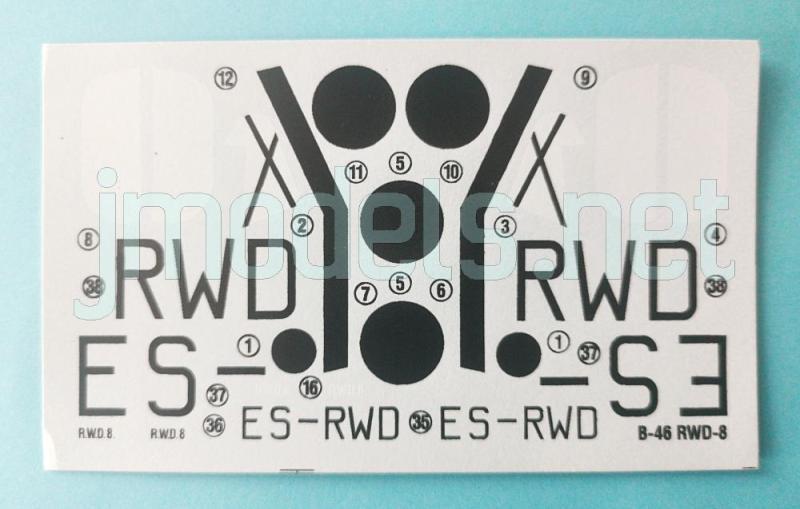
- Dos hojas. Insignias nacionales y de unidad, matrículas, numerales y marcas de cola. Acabado fino y brillante. Registro y nitidez correctos. Sin soporte excedente.
- Two sheet. National and unit insignia, registrations, aircraft numbers and tail markings. Thin and glossy finish. Correct register and sharpness. No excess carrier.
OPCIONES – OPTIONS:
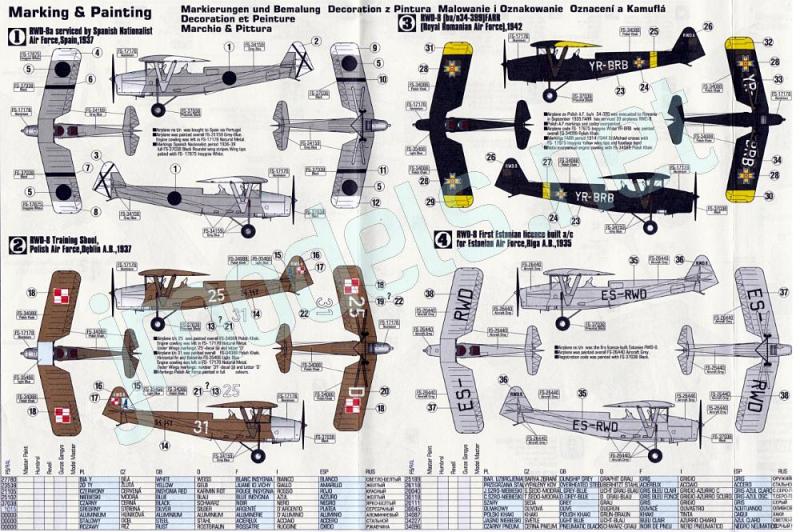
- RWD-8a. Spanish Nationalist Air Force. Spain, 1937.
- RWD-8. Polish Air Force. Training School. Aircraft white 25. Dęblin (Poland). 1937.
- RWD-8. Polish Air Force. Training School. Aircraft white 31. Dęblin (Poland). 1937.
- RWD-8. Bu. No. 34-399. YR-BRB. Royal Romanian Air Force. 1942.
- RWD-8. ES-RWD. Estonian Air Force. Riga. 1935. First Estonian licence-built aircraft.
INSTRUCCIONES – INSTRUCTIONS:
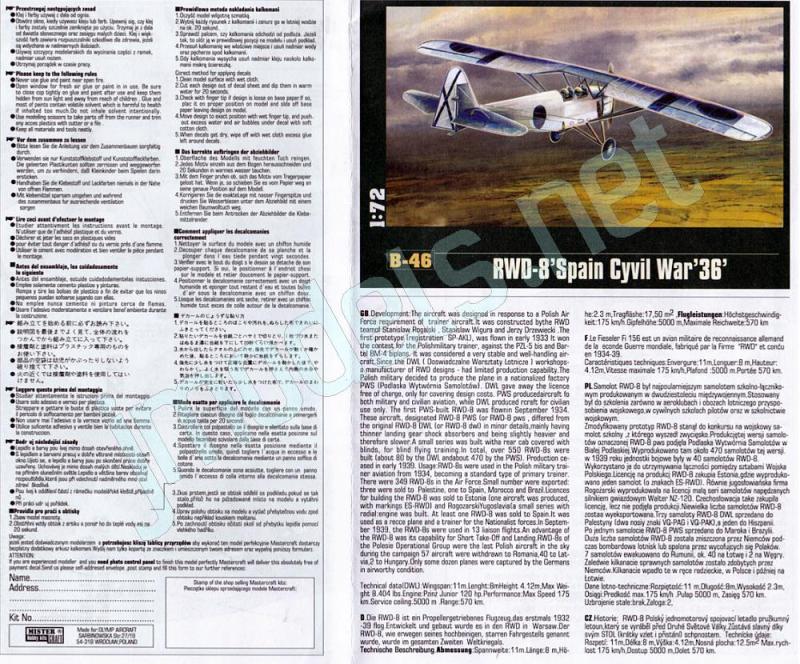
- Folleto doblado formando 8 páginas impreso en color. Contiene una introducción histórica con datos técnicos, un plano de piezas numerado, 9 secuencias de montaje y perfiles. Una tabla de colores muestra correspondencias de algunos de ellos con los códigos Federal Standard y RAL.
- 8-page folded leaflet printed in color containing a historical introduction with technical data, a numbered parts diagram, 9 construction steps and profiles. A color chart shows paint matches in the Federal Standard and RAL codes.
LO MEJOR – THE BEST:
- Montaje sencillo. Calcas.
- Ease of assembly. Decals.
LO PEOR – THE WORST:
- Interior escaso. Superficies de alas y cola. Instrucciones erróneas.
- Sparse cockpit. Wing and tail surfaces. Mistakes in the instructions.
VALORACIÓN – CONCLUSION:
- Reedición de un molde de los años 80. El moldeado de las alas y la cola limita mucho la maqueta, que en otros aspectos no es tan deficiente y se puede mejorar. Sólo merece la pena si no podemos conseguir la alternativa de IBG Models o por las calcas, si el precio es módico.
- Reissue of an old tooling from the 1980s. The molding of the wings and tail severely limits the kit, which in other aspects isn’t so bad and could be improved. It’s only worthwhile if you can’t get the IBG Models alternative or for the decals, and only if the price is reasonable.

La maqueta
Este avión, como otros de su país, parece destinado a que sólo lo hagan marcas polacas. El molde original perteneció al extinto fabricante PZW en los años 80 y la maqueta ha sido reeditada por varias marcas, entre ellas la española Bum (Barcelona Universal Models), única de fuera del país en ponerle su sello, y ZTS Plastyk, que ha sido la última en sacarlo, por ahora. Del RWD-8 en la escala 1/72 contamos con un molde más actual de IBG Models.
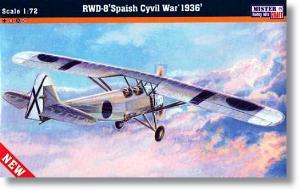
Algún lote de la edición, o toda ella entera, salió más descuidado porque esta caja concreta reza en su título el erróneo “Spaish Cyvil War 1936”. También hay un desliz incomprensible en las instrucciones, como luego veremos. Se conoce que alguien no tuvo su día.
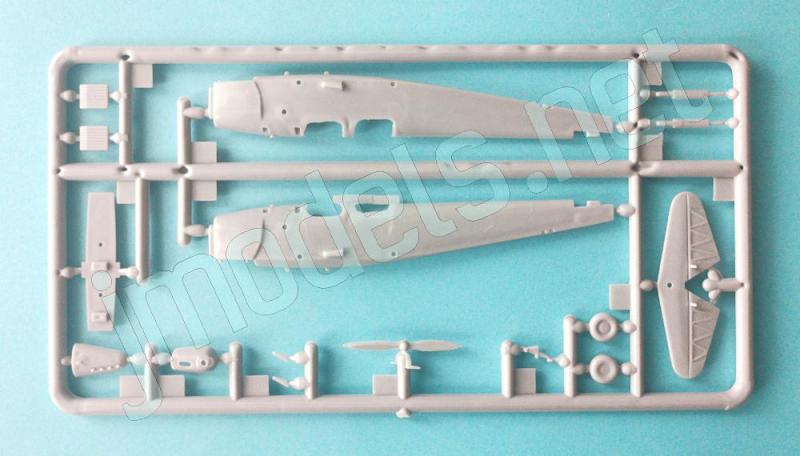
En la caja encontramos dos bastidores de piezas más bien pequeños, los dos parabrisas transparentes, dos hojas de calcas y el folleto de instrucciones. También hay un pequeño bote de plástico que parece contener pegamento para aplicarlo a pincel.
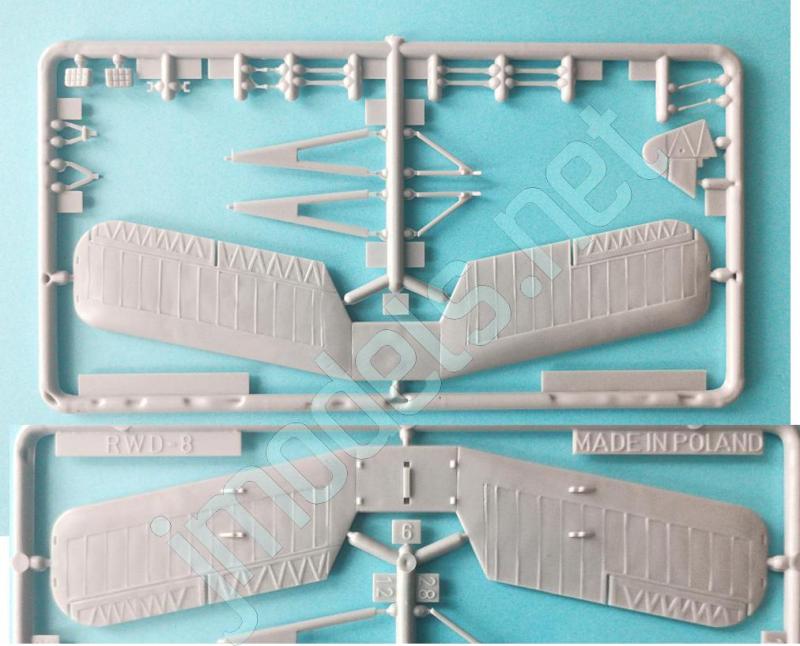
Las piezas están bien moldeadas y carecen de defectos. Hay finas líneas de molde por limpiar en la mayoría y las marcas se reducen a unas pocas a los lados de las carlingas, sencillas de eliminar además de poco evidentes. La reproducción de la estructura de avión está descompensada y fuera de mesura, puesto que está exageradamente marcada en relieve tanto en las alas como en la cola, mientras que es casi nula en el fuselaje. A esto se añade el poco acierto en la representación de los paneles del fuselaje situados tras la carlinga y la separación excesiva e irreal que hay entre el timón vertical y la aleta así como entre los alerones y las supeficies colindantes.
La construcción de esta maqueta aparenta gran sencillez por el número de piezas y por la simplicidad del mismo avión, por ello parece adecuada para todos los públicos. La pintura es sencilla de realizar y ofrece cierta variedad en las libreas. El único inconveniente es que los colores no tienen sus correspondencias con marcas de pintura conocidas. La tabla de las instrucciones menciona algunas, pero sin mencionar equivalentes.
Reseña
Los lados de la carlinga no poseen detalle alguno. Los elementos internos tan solo comprenden el suelo, los asientos, y las palancas. No hay pedales y los paneles de instrumentos están moldeados con el fuselaje y por tanto separados por la mitad. Para completar la parte externa de las carlingas tenemos dos parabrisas transparentes y delgados más algunas piezas que el modelista debe aportar, como un par de instrumentos a los lados del panel trasero y los retrovisores a los lados y por delante del puesto delantero. Las instrucciones no ofrecen dimensiones de estas piezas, así que hay que fabricarlas “a ojímetro”.
El fuselaje tiene el capó motor marcado a los lados, aunque naturalmente no hueco, lo mismo que los carenados de las salidas de los cables de control de los timones de la cola. La cubierta inferior del motor viene aparte. Las instrucciones indican que hay que añadir un pequeño carenado y el tubo de escape único en esta pieza, pero en su lugar aparecen cuatro diminutos escapes sin carena propios del RWD-8 fabricado por DWL. En consonancia con este modelo también tenemos los amortiguadores con protectores de este fabricante. Las instrucciones muestran justamente el modelo de PWS, con amortiguadores más finos y un solo escape carenado. La cara frontal del motor también está separada y muestra la toma de aire abierta y bien reproducida. La hélice es de una pieza, fina y unida al buje.
La parte central del fuselaje posee también el tubo Venturi y los balancines de los cables de control de la cola, detalle este que afortunadamente no se ha pasado por alto. En la parte trasera hay dos pequeñas asas que permitían levantar la cola para mover el avión en tierra.
El relieve de la estructura en las alas deja que desear. Las costillas están moldeadas con excesivo relieve y son muy desiguales. Además, se han grabado en la superficie dejando demasiado espacio entre los bordes de ataque y el arranque de las costillas. La separación a los lados de los alerones es mayor de la necesaria y la estructura de los alerones resulta demasiado evidente, cuando apenas es perceptible en las fotos del avión real. Lo único que parece acertado son los asideros huecos en las puntas para mover el avión en tierra y la estructura evidente en el flap del ala derecha, pero no sobre el ala de babor.
Los puntos de unión de los soportes de las alas se ven bien marcados en ambos extremos y las piezas están correctamente moldeadas. Los soportes centrales aparecen mal situados en las instrucciones, pero por fortuna su posición es evidente en el fuselaje y las alas. Estos soportes están complementados por otros cuatro separados a sus lados. Los puntales principales vienen en una sola pieza, aunque al diestro le falta el tubo Pitot que se aprecia en las instrucciones.
Los estabilizadores son de una pieza y van pegados sobre un rebaje del puro de cola. Sobre ellos se añade el timón y la deriva. El detalle estructural de los timones es igual de excesivo que en las alas. Los timones de profundidad incluyen las aletas de los actuadores por ambas caras, mientras que las del timón vertical se proporcionan aparte. La aleta y el timón vertical muestran una separación muy grande en la parte superior. Se incluyen también dos soportes separados bajo los estabilizadores y el patín de cola.
El tren de aterrizaje se compone de dos soportes en V y un puntal con la amortiguación carenada propia del modelo DWL, como ya he mencionado. Faltan un par de barras de torsión en V situadas por detras del tren principal que el modelista puede añadir sin mucha dificultad. Las ruedas serían pasables de no ser por el moldeado diferente de las llantas externas, una más abultada que la otra.
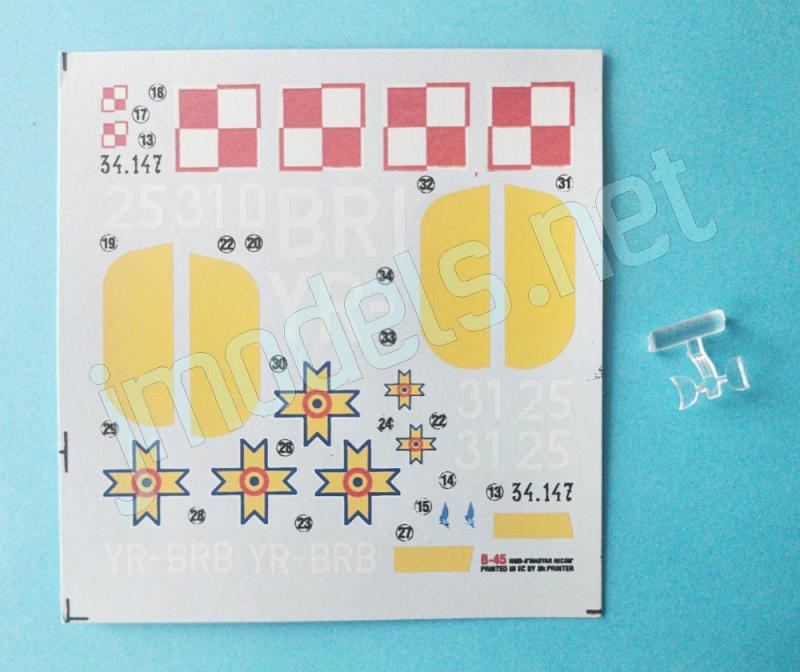
Las calcas se han impreso en dos hojas. Una de ellas contiene las necesarias para el avión español y la otra todas las demás. En ambas vemos insignias nacionales y de unidad, matrículas, numerales y marcas de cola. Todas muestran un acabado fino y brillante, con registro y nitidez correctos. Carecen de soporte excedente.
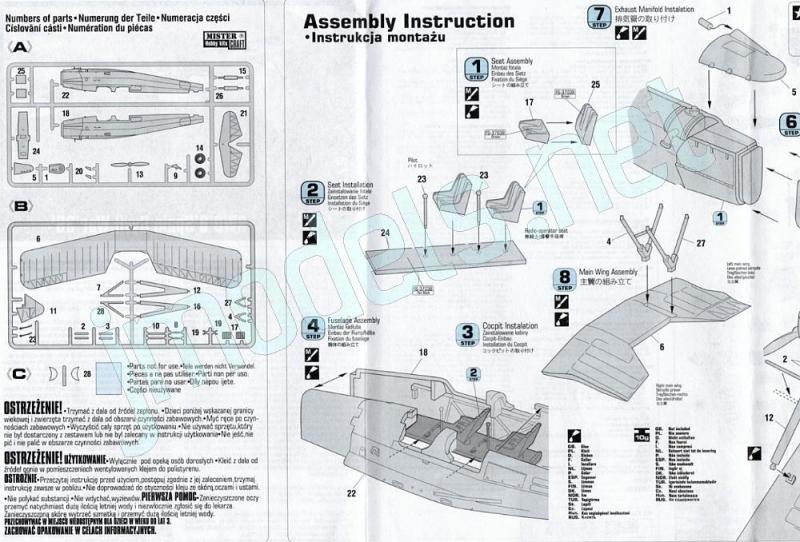
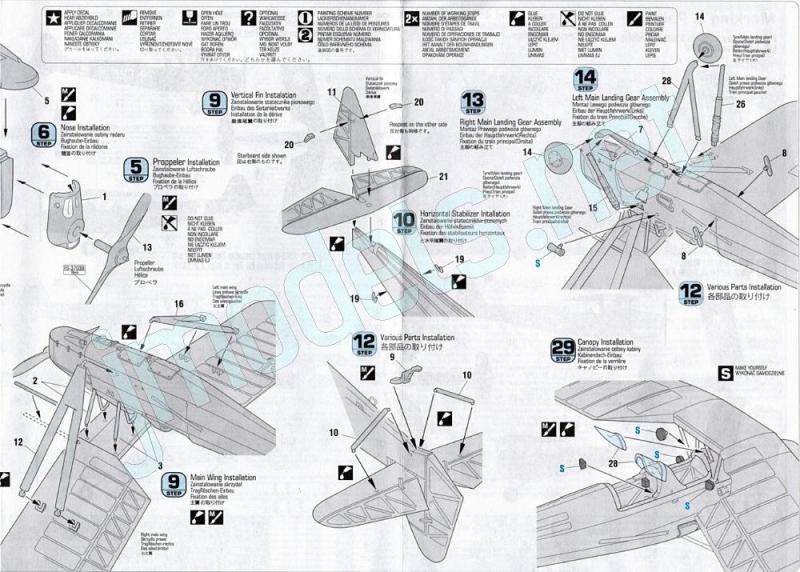
El manual de instrucciones consiste en un folleto doblado formando ocho páginas impreso en color. Contiene una introducción histórica con datos técnicos, un plano de piezas numerado, diez secuencias de montaje mal numeradas y perfiles. Una tabla de colores muestra correspondencias de algunos de ellos con los códigos Federal Standard y RAL. La numeración del montaje es un despropósito salvo en los tres primeros capítulos y no se me ocurre otra explicación bondadosa que la de suponer que la realizó alguien iletrado. Por ventura las imágenes son bastante claras y no dan lugar a dudas.
Los perfiles en color presentan cinco aparatos, ya que el polaco se puede finalizar con dos numerales diferentes. Entre ellos está el único RWD-8 empleado por la Aviación Nacional en la Guerra Civil Española y también el solitario avión civil fabricado con licencia en Estonia.
Valoración
Este RWD-8 no es tan horrendo como a primera vista podría parecer ni tan bueno que pueda resultar apetecible de montar, a menos que no se tenga a tiro la alternativa realmente mejor de IBG Models. El detalle en las alas y la cola merma mucho la posibilidad de lograr una réplica acertada del avión. Con todo, si aún queremos darle una oportunidad, la maqueta admite modificaciones y añadidos que le darán mejor aspecto al terminarla.◊

The kit
This aircraft, like others from the country, seems destined to be produced only by Polish manufacturers. The original mold belonged to the extinct manufacturer PZW in the 1980s, and the kit has been reissued by several companies, including the Spanish firm Bum (Barcelona Universal Models), the only non-Polish company to rebox it, and ZTS Plastyk, which is the most recent to release it, for now. A more recent tool of the RWD-8 in the 1/72 scale is available from IBG Models.
Some batches of this edition, or perhaps the entire set, were produced with some minor mistakes, as this particular box incorrectly reads «Spaish Cyvil War 1936.» There is also some neglect in the instructions, as we will see later. Clearly, someone had a bad day at the office.
Inside the box we find two small sprues, two clear windscreens, two decal sheets, and the instruction leaflet. There is also a small plastic jar of glue to build the kit.
Parts are well-molded and free from blemishes. There are fine seam lines to clean on some of them, and marks are only a few and limited to the cockpit side walls.. They are easy to remove and not very noticeable. The rendition of the aircraft structural detail is too evident and uneven on both the wings and tail, while it is almost nonexistent on the fuselage. In addition, the fuselage panels behind the cockpit are poorly represented, and there is an excessive and unrealistic gap between the vertical stabilizer and the fin, as well as between the ailerons and the adjacent surfaces.
Assembly looks very simple due to the number of parts and the simplicity of the aircraft itself, making it suitable for most modelers. The painting is straightforward and offers some variety in the liveries. The only drawback is that the colors don’t correspond to any paint brands. The instructions mention a few, but don’t provide matches.
Review
The cockpit sides are empty. Detail only includes a floor, the seats, and the levers. There are no pedals, and the instrument panels are molded with the fuselage and separated in halves. To complete the cockpit, there are two thin clear windscreens plus some parts that the modeler has to make himself, such as a pair of instruments for the rear instrument panel and the rear view mirrors. The instructions do not provide dimensions for these parts.
The fuselage has the engine cowling engraved on the sides, although the side outlets are not hollow, as are the side fairings for the tail control wires. The lower engine cowling is a separate part. The instructions show a small fairing and a single exhaust pipe to be attached here, but instead, we find four tiny, unfaired exhausts, typical of the DWL-built RWD-8, on the piece. In keeping with this variant, we also have the faired shock absorbers from DWL. In fact, the instructions show the PWS model, with thinner shock absorbers and a single, faired exhaust. The engine front is also separate, showing an open and well-reproduced air intake. The propeller is a single piece with thin blades attached to the hub.
The fuselage also features the Venturi tube and the tail control rockers, a detail that fortunately hasn’t been overlooked. The rear fuselage has two small handles that allowed the tail to be lifted for moving the aircraft on the ground.
The structural detail on the wings leaves much to be desired. The ribs are too evident and have an uneven molding. Also, there is too much space between the leading edges and the ribs. The ailerons leave small gaps with the trailing edges on the sides and the aileron structure is too obvious, whereas it is barely perceptible in photos of the real aircraft. The only things that seem well done are the hollow handles at the wingtips used for moving the aircraft on the ground and the evident structure on the right wing flap, but not on the port wing.
The wing strut attachment points are clearly marked and the struts are correctly molded. The cabane struts are incorrectly positioned in the instructions, but fortunately their position is apparent on the fuselage and wings. These struts are complemented by four separate ones on either side. The main struts come as single pieces, although the right one lacks the Pitot tube shown in the instructions.
The tail planes are a single piece glued onto a recess in the tail boom. The rudder and fin are then attached on them. The rudder structural detail is just as excessive as that of the wings. The elevators include the control horns on both sides, while those on the rudder are provided separately. The fin and rudder show a very large gap at the top. Two separate tailplane brace struts and the tail skid are also included.
The landing gear on each side consists of a V-struts and a strut with a faired shock absorber characteristic of the DWL model, as mentioned. The V-struts behind the main undercarriage are missing, but they can be made by the modeler easily. The wheels would be acceptable if the outer rims were not so different, one being more prominent than the other.
The decals are printed on two sheets. One of them contains the decals for the Spanish aircraft, and the other those for the rest of the paint finishes. Both sheets include national and unit markings, registrations, numbers, and tail markings. All the decals have a fine, glossy finish, with correct registration and sharpness. They lack surplus carrier.
The 8-page folded leaflet has eight pages printed in color. It contains a historical introduction with technical data, a numbered parts diagram, ten incorrectly numbered assembly sequences, and profiles. A color chart shows the correspondences of some colors with the Federal Standard and RAL codes. The numbering of the assembly chapters is wrong except in the first three chapters, and I can think of no other charitable explanation than to assume it was done by someone illiterate. Fortunately, the images are quite clear and leave no room for doubt.
The color profiles show five aircraft, as the Polish aircraft can be finished with two different numbers. Among them is the only RWD-8 flown by the Nationalist Air Force in the Spanish Civil War, and also the lone civilian aircraft manufactured under license in Estonia.
Conclusion
This RWD-8 isn’t as bad as it might first appear, nor is it so good that it would be appealing to build, unless you can’t get the truly superior kit from IBG Models. The raised detail on the wings and tail significantly reduces the chances of achieving an accurate replica of the aircraft. However, if you still want to give it a try, the kit allows for modifications and additions that will improve its appearance on completion.◊
Publicado – Published: 7 / 2026
©www.jmodels.net

 jmodels.net
Debe estar conectado para enviar un comentario.