
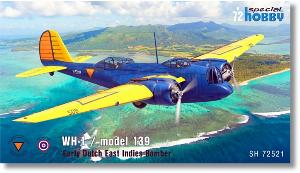
De un vistazo – Quick look
MATERIAL Y PIEZAS
MEDIA & PARTS:
- Plástico inyectado (91 piezas), plástico transparente (11 piezas), fotograbado (12 piezas), resina impresa en 3D (3 piezas).
- Injected plastic (91 parts), clear plastic (11 parts), photo-etched (12 parts), 3D printed resin (3 parts).
CALCAS – DECALS:
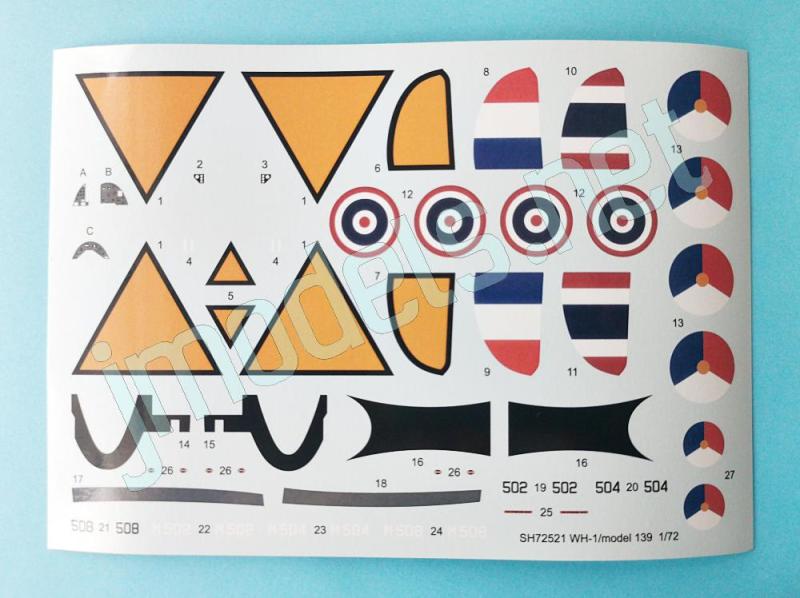
- Insignias holandesas y tailandesas, paneles de instrumentos, matrículas y marcas del fuselaje, alas y cola. Impresas con un acabado brillante, tienen apariencia fina, buen registro y saturación de color. Poco exceso de soporte.
- Dutch and Thai insignia, instrument panels, registrations and fuselage tail and wing markings. Thin and glossy finish, with correct register and good color saturation. Not too much surplus carrier film.
OPCIONES – OPTIONS:
- WH-1 / model 139. N.º de Fabricación 671. Militaire Luchtvaart van het Koninklijk Nederlands-Indisch Leger (ML-KNIL) (Real Fuerza Aérea del Ejército de las Indias Orientales Holandesas). Aparato M-508 blanco. Aeródromo de Andir (Java). Marzo de 1942.
- WH-1 / model 139. N.º de Fabricación 665 .ML-KNIL. Aparato M-502 blanco. Aeródromo de Andir (Java). Marzo de 1942.
- WH-1 / model 139. N.º de Fabricación 667. ML-KNIL. Aparato M-504 blanco. Aeródromo de Andir (Java). Marzo de 1942.
- WH-1 / model 139. N.º de Fabricación desconocido. Real Fuerza Aérea Tailandesa. Aparato 11 blanco. 1943-46.
- WH-1 / model 139. C. Nr. 671. Militaire Luchtvaart van het Koninklijk Nederlands-Indisch Leger (ML-KNIL) (Royal Netherlands East Indies Army Air Force). Aircraft White M-508. Andir airfield (Java). March 1942.
- WH-1 / model 139. C. Nr. 665. ML-KNIL. Aircraft White M-502. Andir airfield (Java). March 1942.
- WH-1 / model 139. C. Nr. 667. ML-KNIL. Aircraft White M-504. Andir airfield (Java). March 1942.
- WH-1 / model 139. Unknown C. Nr. Royal Thai Air Force. Aircraft White 11. 1943-46.
INSTRUCCIONES – INSTRUCTIONS:
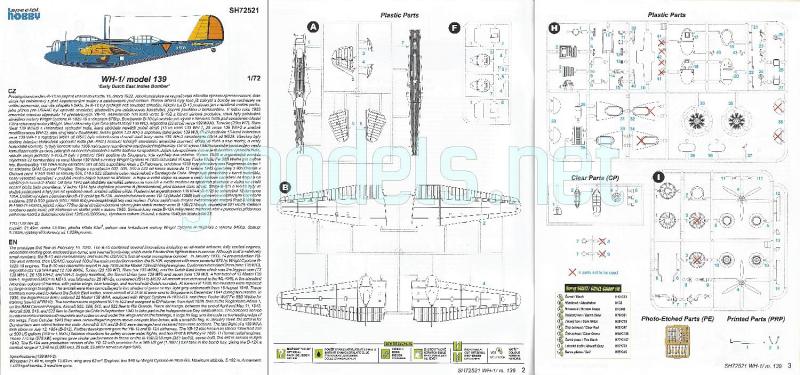
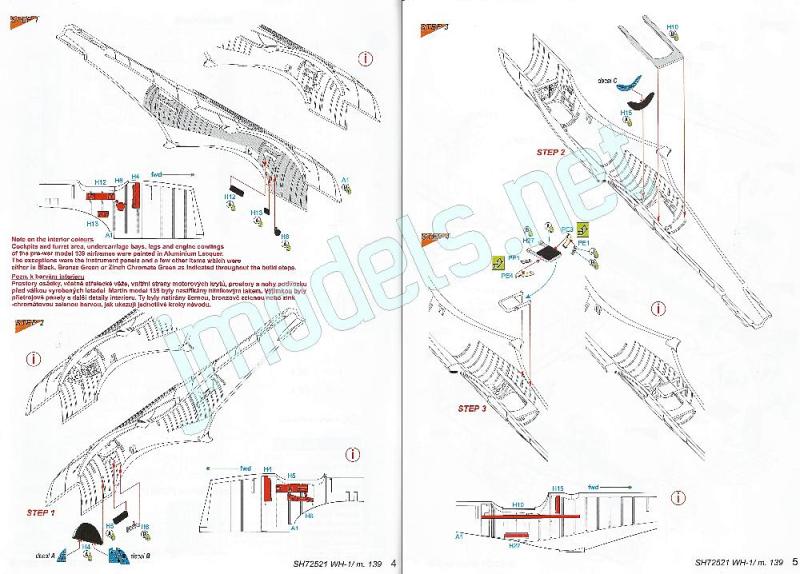
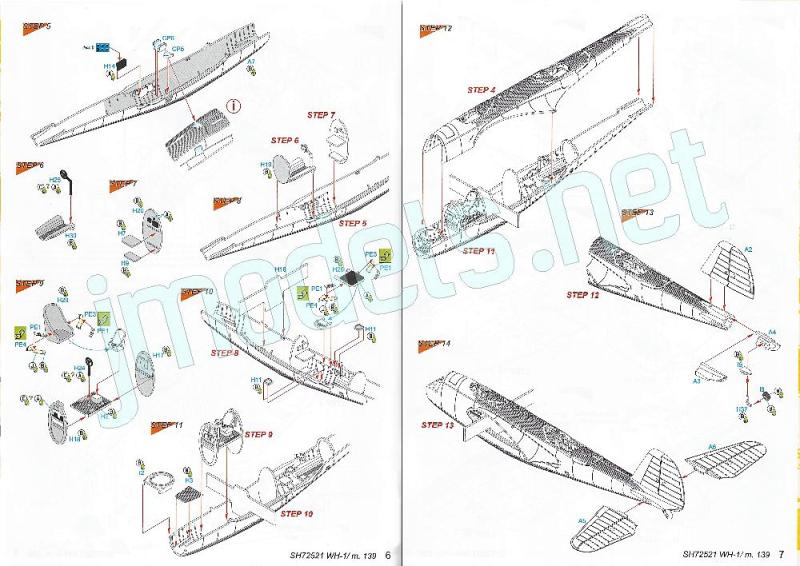
- Folleto A4 de 16 páginas impreso en color sobre papel satinado. Contiene una introducción histórica sobre el avión, un plano numerado de piezas, una lista de colores con equivalencias de pinturas de Gunze Sangyo, 31 secuencias de montaje y 4 páginas de perfiles en color.
- 16-page A4 booklet printed in color on satin paper. It shows a historical introduction about the aircraft, a numbered parts diagram, a list of colors with Gunze Sangyo paint matches, 31 assembly chapters and 4 pages of profiles in color.
LO MEJOR – THE BEST:
- Acertado despiece del fuselaje. Buen detalle interno y muy destacable en el exterior. Instrucciones.
- Accurate fuselage breakdown. Nice interior detail and outstanding on the outside. Instructons.
LO PEOR – THE WORST:
- Cubiertas transparentes de una pieza. Versiones de pintura atractivas, aunque poco variadas.
- One-piece canopies. Colorful paint finishes but not quite different.
VALORACIÓN – CONCLUSION:
- Por fin tenemos un nuevo molde adecuado a los tiempos de este interesante bombardero de entreguerras. Cuenta con un detalle en general preciso y de gran definición. Para modelistas avezados.
- Finally, we have a new and updated kit of this interesting interwar bomber. It boasts excellent detail and good definition. For expert modelers.

La maqueta
Este Martin Modelo 139 es la copia más reciente del molde de Azur de 2020 por el momento. Azur tiene dos series de cajas. Las tres primeras ediciones de 2020 pertenecen al Modelo 139 en versiones norteamericanas (B-10B) y de exportación 139WC (China), 139WAN (Armada Argentina), 139WAA (Fuerza Aérea Argentina) y 139WH-2 (ML-KNIL). La siguiente serie de dos cajas lanzada en 2025 representa un modelo ulterior, el Martin Tipo 166, en versiones del ML-KNIL (139WH-3) y de Tailandia (139WS). Por su parte, Special Hobby ha lanzado tres copias a partir de 2021, todas ellas del modelo inicial con versiones y calcas reorganizadas de manera algo diferente. Así, la primera caja contiene aviones de exportación (Tailandia, China y Turquía), la segunda un B-10A norteamericano y la tercera aparatos holandeses.
Antes de todo esto, la única maqueta medianamente asequible en la escala 1/72 era la antigua de la casa norteamericana Williams Brothers. Cuando escribo estas líneas, el fabricante aún la vende a través de su sitio web con el título B-10 The Eclipsed Marvel. Y tan eclipsada, piensa uno.
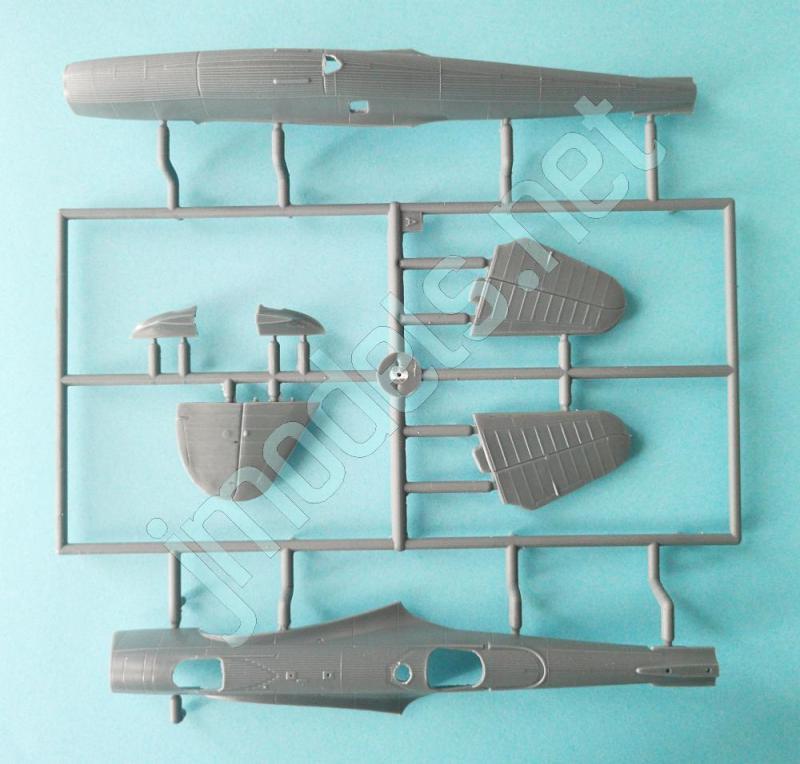
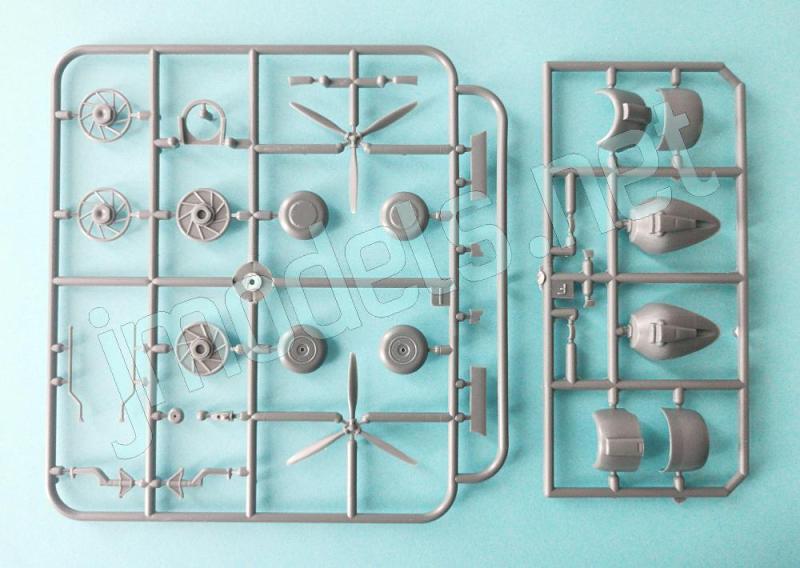
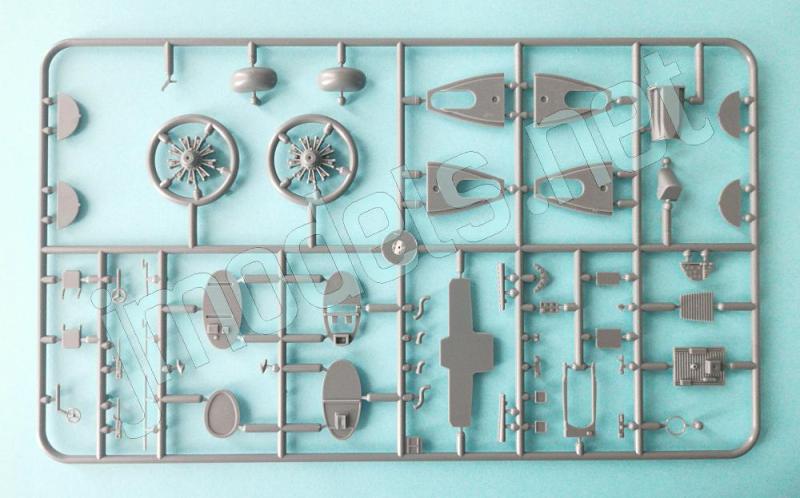
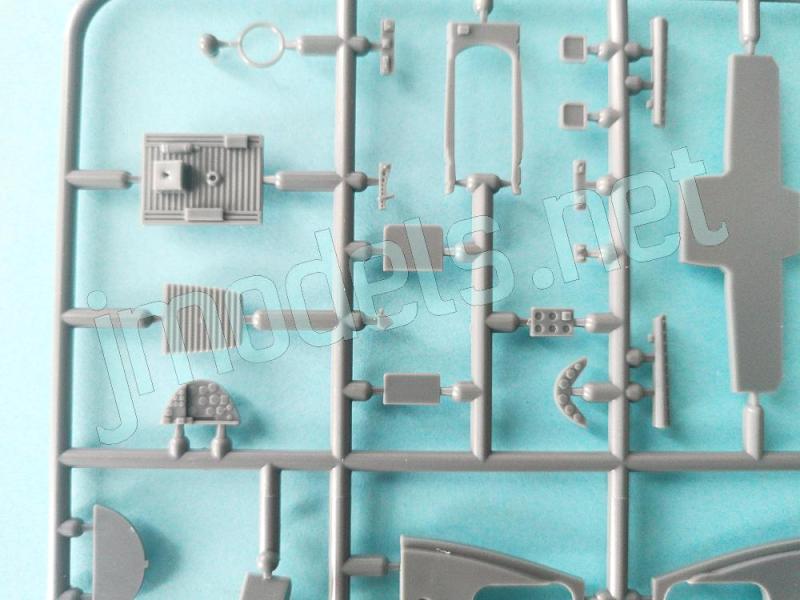
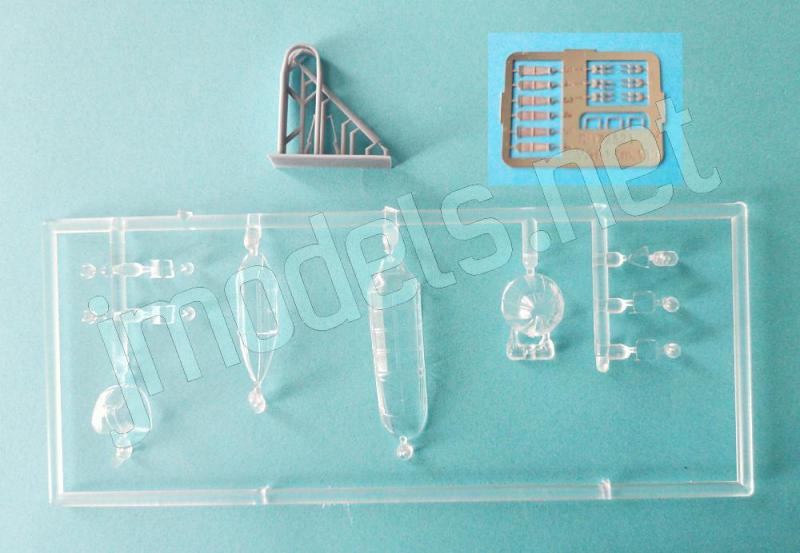
La caja contiene seis bastidores de piezas, uno de ellos transparente, un bastidor con tres piezas impresas en 3D, una pequeña plancha de fotograbados, las calcas y las instrucciones. El moldeado es muy notable y en general limpio. Las rebabas son marginales y se concentran en las puntas de las hélices y superficies de la cola. Algunas piezas muestran los habituales nódulos del eyector sin más importancia y las marcas no son visibles.
La maqueta requiere una construcción cuidadosa para sacarle el partido que sin duda puede dar, por ello es más adecuada para modelistas calificados por su práctica en las ediciones limitadas.
La pintura ofrece tres aviones del ML-KNIL con idéntica librea, más un aparato tailandés que los aficionados a los desgastes sutiles pueden aprovechar para lucirse.
La maqueta reproduce un modelo inicial de exportación denominado 139WH-1, del cual la Fuerza Aérea de las Indias Orientales Holandesas recibió doce unidades entre 1936 y 1937. Otros 78 ejemplares llegaron en 1939, pero eran del modelo 139WH-3, con la cubierta de la carlinga extendida desde el puesto de pilotaje a la ametralladora dorsal. Estos aviones eran ya demasiado anticuados para tener un buen desempeño contra la invasión japonesa en 1942, y muchos fueron destruidos en tierra o capturados.
Reseña
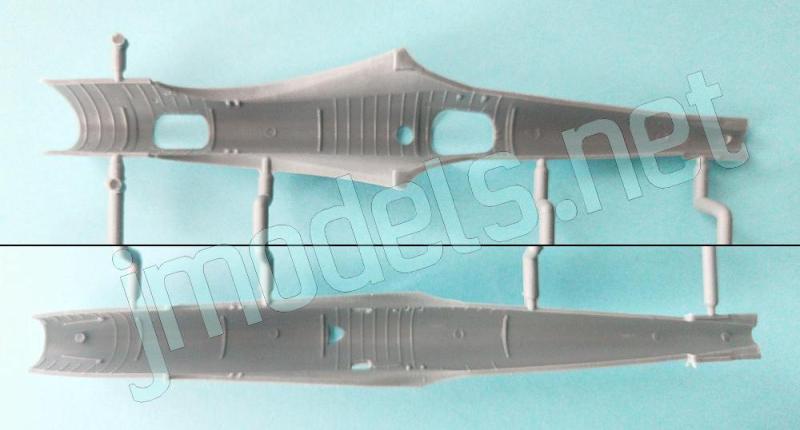
El fuselaje está separado transversalmente a fin de conservar la excelente reproducción de las supeficies corrugadas en la zona dorsal y ventral. Por este motivo los diversos instrumentos situados a los lados de las carlingas hay que pegarlos en la pieza superior, mientras que los suelos, asientos y palancas van situados en la inferior. La parte interna del fuselaje está parcialmente detallada con costillas delgadas de la estructura no solamente a los lados, sino también en el techo y suelo.
El puesto del piloto contiene, además de variado instrumental a los lados, el panel muy bien detallado en relieve más calcas para realzarlo. El suelo va pegado entre los mamparos delantero y trasero. El primero es hueco y contiene los pedales, en el posterior aparece una pequeña caja tras el asiento. El suelo tiene un detalle en relieve excelente. Piezas separadas son el volante de control y el asiento con los arneses de fotograbado.
El espacio trasero está comprendido también entre dos mamparos, pero contiene en realidad dos compartimentos. El primero es el de la radio, dotado de ventanillas a los lados y sobre el techo que se pegan desde el interior. El puesto lleva dos estantes unidos al mamparo delantero y calcas simulando instrumentos, lo que parece la radio a un lado del fuselaje, y un banco plegable con cinturones de fotograbado. El puesto posterior, que tiene los controles doblados, dispone de un asiento idéntico al recién mencionado, un panel diferente con calca, el volante, una ametralladora de formas aceptables en la parte posterior bajo la cubierta, más un panel hueco situado en posición horizontal que forma parte de la estructura interna y que se pega sobre la pieza superior del fuselaje. Como ayuda adicional, las instrucciones incluyen una nota sobre los posibles colores para pintar todo el interior.
En el puesto de proa hay que colocar el suelo texturizado del bombardero y el anillo de la torreta. Tras completar el interior, sólo hay que colocar una pieza que sirve de travesaño vertical para sostener y reforzar la unión de unas alas tan amplias con el fuselaje.
Las piezas transparentes de las cubiertas de la carlinga y la torreta son bastante finas, aunque lo es algo menos el panel acristalado del bombardero. Todas las piezas muestran un detalle muy bueno en la estructura. La torreta va simplemente pegada sobre su anillo tras colocar la ametralladora. Las cubiertas de ambas carlingas son de una pieza, por ello el detalle interno es apenas visible.
Además de las superficies corrugadas que mencionaba antes, las mitades del fuselaje muestran paneles bien grabados y las raíces de las alas. La zona dorsal entre las dos carlingas está ocupada por el mástil de la antena, que tiene dos opciones, y un par de diminutos fotograbados. Hay también una antena de bucle adicional para el avión tailandés.
La punta del puro de cola está separada en dos mitades con el hueco del pozo de la rueda entre ellas. El tren auxiliar consta de una base, la pata separada y la rueda. Al unir las mitades del fuselaje es esencial tener cuidado de no estropear el detalle interno, puesto que no hay vástagos para alinearlas.
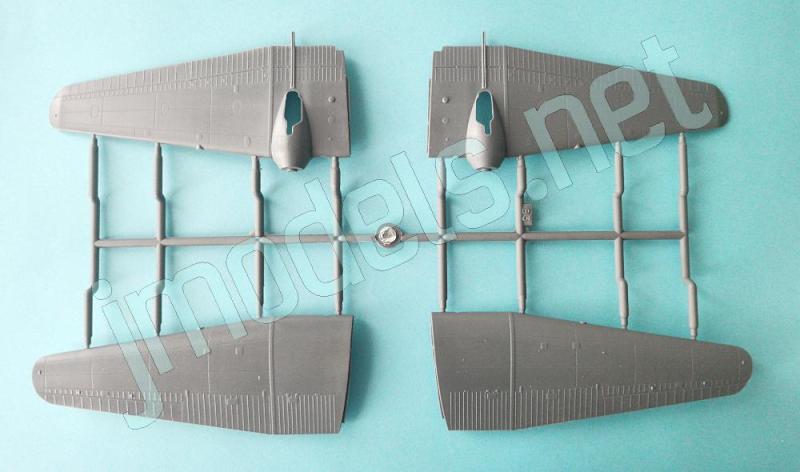
El despiece de las alas consta de las cuatro mitades convencionales. Las superficies tienen un grabado destacable y un detalle estructural en relieve muy convincente en las superficies de control. Las luces de las puntas son nítidas, los faros de aterrizaje cuentan con lentes transparentes y hay además dos tubos Pitot separados. Las piezas inferiores incluyen la mitad de cada góndola. Tras pegar las alas al fuselaje hay que añadir dos aletas sobre los bordes de ataque situados entre el fuselaje y las góndolas motoras.
Antes de unir las mitades de las alas tendremos que añadir en cada pozo el mamparo delantero, la pata de la rueda con su brazo de plegado aparte, y el suelo del pozo con el hueco de la rueda. Las ruedas vienen en mitades y los neumáticos son lisos. Las llantas tienen un detalle más bien vago.
Tras construir las alas y añadir las mitades superiores de las góndolas, se procede a montar los motores. Estos son de una pieza e incluyen la caja de engranajes y los alzaválvulas. El detalle muestra buena definición. Cada motor va pegado a un soporte trasero moldeado con un colector de escape. Esta pieza va a su vez pegada sobre el frontal de cada góndola. Las hélices son de una pieza. Las palas son delgadas y tienen perfiles correctos, aunque el eje para unir las hélices a los motores es mínimo. Los capós están divididos en mitades con la aleta de refrigeración en la parte interna y la boca de la toma superior aparte. Los escapes son rectos y van pegados sobre pequeños huecos situados en la parte posterior de cada góndola.
Los estabilizadores poseen lengüetas para fijarlos a la cola. Las superficies están bien grabadas y a la vez muestran nitidez en el relieve de la estructura, con los actuadores de las aletas de los timones definidos. En las superficies verticales el relieve estructural es ligeramente más sutil y se distinguen bien tanto el actuador de la aleta como las luces de navegación.
Las calcas muestran insignias holandesas y tailandesas, los paneles de instrumentos, matrículas y marcas del fuselaje, alas y cola. Están impresas con un acabado brillante, tienen apariencia fina, buen registro y saturación de color. La película de soporte no es muy excesiva.
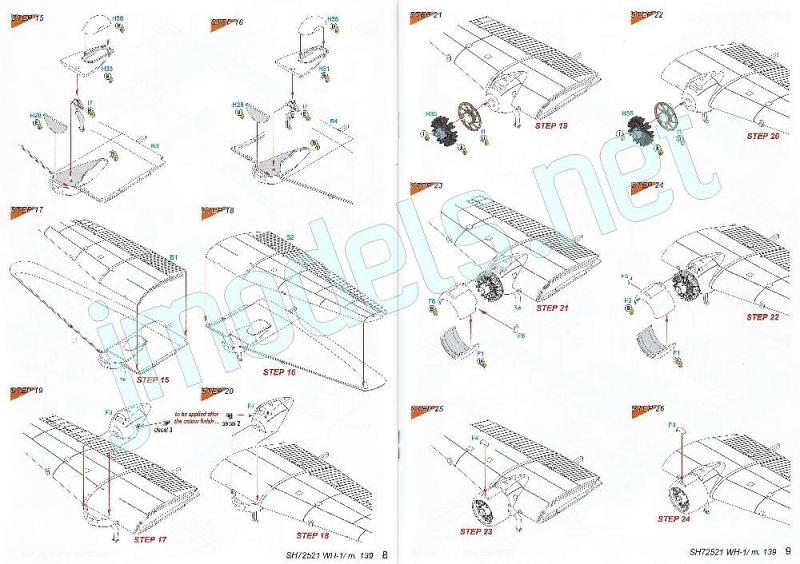
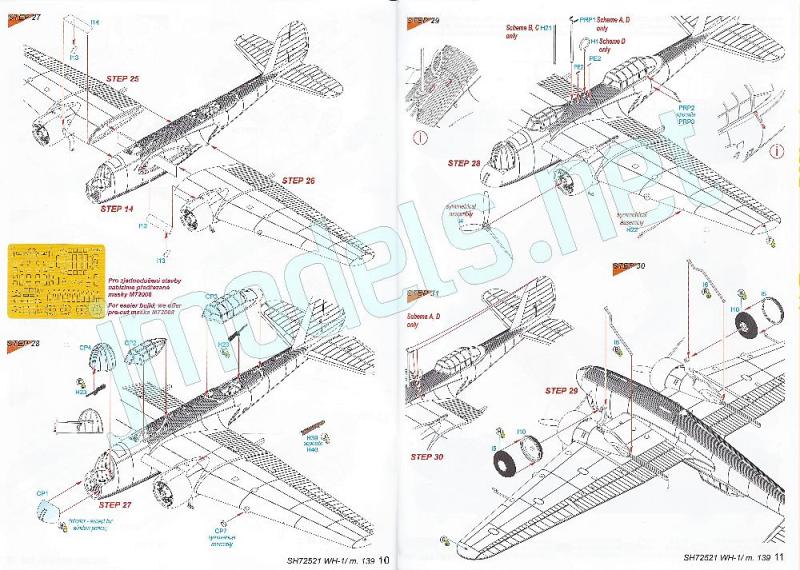
El folleto de instrucciones tiene formato A4 y consta de 16 páginas impresas en color sobre papel satinado. Contiene una introducción histórica sobre el avión, un plano numerado de piezas, una lista de colores con equivalencias de pinturas de Gunze Sangyo, 31 secuencias de montaje y cuatro páginas de perfiles en color. El libreto es encomiable por su presentación, claridad e información, lo que no suele ser raro en el fabricante.
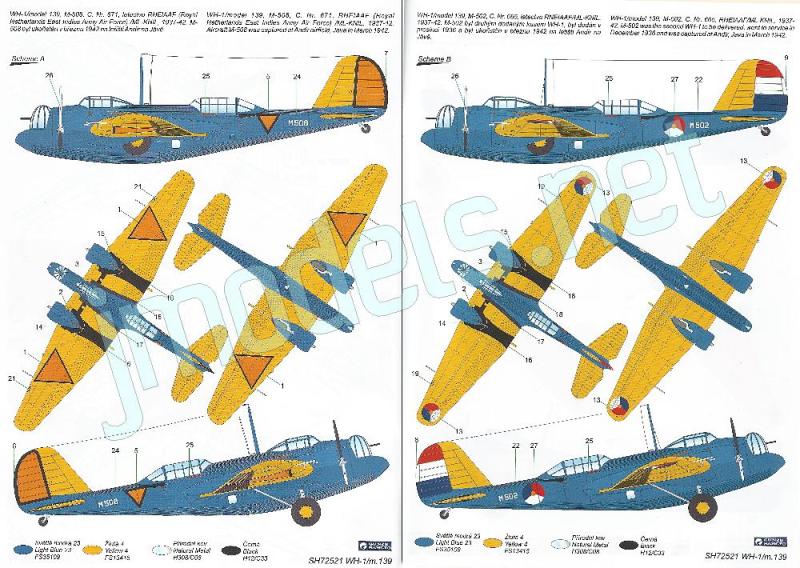
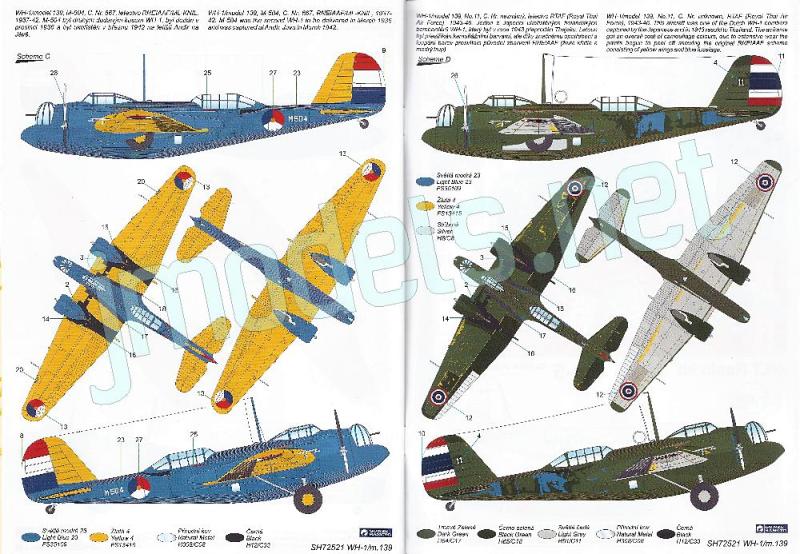
Los perfiles en color nos ofrecen tres aviones holandeses con su librea de azul y amarillo, más otro tailandés pintado de verde oscuro sobre gris claro, con desgastes en la pintura que dejan adivinar sus colores anteriores del ML-KNIL.
Valoración
Hacía falta hacía un molde actual de este interesante avión de entreguerras. Gracias a las ediciones de Azur y Special Hobby podemos contar ya con diferentes versiones de varios países usuarios. La maqueta tiene un destacabkle detalle en general y seguramente tendrá su hueco en las vitrinas de los aficionados a este periodo de la aviación. Muy recomendable, aunque no sea pieza para modelistas noveles.◊

The kit
This Martin Model 139 is the most recent rebox of the 2020 Azur new tool. So far, Azur have released two series of boxes. The first three boxings from 2020 feature the Model 139 in North American (B-10B) and export versions: 139WC (China), 139WAN (Argentine Navy), 139WAA (Argentine Air Force), and 139WH-2 (ML-KNIL). The next series of two boxes, released in 2025, represents a later variant, the Martin Type 166, in versions of the ML-KNIL (139WH-3) and Thailand (139WS). Special Hobby have reboxed this kit three times starting in 2021, all of them of the initial variant with slightly different versions and decals. The first box contains export aircraft (Thailand, China, and Turkey), the second is dedicated to the North American B-10A, and the third includes Dutch aircraft.
Before all this, the only apparently available 1/72 B-10 was the old kit from the American company Williams Brothers. At the time of writing this review, the manufacturer still sells it through their website under the title B-10 The Eclipsed Marvel. And eclipsed it is, one might think.
The box contains six sprues, one of them clear, a sprue with three 3D-printed parts, a small photo-etched fret, the decals, and the instructions. The molding of parts is very good and generally clean. There is marginal flash on the propellers and tail plane pieces. Some parts show the usual ejector nodules, but this is not a significant issue, and pin marks are not visible.
The kit needs a well-planned and careful construction to fully develop its potential, for this reason it is best suited for modelers with experience in short runs.
Paint finishes offer three ML-KNIL aircraft in identical liveries, plus a Thai aircraft that fans of subtle weathering can use to test their skills.
The kit renders an early export version designated 139WH-1, of which the Dutch East Indies Air Force received twelve units between 1936 and 1937. Another 78 examples arrived in 1939, but these were the 139WH-3 model, with the enclosed canopy extending from the cockpit to the dorsal machine gun. These aircraft were already outdated to perform effectively against the Japanese invasion in 1942, and many were destroyed on the ground or captured.
Review
The fuselage is split transversely to preserve the excellent reproduction of the corrugated detail on the dorsal and ventral surfaces. For this reason, the various instruments located on the cockpits side walls are glued on the upper piece, while the floors, seats, and levers are attached on the lower piece. The fuselage interior is partially detailed with thin structural ribs not only on the sides but also on the roof and floor.
The pilot’s cockpit contains, in addition to several instruments on the sides, a very well-detailed panel with raised instruments and decals to enhance it. The floor is glued between the forward and aft bulkheads. The forward bulkhead is hollow and contains the pedals; the aft bulkhead has a small box behind the seat. The floor has excellent raised detail. The control wheel and the seat provided with photo-etched harnesses are separate pieces.
The rear compartment is also placed between two bulkheads, but actually contains two separate positions. The first is the radio station, detailed with windows on the sides and roof. The station has two shelves attached to the forward bulkhead and decals simulating instruments, what seems to be the radio on the fuselage side, and a folding bench with photo-etched seat belts. The gunner’s position, which has the flight instruments doubled, comprises an identical bench, a smaller panel with a decal, the steering wheel, a machine gun placed under the rear canopy, plus a hollow horizontal piece of the internal structure attached to the upper fuselage section. As an additional aid, the instructions include a note on possible colors for painting the interior.
The nose position includes the bomber’s textured floor and the turret ring. After completing the interior, you add a vertical spar to strengthen the fuselage-wing assembly.
The clear parts for the canopy and nose turret are quite thin, though the bomber’s glazed panel is slightly thicker. All these parts show very nice raised structural detail. The turret is simply glued onto the nose ring after the machine gun is installed. The canopies are molded as one piece, so the internal detail will be barely visible.
In addition to the corrugated surfaces I mentioned before, the fuselage halves show well-engraved panel lines and are molded with the wing roots. The dorsal fuselage between the two cockpits shows an antenna mast, which has two alternative pieces, and a couple of tiny photo-etched parts. There is also an additional loop antenna for the Thai aircraft.
The tail boom is separated into halves with the wheel well gap between them. The auxiliary landing gear consists of a base, a separate leg, and a wheel. When joining the fuselage halves, it is essential to be careful not to damage the internal detail, as there are no alignment pins. The wings consist of four conventional halves. The surfaces has remarkable engraved lines and very convincing raised structural ribbing on the control surfaces. The wingtip lights are sharp, the landing lights have clear lenses, and there are also two separate Pitot tubes. The lower wing pieces are molded with half of each engine nacelle. After attaching the wings to the fuselage, two fins are added to the inboard leading edges.
Before joining the wing halves, the wheel wells are detailed with a forward bulkhead, a roof, the wheel recess and the main gear legs. The wheels come in halves, and the tires are smooth. The rims have rather vague detail.
After finishing the wings and adding the upper nacelle halves, the next step is to build the engines. These are one-piece molded with the crankshaft and valve tappets. Each engine is provided with a separate exhaust manifold behind it and this part is, in turn, glued onto the nacelle. The propellers are also one-piece. The blades are thin and have correct profiles, although the shaft is way too short. The cowlings are provided in halves, with separate one-piece cooling fin and upper air intake. The exhausts are straight and glued into small recesses on the nacelles.
The stabilizers have tabs for attaching them to the tail. The surfaces are well-engraved and have a nice rendition of the structural raised detail, with the rudder tab hinges clearly defined. On the vertical piece, the structural detail is slightly more subtle, and both the trim tab actuator and the navigation lights are sharp.
The decals show Dutch and Thai insignia, instrument panels, registration numbers, and markings on the fuselage, wings, and tail. They are printed with a glossy finish, have a fine appearance, good register, and color saturation. Carrier film is not excessive.
The instruction booklet is A4 format and consists of 16 pages printed in color on glossy paper. It contains a historical introduction to the aircraft, a numbered parts diagram, a list of colors with Gunze Sangyo paint matches, 31 assembly sequences, and four pages of profiles. The booklet is commendable for its presentation, clarity, and information, but all this is not uncommon in this manufacturer.
The color profiles offer three Dutch bombers with a blue and yellow livery, plus another Thai aircraft painted dark green over light gray, with wear on the paint revealing its previous ML-KNIL colors.
Conclusion
This is a most welcome kit of an interesting interwar bomber that has been long overlooked. Thanks to Azur and Special Hobby, we now have the two main variants in liveries from different operators. The kit boasts remarkable detail overall and will surely find a place on the shelves of aviation enthusiasts. Highly recommended, though it is not suitable for novice modelers.◊
Publicado – Published: 7 / 2026
©www.jmodels.net


Debe estar conectado para enviar un comentario.